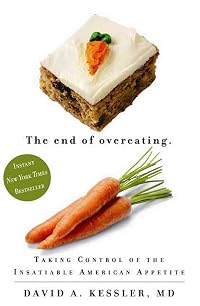
The End of Overeating
by David A. Kessler
On This Page
Description
Most of us know what it feels like to fall under the spell of food--when a handful of chips leads to an empty bag. But it's harder to understand why we can't seem to stop eating, even when we know better. Dr. David Kessler, the dynamic former FDA commissioner who reinvented the food label and tackled the tobacco industry, now cracks the code of overeating by explaining how our bodies and minds are changed when we consume foods that contain sugar, fat, and salt. Food manufacturers create show more products by manipulating these ingredients to stimulate our appetites, setting in motion a cycle of desire and consumption that ends with a nation of overeaters. This book explains for the first time why it is exceptionally difficult to resist certain foods and why it's so easy to overindulge. Dr. Kessler's cutting-edge investigation offers new insights and helpful tools to help us find a solution.--From publisher description. show lessTags
Recommendations



Member Recommendations
Member Reviews
Kessler is a physician, lawyer, and top FDA bureaucrat who in spite of being as well informed as anyone, didn't manage not to be fat. So eventually he went looking for the science behind this, which he presents in this book. It's almost 300 pages long, and he could have written it in 30 - but again, as with Shlaes, those 30 would have been intense and demanding (and wouldn't have counted as a book). This way, it's a readable book that can be skimmed with no major intellectual challenge.
Kessler's thesis, in one sentence, is that sugar fat and salt make us want to eat more sugar salt and fat. Whether they understand the science or not, the food industry has cracked this truth and does its best to offer what Kessler calls hyper-palatable show more food, which means irresistible.
I came away from the book with the conviction that the only food one should eat is unprocessed food. As an acquaintance of mine (who hasn't read the book but gets the message) has been saying all along: I never eat anything that was created in a factory.
Near the end of the book Kessler tries to offer ways to free oneself from the tyranny of industrial sugar-salt-fat. He recommends formulating and applying counter-commands, that will block the imperatives of the enticing food we see all around us. It occurs to me that this really may work. I eat only kosher food, so all those yummy-looking extravagances I see all around me when I'm in America: I've never had them, I have no chemically inbuilt memories of how much I crave them, and were I to reach for one of them, my own repulsion would be stronger. I'll bet they taste heavenly, but I have no urge to eat them. On the contrary. show less
Kessler's thesis, in one sentence, is that sugar fat and salt make us want to eat more sugar salt and fat. Whether they understand the science or not, the food industry has cracked this truth and does its best to offer what Kessler calls hyper-palatable show more food, which means irresistible.
I came away from the book with the conviction that the only food one should eat is unprocessed food. As an acquaintance of mine (who hasn't read the book but gets the message) has been saying all along: I never eat anything that was created in a factory.
Near the end of the book Kessler tries to offer ways to free oneself from the tyranny of industrial sugar-salt-fat. He recommends formulating and applying counter-commands, that will block the imperatives of the enticing food we see all around us. It occurs to me that this really may work. I eat only kosher food, so all those yummy-looking extravagances I see all around me when I'm in America: I've never had them, I have no chemically inbuilt memories of how much I crave them, and were I to reach for one of them, my own repulsion would be stronger. I'll bet they taste heavenly, but I have no urge to eat them. On the contrary. show less
Why do so many of us have a tendency, or even a compulsion, to eat more than is good for us, and to eat things we know perfectly well aren't healthy? David Kessler answers this question in two parts. First, he discusses what happens in our brains when food gets associated with wonderful floods of reward chemicals washing over our neurons, and why that can have so much power over us. Then he talks about the food industry, and the ways in which it deliberately engineers food for "craveability." Which, yes, is an actual term they actually use.
Kessler lays out the facts and the scientific arguments and their implications in a clear and readable way, although he sometimes repeats things more than he really has to. And I could have done show more without the many detailed descriptions of how various restaurants cook up their various yummy dishes with remarkably similar salt-and-fat-infusing techniques, if only because they made me really, really hungry. Which undoubtedly helps to prove his point, but is nevertheless somewhat unkind. I also think he leaves out or downplays some of the more complex social factors that help determine how we relate to food. But his points all seem pretty good, as far as they go.
Then, in the last few sections, he addresses the question of what can be done about overeating, offering up some suggestions for those seeking to lose weight, including some that have worked for him. They're all very sane and sensible suggestions, offered up in a tone that is encouraging without downplaying the difficulty. And yet, I cannot help but come away with the depressing feeling that for those of us conditioned towards unhealthy eating, real change and lasting weight loss require such Herculean effort and the sacrifice of so many sources of joy and satisfaction that even the first step of convincing ourselves it's truly worth it may be insurmountably hard.
Also, I want some pizza now. And a chocolate chip cookie. Sigh. show less
Kessler lays out the facts and the scientific arguments and their implications in a clear and readable way, although he sometimes repeats things more than he really has to. And I could have done show more without the many detailed descriptions of how various restaurants cook up their various yummy dishes with remarkably similar salt-and-fat-infusing techniques, if only because they made me really, really hungry. Which undoubtedly helps to prove his point, but is nevertheless somewhat unkind. I also think he leaves out or downplays some of the more complex social factors that help determine how we relate to food. But his points all seem pretty good, as far as they go.
Then, in the last few sections, he addresses the question of what can be done about overeating, offering up some suggestions for those seeking to lose weight, including some that have worked for him. They're all very sane and sensible suggestions, offered up in a tone that is encouraging without downplaying the difficulty. And yet, I cannot help but come away with the depressing feeling that for those of us conditioned towards unhealthy eating, real change and lasting weight loss require such Herculean effort and the sacrifice of so many sources of joy and satisfaction that even the first step of convincing ourselves it's truly worth it may be insurmountably hard.
Also, I want some pizza now. And a chocolate chip cookie. Sigh. show less
There is no question about David Kessler’s strong sense of purpose in his book The End of Overeating. He wants you to know what commercial food preparers do to make you want their food even when you are not hungry, and he is going to make sure you get the message. Even if he has to say it a very large number of times.
And that’s the primary problem I had with this book. I listened to it as an audiobook, which can be quite a different experience, so I’ll disclose that to begin with. The book focuses on the way current U.S. culture is designed to make the average consumer eat more often, more volume & faster. On the outside, it is a really good idea – as someone who struggles with overeating there’s no question that many things show more in the book rang true. Unfortunately the rhetoric is tiring and repetitive. To borrow an idea from my friend Fred, it’s like having a pamphlet’s worth of helpful information and stretching it out into book form.
Popular science books are hard to review from an authoritative position when you’re not… well… a scientist so from here on out I’ll just review it as a layman. I felt this book had some good things to say about possible psychological triggers for overeating, and tools to use to overcome them. You may appreciate those tools… if you can make it through the first 4/5ths of the book which are generally discouraging. (Literally – the book is 250 pages, and only 45 are on the deconditioning.)
I mean, it is very hard to read (or in my case, listen to) someone describing for over 6 hours the ways in which food is designed to make you feel powerless to resist it. The words “hyper-palatable” and “satiety” were new to my vocabulary at the beginning of the book, and like torture by the end. Maybe he was trying to get you to associate torture with really tasty food. Actually that’s not too far off the mark, I think.
Unfortunately, it doesn’t entirely work that way. And I think many people who try to read this book are going to get turned off before they can get to the useful part. I know I had to really force myself to listen to the whole thing. If that’s happening, you’re not necessarily helping people, which is ostensibly the goal here. Not to mention, describing the horrific amount of fat in a food made me feel revulsion only about half the time – the other half I was thinking, “Turn this car around and get me to a Pizza Hut, stat!”. Come on, Dr. Kessler! Sprinkle some of the helpful info throughout to keep the reader engaged! A simple “if this is you, don’t worry, we’re getting to the part where you can cope” would suffice.
Ultimately, if Kessler wants us to create a cultural shift like the one we’ve seen for tobacco (the last answer he gives in that article), that’s a real uphill climb. It probably shows the bias in my vices to say that I think accepting that smoking tastes like crap is far easier than accepting that buttermilk biscuits taste like crap. Getting people to be snotty to each other about biscuits is more about recipe preference than moral superiority.
I wasn’t even going to write about this book, but this week I’ve been ill for days thanks to a lifetime’s poor nutrition habits. So when I sent Jack to the store to get me bran muffins, it was quite a treat to read the label and find that the %DV of fiber was far outclassed by the %DV of fat. These are tasty, commercially viable muffins. Sadly I am in need of the far more difficult to market, actually beneficial muffins.
If you really, really want to dig into cognitive ways to deal with an overeating problem you perceive that you have, then I can say that I would recommend reading this book. It will not be the most fun you ever had, but some things just take work. If you’re just reading because you want to learn more about food science, maybe find another book. show less
And that’s the primary problem I had with this book. I listened to it as an audiobook, which can be quite a different experience, so I’ll disclose that to begin with. The book focuses on the way current U.S. culture is designed to make the average consumer eat more often, more volume & faster. On the outside, it is a really good idea – as someone who struggles with overeating there’s no question that many things show more in the book rang true. Unfortunately the rhetoric is tiring and repetitive. To borrow an idea from my friend Fred, it’s like having a pamphlet’s worth of helpful information and stretching it out into book form.
Popular science books are hard to review from an authoritative position when you’re not… well… a scientist so from here on out I’ll just review it as a layman. I felt this book had some good things to say about possible psychological triggers for overeating, and tools to use to overcome them. You may appreciate those tools… if you can make it through the first 4/5ths of the book which are generally discouraging. (Literally – the book is 250 pages, and only 45 are on the deconditioning.)
I mean, it is very hard to read (or in my case, listen to) someone describing for over 6 hours the ways in which food is designed to make you feel powerless to resist it. The words “hyper-palatable” and “satiety” were new to my vocabulary at the beginning of the book, and like torture by the end. Maybe he was trying to get you to associate torture with really tasty food. Actually that’s not too far off the mark, I think.
Unfortunately, it doesn’t entirely work that way. And I think many people who try to read this book are going to get turned off before they can get to the useful part. I know I had to really force myself to listen to the whole thing. If that’s happening, you’re not necessarily helping people, which is ostensibly the goal here. Not to mention, describing the horrific amount of fat in a food made me feel revulsion only about half the time – the other half I was thinking, “Turn this car around and get me to a Pizza Hut, stat!”. Come on, Dr. Kessler! Sprinkle some of the helpful info throughout to keep the reader engaged! A simple “if this is you, don’t worry, we’re getting to the part where you can cope” would suffice.
Ultimately, if Kessler wants us to create a cultural shift like the one we’ve seen for tobacco (the last answer he gives in that article), that’s a real uphill climb. It probably shows the bias in my vices to say that I think accepting that smoking tastes like crap is far easier than accepting that buttermilk biscuits taste like crap. Getting people to be snotty to each other about biscuits is more about recipe preference than moral superiority.
I wasn’t even going to write about this book, but this week I’ve been ill for days thanks to a lifetime’s poor nutrition habits. So when I sent Jack to the store to get me bran muffins, it was quite a treat to read the label and find that the %DV of fiber was far outclassed by the %DV of fat. These are tasty, commercially viable muffins. Sadly I am in need of the far more difficult to market, actually beneficial muffins.
If you really, really want to dig into cognitive ways to deal with an overeating problem you perceive that you have, then I can say that I would recommend reading this book. It will not be the most fun you ever had, but some things just take work. If you’re just reading because you want to learn more about food science, maybe find another book. show less
The first half of the book is pure food porn. Detailed, multisensory descriptions of super-unhealthy menu items from chain restaurants or snack foods - it's just about perfectly designed to send you running to the refrigerator. It's not a huge surprise to discover that the addictive qualities of this kind of food are well-known to people in the restaurant and snack-food industries, and even less a surprise to be told they are, in fact, addictive. So that part is really only good for salivating over descriptions of fried food.
The second half of the book is just dumb. Having spent all of those pages citing behavioral studies in rats, industry studies of humans, and all sorts of information about the neurochemistry of certain show more salt-sugar-fat combinations, the author then spends the last third of the book basically telling people it's a matter of willpower. (After specifically saying that it's not a willpower issue in the introduction, at that.) Not once does he suggest, you know, eating whole, unprocessed food, fewer carbs, or any of the not-all-that-controversial ideas that seem eminently supported by his research.
To be fair, the hefty end-notes suggest that he had an editor with a machete handy, and the copious industry-insider interviews make me think that perhaps he softened his stance in order to retain their cooperation in future books, but it means that this book is pretty much a waste of dead trees. If you want to drool over the Chili's menu, go to Chili's. At least there you'll have pictures. show less
The second half of the book is just dumb. Having spent all of those pages citing behavioral studies in rats, industry studies of humans, and all sorts of information about the neurochemistry of certain show more salt-sugar-fat combinations, the author then spends the last third of the book basically telling people it's a matter of willpower. (After specifically saying that it's not a willpower issue in the introduction, at that.) Not once does he suggest, you know, eating whole, unprocessed food, fewer carbs, or any of the not-all-that-controversial ideas that seem eminently supported by his research.
To be fair, the hefty end-notes suggest that he had an editor with a machete handy, and the copious industry-insider interviews make me think that perhaps he softened his stance in order to retain their cooperation in future books, but it means that this book is pretty much a waste of dead trees. If you want to drool over the Chili's menu, go to Chili's. At least there you'll have pictures. show less
A fun mix of popular science and food industry reports with a little self-help section thrown in at the end. There's nothing really new here, but it's put together in an easily digestible way so it goes down very easily (and that's about as close to punning as I get).
A lot of the focus is on how the brain responds to food, particularly junk food, which is addicting because it sets off self-reinforcing triggers in our brains that cause not just a chemical reaction but also becomes habit forming and largely unconscious. The author referenced his own experiences in discovering his hand reaching for a cookie or walking into a fast food restaurant without him even being aware of it. Afterwords, he would feel bad about it, but until he show more trained himself to become aware of his eating, he was on auto-pilot for the before and during parts. What makes this even worse is that because so much of this type of eating is unconscious and because junk food has been basically pre-chewed, people have no real awareness of how much they're consuming. (They think they do, but studies have found that most people, especially overweight people, greatly underestimate how many calories they've consumed. It's not a lack of willpower, it's a lack of knowledge and self-monitoring skills.)
There were some parts that surprised me, like when the author was surprised by the inclusion of HFCS in bread (hello, it's on the label--which makes me wonder, if doctors aren't reading food labels, who besides me is?). I'm also curious about the process of how fast food became so ubiquitous. The author interviews a Japanese food industry exec who thinks American fast food is a sort of bland, over-sweetened goo (my words, not his), yet it's a global phenomenon. How did that happen?
It also doesn't go into how people acquire tastes for certain types of junk foods, but not others. For example, I can go to town on a bag of Cheetos, but the smell of Krispy Kreme donuts makes me want to vomit. What influences which forms of junk foods we find appealing, which foods will become our trigger foods?
The last few chapters provide advice about re-training your brain and becoming aware of and in control over your own eating habits. Once again, nothing terribly new, but it all makes sense.
I have a lot of friends who've done Weight Watchers, and this seems like it would be a nice complement to that program. Even if you're not trying to lose weight or don't have overeating issues of your own, this sort of practical information seems like it would increase empathy and awareness when dealing with friends and loved ones who are struggling with their eating. show less
A lot of the focus is on how the brain responds to food, particularly junk food, which is addicting because it sets off self-reinforcing triggers in our brains that cause not just a chemical reaction but also becomes habit forming and largely unconscious. The author referenced his own experiences in discovering his hand reaching for a cookie or walking into a fast food restaurant without him even being aware of it. Afterwords, he would feel bad about it, but until he show more trained himself to become aware of his eating, he was on auto-pilot for the before and during parts. What makes this even worse is that because so much of this type of eating is unconscious and because junk food has been basically pre-chewed, people have no real awareness of how much they're consuming. (They think they do, but studies have found that most people, especially overweight people, greatly underestimate how many calories they've consumed. It's not a lack of willpower, it's a lack of knowledge and self-monitoring skills.)
There were some parts that surprised me, like when the author was surprised by the inclusion of HFCS in bread (hello, it's on the label--which makes me wonder, if doctors aren't reading food labels, who besides me is?). I'm also curious about the process of how fast food became so ubiquitous. The author interviews a Japanese food industry exec who thinks American fast food is a sort of bland, over-sweetened goo (my words, not his), yet it's a global phenomenon. How did that happen?
It also doesn't go into how people acquire tastes for certain types of junk foods, but not others. For example, I can go to town on a bag of Cheetos, but the smell of Krispy Kreme donuts makes me want to vomit. What influences which forms of junk foods we find appealing, which foods will become our trigger foods?
The last few chapters provide advice about re-training your brain and becoming aware of and in control over your own eating habits. Once again, nothing terribly new, but it all makes sense.
I have a lot of friends who've done Weight Watchers, and this seems like it would be a nice complement to that program. Even if you're not trying to lose weight or don't have overeating issues of your own, this sort of practical information seems like it would increase empathy and awareness when dealing with friends and loved ones who are struggling with their eating. show less
I found this book to be a real let-down. I wasn't expecting much but this book managed not even to reach that low bar I had set.
The first thing I didn't like about this book is the author's writing style. It's not compelling, it's not interesting, it reads like a drawn-out ramble and comes together as a very disjointed text. I feel that the author spent a lot of time not saying much and a lot more time repeating himself.
The second beef I have with this book comes with the actual message that the author makes. First he covers animal studies about reward systems and dopamine, talks about the overabundance of food at restaurants, talks about reward systems in humans, talks about how to stop that process, and then goes into a very tiny show more chapter about the food industry's responsibility.
I disliked how the author frames this problem as almost entirely the burden of individuals. It is up to us to stop eating impulsively, it is up to us to think about what we eat before shoving it in our mouths. Yes, this is true, but it really ignores the heart of the issues. The government subsidizes corn and soy, this means we have a lot of cheap sugar, protein and fat available to us. Produce isn't subsidized and, as anybody who has gone to a grocery store can attest, costs more than candy and processed nonsense. The author never brings this up, I guess he doesn't see it as a problem.
The author also never really brings up the issue of exclusively eating out. I know it comes from a position of privilege for me to say that people should eat more home-made meals, but compulsively eating is a lot more difficult if you open your fridge and realize you have to cook something in order to eat. This also prevents you from eating so much processed crap, frozen microwaveable meals, which are really questionable from a nutritional standpoint in the first place.
Finally, the author never really says that food needs to be regulated. He only says that we have to keep in mind that their marketing is pervasive and helps lead to this big problem. He does mention that getting people to overeat is exactly how chain restaurants make money, but he never suggests to stop eating at them.
I really don't know if this book will be useful to anybody, but I guess if it helps people to be more aware of what they eat, than that is a good thing. But I wouldn't recommend this book at all. show less
The first thing I didn't like about this book is the author's writing style. It's not compelling, it's not interesting, it reads like a drawn-out ramble and comes together as a very disjointed text. I feel that the author spent a lot of time not saying much and a lot more time repeating himself.
The second beef I have with this book comes with the actual message that the author makes. First he covers animal studies about reward systems and dopamine, talks about the overabundance of food at restaurants, talks about reward systems in humans, talks about how to stop that process, and then goes into a very tiny show more chapter about the food industry's responsibility.
I disliked how the author frames this problem as almost entirely the burden of individuals. It is up to us to stop eating impulsively, it is up to us to think about what we eat before shoving it in our mouths. Yes, this is true, but it really ignores the heart of the issues. The government subsidizes corn and soy, this means we have a lot of cheap sugar, protein and fat available to us. Produce isn't subsidized and, as anybody who has gone to a grocery store can attest, costs more than candy and processed nonsense. The author never brings this up, I guess he doesn't see it as a problem.
The author also never really brings up the issue of exclusively eating out. I know it comes from a position of privilege for me to say that people should eat more home-made meals, but compulsively eating is a lot more difficult if you open your fridge and realize you have to cook something in order to eat. This also prevents you from eating so much processed crap, frozen microwaveable meals, which are really questionable from a nutritional standpoint in the first place.
Finally, the author never really says that food needs to be regulated. He only says that we have to keep in mind that their marketing is pervasive and helps lead to this big problem. He does mention that getting people to overeat is exactly how chain restaurants make money, but he never suggests to stop eating at them.
I really don't know if this book will be useful to anybody, but I guess if it helps people to be more aware of what they eat, than that is a good thing. But I wouldn't recommend this book at all. show less
As someone who has struggled with food for her entire life, I admit fully that I enjoyed this book. It further helped me to rethink my perception on what was actually going in my mouth (another great one for this is “In the Defense of Food”), and also to think about how the food industry plays a large psychological role on shaping people’s desires toward food – like my own.
Kessler’s book is well-researched. He cites numerous studies, experts, and restaurant nutritional information (I swear, I’ll never eat at Chilis again). While technical in nature, Kessler’s writing style is informal, and makes the book easily accessible to any audience.
In brief, I highly recommend this book. I know that I won’t be able to look at show more French fries or a chocolate bar in the same way after having read “The End of Overeating” show less
Kessler’s book is well-researched. He cites numerous studies, experts, and restaurant nutritional information (I swear, I’ll never eat at Chilis again). While technical in nature, Kessler’s writing style is informal, and makes the book easily accessible to any audience.
In brief, I highly recommend this book. I know that I won’t be able to look at show more French fries or a chocolate bar in the same way after having read “The End of Overeating” show less
Members
- Recently Added By
Published Reviews
ThingScore 75
It's a quick read, partly because of the short chapters, and partly because it runs a little to repetition, but for all that, it's a fascinating read.
added by lampbane
Author Information

50+ Works 3,530 Members
David A. Kessler, MD, served as commissioner of the U.S. Food and Drug Administration under presidents George H. W. Bush and Bill Clinton. He is the author of A Question of Intent and The End of Overeating, a New York Times bestseller. He is a pediatrician and has been the dean of the medical schools at Yale and the University of California, San show more Francisco. Dr. Kessler is a graduate of Amherst College, the University of Chicago Law School, and Harvard Medical School. show less
Some Editions
Awards and Honors
Awards
Distinctions
Common Knowledge
- Canonical title
- The End of Overeating
- Original title
- The End of Overeating: Taking Control of the Insatiable American Appetite
- Alternate titles
- The End of Overeating: Taking Control of Our Insatiable Appetite
- Canonical DDC/MDS
- 613.2
Classifications
Statistics
- Members
- 1,195
- Popularity
- 20,862
- Reviews
- 39
- Rating
- (3.52)
- Languages
- 6 — Dutch, English, French, German, Hungarian, Italian
- Media
- Paper, Audiobook, Ebook
- ISBNs
- 20
- ASINs
- 9