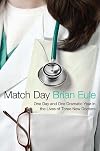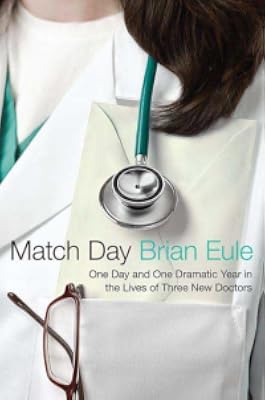
Match Day: One Day and One Dramatic Year in the Lives of Three New Doctors
by Brian Eule
On This Page
Description
Three new doctors--all women--struggle to balance professional ambitions and personal relationships, triumphs and crises, uncertainties and decisions, through one pressure-packed day and the first year of their careers in medicineEach year, on the third Thursday in March, more than 15,000 graduating medical students exult, despair, and endure Match Day: the decision of a controversial computer algorithm, which matches students with hospital residencies in every field of medicine. The match show more determines where each graduate will be assigned the crucial first job as an intern, and shapes the rest of his--or, in increasing number, her--life.In Match Day, Brian Eule follows three women from the anxious months before the match through the completion of their first year of internship. Each woman makes mistakes, saves lives, and witnesses death; each must keep or jettison the man in her life; each comes to learn what it means to heal, to comfort, to lose, and to grieve, while maintaining a professional demeanor.Just as One L became the essential book about the education of young attorneys, so Match Day will be for every medical student, doctor, and reader interested in medicine: a guide to what to expect, and a dramatic recollection of a pressured, perilous, challenging, and rewarding time of life. show lessTags
Recommendations
Member Reviews
Match Day is the most important — and most nerve wracking — day for graduating students in every medical school in the United States, as more than 15,000 fourth years find out which residency program they have been matched to. The process involves a complicated dance, in which students interview at different hospitals and medical schools with their prospective program directors, attending physicians, and future resident colleagues, and both the students and the residency programs submit ranked lists; the students indicate which programs they would most prefer to attend, and the residency programs rate which students they desire the most. A computer program in a small room in the nation's capital compiles this data and spits out its show more results, in a process that cannot be challenged by the students or program directors.
On Match Day, each student is given a sealed envelope in an auditorium, in a ceremony filled with extreme tension and high emotions, as the students' career plans and the schools' reputation for placing their graduates in the top programs are on the line. Medical students are by nature competitive, highly driven, and even more highly anxious, and each has spent countless hours on the Match process and lost nearly as many hours of sleep worrying about it. At several schools, including my own, one or more local television news stations film the ceremony, which is broadcast on that evening's news. As each student opens his or her envelope, screams of joys are mingled with silent tears or looks of stunned disbelief, depending on the individual Match results.
For some students, generally those who are not married, in a serious relationship, or seeking a very unique career path,the program they match to is not critical, as long as they get into a solid one. However, many students do have fiancees, or spouses with or without children, whose lives are also deeply affected by the contents of those envelopes.
Brian Eule, the author of Match Day, writes poignantly of his experiences as a person removed from the process, yet deeply affected by it as his girlfriend, a surgeon who is now his wife, and two other couples go through the Match and intern year. All three women are in medicine, whereas two of the men are not, in keeping with the dramatic strides made to equalize the gender bias in U.S. medical schools in the past 25 years (my graduating class was the first in the 100-plus year history of the school to have more women than men, and practically all schools have achieved gender parity). Eule's description of the day to day lives of these interns, their spouses, and the effect of medical school and residency on their relationships is spot on; each doctor struggles daily with the soul crushing demands of intern year, each non-medical spouse tries to be as supportive as possible while putting their own needs and desires on a back burner, and each couple's love is challenged on a regular basis. This excerpt by Eule about his wife and their relationship is especially insightful:
It would always be a tug-of-war. I had come to terms with the idea that I was marrying a woman with a double identity. For the thirty seconds she sat in the car with me, she was the Stephanie I had known for the last six years. But running back into the hospital, she was a woman whose level of responsibility would always be hard for me to relate to, no matter how much I learned from her and from my friends about the culture of becoming a doctor.
Match Day is a superb book about the lives of young doctors and their partners, which would be of special interest to medical students, their significant others and families, but I would also recommended it to the general reader, as Eule tells a compelling and highly readable account of love under highly stressful circumstances. show less
On Match Day, each student is given a sealed envelope in an auditorium, in a ceremony filled with extreme tension and high emotions, as the students' career plans and the schools' reputation for placing their graduates in the top programs are on the line. Medical students are by nature competitive, highly driven, and even more highly anxious, and each has spent countless hours on the Match process and lost nearly as many hours of sleep worrying about it. At several schools, including my own, one or more local television news stations film the ceremony, which is broadcast on that evening's news. As each student opens his or her envelope, screams of joys are mingled with silent tears or looks of stunned disbelief, depending on the individual Match results.
For some students, generally those who are not married, in a serious relationship, or seeking a very unique career path,the program they match to is not critical, as long as they get into a solid one. However, many students do have fiancees, or spouses with or without children, whose lives are also deeply affected by the contents of those envelopes.
Brian Eule, the author of Match Day, writes poignantly of his experiences as a person removed from the process, yet deeply affected by it as his girlfriend, a surgeon who is now his wife, and two other couples go through the Match and intern year. All three women are in medicine, whereas two of the men are not, in keeping with the dramatic strides made to equalize the gender bias in U.S. medical schools in the past 25 years (my graduating class was the first in the 100-plus year history of the school to have more women than men, and practically all schools have achieved gender parity). Eule's description of the day to day lives of these interns, their spouses, and the effect of medical school and residency on their relationships is spot on; each doctor struggles daily with the soul crushing demands of intern year, each non-medical spouse tries to be as supportive as possible while putting their own needs and desires on a back burner, and each couple's love is challenged on a regular basis. This excerpt by Eule about his wife and their relationship is especially insightful:
It would always be a tug-of-war. I had come to terms with the idea that I was marrying a woman with a double identity. For the thirty seconds she sat in the car with me, she was the Stephanie I had known for the last six years. But running back into the hospital, she was a woman whose level of responsibility would always be hard for me to relate to, no matter how much I learned from her and from my friends about the culture of becoming a doctor.
Match Day is a superb book about the lives of young doctors and their partners, which would be of special interest to medical students, their significant others and families, but I would also recommended it to the general reader, as Eule tells a compelling and highly readable account of love under highly stressful circumstances. show less
Every year, on the third Thursday of March, soon-to-graduate medical students are "matched" via computer program with medical residency programs. At the same moment, virtually all medical students in the U.S. (roughly 15,000 or so) find out exactly where they will be spending their next 3 to 7 years.
Match Day follows three female medical students going through the match process and then, their first year of residency (i.e., internship). One of the women is a budding surgeon, one hopes to go into internal medicine, and the third one wants to become a radiologist. The author is the long-time boyfriend of one of these women.
I've read many books about medical students, interns, and residents, and this is now among my favorites of this show more type. Because the author is not the student/resident himself, he is able to put things into perspective, to talk about the exhaustion for instance, without getting bogged down in excessive detail.
I'd highly recommend this book--one of my favorites so far this year. show less
Match Day follows three female medical students going through the match process and then, their first year of residency (i.e., internship). One of the women is a budding surgeon, one hopes to go into internal medicine, and the third one wants to become a radiologist. The author is the long-time boyfriend of one of these women.
I've read many books about medical students, interns, and residents, and this is now among my favorites of this show more type. Because the author is not the student/resident himself, he is able to put things into perspective, to talk about the exhaustion for instance, without getting bogged down in excessive detail.
I'd highly recommend this book--one of my favorites so far this year. show less
This book provides an interesting look into the lives of medical school students.
It addresses long hours, months of anticipation and acceptance of the fact that their
lives will to some extent be affected by an algorithm that they have no control over.
I have long known that a medical school student had a long row to hoe, and often wondered
at the choice to follow that path. I try to convince myself that it is because of a true calling, and
not the prospect of a large bank account at the end of the day. Sometimes I succeed.
This would be a wonderful book for school libraries, and student counselors to have on hand, as it
does give a good bit of insight into this choice. Not quite a page turner, it did hold my interest from cover
to cover.
It addresses long hours, months of anticipation and acceptance of the fact that their
lives will to some extent be affected by an algorithm that they have no control over.
I have long known that a medical school student had a long row to hoe, and often wondered
at the choice to follow that path. I try to convince myself that it is because of a true calling, and
not the prospect of a large bank account at the end of the day. Sometimes I succeed.
This would be a wonderful book for school libraries, and student counselors to have on hand, as it
does give a good bit of insight into this choice. Not quite a page turner, it did hold my interest from cover
to cover.
This a really interesting book. It traces the lives of 3 women from the time they're medical students about to be 'matched' by a computer algorithm to residency programs at hospitals around the country. The 3 women are different, all in relationships, one partner being a medical student as well, and within the year of their internship, we follow them through their experiences with facing death, making mistakes, struggling to maintain their relationships, and also learning how to heal and provide comfort to their patients.
The book brings us behind the professional facade these doctors need to maintain and allows us to see them as the dedicated, strong and at times scared and fragile people they are.
The book brings us behind the professional facade these doctors need to maintain and allows us to see them as the dedicated, strong and at times scared and fragile people they are.
A fascinating look at how three brand new doctors begin their careers, starting with the big day where they are matched to the hospital they will spend the next several years as interns. Loved this book!
Fabulous book for anyone who may be entering the field of medicine as a resident or a spouse. The author quickly had me cheering for these interns as well as their significant others. Eule did a fabulous job on this book and perhaps can accredit his successful marriage to the time spent writing this book! haha
Reads like a novel, but this is nonfiction. The author follows 3 women med students from the day they lern where they will be doing their internships through the first year of post med school training.
Members
- Recently Added By
Lists

Best Medical Nonfiction
79 works; 29 members

Really Good Narrative Non-Fiction
65 works; 24 members
Author Information
2 Works 99 Members
Brian Eule is a graduate of Stanford University and received an MFA in writing from Columbia University. He has worked as a journalist for two Massachusetts newspapers, and contributes to Stanford magazine. He lives with his wife in Northern California.
Classifications
- Genres
- Nonfiction, General Nonfiction, Biography & Memoir
- DDC/MDS
- 610.922 — Applied science & technology Medicine & health Medicine and health History, geographic treatment, biography Biography
- LCC
- RA972 .E95 — Medicine Public aspects of medicine Public aspects of medicine Medical centers. Hospitals. Dispensaries. Clinics
- BISAC
Statistics
- Members
- 83
- Popularity
- 384,012
- Reviews
- 7
- Rating
- (3.76)
- Languages
- English
- Media
- Paper, Ebook
- ISBNs
- 3
- ASINs
- 3