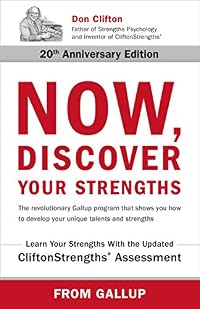
Now, Discover Your Strengths: How to Develop Your Talents and Those of the People You Manage
by Marcus Buckingham, Donald O. Clifton
Strengths Management (2)
On This Page
Description
The authors "have created a revolutionary program to help readers identify their talents, build them into strengths, and enjoy consistent, near-perfect performance. At the heart of the book is the Internet-based StrengthsFinder' Profile, the product of a 25-year, multimillion-dollar effort to identify the most prevalent human strengths. The program introduces 34 dominant "themes" with thousands of possible combinations, and reveals how they can best be translated into personal and career show more success. In developing this program, Gallup has conducted psychological profiles with more than two million individuals to help readers learn how to focus and perfect these themes. So how does it work? This book contains a unique identification number that allows you access to the StrengthsFinder Profile on the Internet. This Web-based interview analyzes your instinctive reactions and immediately presents you with your five most powerful signature themes. Once you know which of the 34 themes -- such as Achiever, Activator, Empathy, Futuristic, or Strategic -- you lead with, the book will show you how to leverage them for powerful results at three levels: for your own development, for your success as a manager, and for the success of your organization."--Publisher description. show lessTags
Recommendations
Member Reviews
Enh.
I've to this one with a solid decade of reading neuroscience and positive psychology behind me, so not only am I already familiar with the research he cites, but I am well aware of when it is misused. Let's just get this out of the way before we discuss any strengths (haha) the book may have, as I have yet to see its weaknesses covered in any of the reviews:
a) it is NOT TRUE that you can't significantly strengthen your weaknesses. Read The Brain that Changes Itself for a good introduction. Saying that most of us DON'T change is NOT the same thing. Even his own statistics don't support him: yes, you can draw a 0.7 to 0.9 correlation between people's scores on personality tests over time, but this is an AVERAGE--there will be some show more people with a 0.99 correlation and other people with a 0.5 correlation. Some people do change significantly over time, and it is worth discussing how and why, and when this is important. Not to mention that a 0.7 correlation is impressive, but it implies a CHANGE of 0.3--and that's not insignificant. (I've read a few of his books at this point and parts of this are drawn from more than one of them.)
It takes a lot of hard work and effort over a serious amount of time to really change an aspect of personality, and it likely is not worth it if you're trying to tackle something benign like "I hate public speaking." But some people's 'weaknesses' are serious character defects that cause harm to their friends, families and colleagues, and these folks should absolutely be expected to put the time and effort required into real change. Moreover, much research has shown that it CAN be done. So wtf, Buckingham?
b) The ipsative nature of the scoring makes the tool of use only on an individual level, though the author argues that organizations can use this in hiring. Nuh uh. No way.
So, the strengthsfinder gives you your top five strengths in business contexts. Handy, if you're trying to figure out what job to take or a continuing ed course or how to tackle some big project at work. But.
But it doesn't give you a SCORE. Just a list of your top five. Just because you and your best friend both have "empathy" as a top strength doesn't mean you're equally empathic; indeed, just because your best friend's top strength is "empathy" and it doesn't even appear on your top five doesn't mean you're not in fact MORE empathic than your friend. Maybe your best friend is mediocre in everything and even their top strengths are not very strong. This is harmless so long as it is used for self-discovery and planning, but used for hiring and promotions, as Buckingham openly advocates?
Stupidest idea ever. Sorry.
(deep breath)
So, the pluses: it was certainly rigorously researched and the central thesis of focusing on developing strengths rather than correcting weaknesses has a lot to recommend it. Much research backs up their claim that this is a better use of resources for corporations, and that I will buy. I was amused by the test results (I am very good at thinking: I like thinking abstractly, thinking about concepts, thinking about strategies, collecting thoughts, and then, when all of this is done, thinking about my values and beliefs. And yes, those are my top five strengths. They do seem somewhat repetitive, no?) and given previous experience with Seligmen et al's research on character strengths, not entirely convinced by them. I mean, yes, I love thinking--but it's not all I do, not even at work, and I got much more balanced results from less commercially-oriented researchers.
Incidentally, the tests developed by the positive psychology researchers, who are also looking at character strengths and how to focus on them, are available for free on the internet--you don't need to buy the book to take the test. Just an fyi. It's a brilliant marketing strategy but that doesn't make it sound science. show less
I've to this one with a solid decade of reading neuroscience and positive psychology behind me, so not only am I already familiar with the research he cites, but I am well aware of when it is misused. Let's just get this out of the way before we discuss any strengths (haha) the book may have, as I have yet to see its weaknesses covered in any of the reviews:
a) it is NOT TRUE that you can't significantly strengthen your weaknesses. Read The Brain that Changes Itself for a good introduction. Saying that most of us DON'T change is NOT the same thing. Even his own statistics don't support him: yes, you can draw a 0.7 to 0.9 correlation between people's scores on personality tests over time, but this is an AVERAGE--there will be some show more people with a 0.99 correlation and other people with a 0.5 correlation. Some people do change significantly over time, and it is worth discussing how and why, and when this is important. Not to mention that a 0.7 correlation is impressive, but it implies a CHANGE of 0.3--and that's not insignificant. (I've read a few of his books at this point and parts of this are drawn from more than one of them.)
It takes a lot of hard work and effort over a serious amount of time to really change an aspect of personality, and it likely is not worth it if you're trying to tackle something benign like "I hate public speaking." But some people's 'weaknesses' are serious character defects that cause harm to their friends, families and colleagues, and these folks should absolutely be expected to put the time and effort required into real change. Moreover, much research has shown that it CAN be done. So wtf, Buckingham?
b) The ipsative nature of the scoring makes the tool of use only on an individual level, though the author argues that organizations can use this in hiring. Nuh uh. No way.
So, the strengthsfinder gives you your top five strengths in business contexts. Handy, if you're trying to figure out what job to take or a continuing ed course or how to tackle some big project at work. But.
But it doesn't give you a SCORE. Just a list of your top five. Just because you and your best friend both have "empathy" as a top strength doesn't mean you're equally empathic; indeed, just because your best friend's top strength is "empathy" and it doesn't even appear on your top five doesn't mean you're not in fact MORE empathic than your friend. Maybe your best friend is mediocre in everything and even their top strengths are not very strong. This is harmless so long as it is used for self-discovery and planning, but used for hiring and promotions, as Buckingham openly advocates?
Stupidest idea ever. Sorry.
(deep breath)
So, the pluses: it was certainly rigorously researched and the central thesis of focusing on developing strengths rather than correcting weaknesses has a lot to recommend it. Much research backs up their claim that this is a better use of resources for corporations, and that I will buy. I was amused by the test results (I am very good at thinking: I like thinking abstractly, thinking about concepts, thinking about strategies, collecting thoughts, and then, when all of this is done, thinking about my values and beliefs. And yes, those are my top five strengths. They do seem somewhat repetitive, no?) and given previous experience with Seligmen et al's research on character strengths, not entirely convinced by them. I mean, yes, I love thinking--but it's not all I do, not even at work, and I got much more balanced results from less commercially-oriented researchers.
Incidentally, the tests developed by the positive psychology researchers, who are also looking at character strengths and how to focus on them, are available for free on the internet--you don't need to buy the book to take the test. Just an fyi. It's a brilliant marketing strategy but that doesn't make it sound science. show less
When I first read through the Strengthsfinder material in this book, I took guesses at what I thought described me. Then I took the online test. What I found not only surprised me, but revealed to me some insights about who I am. Over time, I've found these descriptors to be useful not only in self-reflection, but in the practice of leadership and, in my case, ministry.
You should know that each book allows for one test. Like other personality profiles, the results need to be interpreted and thought through, but with this text that process remains engaging and revealing. Worth the experiment and reflection.
You should know that each book allows for one test. Like other personality profiles, the results need to be interpreted and thought through, but with this text that process remains engaging and revealing. Worth the experiment and reflection.
this is a recent mailing list post i made about the strengthsfinder that i thought would make a good librarything review. it was in response to someone who was required to do it at their workplace and found it a waste of time because they didn't learn anything new about themselves in the process.
. . .
in 2003 the strengthsfinder inventory was the catalyst that changed my life. my manager's manager bought a copy of the book for his entire team because he found it useful, but didn't require us to take the inventory, we were free to do it, or not. i figured why not, so i did. i had no idea that anyone would think things like "input" and "intellection" are strengths, and while i recognized them as things i did a lot, i thought of them as show more weaknesses, because they make me a lazy daydreamer who surfs the internet all the time.
it hadn't occurred to me that i might be able to put what i considered my worst tendencies to good use, and that doing so would make me happy, and that maybe i was in the wrong career (i thought i just needed to keep trying and someday i would like my job). it was the kick in the butt i needed to seek out something other than software testing, it was a foundation for seeking a library science degree, and it kept me from staying at a job i hated and eventually driving my car into the median barrier on the highway. (yes, that's right. strengthsfinder saved my life.)
before i took the inventory i would have told you my top strength was communication. that one didn't even make my top five. if you are the rare person who is already well-aware of your personal talents, i can see how it might be a waste of time, and it's probably less enjoyable if you're required to do it, and it is written in a cheesy pop-business-book tone that some find annoying, but as they point out, most folks focus on their weaknesses and struggle to name their strengths, so it can make people wake up to who they are and what they should be doing with their lives, and that can be really valuable. (holy run on sentence, batman.) that's what happened with me, anyway.
i recommend it to anyone who hates their job and doesn't know what they want to do with their life. it seriously pulled me out of a rut. show less
. . .
in 2003 the strengthsfinder inventory was the catalyst that changed my life. my manager's manager bought a copy of the book for his entire team because he found it useful, but didn't require us to take the inventory, we were free to do it, or not. i figured why not, so i did. i had no idea that anyone would think things like "input" and "intellection" are strengths, and while i recognized them as things i did a lot, i thought of them as show more weaknesses, because they make me a lazy daydreamer who surfs the internet all the time.
it hadn't occurred to me that i might be able to put what i considered my worst tendencies to good use, and that doing so would make me happy, and that maybe i was in the wrong career (i thought i just needed to keep trying and someday i would like my job). it was the kick in the butt i needed to seek out something other than software testing, it was a foundation for seeking a library science degree, and it kept me from staying at a job i hated and eventually driving my car into the median barrier on the highway. (yes, that's right. strengthsfinder saved my life.)
before i took the inventory i would have told you my top strength was communication. that one didn't even make my top five. if you are the rare person who is already well-aware of your personal talents, i can see how it might be a waste of time, and it's probably less enjoyable if you're required to do it, and it is written in a cheesy pop-business-book tone that some find annoying, but as they point out, most folks focus on their weaknesses and struggle to name their strengths, so it can make people wake up to who they are and what they should be doing with their lives, and that can be really valuable. (holy run on sentence, batman.) that's what happened with me, anyway.
i recommend it to anyone who hates their job and doesn't know what they want to do with their life. it seriously pulled me out of a rut. show less
If you ever have the opportunity to read this book and take the StrengthsFinder quiz, I HIGHLY recommend that you do so. I read this book as part of a leadership development program that I am in for work. I learned more about myself from this book and the quiz results than I have in the first twelve months of the program. I learned why I have issues with losing my train of thought when speaking, why I feel this incessant need to constantly achieve and learn something, why I value my alone time.
More importantly, I learned that these are strengths rather than shortcomings. Of even greater importance, I was given helpful hints how to make these strengths work for me on the job and in my personal life. This blog is an excellent example of show more something that is using my strength of the need to reflect and think about things thoroughly. The fact that I read so many books of almost every genre is due to my passion for learning, which I can channel into my now-complete MBA studies and my CMA studying. I also discovered that my ideal job is ideal because it perfectly suits each one of my top five strengths.
What was of interest to me was that each one of the other twenty-three members of my leadership group had just as profound experiences as I did. When it happens to all of us, when we all feel empowered by the information learned about ourselves, you know that this is a life-altering book.
I am so thankful that I took the time to read this book for my program. It was recommended but not required, but I feel I got more out of the quiz results and the list of my top five strengths because I read the book. (Of course, it is a book, and I'm not someone to turn down reading one.) I cannot stress enough how much my perception on who I am has changed as a result of reading this and getting my top five themes. It was worth every minute of reading. show less
More importantly, I learned that these are strengths rather than shortcomings. Of even greater importance, I was given helpful hints how to make these strengths work for me on the job and in my personal life. This blog is an excellent example of show more something that is using my strength of the need to reflect and think about things thoroughly. The fact that I read so many books of almost every genre is due to my passion for learning, which I can channel into my now-complete MBA studies and my CMA studying. I also discovered that my ideal job is ideal because it perfectly suits each one of my top five strengths.
What was of interest to me was that each one of the other twenty-three members of my leadership group had just as profound experiences as I did. When it happens to all of us, when we all feel empowered by the information learned about ourselves, you know that this is a life-altering book.
I am so thankful that I took the time to read this book for my program. It was recommended but not required, but I feel I got more out of the quiz results and the list of my top five strengths because I read the book. (Of course, it is a book, and I'm not someone to turn down reading one.) I cannot stress enough how much my perception on who I am has changed as a result of reading this and getting my top five themes. It was worth every minute of reading. show less
I have to read this for work which immediately lessens its appeal. I finally started to read it and, thought I am skeptical about whether or not it is cult-ish, I think they make a lot of sense. The premise of the book is to manage your weaknesses and capitalize on your strengths. You might think that this concept is a given, but after I thought about it, I realized that most organizations try and improve employee weaknesses.
Fantastic follow-up to "First, Break All the Rules." Quicker, too, because I'd already taken the StrengthsFinder test and read about the strengths, which constitute a bulk of the book's content. Definitely a fantastic resource and worth revisiting; I would love to see capitalizing on our strengths (rather than weaknesses) a lot more in society today.
A very thought-provoking book which brings the focus back into one inner self. The authors advocate that strengths = talents + knowledge + skills. Instead of spending time perfecting skills which one don't have an innate talent for, why not focus on skills which you are born for? The best thing about this book is that it has a extensive questionaire which helps you discover what talents you have. I did the test and it was quite accurate. :)
However, the book provided limited insight about how to hone the talents into strengths. So reader is left hanging in the air. Although there's no standard procedure, the authors could have highlighted some areas where the reader can start to take actions.
However, the book provided limited insight about how to hone the talents into strengths. So reader is left hanging in the air. Although there's no standard procedure, the authors could have highlighted some areas where the reader can start to take actions.
Members
- Recently Added By
Lists

My List
302 works; 1 member
Author Information

30+ Works 8,819 Members
British motivational speaker, trainer, and author Marcus Buckingham graduated from Cambridge University with a Master's Degree in Social and Political Science in 1987. He is internationally known as an authority on employee productivity and is a member of the Secretary of State's Advisory Committee on Leadership and Management. Buckingham worked show more as a senior researcher at The Gallup Organization for 17 years and founded TMBC in 2007 in order to create strengths-based management training solutions for organizations. He has appeared on television shows including The Oprah Winfrey Show, Larry King Live, The Today Show, Good Morning America, and The View. Buckingham has been profiled in the following publications: The New York Times, The Wall Street Journal, USA Today, Fortune, Fast Company, and Harvard Business Review. He has written or co-written numerous bestselling books, such as First, Break All the Rules; Now, Discover Your Strengths; The One Thing You Need to Know; and Go Put Your Strengths to Work. (Bowker Author Biography) show less

7 Works 6,129 Members
Series

Common Knowledge
- Canonical title
- Now, Discover Your Strengths: How to Develop Your Talents and Those of the People You Manage
- Alternate titles
- Now, Discover your Strengths
- Dedication
- to my wife, Jane, strong enough for three... -- Marcus
to those who helped me discover my strengths -- my wife, Shirley, and our family -- Don - First words
- Guided by the belief that good is the opposite of bad, mankind has for centuries pursued its fixation with fault and failing.
- Last words
- (Click to show. Warning: May contain spoilers.)Only then will we win.
- Blurbers
- Morrison, Mike; Seligman, Martin E.P.; Csikszentmihalyi, Mihaly; Diener, Ed; Schmidt, Frank; Pucci, Mike (show all 16); Thompson, Bill; Andriga, Robert C.; Eisenhower, David; Bass, Bernard M.; Spanier, Graham B.; Avolio, Bruce J.; Stone, Philip; Matusak, Larraine; Anderson, Edward; Mullins, Garrett R.
Classifications
Statistics
- Members
- 3,518
- Popularity
- 4,672
- Reviews
- 27
- Rating
- (3.65)
- Languages
- 8 — Chinese, Dutch, English, French, German, Polish, Portuguese, Spanish
- Media
- Paper, Audiobook, Ebook
- ISBNs
- 33
- ASINs
- 19