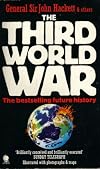
The Third World War
by Sir John Winthrop Hackett
On This Page
Description
Written as though compiled shortly after the war's conclusion, this imaginary history of the Third World War describes why, where, and when it would be fought, and what its effects would be.Tags
Recommendations




















Member Reviews
Wow, this is probably the longest a book has sat on my "currently reading" shelf on Goodreads. It's hard to really give this book a truly fair review considering the authors were prognosticating and didn't have the benefit of hindsight like I do reading it now. So much of their predictions for the future are not just off, but hilariously wrong: the US and Iran remaining staunch allies through the 1980s, China and Japan allying to form a "sphere of co-prosperity," East and West Germany never reunifying, etc. But some of their less specific predictions were quite prescient: the idea of specific citizenship in a more economically and diplomatically unified Europe becoming less important, nationalist sentiment in border republics of the show more USSR helping lead to its downfall, and the advancement of telecommunications leading to the rise of telecommuting, making where you live less and less relevant to your employment.
The authors personal political bias seeps through often, blaming liberals and trade unionists and "peaceniks" for a decline in military ability for NATO that almost costs them the war. They blame generational shifts for not having proper military officers ready to serve. The book reads like a thinly veiled Cold Warrior's appeal to ramp up defense budgets, relying on a severe misunderstanding of the actual aims and motivations of their adversary.
The speculative history (or for us now, alternate history) the authors create is quite intriguing to read. The authors weave a tale of international and domestic events that lead to the outbreak of war in August 1985 that while some of it quite implausible, does tend to follow its own logic if your accept the initial premise. I found myself really wanting to dive in more to the series of events they laid out, and found myself craving an old school History Channel documentary made about it.
The real reason the review is as low as it is, and why it took me almost a year to actually get through this book (reading 14 books in between starting and finishing it) is while its marketed as a thriller paperback, it reads most of the time like a very dry think tank report. The entire middle section of the book is dedicated to intricate discussions of force structure and armaments development. Chapter after chapter of the reshuffling of chains of command, civil defense development, replacement of aircraft models with new ones, etc. While this information is important to understanding the war, it is overly detailed here to a point it just serves to dissuade you from reading more. At least half of the info contained within could have been cut and summarized much more efficiently.
Unless you're a cold war military buff, there's not really enough redeeming here to really make this worth your time. show less
The authors personal political bias seeps through often, blaming liberals and trade unionists and "peaceniks" for a decline in military ability for NATO that almost costs them the war. They blame generational shifts for not having proper military officers ready to serve. The book reads like a thinly veiled Cold Warrior's appeal to ramp up defense budgets, relying on a severe misunderstanding of the actual aims and motivations of their adversary.
The speculative history (or for us now, alternate history) the authors create is quite intriguing to read. The authors weave a tale of international and domestic events that lead to the outbreak of war in August 1985 that while some of it quite implausible, does tend to follow its own logic if your accept the initial premise. I found myself really wanting to dive in more to the series of events they laid out, and found myself craving an old school History Channel documentary made about it.
The real reason the review is as low as it is, and why it took me almost a year to actually get through this book (reading 14 books in between starting and finishing it) is while its marketed as a thriller paperback, it reads most of the time like a very dry think tank report. The entire middle section of the book is dedicated to intricate discussions of force structure and armaments development. Chapter after chapter of the reshuffling of chains of command, civil defense development, replacement of aircraft models with new ones, etc. While this information is important to understanding the war, it is overly detailed here to a point it just serves to dissuade you from reading more. At least half of the info contained within could have been cut and summarized much more efficiently.
Unless you're a cold war military buff, there's not really enough redeeming here to really make this worth your time. show less
Had to re-read this one as it's over 45 years since I read it the first time. Now it reads as alternate history, it was written as plausible prediction. Still readable, although laughably wrong as prediction. Tainted by the authors obvious politics and more than a few whiffs of subtle racism. It brought to mind a quote from Sandy Berger: "History is written through a rear-view mirror but it unfolds through a foggy windshield." The good General wrote this as though he was looking in the mirror, but his windshield proved exceptionally foggy. Still a worthwhile read.
Early in 1977 a retired NATO general called together six of his colleagues--including an admiral, an airman, an economist and a diplomat--to write a dramatized fantast of the next world war.
The vivid, detailed imagining of on-the-spot reports from battlefronts, excerpts from fantasy memoirs, internal Soviet documents, etc. reads like a treatment for a big screen war movie.
Well, since it it looks like World War III already started, I thought it was finally time to take this prediction of a 1985 WWIII and see how well it matches up. Now, this is basically NATO vs. USSR, so in the post-Soviet world it cannot be an apples to apples comparison. We don't have Warsaw Pact nations (most are in NATO, now) and so no blitzkrieg across the Fulda show more Gap into Central Europe. Still, some similarities and dissimilarities are of interest to me. This war is over in a few weeks and basically starts with Russian expansionist African movements to me somewhat similar to the agitation in provinces of various nations of Central Asia seeking to foment separatism. Also, things go from chemical attacks from both sides to both sides skipping strategic nukes to each launching one city killer in over about ten days. Whoa! Things went from bad to worse fast in this vision!
One thing that does jive with where we are at is anti-tank and other potent man-portable armaments making wreckage out of armor directed from Moscow.
Also, this one imagines beams against space vehicles, etc. and of course misses the cyberwar.
One eerie bullseye is the neo-Nazi claims from the Kremlin:
The vivid, detailed imagining of on-the-spot reports from battlefronts, excerpts from fantasy memoirs, internal Soviet documents, etc. reads like a treatment for a big screen war movie.
Well, since it it looks like World War III already started, I thought it was finally time to take this prediction of a 1985 WWIII and see how well it matches up. Now, this is basically NATO vs. USSR, so in the post-Soviet world it cannot be an apples to apples comparison. We don't have Warsaw Pact nations (most are in NATO, now) and so no blitzkrieg across the Fulda show more Gap into Central Europe. Still, some similarities and dissimilarities are of interest to me. This war is over in a few weeks and basically starts with Russian expansionist African movements to me somewhat similar to the agitation in provinces of various nations of Central Asia seeking to foment separatism. Also, things go from chemical attacks from both sides to both sides skipping strategic nukes to each launching one city killer in over about ten days. Whoa! Things went from bad to worse fast in this vision!
One thing that does jive with where we are at is anti-tank and other potent man-portable armaments making wreckage out of armor directed from Moscow.
Also, this one imagines beams against space vehicles, etc. and of course misses the cyberwar.
One eerie bullseye is the neo-Nazi claims from the Kremlin:
From the outset the world was swamped with Soviet claims, flooding through every possible channel of communication, that this was no more than defensive action, to which the Warsaw Pact had been driven by neo-Nazi ambitions supported by capitalist imperialism. 'It has long been clear,' the announcement proclaimed,show less
'that the new Nazis are set on the reunification of Germany by force and the subsequent domination of Europe as an early step to world supremacy. The policy of "forward defense", which is self-evident military non sense if it does not mean action by the FRG east of the Demarcation Line, has never been more than a thin cloak for the firm intention to invade the GDR as a first move towards the dismemberment of the Warsaw Pact and the destruction of the USSR. The change of name from Vorwärtsverteidigung (Forward Defence) to Vornever teidigung (Frontal Defence) has done nothing to disguise the nakedness of an essentially aggressive policy. Plans for the invasion are now, in total authenticity,' as the announcement put it, 'in Soviet hands, and their authors will in time be brought to justice. Meanwhile, it has become abundantly clear that there is no time to lose in cutting out the Nazi canker. Otherwise all hope will vanish of a lasting peace in Europe.'
Wow, this is probably the longest a book has sat on my "currently reading" shelf on Goodreads. It's hard to really give this book a truly fair review considering the authors were prognosticating and didn't have the benefit of hindsight like I do reading it now. So much of their predictions for the future are not just off, but hilariously wrong: the US and Iran remaining staunch allies through the 1980s, China and Japan allying to form a "sphere of co-prosperity," East and West Germany never reunifying, etc. But some of their less specific predictions were quite prescient: the idea of specific citizenship in a more economically and diplomatically unified Europe becoming less important, nationalist sentiment in border republics of the show more USSR helping lead to its downfall, and the advancement of telecommunications leading to the rise of telecommuting, making where you live less and less relevant to your employment.
The authors personal political bias seeps through often, blaming liberals and trade unionists and "peaceniks" for a decline in military ability for NATO that almost costs them the war. They blame generational shifts for not having proper military officers ready to serve. The book reads like a thinly veiled Cold Warrior's appeal to ramp up defense budgets, relying on a severe misunderstanding of the actual aims and motivations of their adversary.
The speculative history (or for us now, alternate history) the authors create is quite intriguing to read. The authors weave a tale of international and domestic events that lead to the outbreak of war in August 1985 that while some of it quite implausible, does tend to follow its own logic if your accept the initial premise. I found myself really wanting to dive in more to the series of events they laid out, and found myself craving an old school History Channel documentary made about it.
The real reason the review is as low as it is, and why it took me almost a year to actually get through this book (reading 14 books in between starting and finishing it) is while its marketed as a thriller paperback, it reads most of the time like a very dry think tank report. The entire middle section of the book is dedicated to intricate discussions of force structure and armaments development. Chapter after chapter of the reshuffling of chains of command, civil defense development, replacement of aircraft models with new ones, etc. While this information is important to understanding the war, it is overly detailed here to a point it just serves to dissuade you from reading more. At least half of the info contained within could have been cut and summarized much more efficiently.
Unless you're a cold war military buff, there's not really enough redeeming here to really make this worth your time. show less
The authors personal political bias seeps through often, blaming liberals and trade unionists and "peaceniks" for a decline in military ability for NATO that almost costs them the war. They blame generational shifts for not having proper military officers ready to serve. The book reads like a thinly veiled Cold Warrior's appeal to ramp up defense budgets, relying on a severe misunderstanding of the actual aims and motivations of their adversary.
The speculative history (or for us now, alternate history) the authors create is quite intriguing to read. The authors weave a tale of international and domestic events that lead to the outbreak of war in August 1985 that while some of it quite implausible, does tend to follow its own logic if your accept the initial premise. I found myself really wanting to dive in more to the series of events they laid out, and found myself craving an old school History Channel documentary made about it.
The real reason the review is as low as it is, and why it took me almost a year to actually get through this book (reading 14 books in between starting and finishing it) is while its marketed as a thriller paperback, it reads most of the time like a very dry think tank report. The entire middle section of the book is dedicated to intricate discussions of force structure and armaments development. Chapter after chapter of the reshuffling of chains of command, civil defense development, replacement of aircraft models with new ones, etc. While this information is important to understanding the war, it is overly detailed here to a point it just serves to dissuade you from reading more. At least half of the info contained within could have been cut and summarized much more efficiently.
Unless you're a cold war military buff, there's not really enough redeeming here to really make this worth your time. show less
An absurd tale of Soviet aggression in Europe, countered by valiant NATO troops, and ending in a civilized nuclear exchange: Birmingham, UK, for Minsk, USSR. Written in the style of a retrospective look at the one-month conflict. Silly stuff, but probably useful in making a case for escalating military spending. Pictures of NATO and Soviet training exercises (plus one WW2-era photo) are recycled here as photos documenting World War III.
A very interesting, but now outdated, speculative work about the possible causes and initial phases of WWIII. I found this really interesting at the time it came out, but it is now almost 30 years out of date.
A chilling, apocalyptic book about a possible World War III and how, why, when, and where it would be fought, as told by Sir John Hackett, the former commander of the British Army of the Rhine and other top-ranking NATO Generals and Advisors.
A chilling, apocalyptic book about a possible World War III and how, why, when, and where it would be fought, as told by Sir John Hackett, the former commander of the British Army of the Rhine and other top-ranking NATO Generals and Advisors.
Interesting hypothetical look at a potential world conflict in the 80's. Bit dry in some places but very interesting none the less.
Members
- Recently Added By
Lists

Publisher's Weekly Bestsellers - Part II - 1940 - 1979
355 works; 5 members
Author Information

12+ Works 1,615 Members
Some Editions
Awards and Honors
Distinctions
Common Knowledge
- Canonical title*
- De derde wereldoorlog
- Original title
- The Third World War. A future history
- Alternate titles
- The Third World War : a future history; The Third World War August 1985
- Original publication date
- 1978
- Important events
- World War III
- Epigraph*
- Augustus 1985 - Geschiedenis van de toekomst
- First words
- "Black Horse One Zero, Black Horse One Zero,..."
- Last words
- (Click to show. Warning: May contain spoilers.)They lockled him up as a madman, of course.
- Original language
- English
- Disambiguation notice
- The Third World War, August 1985 (also published as The Third World War: A Future History) is a different work from The Third World War: The Untold Story.
*Some information comes from Common Knowledge in other languages. Click "Edit" for more information.
Classifications
Statistics
- Members
- 860
- Popularity
- 31,487
- Reviews
- 17
- Rating
- (3.45)
- Languages
- 8 — Danish, Dutch, English, French, German, Russian, Spanish, Swedish
- Media
- Paper, Audiobook
- ISBNs
- 32
- ASINs
- 16