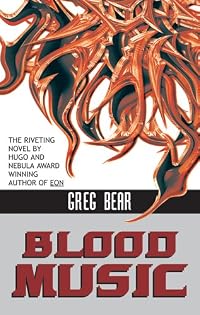
Blood Music
by Greg Bear
On This Page
Description
In the tradition of the greatest cyberpunk novels, Blood Music explores the imminent destruction of mankind and the fear of mass destruction by technological advancements. The novel follows present-day events in which the fears concerning the nuclear annihilation of the world subsided after the Cold War and the fear of chemical warfare spilled over into the empty void it left behind. An amazing breakthrough in genetic engineering made by Vergil Ulam is considered too dangerous for further show more research, but rather than destroy his work, he injects himself with his creation and walks out of his lab, unaware of just how his actions will change the world. Author Greg Bear's treatment of the traditional tale of scientific hubris is both suspenseful and a compelling portrait of a new intelligence emerging amongst us, irrevocably changing our world. show lessTags
Recommendations
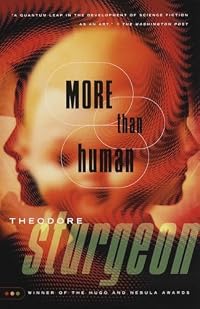
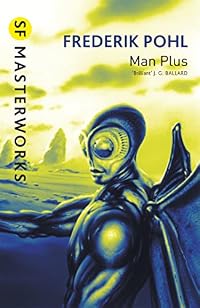
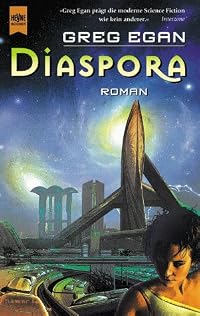
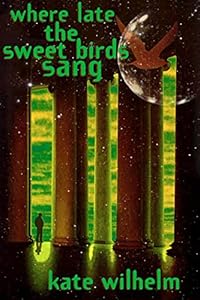
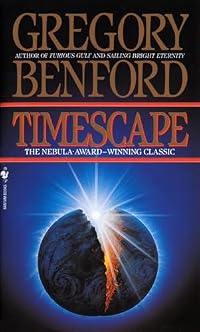
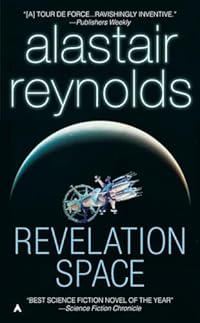
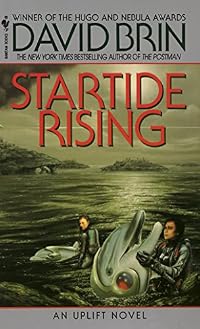

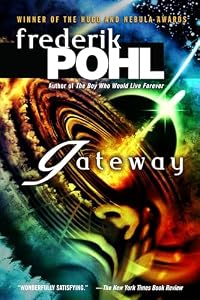



Member Recommendations
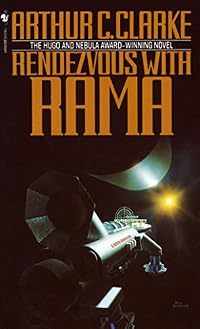
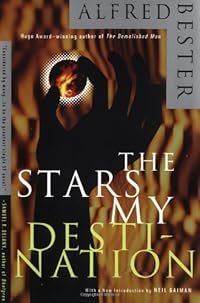
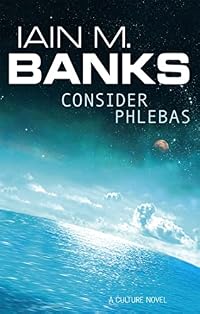
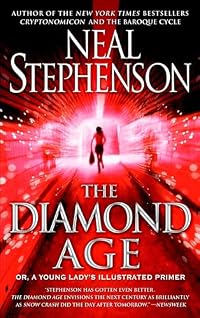
sandstone78 For sentience at the microscopic level affecting human life and behavior.
20
Member Reviews
This is the first science fiction novel that I have finished in what I am presuming to be my post-juvenile phase, possibly a "neophyte." Neither am I a scientist, let alone a biologist, so am unable to say anything about the hard sf conceit of this book (bio-AI nanotechnology), other than that it is a what-if question I've privately held for some time. All this is to say that I may be reaching with this review. Spoilers ahead.
To blindly proclaim a philosophical reading of Blood Music: "Nietzschean human vitality (in the strictly embodied sense) is severed from its all too human form, evolving beyond the discreteness that is the existential reality of humanity, and recapitulates all tragedy into secular apotheosis via biological show more singularity."
Perhaps I am only remarking upon the obvious, fundamental themes of human evolution, etc. that has inevitably arrived downstream from it's blossoming point, Nietzsche, but the metaphysics maps too cleanly not to talk about. If you know much at all about N, then you know how he feels about music, and you know how he feels about the body. Music is the will-to-power, and even Communion is only consummated by the blood and flesh of Christ. As such the noocytes are sort of these Ubermenschian meat angels who must sing, chant, and guide the humans to the great Dionysian rite at the end of the world. Vergil acts as our prophet here, symbolically acting as the pure Promethean spirit of innovation that entirely swallows up Apollonian bureacracy.
The singularity then allows humans, as we see in Bernard, to relive any part of their lives as many times as they'd like: eternal recurrence. Not exactly... eternal recurrence does not propose that we get to redo anything, only to relive, no matter how tragic. But N was chronically afflicted... would he have taken up the noocytes' bargain? A Catholic must necessarily say no, for her limits, in the Weilian sense, are the source of beauty.
We do end this book in what may be described as a transhumanist utopia. The physically impossible, logical endpoint of transhumanism as the absolute freedom of the human spirit unshackled by biology. This is also where the body horror occurs, so clearly there is some ambiguity.
Then there is the matter of racial memory, which the noocytes discover latently extant in the humans' introns. Even the reavaluation of all values is in this fleshly flat circle.
The society of cells also form a panpsychic world, a clever throughline from cell-to-human scale to noocyte-to-biosphere scale, but the question of mind here is perhaps best explored by another story. It is also remarked upon once by Vergil that he felt beckoned to create them... a thought worth tugging on.
I don't understand some of the criticism levied at Blood Music's speculation. The first part that is entirely dedicated to RNA/DNA coding is great. If we can accept that ACGT codons can be used like bytes of information, then there is no difficulty imagining that a cell can acting as a Turing complete computer, a cluster of cells can act as big data models, and spontaneous intelligence can emerge from the whole network, especially given that they have literally the entire biological history of DNA to run simulations on. In this age of ChatGPT, to have an alternative, lively depiction of AI rather than digital slop is so so refreshing. And how is it so hard to accept that the noocytes enter hyperspace? Observation does literally collapse superpositions, and we literally don't know would happen if a gajillion observations fell upon matter. In 2024, Netflix has just released an adaptation of the 3-Body-Problem and audiences do not seem to have an issue suspending their disbelief for Sophons.
Anyways, I will revisit these ideas one day when I have read more of Bear, more N, and more singularity stories to compare with (I found it funny that Suzy literally receives her own Evangelion omedetou scene). Otherwise:
- Prose is proficient. Nothing less, nothing more.
- Some characters feel inconsequential. Suzy serves her purpose as the normal but lacks motivation, though charming. Others get no ending. Love the three principal male characters though.
- I read somewhere that Orson Scott Card said Bear can't be biopunk because he's too nice to be punk. Certainly true here: every character feel like real humans and are treated quite tenderly.
- It must also be said that this is considered the first biopunk book and the first account of nanotechnology. Huge if true. Genuinely quite like Frankenstein in its ability to act as a comparison point for all further sf speculations, just without Shelley's incredible writing.
- Really enjoyed this despite the messiness. show less
To blindly proclaim a philosophical reading of Blood Music: "Nietzschean human vitality (in the strictly embodied sense) is severed from its all too human form, evolving beyond the discreteness that is the existential reality of humanity, and recapitulates all tragedy into secular apotheosis via biological show more singularity."
Perhaps I am only remarking upon the obvious, fundamental themes of human evolution, etc. that has inevitably arrived downstream from it's blossoming point, Nietzsche, but the metaphysics maps too cleanly not to talk about. If you know much at all about N, then you know how he feels about music, and you know how he feels about the body. Music is the will-to-power, and even Communion is only consummated by the blood and flesh of Christ. As such the noocytes are sort of these Ubermenschian meat angels who must sing, chant, and guide the humans to the great Dionysian rite at the end of the world. Vergil acts as our prophet here, symbolically acting as the pure Promethean spirit of innovation that entirely swallows up Apollonian bureacracy.
The singularity then allows humans, as we see in Bernard, to relive any part of their lives as many times as they'd like: eternal recurrence. Not exactly... eternal recurrence does not propose that we get to redo anything, only to relive, no matter how tragic. But N was chronically afflicted... would he have taken up the noocytes' bargain? A Catholic must necessarily say no, for her limits, in the Weilian sense, are the source of beauty.
We do end this book in what may be described as a transhumanist utopia. The physically impossible, logical endpoint of transhumanism as the absolute freedom of the human spirit unshackled by biology. This is also where the body horror occurs, so clearly there is some ambiguity.
Then there is the matter of racial memory, which the noocytes discover latently extant in the humans' introns. Even the reavaluation of all values is in this fleshly flat circle.
The society of cells also form a panpsychic world, a clever throughline from cell-to-human scale to noocyte-to-biosphere scale, but the question of mind here is perhaps best explored by another story. It is also remarked upon once by Vergil that he felt beckoned to create them... a thought worth tugging on.
I don't understand some of the criticism levied at Blood Music's speculation. The first part that is entirely dedicated to RNA/DNA coding is great. If we can accept that ACGT codons can be used like bytes of information, then there is no difficulty imagining that a cell can acting as a Turing complete computer, a cluster of cells can act as big data models, and spontaneous intelligence can emerge from the whole network, especially given that they have literally the entire biological history of DNA to run simulations on. In this age of ChatGPT, to have an alternative, lively depiction of AI rather than digital slop is so so refreshing. And how is it so hard to accept that the noocytes enter hyperspace? Observation does literally collapse superpositions, and we literally don't know would happen if a gajillion observations fell upon matter. In 2024, Netflix has just released an adaptation of the 3-Body-Problem and audiences do not seem to have an issue suspending their disbelief for Sophons.
Anyways, I will revisit these ideas one day when I have read more of Bear, more N, and more singularity stories to compare with (I found it funny that Suzy literally receives her own Evangelion omedetou scene). Otherwise:
- Prose is proficient. Nothing less, nothing more.
- Some characters feel inconsequential. Suzy serves her purpose as the normal but lacks motivation, though charming. Others get no ending. Love the three principal male characters though.
- I read somewhere that Orson Scott Card said Bear can't be biopunk because he's too nice to be punk. Certainly true here: every character feel like real humans and are treated quite tenderly.
- It must also be said that this is considered the first biopunk book and the first account of nanotechnology. Huge if true. Genuinely quite like Frankenstein in its ability to act as a comparison point for all further sf speculations, just without Shelley's incredible writing.
- Really enjoyed this despite the messiness. show less
4.5/5
A suspenseful and grotesque story that slowly unfolds itself into something with massive scope. Bear builds momentum in the story bit by bit, and then unleashes some really captivating moments and ideas. There were several twists that were memorable enough that I am sure they will stick to my brain for quite some time. Bear writes with a steady hand that draws you into the story. Characters are better than most within the science fiction genre for sure, but nothing to write home about. I think that the first 1/2 of the book was a little more compelling and exciting to read, but the second half sure does have it's moments too, especially considering the ideas that it touches upon (E.g. genetic memory, consciousness, & reality).
I show more think that some consider this to fall into the horror genre, but I don't know if I agree fully. Suspenseful? Sure. Body horror? Absolutely. But I don't think that the horror elements are really the focus. A stunner for sure, highly recommended.
I'm not sure if this is just an issue with my printing of the book, but there were an egregious amount of grammatical errors, so much so that they became distracting at points. Hoping to eventually get a different copy in my hands and see if it is better copy-edited. show less
A suspenseful and grotesque story that slowly unfolds itself into something with massive scope. Bear builds momentum in the story bit by bit, and then unleashes some really captivating moments and ideas. There were several twists that were memorable enough that I am sure they will stick to my brain for quite some time. Bear writes with a steady hand that draws you into the story. Characters are better than most within the science fiction genre for sure, but nothing to write home about. I think that the first 1/2 of the book was a little more compelling and exciting to read, but the second half sure does have it's moments too, especially considering the ideas that it touches upon (E.g. genetic memory, consciousness, & reality).
I show more think that some consider this to fall into the horror genre, but I don't know if I agree fully. Suspenseful? Sure. Body horror? Absolutely. But I don't think that the horror elements are really the focus. A stunner for sure, highly recommended.
I'm not sure if this is just an issue with my printing of the book, but there were an egregious amount of grammatical errors, so much so that they became distracting at points. Hoping to eventually get a different copy in my hands and see if it is better copy-edited. show less
A great opening third followed by a much more conceptual latter part. It takes the concept of nanomachines beyond grey goo and into a (scientifically dubious) interpretation of quantum mechanics.
This is one of those novels that are heavy on the ideas and light on the characters. Outside of our rather slimy main protagonist we're treated to some half baked people meant to stand in for different reactions to the nanomachine terror that's unleashed; unfortunately this results in a story that's more interesting to think about than it's engaging to read.
This is one of those novels that are heavy on the ideas and light on the characters. Outside of our rather slimy main protagonist we're treated to some half baked people meant to stand in for different reactions to the nanomachine terror that's unleashed; unfortunately this results in a story that's more interesting to think about than it's engaging to read.
It is difficult to put into words why I like this book so much. I’ve read it probably 6 or 7 times and I’m still fascinated with the concept of high intelligence at the micro-scale. Yes, it is perhaps too long and quite choppy, but I can forgive that because the ideas in this book are so intriguing. Plus George Guidall’s voice in narration is gentle and dreamlike; adding to the nirvana-like concept of the Noo-Sphere and the Thought Universe. Tantalizing.
Like other good science thriller writers, Bear gives us an explanation of the mechanics underlying his story. I both understood it and took it as read; not being a scientist myself I can’t easily verify whether what he says is true. Basically it sounded plausible and so I could show more go with it as the basis of the novel; that is that the scientist Ulam in working with the natural mechanics of information exchange among cells, accidentally engineered learning cells, which evolved into sentient, intelligent cells. Not so scary until it is explained that they still work like cells; that is in groups. Now we have groups of intelligent cells running amok in the human body.
Eventually they figure out how to overcome the rejection syndrome when moving to another human and they spread. They are explorers and consider Ulum and other early hosts as godlike beings. They have no concept of the macro scale, but when they do get it, they bide their time and continue to learn.
It seems to me that because of their co-dependent nature they aren’t subject to the same selfish aggression that humans are. Their very natures are rooted in cooperation and co-existence; like the Borg the concept of the individual is difficult for them to understand. Through interaction as peers with their hosts Ulam and Bernard, they realize more and more about what it is to be human and Bernard experiences not only his own memories, but those of others. This is accomplished through something like mitochondrial DNA; a structure within cells that encodes for memory and serves as a long-term storage vault through generations of people. Racial memory for lack of a better term, only it is stored at a cellular level and can be reproduced and replayed; experienced by others.
The original story (which I’ve only read once) is more of a cautionary tale a la Frankenstein; casting the scientist as arrogant, irresponsible and destructive. The novel only starts out that way when the changes to humans in the story are thought to be a disease. The “plague” quickly turns to something else in my mind; a salvation. Humanity will surely destroy itself one day, but preserving ourselves (encoding ourselves) as noocytes gives us immortality of a sense. Basically the story changes to one of the next stage in human evolution. A topic Bear seems to like.
Eventually every human loses its macro scale and becomes literally dissolved into a mass of living “tissue”. Certain portions of a person’s brain are encoded to retain the whole of the personality, memories, knowledge and experiences. The rest of the body is taken as general building material for this new micro-scale world. The parts that are fully developed noocytes continue to think, feel and become part of the whole; working with peer cell groups from other people. It’s as if all of humanity has become one gigantic organism. Of course the cells encoded with individual personalities continue to change and one can meet up with a version of oneself; one changed and evolved, but yet still containing the essential personality of the original person. It’s all very idealistic and dreamlike.
Many hard core science fiction fans hate this idea and would have liked Bear to keep to known territory; the sacred state of humanity and the preservation there of. Some even liken this to a fascist attempt at racial cleansing; to get rid of the old, the ugly, the mentally challenged etc. Bear never goes there though. He wonders at it through a character; are the bad and defective people integrated as well as the geniuses, or are they deleted or altered to shed their negative characteristics? Another character’s relatives explain it to one not immediately assimilated by saying that they ‘fix’ people. And they do, but do they delete people who don’t meet some kind of standard? We readers never know, but we can speculate.
The upshot of so many billions of trillions of intelligent beings concentrated in such a small space is the observer effect. That is the premise that mere observation and/or measurement of a phenomenon will affect it in some way. Any set of closely observed phenomena will change and too much change upsets the balance of the physics of the universe. Then the question; does the universe set the mind’s direction or does the mind set the universe’s direction? Bear doesn’t answer because he can’t. We’re left to wonder about it.
And a good deal more. One problem of this novel is that of characters created, fussed over and then dropped completely without resolution. He does the same with some ideas and concepts. I would have liked more resolution if only to bring the story to a close, if not to answer scientific queries. Once the noocytes return, what happens? We’re left with a dream-like vignette of Bernard and his first girlfriend and their first date. In actuality, they never had a second and he’s regretted it all his life. Now encoded into the Thought Universe, he has reconnected with the encoded version of this woman and some of each part of them can relive and redirect the past in a new future. All very idealistic and sort of clangs against the hard science of what came before it. I love the idea of it and I think Bear did, too, but it seems he came to it late in the writing of the novel and I think he should have gone back and modified the spirit and execution of the first parts of the story to check up with his change of plans. He also could have killed some story lines that went nowhere, too. It makes for a messy, but strangely satisfying package. show less
Like other good science thriller writers, Bear gives us an explanation of the mechanics underlying his story. I both understood it and took it as read; not being a scientist myself I can’t easily verify whether what he says is true. Basically it sounded plausible and so I could show more go with it as the basis of the novel; that is that the scientist Ulam in working with the natural mechanics of information exchange among cells, accidentally engineered learning cells, which evolved into sentient, intelligent cells. Not so scary until it is explained that they still work like cells; that is in groups. Now we have groups of intelligent cells running amok in the human body.
Eventually they figure out how to overcome the rejection syndrome when moving to another human and they spread. They are explorers and consider Ulum and other early hosts as godlike beings. They have no concept of the macro scale, but when they do get it, they bide their time and continue to learn.
It seems to me that because of their co-dependent nature they aren’t subject to the same selfish aggression that humans are. Their very natures are rooted in cooperation and co-existence; like the Borg the concept of the individual is difficult for them to understand. Through interaction as peers with their hosts Ulam and Bernard, they realize more and more about what it is to be human and Bernard experiences not only his own memories, but those of others. This is accomplished through something like mitochondrial DNA; a structure within cells that encodes for memory and serves as a long-term storage vault through generations of people. Racial memory for lack of a better term, only it is stored at a cellular level and can be reproduced and replayed; experienced by others.
The original story (which I’ve only read once) is more of a cautionary tale a la Frankenstein; casting the scientist as arrogant, irresponsible and destructive. The novel only starts out that way when the changes to humans in the story are thought to be a disease. The “plague” quickly turns to something else in my mind; a salvation. Humanity will surely destroy itself one day, but preserving ourselves (encoding ourselves) as noocytes gives us immortality of a sense. Basically the story changes to one of the next stage in human evolution. A topic Bear seems to like.
Eventually every human loses its macro scale and becomes literally dissolved into a mass of living “tissue”. Certain portions of a person’s brain are encoded to retain the whole of the personality, memories, knowledge and experiences. The rest of the body is taken as general building material for this new micro-scale world. The parts that are fully developed noocytes continue to think, feel and become part of the whole; working with peer cell groups from other people. It’s as if all of humanity has become one gigantic organism. Of course the cells encoded with individual personalities continue to change and one can meet up with a version of oneself; one changed and evolved, but yet still containing the essential personality of the original person. It’s all very idealistic and dreamlike.
Many hard core science fiction fans hate this idea and would have liked Bear to keep to known territory; the sacred state of humanity and the preservation there of. Some even liken this to a fascist attempt at racial cleansing; to get rid of the old, the ugly, the mentally challenged etc. Bear never goes there though. He wonders at it through a character; are the bad and defective people integrated as well as the geniuses, or are they deleted or altered to shed their negative characteristics? Another character’s relatives explain it to one not immediately assimilated by saying that they ‘fix’ people. And they do, but do they delete people who don’t meet some kind of standard? We readers never know, but we can speculate.
The upshot of so many billions of trillions of intelligent beings concentrated in such a small space is the observer effect. That is the premise that mere observation and/or measurement of a phenomenon will affect it in some way. Any set of closely observed phenomena will change and too much change upsets the balance of the physics of the universe. Then the question; does the universe set the mind’s direction or does the mind set the universe’s direction? Bear doesn’t answer because he can’t. We’re left to wonder about it.
And a good deal more. One problem of this novel is that of characters created, fussed over and then dropped completely without resolution. He does the same with some ideas and concepts. I would have liked more resolution if only to bring the story to a close, if not to answer scientific queries. Once the noocytes return, what happens? We’re left with a dream-like vignette of Bernard and his first girlfriend and their first date. In actuality, they never had a second and he’s regretted it all his life. Now encoded into the Thought Universe, he has reconnected with the encoded version of this woman and some of each part of them can relive and redirect the past in a new future. All very idealistic and sort of clangs against the hard science of what came before it. I love the idea of it and I think Bear did, too, but it seems he came to it late in the writing of the novel and I think he should have gone back and modified the spirit and execution of the first parts of the story to check up with his change of plans. He also could have killed some story lines that went nowhere, too. It makes for a messy, but strangely satisfying package. show less
I'd read a few bks by Bear before this one. They were ok but this one was the one that convinced me that Bear has a far-reaching imagination. A biological researcher unleashes changes in life that speed up the paradigm shifts far faster than anything before this has ever done. Basic human form will never be the same again. This cd be taken as a warning against irresponsible biological/genetic/nanotechnology research or as a harbinger of possible changes to come that might be embraced by those who're totally sick of life as it is today. Either way, it's a fantastic novel ripe w/ implications. For those poor deluded people who somehow think that Michael Crichton's at the forefront of SF writing: Crichton's bk "Prey" (2002) is a weak show more version of Bear's "Blood Music" (1985). Crichton's got the moolah & the reputation but he's basically a propagandist for the status quo. Read the original! show less
Great exploration of biotech, biochips and intelligence.
I had read the Analog short-story (which was great on its own) and the novella takes it further, not necessarily in a great direction, sometimes stretching credulity but interesting nonetheless.
A solid, enjoyable scifi book.
I had read the Analog short-story (which was great on its own) and the novella takes it further, not necessarily in a great direction, sometimes stretching credulity but interesting nonetheless.
A solid, enjoyable scifi book.
Remember when MRIs were called NMRs? The N standing for "nuclear" scared people so they had to change the name. Researchers at a company like Genetron would have been on the Internet back then (which still had a capital 'I') but ordinary humans hadn't heard of it and Greg Bear was either ordinary or writing for the ordinary. There was still a World Trade Center and a Soviet Union and a West Germany. This is the future-past of Blood Music. The world will end before 9-11, taken over by smart blood cells who encode us all on a micro level. The original "Downsizing."
In one chapter, a paranoid Dr. Bernard asks himself about the BAD people. Will they be miniatured and preserved as is? The question is never answered but needs to be. It could show more have been resolved by showing us what happened to Vergil's father, a bad person, but he never appears. Other characters wander off and we never find out what ultimately becomes of them. Vergil's mother, for one. And Candice deserved more of a future too. Mr. Bear writes well enough to have developed these characters better. He could have gotten a 4th star from me. show less
In one chapter, a paranoid Dr. Bernard asks himself about the BAD people. Will they be miniatured and preserved as is? The question is never answered but needs to be. It could show more have been resolved by showing us what happened to Vergil's father, a bad person, but he never appears. Other characters wander off and we never find out what ultimately becomes of them. Vergil's mother, for one. And Candice deserved more of a future too. Mr. Bear writes well enough to have developed these characters better. He could have gotten a 4th star from me. show less
Members
- Recently Added By
Lists

Best Science Fiction Novels
816 works; 430 members
Survey of Classic Science Fiction
171 works; 47 members

Recommended Apocalyptic Novels
53 works; 23 members

Amazon's 100 Science Fiction & Fantasy Books to Read in a Lifetime
87 works; 23 members

S.F. Masterworks (Complete)
229 works; 15 members

SF Masterworks
193 works; 8 members

It's the end of the world as we know it!
90 works; 23 members

1980s
356 works; 23 members

Books Read in 2002
197 works; 8 members

Books Read in 2022
5,164 works; 113 members

Books Read in 2025
4,091 works; 97 members
Favorite Science Fiction
452 works; 216 members
An evolving science fiction novel canon
50 works; 2 members
Author Information

140+ Works 47,127 Members
Greg Bear was born in San Diego, California, on August 20, 1951. He received a Bachelor of Arts degree from San Diego State University in 1973. At age 14, he began submitting pieces to magazines and at 15 he sold his first story to Robert Lowndes' Famous Science Fiction. It would be five years before he sold another piece, but by 23 he was selling show more stories regularly. He has written more than 30 science fiction and fantasy books and has won numerous awards for his work. In 1984, Hardfought and Blood Music won the Nebula Awards for best novella and novelette; Blood Music went on to win the Hugo Award. The novel version of that story, also called Blood Music, won the Prix Apollo in France. In 1987, Tangents won the Hugo and Nebula awards for best short story. He also won a Nebula in 1994 for Moving Mars and in 2001 for Darwin's Radio. Both Dinosaur Summer and Darwin's Radio have been awarded the Endeavour for best novel published by a Northwest science fiction author. He is also an illustrator and his work has appeared in Galaxy, Fantasy and Science Fiction, and Vertex, and in both hardcover and paperback books. He was a founding member of ASFA, the Association of Science Fiction Artists. His works include City at the End of Time, Hull Zero Three, The Mongoliad, Mariposa, Halo: Cryptum, Halo: Primordium and Halo: Silentium. (Bowker Author Biography) show less
Some Editions
Awards and Honors
Awards
Series
Belongs to Publisher Series
Work Relationships
Is an expanded version of
Inspired
Common Knowledge
- Canonical title*
- Blutmusik
- Original publication date
- 1985-04
- People/Characters
- Vergil Ulam; Edward Milligan; Michael Bernard
- Dedication
- For Astrid - Luxury, necessity, obsession With all my love
- First words
- Each hour, a myriad of trillion of little live things - microbes, bacteria, the peasants of nature - are born and die, not counting for much except in the bulk of their numbers and the accumulation of their tiny lives.
- Last words
- (Click to show. Warning: May contain spoilers.)Nothing is lost. Nothing is forgotten. It was in the blood, the flesh, And now it is forever.
- Blurbers
- Anderson, Poul; Benford, Gregory
- Original language
- English
*Some information comes from Common Knowledge in other languages. Click "Edit" for more information.
Classifications
Statistics
- Members
- 3,150
- Popularity
- 5,500
- Reviews
- 66
- Rating
- (3.78)
- Languages
- 11 — Czech, Dutch, English, Finnish, French, German, Greek, Hungarian, Italian, Polish, Spanish
- Media
- Paper, Audiobook, Ebook
- ISBNs
- 45
- ASINs
- 27