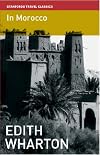
In Morocco
by Edith Wharton
On This Page
Description
American novelist and designer Edith Wharton traveled to Morocco after the end of World War I. Morocco is her account of her time there as the guest of General Hubert Lyautey. Her account praises Lyautey and his wife and also the French administration of the country.Tags
Recommendations
























Member Reviews
It may be the first guidebook to Morocco in English; at least, Wharton was very aware that she was unusually privileged in 1919, passing through a country on the brink of succumbing to mass tourism. She even reported on the road networks being built by the French (Morocco at the time was their protectorate) and assessed them in her capacity of a motor fiend (see Henry James' stricken accounts of tooling with her in her car down the Riviera...)
Most of the book are descriptions (quite beautiful) of places. She is flattering to the French, but after all they were her hosts and enabled her travel, so I don't know how much of that is politeness or real conviction. During the war the preponderant question had been whether France or Germany show more would prevail in North Africa, nobody gave a thought to something like "native" independence. There'd be some strongman somewhere and you made treaties with him, or threats to him. Whoever he led and whatever territory he laid claim to was a "country" or maybe not. Depending on various interests, but least of all "the will of the people".
She mentions a visit to a Jewish quarter, in Fez, which she says is typical, and that's where I had my first shock--in 1919 that was still a classic ghetto locked up every night, as in medieval Europe, with no Jews allowed out or circulating in other parts of town. Plus a myriad other restrictions and humiliations, and a picture of devastating poverty. I suppose I thought naively the French would have removed such rules... although Wharton writes they aimed, after Lyautey became the resident-general, to interfere with local "customs" as little as possible. (Algeria was a somewhat different story.)
Recently I read some brave youngish Moroccan intellectual saying he wishes for the one million (his number) Amazigh-speaking Jews to return to Morocco (from Israel). That would be an interesting dialogue to follow...
Wharton visited with the women where she was allowed, all from the upper class, sequestered in harems and with less physical freedom than their servants and slaves. It's a dismal picture and unfortunately it was still something you'd experience almost seventy years later.
The entrapment of girls into sexual slavery is for me the worst possible aspect of any society. There is no clearer nor more brutal way of showing you think of women as cunts and wombs and things and ways to make men, and not as people. To take an eight year old, nine year old, or as I read not too long ago, in Afghanistan, a six year old, and "marry" her, leave her illiterate and ignorant, disenfranchised and producing babies from the moment the miserable little body can until it can't--there should be a special category for this kind of protracted, repeated, long and slow murder of body and soul.
And then the other slavery, of people one does not "marry"... this was the second shock, that in 1919, "under Western eyes", there were still slaves in all the "good" Moroccan homes, formal slaves, people formally owned by others, like kitchen appliances and foodstuff and donkeys...
Most of the book are descriptions (quite beautiful) of places. She is flattering to the French, but after all they were her hosts and enabled her travel, so I don't know how much of that is politeness or real conviction. During the war the preponderant question had been whether France or Germany show more would prevail in North Africa, nobody gave a thought to something like "native" independence. There'd be some strongman somewhere and you made treaties with him, or threats to him. Whoever he led and whatever territory he laid claim to was a "country" or maybe not. Depending on various interests, but least of all "the will of the people".
She mentions a visit to a Jewish quarter, in Fez, which she says is typical, and that's where I had my first shock--in 1919 that was still a classic ghetto locked up every night, as in medieval Europe, with no Jews allowed out or circulating in other parts of town. Plus a myriad other restrictions and humiliations, and a picture of devastating poverty. I suppose I thought naively the French would have removed such rules... although Wharton writes they aimed, after Lyautey became the resident-general, to interfere with local "customs" as little as possible. (Algeria was a somewhat different story.)
Recently I read some brave youngish Moroccan intellectual saying he wishes for the one million (his number) Amazigh-speaking Jews to return to Morocco (from Israel). That would be an interesting dialogue to follow...
Wharton visited with the women where she was allowed, all from the upper class, sequestered in harems and with less physical freedom than their servants and slaves. It's a dismal picture and unfortunately it was still something you'd experience almost seventy years later.
The Moroccan lady knows little of cooking, needlework, or any household arts. When her child is ill she can only hang it with amulets and wail over it; the great lady of the Fazi palace is as ignorant of hygiene as the peasant woman of the bled. And all these colourless eventless lives depend on the favour of one fat tyrannical man, bloated with good living and authority, himself almost as inert and sedentary as his women, and accustomed to impose his whims on them ever since he ran about the same patio as a little short-smocked boy. {Oh what memories of a nasty little brute who terrorised his sisters and anyone woman-shaped this brought back...} (...) Ignorance, unhealthiness and a precocious sexual initiation prevail in all classes. Education consists in learning by heart endless passages of the Koran, and amusement in assisting at spectacles that would be unintelligible to Western children, but that the pleasantries of the harem make perfectly comprehensible to Moroccan infancy. {Compare to Taïa's recurring theme of not only being privy to his parents' abundant and unconcealed lovemaking, but the routine sexual games with his siblings...} At eight or nine the little girls are married, at twelve the son of the house is 'given his first negress'; and thereafter, in the rich and leisured class, both sexes live till old age in an atmosphere of sensuality without seduction.
The entrapment of girls into sexual slavery is for me the worst possible aspect of any society. There is no clearer nor more brutal way of showing you think of women as cunts and wombs and things and ways to make men, and not as people. To take an eight year old, nine year old, or as I read not too long ago, in Afghanistan, a six year old, and "marry" her, leave her illiterate and ignorant, disenfranchised and producing babies from the moment the miserable little body can until it can't--there should be a special category for this kind of protracted, repeated, long and slow murder of body and soul.
And then the other slavery, of people one does not "marry"... this was the second shock, that in 1919, "under Western eyes", there were still slaves in all the "good" Moroccan homes, formal slaves, people formally owned by others, like kitchen appliances and foodstuff and donkeys...
While tea was being served I noticed a tiny negress, not more than six or seven years old, who stood motionless in the embrasure of an archway. Like most of Moroccan slaves, even in the greatest households, she was shabbily, almost raggedly, dressed. A dirty gandarah of striped muslin covered her faded caftan, and a cheap kerchief was wound above her grave and precocious little face. With preternatural vigilance she watched each movement of the Caïd, who never spoke to her, looked at her, or made her the slightest perceptible sign, but whose least wish she instantly divined, refilling his tea-cup, passing the plates of sweets, or removing our empty glasses, in obedience to some secret telegraphy on which her whole being hung. (...)show less
The Caïd's little black slaves are well known in Morocco...(...)
This book has problems. Not least being the fact that Wharton couldn’t speak Arabic and appears to have travelled at times without a translator or Moroccan guide. Take the episode in chapter two where they visit the village of black people and come up with a theory about their origins. Why not just ask them? Well, she can’t, and apparently neither can anyone else in her party. On the other hand, in the space of one paragraph Wharton uses five animal metaphors to describe the inhabitants before finally settling on referring to the children as “jolly pickaninnies”. Oh but wait... the inhabitants had already given them directions so they could understand other. Here’s an out-there theory. Perhaps she felt that speaking to them show more was beneath her or that they couldn’t be trusted to know their own origins. This lack of interest in people extends to her travelling companions. She’s shy of telling us who she’s with so we’re largely denied to pleasure of those little portraits that make travel writing so enjoyable.
The purpose of the book appears to be propagandistic. Eleven pages out of one hundred and twenty-nine are devoted to the work of the colonial administrator. I suspect her tour and book were arranged as war-work to shore up support for the new Protectorate. Compare her comments on the Spanish zone.
But it’s not all bad. The scenes in the harems are particularly interesting, when she’s forced by circumstance to talk to people. She doesn’t seem inclined to join one. Also, she does a good job of parlaying her brief impressions of places into an actual book. You might find some of her descriptions a little florid, but I rather liked the welter of impressions which create a dream-like state. show less
The purpose of the book appears to be propagandistic. Eleven pages out of one hundred and twenty-nine are devoted to the work of the colonial administrator. I suspect her tour and book were arranged as war-work to shore up support for the new Protectorate. Compare her comments on the Spanish zone.
But it’s not all bad. The scenes in the harems are particularly interesting, when she’s forced by circumstance to talk to people. She doesn’t seem inclined to join one. Also, she does a good job of parlaying her brief impressions of places into an actual book. You might find some of her descriptions a little florid, but I rather liked the welter of impressions which create a dream-like state. show less
Edith Wharton travels to Morocco--a place without a published travel guide--in 1917. She describes her travels, providing background for sites visited and adding colorful bits of Moroccan life. She mentions remarks by guides at several sites. At the close of the book she provides a brief history of Morocco and notes on its architecture. She provides a list of works consulted in preparing her work. While it would not live up to a twenty-first century standard of a travel guide, it works well as a travel narrative. Wharton's well-written descriptions make this short volume a worthwhile read.
I expected so much more from this book. I expected that like in Wharton’s work of fiction, we would be exposed to her insight into the people she met. But in this account we find very little about the personal lives of the people she encounter. This book feels dry and soulless.
La narrazione del viaggio compiuto dalla Wharton nel 1917 sull'onda delle suggestioni esotiche ricavate dalla pittura di Delacroix e dai resoconti letterari dell'Ottocento. Fine osservatrice, la Wharton sa rendere vivide e autentiche le descrizioni del deserto, delle città e dei suoi abitanti, astenendosi da ogni facile tentazione all'esotismo.
Mar 26, 2011 (Edited)Italian
1
Ratings
Members
- Recently Added By
Lists

Women in Islam
120 works; 8 members
Author Information

379+ Works 63,801 Members
Edith Wharton was a woman of extreme contrasts; brought up to be a leisured aristocrat, she was also dedicated to her career as a writer. She wrote novels of manners about the old New York society from which she came, but her attitude was consistently critical. Her irony and her satiric touches, as well as her insight into human character, show more continue to appeal to readers today. As a child, Wharton found refuge from the demands of her mother's social world in her father's library and in making up stories. Her marriage at age 23 to Edward ("Teddy") Wharton seemed to confirm her place in the conventional role of wealthy society woman, but she became increasingly dissatisfied with the "mundanities" of her marriage and turned to writing, which drew her into an intellectual community and strengthened her sense of self. After publishing two collections of short stories, The Greater Inclination (1899) and Crucial Instances (1901), she wrote her first novel, The Valley of Decision (1902), a long, historical romance set in eighteenth-century Italy. Her next work, the immensely popular The House of Mirth (1905), was a scathing criticism of her own "frivolous" New York society and its capacity to destroy her heroine, the beautiful Lily Bart. As Wharton became more established as a successful writer, Teddy's mental health declined and their marriage deteriorated. In 1907 she left America altogether and settled in Paris, where she wrote some of her most memorable stories of harsh New England rural life---Ethan Frome (1911) and Summer (1917)---as well as The Reef (1912), which is set in France. All describe characters forced to make moral choices in which the rights of individuals are pitted against their responsibilities to others. She also completed her most biting satire, The Custom of the Country (1913), the story of Undine Spragg's climb, marriage by marriage, from a midwestern town to New York to a French chateau. During World War I, Wharton dedicated herself to the war effort and was honored by the French government for her work with Belgian refugees. After the war, the world Wharton had known was gone. Even her Pulitzer Prize-winning novel, The Age of Innocence (1920), a story set in old New York, could not recapture the former time. Although the new age welcomed her---Wharton was both a critical and popular success, honored by Yale University and elected to The National Institute of Arts and Letters---her later novels show her struggling to come to terms with a new era. In The Writing of Fiction (1925), Wharton acknowledged her debt to her friend Henry James, whose writings share with hers the descriptions of fine distinctions within a social class and the individual's burdens of making proper moral decisions. R.W.B. Lewis's biography of Wharton, published in 1975, along with a wealth of new biographical material, inspired an extensive reevaluation of Wharton. Feminist readings and reactions to them have focused renewed attention on her as a woman and as an artist. Although many of her books have recently been reprinted, there is still no complete collected edition of her work. (Bowker Author Biography) show less
Series
Belongs to Publisher Series
Work Relationships
Is contained in
Is abridged in
Common Knowledge
- Canonical title
- In Morocco
- Original publication date
- 1919
- People/Characters
- Edith Wharton
- Important places
- Sale, Morocco; Marrakech, Morocco; Rabat, Morocco; Fez, Morocco; Volubilis, Morocco; Moulay Idriss, Morocco (show all 7); Meknez, Morocco
- Dedication
- To General Lyautey Resident General of France in Morocco and to Madame Lyautey thanks to whose kindness the journey I had so long dreamed of surpassed what I had dreamed
- Last words
- (Click to show. Warning: May contain spoilers.)To step on board, a steamer in a Spanish port, and three hours later to land in a country without a guide-book, is a sensation to rouse the hunger of the repletest sight-seer.
Classifications
- Genres
- Travel, Nonfiction, General Nonfiction, Biography & Memoir
- DDC/MDS
- 916.4 — History & geography Geography & travel Geography of and travel in Africa Morocco; Western Sahara; Canary Islands
- LCC
- DT310 .W5 — History of Europe, Asia, Africa and Oceania Africa History of Africa Maghrib. Barbary States Morocco
- BISAC
Statistics
- Members
- 270
- Popularity
- 119,955
- Reviews
- 6
- Rating
- (3.02)
- Languages
- 5 — English, French, German, Italian, Spanish
- Media
- Paper, Audiobook, Ebook
- ISBNs
- 64
- ASINs
- 14