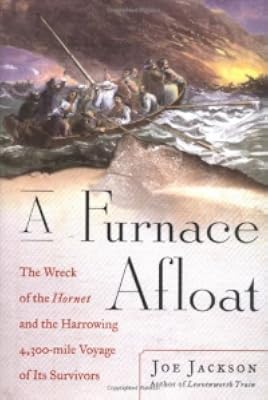
A Furnace Afloat: The Wreck of the Hornet and the Harrowing 4,300-mile Voyage of Its Survivors
by Joe Jackson
On This Page
Description
When an accident with an open oil lantern set the American clipper Hornet alight in 1866, the 31 passengers and crew were forced to abandon ship. share between them. they were to encounter every danger the Pacific could throw at them. sea-water, were driven to the edge of cannibalism. A FURNACE AFLOAT tells the story of their 4000-mile voyage through the eyes of three men, who kept journals throughout their ordeal. transcends its genre: the boatful of castaways becomes a microcosm of 1866 show more America - a diverse mix of immigrants struggling to overcome class divisions, and to recover from the recent Civil War. show lessTags
Recommendations























Member Recommendations

Member Reviews
On May 3, 1866, the American clipper ship Hornet caught fire. The 31 castaways were left with ten days' rations, 12 gallons of potable water and three small boats. 43 days later, having floated 4,300 miles some of them reached Hawaii. The burning itself occurred 1,000 miles due west of the Galapagos Islands. The book is about this trip, what the men went through both psychologically and physically. In addition it documents scientific and historical details of the time. It covers the construction of ships, the shipping industry, the political climate following the Civil War, Victorian mannerisms and what was known about the flora and fauna of the seas at this time. What happened to the survivors afterward? The book follows all of them show more until their deaths.
The author repeatedly increases suspense by first telling us of an imminent disaster and then filling out with historical details of other similar events in history. Only then do we return to what happens on the boats. Storm clouds approach and the text switches to a detailed analysis of storms and winds. The water runs out, and we are given an account of what happens to the body with dehydration. Food is gone and cannibalism threatens, the author explains what had happened in other comparable situations. This book is chock full of history and scientific information, it is not merely an exciting adventure story. It is that too, of course. I found the mix of fact and adventure very well done, but for those of you who just want an exciting adventure story, I would not recommend this book.
The book includes an index, a glossary of nautical terms, notes for every chapter and an extensive bibliography. There is a map of the voyage and photos of the ship, the captain, picture clips that appeared in the Harper's Weekly after the dramatic landing and diary drawings too.
Sam Clemens/Mark Twain was in Hawaii at the time and he began to make his career with his recount of the Hornet's epic story. This too is interesting. What he chose to report is questionable, but read the book to judge for yourself!
Completed May 10, 2013 show less
The author repeatedly increases suspense by first telling us of an imminent disaster and then filling out with historical details of other similar events in history. Only then do we return to what happens on the boats. Storm clouds approach and the text switches to a detailed analysis of storms and winds. The water runs out, and we are given an account of what happens to the body with dehydration. Food is gone and cannibalism threatens, the author explains what had happened in other comparable situations. This book is chock full of history and scientific information, it is not merely an exciting adventure story. It is that too, of course. I found the mix of fact and adventure very well done, but for those of you who just want an exciting adventure story, I would not recommend this book.
The book includes an index, a glossary of nautical terms, notes for every chapter and an extensive bibliography. There is a map of the voyage and photos of the ship, the captain, picture clips that appeared in the Harper's Weekly after the dramatic landing and diary drawings too.
Sam Clemens/Mark Twain was in Hawaii at the time and he began to make his career with his recount of the Hornet's epic story. This too is interesting. What he chose to report is questionable, but read the book to judge for yourself!
Completed May 10, 2013 show less
This is one of the few books that I have read that can stand up to a comparison to Philbrink's "In the Heart of the Sea". It was well written, well researched, & once you start reading you will not want to put it down.
The story is interesting but the author tends to digress into to much related detail.
Ratings
Members
- Recently Added By
Lists

Best Naval History Books
40 works; 12 members

Days of yarrr
13 works; 1 member
Author Information

9 Works 794 Members
Classifications
- Genres
- Nonfiction, History, General Nonfiction, Travel, Biography & Memoir
- DDC/MDS
- 910.9164 — History & geography Geography & travel modified standard subdivisions of Geography and travel Explorers & Travelers Geography of and travel in areas, regions, places in general Air And Water Pacific Ocean
- LCC
- G530 .H82 .J33 — Geography, Anthropology and Recreation Geography (General) Adventures, shipwrecks, buried treasure, etc.
- BISAC
Statistics
- Members
- 79
- Popularity
- 400,376
- Reviews
- 3
- Rating
- (3.83)
- Languages
- Dutch, English
- Media
- Paper
- ISBNs
- 5
- ASINs
- 2