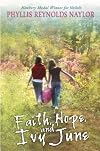
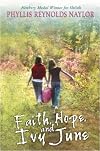
Faith, Hope, and Ivy June
by Phyllis Reynolds Naylor
On This Page
Description
During a student exchange program, seventh-graders Ivy June and Catherine share their lives, homes, and communities, and find that although their lifestyles are total opposites they have a lot in common.Tags
Recommendations

















Member Recommendations
Member Reviews
In this story there are two young girls, one rich and one poor, one with abundance and wealth and another with a family barely making ends meet.
Ivy June is chosen as an exchange student and stays with a wealthy Lexington Kentucky family, in return the wealthy child stays with Ivy June's poor, coal mining family.
In the end they discover the similar bonds that hold them together.
While the plot seems trite, somehow in the hands of this gifted writer, it works.
Ivy June is chosen as an exchange student and stays with a wealthy Lexington Kentucky family, in return the wealthy child stays with Ivy June's poor, coal mining family.
In the end they discover the similar bonds that hold them together.
While the plot seems trite, somehow in the hands of this gifted writer, it works.
Well, Phyllis Reynolds Naylor has done it again. She writes stories that pull you right in and make you feel as if you are one of the characters. One of the first things I liked about this book was the teacher. She had the students brainstorming ideas about the unknown. This is the story of two girls from two totally different backgrounds. They will each spend two weeks in each other’s home. Ivy June comes from the poor, coal mining section of Kentucky while Catherine comes from a wealthier area. The teachers wanted Ivy June and Catherine to write down any preconceived ideas they had about the other person’s lifestyle. There were so many connections to make with this book. My father-in-law grew up in the hills of Tennessee and I had show more spent some time in my childhood living in Lexington, Kentucky. I personally love the mountains. Another connection I made with this book was the ideas they and their friends had about each other. In eighth grade one of my best friends was a girl people talked about because they lived in a very run down house. The love and friendship in her home was not much different than those friends we shared who had lots of money. In the story both girls learn that prejudice can raise it ugly head in all forms. When tough times came they both relied on their friendship to get them through. They both came away learning something about each other’s world and realizing that change can only happen if we open our eyes to the possibilities without judging first. I absolutely loved this book. I cried when each of them faced their own challenge. I laughed when they described taking a bath in the big round tub one after the other. Yes I could relate to a lot of this. It is definitely a book for my shelves. show less
This review is also available on my blog, Read Till Dawn.
Hmm. I'm wondering if part of my apathy toward the book comes from reading it at the wrong time or something. It has all the pieces that I normally love in a story, but this time around it just felt a little tired. Then again, I'm tired, so who knows whether the book is to fault?
The characterization is pretty well done. Ivy June and Catherine are very typical twelve-year-olds, and they are painted with the right mixture of faults and merits to be neither saccarine angels or cliche cheeky devils. The characterization (now that I think about it a little more) might err slightly on the side of the generic, but it serves its purpose and is done very well.
The depiction of city life show more seemed really straight-on to me, warts and all. The attitude the "city folk" have toward their destitute neighbors is a very realistic cocktail of curiosity, snobbishness, pity, and (in some people) spite. I enjoyed watching Ivy June interact with the city for the first time, seeing my culture through the eyes of a newbie.
As for Ivy June's culture . . . I don't know. I was definitely stressing right alongside her when things got scary in the second half of the book, but when it comes to the town as a whole I had a hard time connecting. Do people really live like that, in America, in the 21st century? Are outhouses really still a thing out in rural areas? I have a hard time suspending my inside realist and accepting the fact that Ivy June lives such a ninteenth-century life. I couuld be completely wrong, though - I don't really know much about rural Kentuky. If anyone knows, I would love to learn whether this aspect of the story was realistic or not.
At the end of the day, I liked Faith, Hope, and Ivy June, but I wasn't swept away. I almost wanted more. The similarities and contrasts between Ivy June and Catherine was interesting, especially once things started going wrong in the second half of the book, but when I put the book down I felt almost apathetic toward it. Somehow I didn't really connect at all with the characters - I felt like I'd seen everything before. Perhaps you might be able to get more out of it than I did; I think it is a good book, it just didn't really do for me. show less
Hmm. I'm wondering if part of my apathy toward the book comes from reading it at the wrong time or something. It has all the pieces that I normally love in a story, but this time around it just felt a little tired. Then again, I'm tired, so who knows whether the book is to fault?
The characterization is pretty well done. Ivy June and Catherine are very typical twelve-year-olds, and they are painted with the right mixture of faults and merits to be neither saccarine angels or cliche cheeky devils. The characterization (now that I think about it a little more) might err slightly on the side of the generic, but it serves its purpose and is done very well.
The depiction of city life show more seemed really straight-on to me, warts and all. The attitude the "city folk" have toward their destitute neighbors is a very realistic cocktail of curiosity, snobbishness, pity, and (in some people) spite. I enjoyed watching Ivy June interact with the city for the first time, seeing my culture through the eyes of a newbie.
As for Ivy June's culture . . . I don't know. I was definitely stressing right alongside her when things got scary in the second half of the book, but when it comes to the town as a whole I had a hard time connecting. Do people really live like that, in America, in the 21st century? Are outhouses really still a thing out in rural areas? I have a hard time suspending my inside realist and accepting the fact that Ivy June lives such a ninteenth-century life. I couuld be completely wrong, though - I don't really know much about rural Kentuky. If anyone knows, I would love to learn whether this aspect of the story was realistic or not.
At the end of the day, I liked Faith, Hope, and Ivy June, but I wasn't swept away. I almost wanted more. The similarities and contrasts between Ivy June and Catherine was interesting, especially once things started going wrong in the second half of the book, but when I put the book down I felt almost apathetic toward it. Somehow I didn't really connect at all with the characters - I felt like I'd seen everything before. Perhaps you might be able to get more out of it than I did; I think it is a good book, it just didn't really do for me. show less
This could have been a great story, but it was so out of touch with kids today. I seriously thought it was set in the 50's or 60's until about a quarter of the way through when it mentioned cell phones. Though it is supposed to be set in extremely remote small towns in the midwest, I still don't think teenagers say things like "that's swell" or "she's a cut up". Unfortunately this just annoyed me so much I couldn't fully appreciate the story.
I loved this book. The author really made you feel what life in the hills of Kentucky would be like. I cried with Ivy June when the men were trapped in the mine. A great lesson on friendships between people from different backgrounds. I'm not sure in real life a situation such as in this book would really work out, but I like to think that it would. The feelings of Ivy June and her new friend Catherine are very authentic.
This could have been a great story, but it was so out of touch with kids today. I seriously thought it was set in the 50's or 60's until about a quarter of the way through when it mentioned cell phones. Though it is supposed to be set in extremely remote small towns in the midwest, I still don't think teenagers say things like "that's swell" or "she's a cut up". Unfortunately this just annoyed me so much I couldn't fully appreciate the story.
Two seventh grade girls participate in a school exchange program where each spends 2 weeks at the others's home and school. The program is intended to confront stereotypes as well as let the girls see the similarities and differences between them.
Ivy June Mosley comes from small town, country Thunder Creek where she lives with her grandparents because her parents's home is too crowded. Catherine Combs lives in big city Lexington in a large house with plenty of space.
Both girls are mature enough to be good ambassadors for their schools and to work through the differences that come up as they spend time together. In the end though, they both end up being there for the other when tragedies hit the other's family.
Ivy June Mosley comes from small town, country Thunder Creek where she lives with her grandparents because her parents's home is too crowded. Catherine Combs lives in big city Lexington in a large house with plenty of space.
Both girls are mature enough to be good ambassadors for their schools and to work through the differences that come up as they spend time together. In the end though, they both end up being there for the other when tragedies hit the other's family.
Members
- Recently Added By
Author Information

185+ Works 36,860 Members
Phyllis Reynolds Naylor was born in Anderson, Indiana on January 4, 1933. She received a bachelor's degree from American University in 1963. Her first children's book, The Galloping Goat and Other Stories, was published in 1965. She has written more than 135 children and young adult books including Witch's Sister, The Witch Returns, The Bodies in show more the Bessledorf Hotel, A String of Chances, The Keeper, Walker's Crossing, Bernie Magruder and the Bats in the Belfry, Please Do Feed the Bears, and The Agony of Alice, which was the first book in the Alice series. She has received several awards including the Edgar Allan Poe Award for Night Cry and the Newberry Award for Shiloh. (Bowker Author Biography) show less
Awards and Honors
Awards
Notable Lists
Common Knowledge
- Canonical title
- Faith, Hope, and Ivy June
- Original title
- Faith, Hope, and Ivy June
- Original publication date
- 2009
- People/Characters
- Ivy June Mosely; Iree Mosely; Spencer Mosely "Pappaw"; Mrs. Mosely "Mammaw"; Russell Mosely; Ruth Mosely (show all 22); Howard Mosely; Ezra Mosely; Danny Mosely; Jessie Mosely; Earl; Shirl; Fred Mason; Luke Weller; Jeff Harris; George Wilson; Catherine "Cat" Combs; Mr. Combs; Mrs. Combs; Peter Combs; Claire Combs; Rosemary Combs
- Important places
- Lexington, Kentucky, USA; Thunder Creek, Kentucky, USA
- Dedication
- To the other members of our critique group--Betsy Kraft, Laura Melmed, Peggy Thomson--a thousand thanks for their insight, their patience, and their own marvelous books.
- First words
- March 6 - They'll probably be polite - crisp as a soda cracker on the outside, hard as day-old biscuit underneath. Papaw says not to prejudice my heart before I've got there. But Miss Dixon says to write down what we think ... (show all)so we can compare it with what we feel after.
- Last words
- (Click to show. Warning: May contain spoilers.)It could happen. Ivy June Mosely
- Original language
- English US
Classifications
- Genres
- Kids, Tween, Fiction and Literature, Children's Books
- DDC/MDS
- 813.54 — Literature & rhetoric American literature in English American fiction in English 1900-1999 1945-1999
- LCC
- PZ7 .N24 .F — Language and Literature Fiction and juvenile belles lettres Fiction and juvenile belles lettres Juvenile belles lettres
- BISAC
Statistics
- Members
- 851
- Popularity
- 31,948
- Reviews
- 29
- Rating
- (4.01)
- Languages
- English
- Media
- Paper, Audiobook, Ebook
- ISBNs
- 13
- ASINs
- 9