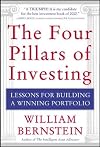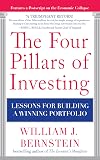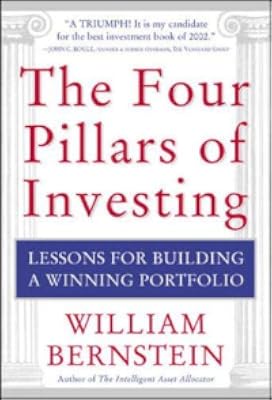
The Four Pillars of Investing: Lessons for Building a Winning Portfolio
by William J. Bernstein
On This Page
Description
The classic guide to constructing a solid portfolio-without a financial advisor! "With relatively little effort, you can design and assemble an investment portfolio that, because of its wide diversification and minimal expenses, will prove superior to the most professionally managed accounts. Great intelligence and good luck are not required." William Bernstein's commonsense approach to portfolio construction has served investors well during the past turbulent decade-and it's what made The show more Four Pillars of Investing an instant classic when it was first published nearly a decade ago. This down-to-earth book lays out in easy-to-understand prose the four essential topics that every investor must master: the relationship of risk and reward, the history of the market, the psychology of the investor and the market, and the folly of taking financial advice from investment salespeople. Bernstein pulls back the curtain to reveal what really goes on in today's financial industry as he outlines a simple program for building wealth while controlling risk. Straightforward in its presentation and generous in its real-life examples, The Four Pillars of Investing presents a no-nonsense discussion of: The art and science of mixing different asset classes into an effective blend The dangers of actively picking stocks, as opposed to investing in the whole market Behavioral finance and how state of mind can adversely affect decision making Reasons the mutual fund and brokerage industries, rather than your partners, are often your most direct competitors Strategies for managing all of your assets-savings, 401(k)s, home equity-as one portfolio Investing is not a destination. It is a journey, and along the way are stockbrokers, journalists, and mutual fund companies whose interests are diametrically opposed to yours. More relevant today than ever, The Four Pillars of Investing shows you how to determine your own financial direction and assemble an investment program with the sole goal of building long-term wealth for you and your family. show lessTags
Recommendations



Member Reviews
This is the first book about money management I've read and it is interesting because of its confirmation of things I thought I knew already. Such as "stock brokers" and investment advisors are crooks (or at least not very honest), and speculation/investment success is statistically proven just pure luck.
The main advise in the book is to go with lowest fee possible for biggest market spread possible (index funds). To expect some very bad years and be happy about them since that allows for higher future returns. To not expect more than the historical returns of investments (since the base value of a company is its earning and every growth beyond that is a temporary bubble that will eventually adjust itself). To divide the savings into show more multiple groups with set relative sizes of the portfolio and use re-balancing techniques to enforce buying of "unpopular" (thus cheap) investments and selling of "popular" (thus overpriced) investments.
At least the first 80% of the book I'd recommend to anyone though it's slightly US-centric so some flexibility will be needed to map to another environment. The last 20% is very US-centric and not very useful for us living elsewhere.
Just some more elaboration on the "stock brokers are crooks part". The main thing to remember is that they need to earn a living and where their main source of income is. Figuring out that and you will realize that their advise is intended to slowly funnel money from you to them until you are out of said money. Even if it's "only" 1-2% per year that will over time be enough to make you poor and them rich, especially as they are unlikely to find a better investment than a low-fee index fund anyway (which they will never recommend since that would mean no money to them). To make things more interesting they have this unhealthy relationship with the economy journalists, many who will only get published if they publish positive recommendations. It's a sick place and the less contact you have with it the better. show less
The main advise in the book is to go with lowest fee possible for biggest market spread possible (index funds). To expect some very bad years and be happy about them since that allows for higher future returns. To not expect more than the historical returns of investments (since the base value of a company is its earning and every growth beyond that is a temporary bubble that will eventually adjust itself). To divide the savings into show more multiple groups with set relative sizes of the portfolio and use re-balancing techniques to enforce buying of "unpopular" (thus cheap) investments and selling of "popular" (thus overpriced) investments.
At least the first 80% of the book I'd recommend to anyone though it's slightly US-centric so some flexibility will be needed to map to another environment. The last 20% is very US-centric and not very useful for us living elsewhere.
Just some more elaboration on the "stock brokers are crooks part". The main thing to remember is that they need to earn a living and where their main source of income is. Figuring out that and you will realize that their advise is intended to slowly funnel money from you to them until you are out of said money. Even if it's "only" 1-2% per year that will over time be enough to make you poor and them rich, especially as they are unlikely to find a better investment than a low-fee index fund anyway (which they will never recommend since that would mean no money to them). To make things more interesting they have this unhealthy relationship with the economy journalists, many who will only get published if they publish positive recommendations. It's a sick place and the less contact you have with it the better. show less
I think of this as the simplified, application oriented version of A Random Walk Down Wall Street. It was decent, but a Random Wall will give you more background and a deeper inside into the suggested strategy.
Provides history, basics, a plan and the psychology of financing. You’ll never hire a broker again.
After reading this book, I assigned it to my middle school math class that I was teaching. Once they were done reading it, they had to manage a Google Stocks portfolio and we monitored their success.
His four pillars are really one: use a mutual fund which indexes the entire market. Walking the dog example for the stock market.
I suck at investments. (and I work for a bank)
I honestly don't feel like I know any more coming out of this book then I did going in. I think I am going to pick up Investing for Dummies I might learn a little more.
I honestly don't feel like I know any more coming out of this book then I did going in. I think I am going to pick up Investing for Dummies I might learn a little more.
Was enjoyable as an audiobook so it gets an extra star for that
Members
- Recently Added By
Author Information

14 Works 2,845 Members
William J. Bernstein is a neurologist, financial theorist, and historian whose books include A Splendid Exchange, Masters of the Word, The Birth of Plenty, and The Four Pillars of Investing. He is the cofounder of the investment management firm Efficient Frontier Advisors and has written for national publications including the Wall Street Journal show more and Money magazine. He was the winner of the 2017 James R. Vertin Award from CFA Institute. He lives in Oregon. show less
Classifications
Statistics
- Members
- 613
- Popularity
- 47,792
- Reviews
- 7
- Rating
- (4.16)
- Languages
- Chinese, English, Spanish, Turkish
- Media
- Paper, Audiobook, Ebook
- ISBNs
- 18
- UPCs
- 1
- ASINs
- 6