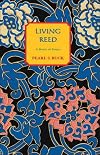
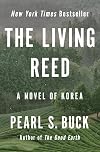
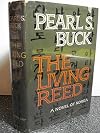
The Living Reed
by Pearl S. Buck
On This Page
Description
The story of a dramatic period in the life of a nation, told through the experiences of one unforgettable family. 'The year was 4214 after Tangun of Korea, and 1881 after Jesus of Judea.' So begins The Living Reed, Pearl S. Buck's epic historical novel about four generations of one aristocratic family in Korea. Through the story of the Kims, Buck traces the country's journey from the late nineteenth century through the end of the Second World War. The chronicle begins as the Kims live show more comfortably as advisors to the Korean royal family. That world is torn apart with the Japanese invasion, when the queen is killed and the Kims are thrust into hiding. Regarded by Buck as 'the best among my Asian books,' The Living Reed is a gripping account of a nation's fight for survival, and a detailed portrait of one family's entanglement in the ebb and flow of history. This ebook features an illustrated biography of Pearl S. Buck including rare images from the author's estate. show lessTags
Recommendations





















Member Reviews
The story follows four generations of one family, the Kims -- beginning with Il-han and his father, both advisors to the royal family. Where his father wants to remain with tradition, adhering to Korea's policy of isolationism, Il-han forsees problems with a battle between China and Japan both wanting Korea as a bridge for commerce and tries to convince the Queen to open relations with the West -- in particular the United states -- in order to learn new ways to protect themselves from invasion.
When Japan does invade and the Queen killed, Il-han takes his family into hiding and tries to find a way to rally his people against the invaders. In the ensuing years, both his children take part in the secret war against the Japanese -- one son show more by becoming a teacher at a Christian school (and ultimately marrying a Christian), the other by becoming a revolutionary known as the Living Reed. The Living Reed becomes the face of hope in the trying times of occupation, especially when all hopes that President Woodrow Wilson will keep America's promise of protection fall on deaf ears.
The Living Reed is a beautifully written epic of Korea and delves into a history that many people outside of Korea (especially myself) don't know or understand. She paints an amazing portrait of the country and its citizens during a terrible time in history, and with her vividly drawn characters, makes us empathize with their struggle for sovereignty. show less
When Japan does invade and the Queen killed, Il-han takes his family into hiding and tries to find a way to rally his people against the invaders. In the ensuing years, both his children take part in the secret war against the Japanese -- one son show more by becoming a teacher at a Christian school (and ultimately marrying a Christian), the other by becoming a revolutionary known as the Living Reed. The Living Reed becomes the face of hope in the trying times of occupation, especially when all hopes that President Woodrow Wilson will keep America's promise of protection fall on deaf ears.
The Living Reed is a beautifully written epic of Korea and delves into a history that many people outside of Korea (especially myself) don't know or understand. She paints an amazing portrait of the country and its citizens during a terrible time in history, and with her vividly drawn characters, makes us empathize with their struggle for sovereignty. show less
A line: "The old beliefs have been taken from us and we have been given nothing in return." It takes time to change hearts, and when people are turned from their beliefs, they often loose sight of their humanity as well. This describes so much of the evil which happened in Asia as they became "modern." The conflicts were inevitable, and yet, oh if things had been different! How much less bloodshed there might have been.
This book describes the history of Korea from about 1880's to the end of WWII. It does so through the eyes of a fictional family, their troubles, joys and hardships. The betrayal of so many nations to this small nation is heartbreaking. The sad part is, I don't think America has learned it's lesson. I never knew what was show more behind the Korean War before. Much more than the spread of Communism. A long history.
This is one of those books you live in while you read it, and it's hard to pull yourself back out. show less
This book describes the history of Korea from about 1880's to the end of WWII. It does so through the eyes of a fictional family, their troubles, joys and hardships. The betrayal of so many nations to this small nation is heartbreaking. The sad part is, I don't think America has learned it's lesson. I never knew what was show more behind the Korean War before. Much more than the spread of Communism. A long history.
This is one of those books you live in while you read it, and it's hard to pull yourself back out. show less
The story takes place over three generations of a Korean family from the mid-late 19th century through the end of WWII. Arguably, the aim of the novel was to tell a story of the transformation of Korea from a more isolationist country through its modernization, colonization by Japan, and eventual geographical and ideological split along the 38th parallel. This historical setting is what attracted me to the novel in the first place.
The book delivers what was promised, but like a lot of sweeping historical fiction, historical nuance is compressed into symbology. As a result, the characters suffer a bit. Il-han and Sunia, of the first generation, are the most solid and fully-dimensional; they are also the only ones around for the entirety show more of the book, so that probably helps.
The sons, Yul-Han and Yul-Chun are less dimensional. Each son is largely emptied of personality and motive and each acts in ways that seem ... maybe tautological is what I'm looking for. Yul-Han seems to symbolize modernity and the Chrisitian-ization of (South) Korea and all of his actions seem directed at this point and characterization. Yul-chun seems to symbolize revolution and the esprit de corps of the emerging Korean nationalism and almost all of his actions and dialogue point back to this symbolic meaning. By the time the story focuses on the younger son, Yul-Chun, the story is almost completely in the realm of symbolism. Yul-Chun even becomes known as and referred to by the symbolic image "The Living Reed."
The story told through the third generation, the grandsons, Liang and Sasha, is similarly symbolic and less narrative-rich. The story captured through the grandsons was also representing a time in Korean history that was close to contemporary with Buck at the time she was writing the novel. So, I suppose Liang and Sasha were more speculative as character types interpreted from the tea leaves of history to that point.
And the wives? Outside of Sunia, who has bit of depth to her, the women are even flatter, which was surprising to me. Perhaps this focus on the men was a reflection of the pressure Buck was under at the time to get this book into print. However, my recollection of Buck, from the only other book of hers that I have read (i.e., The Good Earth) is that she has written strong women characters. I was hoping to see more of that her, but alas no.
Recommended but with reservations. Overall, it is a worthwhile read about global political machinations, misplaced trust, and good intentions and geo-political mismanagement. As a riveting storyline, however ... not so much. show less
The book delivers what was promised, but like a lot of sweeping historical fiction, historical nuance is compressed into symbology. As a result, the characters suffer a bit. Il-han and Sunia, of the first generation, are the most solid and fully-dimensional; they are also the only ones around for the entirety show more of the book, so that probably helps.
The sons, Yul-Han and Yul-Chun are less dimensional. Each son is largely emptied of personality and motive and each acts in ways that seem ... maybe tautological is what I'm looking for. Yul-Han seems to symbolize modernity and the Chrisitian-ization of (South) Korea and all of his actions seem directed at this point and characterization. Yul-chun seems to symbolize revolution and the esprit de corps of the emerging Korean nationalism and almost all of his actions and dialogue point back to this symbolic meaning. By the time the story focuses on the younger son, Yul-Chun, the story is almost completely in the realm of symbolism. Yul-Chun even becomes known as and referred to by the symbolic image "The Living Reed."
The story told through the third generation, the grandsons, Liang and Sasha, is similarly symbolic and less narrative-rich. The story captured through the grandsons was also representing a time in Korean history that was close to contemporary with Buck at the time she was writing the novel. So, I suppose Liang and Sasha were more speculative as character types interpreted from the tea leaves of history to that point.
And the wives? Outside of Sunia, who has bit of depth to her, the women are even flatter, which was surprising to me. Perhaps this focus on the men was a reflection of the pressure Buck was under at the time to get this book into print. However, my recollection of Buck, from the only other book of hers that I have read (i.e., The Good Earth) is that she has written strong women characters. I was hoping to see more of that her, but alas no.
Recommended but with reservations. Overall, it is a worthwhile read about global political machinations, misplaced trust, and good intentions and geo-political mismanagement. As a riveting storyline, however ... not so much. show less
An epic historical fiction that follows Korean modern history through the eyes of one Kim of Andong family. The patriarch is a courtier to Queen Min; his first reckless son becomes the Living Reed, a hero for Korean Independence who travels throughout China and comes to reject Communism; his second son marries a Christian and becomes a local patriot, dying in a church fire with his wife. His son is the final focus of the story, and he is modeled on a couple whom Ms. Buck met while traveling the length of Korea after the war. Buck's skill and talent for portraying the life of real people, and their culture is apparent, though marred somewhat by her didactic approach and insertion of detailed historical information. Her research is show more impressive, and I wondered at her sources, coming as they were during the immediate postwar period of the fifties and sixties. There are moments of descriptive power and literary wisdom, but similar to her more famous novel, Buck tends to overemphasize the obvious, and there are times that this novel's sweeping content overwhelms the story and the connectedness we might otherwise have had with its characters. It felt lengthier than its 478 pages. show less
This beautiful novel is a work of art. You can feel the beauty of the country and the spirit of its people as you read it. It amazes me that Buck was able to immerse herself so thoroughly into so many different cultures.
At the same time, this is a devastating novel. It's no wonder that Korea hates the rest of the world, and if the U.S. treated other countries the way we treated Korea, it's no wonder that the rest of the world hates us.
At the same time, this is a devastating novel. It's no wonder that Korea hates the rest of the world, and if the U.S. treated other countries the way we treated Korea, it's no wonder that the rest of the world hates us.
In the 70's, I read quite a few of Pearl S Buck's novels. From time to time, I still pick them up when I see them in a used book store. This one has been living on Planet TBR since 2007.
This is a family epic of Korea. It followed three generations of a family beginning with Il-Han, an advisor and scholar to the queen in the 1880's.
When the queen is assassinated by Japanese forces and Korea occupied by Japan we see the son, a resistance leader code named The Living Reed, eventually being overcome and like many young Korean fighters, fleeing to China, where he took part in the communist revolution there. Eventually he returns to Korea, and sees the heartbreak of the country arbitrarily divided by US and Russian administered zones after show more the ending of WW II.
The central character of the book, however, is Korean history. I honestly didn't have much knowledge of this region and learned a lot. Korea has been coveted as a stepping stone by Russia, China and Japan for centuries. During the rise of the Western Powers, many Koreans looked to Woodrow Wilson and the US to help them in their struggle for independence. It was a vain hope; time after time the US let the Korean hopes down.
Still Korea itself resembles the living reed, bamboo, springing up in strange places after appearing dead, bending but not breaking.
It was a slow book to get through, but I thought it was well worth the time. show less
This is a family epic of Korea. It followed three generations of a family beginning with Il-Han, an advisor and scholar to the queen in the 1880's.
When the queen is assassinated by Japanese forces and Korea occupied by Japan we see the son, a resistance leader code named The Living Reed, eventually being overcome and like many young Korean fighters, fleeing to China, where he took part in the communist revolution there. Eventually he returns to Korea, and sees the heartbreak of the country arbitrarily divided by US and Russian administered zones after show more the ending of WW II.
The central character of the book, however, is Korean history. I honestly didn't have much knowledge of this region and learned a lot. Korea has been coveted as a stepping stone by Russia, China and Japan for centuries. During the rise of the Western Powers, many Koreans looked to Woodrow Wilson and the US to help them in their struggle for independence. It was a vain hope; time after time the US let the Korean hopes down.
Still Korea itself resembles the living reed, bamboo, springing up in strange places after appearing dead, bending but not breaking.
It was a slow book to get through, but I thought it was well worth the time. show less
This novel is very hard to rate because it is clearly a product of its time. Written in the 1960s it talks about people and nations in a language that we do not necessarily use nowadays-not racist but incredibly idealistic and somewhat judgemental. At the same time, the author is not afraid to include the historical brutality of the early 20th century.
Her characters are engaging and her language poetic (even in the German translation), easily justifying a 4-Star rating.
Her characters are engaging and her language poetic (even in the German translation), easily justifying a 4-Star rating.
Members
- Recently Added By
Author Information

430+ Works 37,093 Members
Pearl S. Buck, June 26, 1892 - March 6, 1973 Pearl Sydenstricker Buck was an American author, best know for her novels about China. Buck was born on June 26, 1892, in Hillsboro, West Virginia, but as the daughter of Presbyterian missionaries she was taken to China in infancy. She received her early education in Shanghai, but returned to the United show more States to attend college, and graduated from Randolph-Macon Woman's College in Virginia in 1914. Buck became a university teacher there and married John Lossing Buck, an agricultural economist, in 1917. Buck and her husband both taught in China, and she published magazine articles about life there. Her first novel East Wind, West Wind was published in 1930. Buck achieved international success with The Good Earth, which won the Pulitzer Prize in 1932. This story of a Chinese peasant family's struggle for survival was later made into a MGM film. Buck resigned from the Presbyterian Board of Foreign Missions after publishing an article that was critical of missionaries. She returned to the United States because of political unrest in China. Buck's novels during this period include Sons, A House Divided, and The Mother. She also wrote biographies of her father (Fighting Angel) and her mother (The Exile). She won the Nobel Prize for Literature in 1938. During her career, Buck published over 70 books: novels, nonfiction, story collections, children's books, and translations from the Chinese. She also wrote under the pseudonym John Sedges. In the United States, Buck was active in the civil rights and women's rights movements. In 1942 she founded the East and West Association to promote understanding between Asia and the West. In 1949, Buck established Welcome House, the first international interracial adoption agency. In 1964, she established the Pearl S. Buck foundation to sponsor support for Amerasian children who were not considered adoptable. Pearl Buck died in Danbury, Vermont, on March 6, 1973. (Bowker Author Biography) show less
Some Editions
Awards and Honors
Distinctions
Series
Belongs to Publisher Series
Zwarte Beertjes (749)
Work Relationships
Common Knowledge
- Canonical title
- The Living Reed
- Original title
- The Living Reed
- Original publication date
- 1963
- First words
- The year was 4214 after Tangun of Korea and 1881 after Jesus of Judea.
- Last words
- (Click to show. Warning: May contain spoilers.)With such noble impulses and final sacrifice, let the past be forgot, except for what it teaches for the future.
- Original language
- English
Classifications
- Genres
- General Fiction, Fiction and Literature, Historical Fiction
- DDC/MDS
- 813.52 — Literature & rhetoric American literature in English American fiction in English 1900-1999 1900-1945
- LCC
- PS3503 .U198 .L58 — Language and Literature American literature American literature Individual authors 1900-1960
- BISAC
Statistics
- Members
- 661
- Popularity
- 43,349
- Reviews
- 18
- Rating
- (3.78)
- Languages
- 8 — Catalan, Danish, Dutch, English, French, German, Spanish, Swedish
- Media
- Paper, Ebook
- ISBNs
- 14
- ASINs
- 45