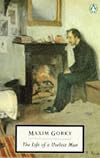
The Life of a Useless Man
by Maxim Gorki
On This Page
Description
This is a story of a young man, Yevsey Kimkov, who became a government spy, when the Russian Empire was on the brink of its first revolution (1905). The novel shows the Yevsey's inner fears and his struggle as he has to betray people.Tags
Recommendations




















Member Reviews
Maxim Gorky was a Russian proponent of the naturalist approach to fiction. He introduced the peasant and workingman as hero and some of his popularity is undoubtedly due to this. Unlike Dostoevsky who saw evil in metaphysical terms, Gorky was an advocate of class conflict as the source of evil. His materialism stemmed from Marxist ideology and would lead him to join with Lenin and the Bolsheviks. This novel was written before that in 1907 and its publication was prohibited by the Czarist regime. Ironically, the Bolsheviks allowed the publication of the novel in 1917 only in an expurgated form. Apparently Gorky's alliance with Lenin did not get him past the censors.
Perhaps young men in Czarist Russia were like those described in this show more novel. From my own reading of Turgenev and Tolstoy, among others, I think that there were others that would have been more representative, but Gorky prefers to focus on mass hysteria and class conflict. The result is an interesting novel, but the history of ideas is badly represented. Read at your own risk. show less
Perhaps young men in Czarist Russia were like those described in this show more novel. From my own reading of Turgenev and Tolstoy, among others, I think that there were others that would have been more representative, but Gorky prefers to focus on mass hysteria and class conflict. The result is an interesting novel, but the history of ideas is badly represented. Read at your own risk. show less
I can see why this book was banned in Russia. Gorky wrote this during the Russian revolution and being a revolutionary himself he was ideal to write of the events from the common people's point of view.
I wonder what Tolstoy had to say about this book. It was definitely a refreshing change from reading Tolstoy.
Recommended
I wonder what Tolstoy had to say about this book. It was definitely a refreshing change from reading Tolstoy.
Recommended
Prachtige woorden en poëzie, waarin de Russische Maksim Gorki (Aleksej Maksimovitsj Pesjkov) schrijft over armoe, en ongeluk en overleven.
Oct 25, 2013Dutch
Ratings
Members
- Recently Added By
Author Information

924+ Works 8,222 Members
Alexei Maximovich Peshkov, better known as Maxim (Maksim) Gorky, was born on March 28th, 1968. Until the recent collapse of the Soviet state, Gorky was officially viewed as the greatest Russian writer of the twentieth century---an evaluation far above the true measure of his nevertheless considerable talent. Proclaimed the founder of socialist show more realism, he significantly influenced many Soviet writers, as well as others in Europe and in the developing world, and his works were for decades part of the Soviet school curriculum. His formal education was minimal. From the age of 11, he fended for himself with a variety of jobs. Self-taught, he published his first story, "Makar Chudra," in 1892. His first collection, Sketches and Stories (1898), is a romantic celebration of society's strong outcasts---the hobos and the drifters---and helped to popularize such literary protagonists. Foma Gordeyev (1899), Gorky's first novel, depicts generational conflict within the Russian bourgeoisie. A popular public figure on the left, Gorky was often in trouble with the tsarist government. During the 1900s, he was the central figure in the Znanie publishing house, which produced realist prose with a social conscience. Some of his own works were extremely successful. The play The Lower Depths (1902), set in a poorhouse and a strong indictment of social injustice, was not only a staple of Soviet theater but also influential in the United States. Eugene O'Neill's The Iceman Cometh was influenced by it. The propagandistic, extraordinarily influential novel Mother (1906) presents an iconic working-class woman who is transformed into a saint of the Revolution; its optimism in the ultimate triumph of the cause made it a prototype of socialist-realist fiction. During the years prior to 1917, Gorky published a number of autobiographical stories: All Over Russia (1912--18) (also Through Russia) and his memoirs; My Childhood (1913--14), My Apprenticeship (1915--16), and My Universities (1923). This trilogy shows his art at its best and includes some very lively reminiscences of such writers as Tolstoy and Chekhov. Although a Bolshevik party member since 1905, Gorky strongly criticized the new regime after the October Revolution: His collected articles from 1917-18, Untimely Thoughts, remained unpublished in the Soviet Union until recently. A cultural activist, he helped to save the lives of many writers, artists, and scholars during the cold and hungry years of the civil war. In 1921 he left Russia for Italy but returned permanently a decade later, recognized as the grand old man of Soviet literature. He then worked for Stalin's economic policies and presided over the institutionalization of socialist realism. At his death, he left unfinished a major novel of considerable interest, The Life of Klim Samgin, which he had been working on since 1925. (Bowker Author Biography) show less
Some Editions
Series
Belongs to Publisher Series
Common Knowledge
- Canonical title*
- Het leven van een nutteloos mens
- Original title
- Ziznj nenuznovo celovek
- Alternate titles*
- De politie-spion : roman uit Rusland
- Original publication date
- 1907 (Russisch) (Russisch); 1930 (Nederlands) (Nederlands)
- People/Characters*
- Jevsej Klimkov; Raisa Pjetrovna
- First words*
- Toen Jevsej Klimkov vier jaar was werd zijn vader door een boswachter doodgeschoten, en toen hij zeven jaar was geworden stierf zijn moeder.
- Last words*
- (Click to show. Warning: May contain spoilers.)Iets hards en breeds stootte hem in zijn rug, hij viel op de dwarsliggers tussen de rode snaren van de rails en het ruwe geraas van ijzer smoorde zijn zwakke gejank...
- Original language*
- Russisch
*Some information comes from Common Knowledge in other languages. Click "Edit" for more information.
Classifications
- Genres
- General Fiction, Fiction and Literature
- DDC/MDS
- 891.7 — Literature & rhetoric Asian Literature East Indo-European and Celtic literatures Russian and East Slavic languages
- LCC
- PZ3 .G678 — Language and Literature Fiction and juvenile belles lettres Fiction and juvenile belles lettres Fiction in English
- BISAC
Statistics
- Members
- 224
- Popularity
- 144,980
- Reviews
- 3
- Rating
- (3.64)
- Languages
- 9 — Dutch, English, Finnish, French, Greek, Italian, Norwegian (Bokmål), Russian, Spanish
- Media
- Paper, Ebook
- ISBNs
- 22
- ASINs
- 14