The Fatal Eggs
by Mikhail Bulgakov
On This Page
Description
This new translation of a key work by one of the greatest Russian satirists is particularly topical to the current debates on genetic modification. An inspired work of science fiction and a biting political allegory, Bulgakov's The Fatal Eggs tells of a brilliant scientist whose experiments with life spiral terribly - and fatefully - out of control. Quite by chance, Professor Persikov discovers a new form of light ray whose effect, when directed at living cells, is to accelerate growth in show more primitive organisms. But when this ray is shone on the wrong batch of eggs, the Professor finds himself both the unwilling creator of giant hybrids, and the focus of a merciless press campaign. For it seems the propaganda machine has turned its gaze on him, distorting his nature in the very way his 'innocent' tampering created the monster snakes and crocodiles that now terrorise the neighbourhood. show lessTags
Recommendations










Member Recommendations
M_Clark The story in Heart of a Dog is much better than the story of The Fatal Eggs.
Member Reviews
Only Bulgakov can get from satire of Soviet bureaucracy to GIANT MONSTERS EATING THE COUNTRYSIDE in a short story and have it make perfect sense. Please, nobody tell the SyFy network about this or they'll buy the film rights in 10 seconds.
I found [b:The Fatal Eggs|47323|The Fatal Eggs|Mikhail Bulgakov|https://i.gr-assets.com/images/S/compressed.photo.goodreads.com/books/1328848460l/47323._SY75_.jpg|46365] in a local library's delightful 'Bestsellers of 1924!' display. Bulgakov first published this darkly funny little sci-fi fable in 1924, although it's set in the near-future of 1928. The plot is straightforward: an irascible scientist named Persikov (who I imagined resembling Professor Calculus in the Tintin series) make an incredible discovery. His strange new kind of ray makes living organisms grow super-rapidly, soon filling his lab with huge frogs. Inevitably word of this spreads, with chaotic and ultimately disastrous results. As the USSR is suffering from a chicken show more shortage, the authorities appropriate Persikov's equipment and set it up to irradiate a lot of imported eggs. Due to an unfortunate mix-up, the eggs are actually from snakes and when the giant serpents hatch they immediately start eating people. Although this isn't directly Persikov's fault, he is murdered by an angry mob over it.
Prior to encountering it in the library I hadn't heard of [b:The Fatal Eggs|47323|The Fatal Eggs|Mikhail Bulgakov|https://i.gr-assets.com/images/S/compressed.photo.goodreads.com/books/1328848460l/47323._SY75_.jpg|46365], but it immediately reminded me of a novel published 8 years later: Karel Čapek's [b:War with the Newts|816440|War with the Newts|Karel Čapek|https://i.gr-assets.com/images/S/compressed.photo.goodreads.com/books/1328766079l/816440._SY75_.jpg|1469484]. Both warn about the dangers of bureaucracies exploiting scientific discoveries, using very effective bleak comedy. [b:The Fatal Eggs|47323|The Fatal Eggs|Mikhail Bulgakov|https://i.gr-assets.com/images/S/compressed.photo.goodreads.com/books/1328848460l/47323._SY75_.jpg|46365] even seems to prefigure creature feature b-movies. I wonder if it has ever been adapted in such a way? It's a sharp and fun novella.
I also enjoyed the short biography of Bulgakov included at the end, as he's a fascinating figure in Soviet literature. I hadn't realised that he wrote so many plays, most of which were never staged. Stalin liked and supported his work, yet Bulgakov was so stifled by Soviet censorship that he repeatedly asked to be allowed to emigrate. These requests were refused and he died in 1940 without ever having left the USSR. His masterpiece, [b:The Master and Margarita|117833|The Master and Margarita|Mikhail Bulgakov|https://i.gr-assets.com/images/S/compressed.photo.goodreads.com/books/1327867963l/117833._SY75_.jpg|876183], was only published in full more than thirty years after his death. show less
Prior to encountering it in the library I hadn't heard of [b:The Fatal Eggs|47323|The Fatal Eggs|Mikhail Bulgakov|https://i.gr-assets.com/images/S/compressed.photo.goodreads.com/books/1328848460l/47323._SY75_.jpg|46365], but it immediately reminded me of a novel published 8 years later: Karel Čapek's [b:War with the Newts|816440|War with the Newts|Karel Čapek|https://i.gr-assets.com/images/S/compressed.photo.goodreads.com/books/1328766079l/816440._SY75_.jpg|1469484]. Both warn about the dangers of bureaucracies exploiting scientific discoveries, using very effective bleak comedy. [b:The Fatal Eggs|47323|The Fatal Eggs|Mikhail Bulgakov|https://i.gr-assets.com/images/S/compressed.photo.goodreads.com/books/1328848460l/47323._SY75_.jpg|46365] even seems to prefigure creature feature b-movies. I wonder if it has ever been adapted in such a way? It's a sharp and fun novella.
I also enjoyed the short biography of Bulgakov included at the end, as he's a fascinating figure in Soviet literature. I hadn't realised that he wrote so many plays, most of which were never staged. Stalin liked and supported his work, yet Bulgakov was so stifled by Soviet censorship that he repeatedly asked to be allowed to emigrate. These requests were refused and he died in 1940 without ever having left the USSR. His masterpiece, [b:The Master and Margarita|117833|The Master and Margarita|Mikhail Bulgakov|https://i.gr-assets.com/images/S/compressed.photo.goodreads.com/books/1327867963l/117833._SY75_.jpg|876183], was only published in full more than thirty years after his death. show less
Overjoyed to find this book at Eighth Day Books on my bookstore tour of Wichita when I was home for Christmas. I thought I'd put every Bulgakov book on my to-read list, but I'd never heard of this one. It felt very apt to have found it at Eight Day.
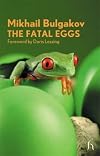
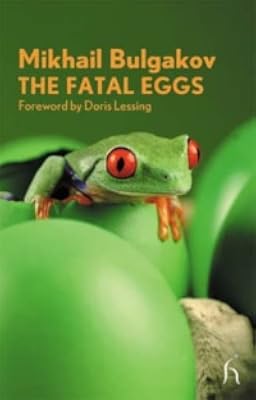
This book is perfection and I could not have not bought it. I mean, it's a novella, it's Bulgakov, it is a lovely edition with French flaps and a beautiful frog on the cover. And it's science fiction - that particular mad scientist type of science fiction like the terribly delightful A Dog's Heart.
This book, of course, can be read as a critique of the perils of Soviet communism, but I think it is all to easy to imagine the central tragedy unfolding under any government with a lack of respect show more for science. Of course, the tragedy seems inevitable under Soviet communism.
A scientist discovers a ray. Not a death ray this time, no! But a ray of life! A ray that speeds the replication and growth of life. When a sudden plague kills off every chicken in the Republic, do they ask the scientist (Persikov) to study how to use the ray to restore the chicken population? Of course not! Instead, a party bureaucrat (Faight) writes a proposal to seize the ray and save the country, and the party leadership green-lights it. Faight, of course, has no scientific or animal husbandry experiment, only party loyalty and a good reputation from the war. What could possibly go wrong?
Everything, of course. And it does so in spectacularly gory B-movie fashion. Even as horrifying as it is, somehow, it's still so fun. A wonderful discovery. show less
This book is perfection and I could not have not bought it. I mean, it's a novella, it's Bulgakov, it is a lovely edition with French flaps and a beautiful frog on the cover. And it's science fiction - that particular mad scientist type of science fiction like the terribly delightful A Dog's Heart.
This book, of course, can be read as a critique of the perils of Soviet communism, but I think it is all to easy to imagine the central tragedy unfolding under any government with a lack of respect show more for science. Of course, the tragedy seems inevitable under Soviet communism.
A scientist discovers a ray. Not a death ray this time, no! But a ray of life! A ray that speeds the replication and growth of life. When a sudden plague kills off every chicken in the Republic, do they ask the scientist (Persikov) to study how to use the ray to restore the chicken population? Of course not! Instead, a party bureaucrat (Faight) writes a proposal to seize the ray and save the country, and the party leadership green-lights it. Faight, of course, has no scientific or animal husbandry experiment, only party loyalty and a good reputation from the war. What could possibly go wrong?
Everything, of course. And it does so in spectacularly gory B-movie fashion. Even as horrifying as it is, somehow, it's still so fun. A wonderful discovery. show less
“I wonder if that great writer of realistic fiction would have used allegory and disguise at all, had it not been for the censorship?“ – These words were found in the Foreword to describe writers such as Mikhail Bulgakov whose creativity blossomed under political restrictions. We, the readers, are treated to clever gems, big and small, such as this short story.
In “The Fatal Eggs”, the eccentric zoologist, Professor Vladimir Ipatyevich Persikov (name played off Lenin) discovers the red Ray of Life. Meanwhile, an unknown disease has decimated the chicken population in the entire country, the “Fowl Plague” (much more creative than the Avian Flu I might add). The little-tested Ray of Life is confiscated by the government to show more accelerate the re-population of the chicken industry. Due to a mix-up, catastrophe befalls the whole of Moscow and neighboring countryside.
It’s pretty easy to dismiss “The Fatal Eggs”. It’s a straight forward mini-not-quite-horror that one might say ripped off “War of the Worlds” (Bulgakov is a fan of H.G. Wells). But it’s so funny(!), even when the horror starts. And like a good Bulgakov read, clues of the Stalin regime sneak into the pages – the Moscow housing shortage in the 1920’s, the fear of Western criticism, saving face tactics, the mockery of “comrade”, etc. With nuggets such as “Plenipotentiary Head of Trade Departments of Foreign Representative Bodies in the Soviet Republic”, it’s hard to not smile.
Despite the humor, Bulgakov keeps it real, and the ending made me sad. After Bulgakov presented this story at a literary event in 1924, he wrote in this diary: “Is it a satire? Or a provocative gesture? ... I'm afraid that I might be hauled off ... for all these heroic feats.” I’m glad he wasn’t; his masterpiece is yet to come.
One Quote:
On the portrait of an intimidating genius:
“Judging by his eyes, he was struck first of all by the cabinet with twelve shelves which extended to the ceiling and was jam-packed with books. Then, of course, by the chambers, in which as in Hell, there glimmered the crimson ray, swollen in the lenses. And in the semi-darkness, in the revolving chair, by the sharp needle of the ray that thrust out from the reflector, Persikov himself was odd and majestic enough.” show less
In “The Fatal Eggs”, the eccentric zoologist, Professor Vladimir Ipatyevich Persikov (name played off Lenin) discovers the red Ray of Life. Meanwhile, an unknown disease has decimated the chicken population in the entire country, the “Fowl Plague” (much more creative than the Avian Flu I might add). The little-tested Ray of Life is confiscated by the government to show more accelerate the re-population of the chicken industry. Due to a mix-up, catastrophe befalls the whole of Moscow and neighboring countryside.
It’s pretty easy to dismiss “The Fatal Eggs”. It’s a straight forward mini-not-quite-horror that one might say ripped off “War of the Worlds” (Bulgakov is a fan of H.G. Wells). But it’s so funny(!), even when the horror starts. And like a good Bulgakov read, clues of the Stalin regime sneak into the pages – the Moscow housing shortage in the 1920’s, the fear of Western criticism, saving face tactics, the mockery of “comrade”, etc. With nuggets such as “Plenipotentiary Head of Trade Departments of Foreign Representative Bodies in the Soviet Republic”, it’s hard to not smile.
Despite the humor, Bulgakov keeps it real, and the ending made me sad. After Bulgakov presented this story at a literary event in 1924, he wrote in this diary: “Is it a satire? Or a provocative gesture? ... I'm afraid that I might be hauled off ... for all these heroic feats.” I’m glad he wasn’t; his masterpiece is yet to come.
One Quote:
On the portrait of an intimidating genius:
“Judging by his eyes, he was struck first of all by the cabinet with twelve shelves which extended to the ceiling and was jam-packed with books. Then, of course, by the chambers, in which as in Hell, there glimmered the crimson ray, swollen in the lenses. And in the semi-darkness, in the revolving chair, by the sharp needle of the ray that thrust out from the reflector, Persikov himself was odd and majestic enough.” show less
Back in 2006, we read The Master and Margarita by Bulgakov in our book group and I loved it. This novel about the devil coming to a town of non-believers in 1930s Russia and spreading mischief paralleled against the a writer in mental hospital who has written a Pilate’s eye view of Jesus is a delicious satire on Stalinism and the repression of religion and art. It wasn’t an easy book to get into – I’d previously tried to read it and failed, but this time it did click with me and I loved it. The Master and Margarita, not published in his lifetime, is arguably Bulgakov’s masterpiece, but when I came across a new translation by Roger Cockrell of one of his earlier novellas written in the mid-1920s, I had to give that a go. The show more Fatal Eggs was originally published in the West in a collection of novellas called Diaboliad.
Bulgakov was a fan of HG Wells, and this novella owes much to Wells’s The Island of Dr Moreau amongst others, which involved a mad scientist doing experiments on animals.
Set in 1928 – just into the future at the time of writing, Bulgakov’s Professor Persikov is a classic mad scientist. The ageing academic is consumed by his passion for zoology, and amphibians in particular. He is a difficult man, and makes the lives of those around him hell, including his assistant Pankrat, and all the students he teaches in Moscow whom he persistently fails in their exams. One day he makes an accidental discovery after having left a microscope on; when he returns the combination of light and lenses has created a red ray which focused on the amoeba under the scope has accelerated their growth immensely. He builds a larger apparatus, and tries it out with similar success on his beloved frogs.
At the same time as Persikov’s discovery, and unbeknown to him, a fatal disease is rampaging its way through Russia’s poutry stock, and all chickens have had to be destroyed. Persikov’s invention by this time has come to the attention of journalists and the secret police – who step in to confiscate his large machines, planning to use them to speedgrow new chickens – but there’s a mix-up with the eggs, and as you might guess, things are going to go badly wrong!
Mad professors, bungling secret agents and mob rule make a heady mix for some broad comedy and swipes at all things red and Russian – nothing escapes his satiric pen, although I’m no expert in the October revolution and what came after it. The ending of this novella is somewhat weak, using a conveniently Wellsian construct that I won’t divulge to save spoiling the plot for anyone else that wants to read it – however, getting there is rather fun, and I’m keen to read more of his other works.
The extra material was also very well worth reading (Oneworld edition 2011). In the introduction we meet Bulgakov, and find out about his influences and some of the references in this novella. After the story, we get the translators notes which include explanations of the puns in the text, and lastly a thirty page biography and survey of Bulgakov’s work. Bulgakov died young at 48 in 1940, and it was thanks to his third wife’s efforts after his death that we got to read his works in the West, although it took until the early 1970s for the first uncensored translations to appear. show less
Bulgakov was a fan of HG Wells, and this novella owes much to Wells’s The Island of Dr Moreau amongst others, which involved a mad scientist doing experiments on animals.
Set in 1928 – just into the future at the time of writing, Bulgakov’s Professor Persikov is a classic mad scientist. The ageing academic is consumed by his passion for zoology, and amphibians in particular. He is a difficult man, and makes the lives of those around him hell, including his assistant Pankrat, and all the students he teaches in Moscow whom he persistently fails in their exams. One day he makes an accidental discovery after having left a microscope on; when he returns the combination of light and lenses has created a red ray which focused on the amoeba under the scope has accelerated their growth immensely. He builds a larger apparatus, and tries it out with similar success on his beloved frogs.
At the same time as Persikov’s discovery, and unbeknown to him, a fatal disease is rampaging its way through Russia’s poutry stock, and all chickens have had to be destroyed. Persikov’s invention by this time has come to the attention of journalists and the secret police – who step in to confiscate his large machines, planning to use them to speedgrow new chickens – but there’s a mix-up with the eggs, and as you might guess, things are going to go badly wrong!
Mad professors, bungling secret agents and mob rule make a heady mix for some broad comedy and swipes at all things red and Russian – nothing escapes his satiric pen, although I’m no expert in the October revolution and what came after it. The ending of this novella is somewhat weak, using a conveniently Wellsian construct that I won’t divulge to save spoiling the plot for anyone else that wants to read it – however, getting there is rather fun, and I’m keen to read more of his other works.
The extra material was also very well worth reading (Oneworld edition 2011). In the introduction we meet Bulgakov, and find out about his influences and some of the references in this novella. After the story, we get the translators notes which include explanations of the puns in the text, and lastly a thirty page biography and survey of Bulgakov’s work. Bulgakov died young at 48 in 1940, and it was thanks to his third wife’s efforts after his death that we got to read his works in the West, although it took until the early 1970s for the first uncensored translations to appear. show less
Admittedly this book was slow to boil (saying something for a barely hundred page novel) but by the end it grabbed me. The translation of this edition was a bit too stylized for my liking, at times too acutely 'British' for my American trained sensibilities. But the story itself was, in the end, great. Science fiction blended with black political satire, how can you go wrong?
Toute réalité comporte, il est vrai, une bonne dose d'irrationnel, à y regarder de plus près ; cependant, tout est une question de degré. Dès l'instant où un certain nombre de critères élémentaires sont remis en question, dès lors que le bon sens et la raison sont mis en hibernation artificielle, l'engrenage diabolique est enclenché. Quand, sur simple décision administrative, on peut payer des travailleurs avec des allumettes qui ne s'allument pas, escamoter sans explication un chef de service chevronné pour le remplacer par un rustre omnipotent, ou passer outre aux mises en garde solennelles d'un savant de renommée mondiale, la déraison est d'ores et déjà installée dans la place. Le destin n'est plus alors qu'un show more petit coup de pouce à donner... .et fouette, cocher ! show less
Members
- Recently Added By
Lists

Best Science Fiction Novels
816 works; 430 members

Russian Literature
184 works; 32 members

Best Science Fiction Originally Published in a Language Other Than English
449 works; 34 members

Best Satire
188 works; 29 members

Books set in Moscow
16 works; 1 member

Speculative Fiction from around the World
610 works; 17 members

Books Read in 2018
4,360 works; 110 members
Author Information

361+ Works 34,996 Members
Mikhail Afanasevich Bulgakov was a Russian playwright, novelist, and short-story writer best known for his use of humor and satire. He was born in Kiev, Ukraine, on May 15, 1891, and graduated from the Medical School of Kiev University in 1916. He served as a field doctor during World War I. Bulgakov's association with the Moscow Art Theater began show more in 1926 with the production of his play The Days of the Turbins, which was based on his novel The White Guard. His work was popular, but since it ridiculed the Soviet establishment, was frequently censored. His satiric novel The Heart of a Dog was not published openly in the U.S.S.R. until 1987. Bulgakov's plays including Pushkin and Moliere dealt with artistic freedom. His last novel, The Master and Margarita, was not published until 1966-67 and in censored form. Bulgakov died in Moscow on March 10, 1940. (Bowker Author Biography) A practicing physician like Anton Chekhov, Mikhail Afanasevich Bulgakov became a popular writer and playwright in the comparatively easier political climate of the Soviet Union during the 1920s. The civil war and its internecine horrors became one of his major themes as did the new Soviet society. His early prose is often satiric, with strong elements of the fantastic and grotesque, but it also contains the themes of guilt and personal responsibility that become so crucial in his later work. Bulgakov wrote a number of important plays that provoked bitter attacks in the press, and he was shut out of the theater and literature in 1929. Only a direct appeal to Stalin allowed Bulgakov to resume a professional career. Even then, however, some publishing houses and theaters rejected some of his important works, such as the novel Life of Monsieur de Moliere (1933). Bulgakov's masterpiece written over a number of years and only published decades after his death is the novel Master and Margarita (1966-67). Combining two principal plot lines-Satan's visit to contemporary Moscow and the trial and execution of Jesus in biblical Judaea-the work may be read on many levels, from the purely satiric to the allegorical. It has been acclaimed as one of the most important achievements of twentieth-century Russian fiction. Today, Bulgakov is celebrated for both his plays and his novels. Several of his plays are public favorites and standard fare in Russian theaters. Bulgakov died in Moscow on March 10, 1940. (Bowker Author Biography) show less
Some Editions
Awards and Honors
Awards
Series
Belongs to Publisher Series
Work Relationships
Is contained in
Verzamelde werken. Dl. II: Diaboliade ; De eieren der Rampp-spoed ; Hondehart ; Het leven van de heer Molière ; Zwarte sneeuw by M.A. Boelgakov
Common Knowledge
- Canonical title
- The Fatal Eggs
- Original title
- Роковые яйца (Rokovije jajca) (Rokovije jajca)
- Alternate titles
- The Red Ray; The Ray of Life
- Original publication date
- 1925
- People/Characters
- Vladimir Ipatyevich Persikov; Pyotr Stepanovich Ivanov
- Important places
- Rusia; Ucrania; Moscow, Russia
- First words
- On the evening of the 16th April 1928, Persikov, Professor of Zoology at the IV State University and Director of the Zoological Institute in Moscow, entered his laboratory, which was located in the Zoological Institute in Her... (show all)zen Street.
- Last words
- (Click to show. Warning: May contain spoilers.)Evidently something special had been required for this, besides knowledge, something which only one man in the world had possessed - the late Professor Vladimir Ipatyevich Persikov.
- Publisher's editor*
- Nevsky
- Original language
- Russian
- Canonical DDC/MDS
- 891.7342
*Some information comes from Common Knowledge in other languages. Click "Edit" for more information.
Classifications
- Genres
- Fiction and Literature, General Fiction, Science Fiction
- DDC/MDS
- 891.7342 — Literature & rhetoric Asian Literature East Indo-European and Celtic literatures Russian and East Slavic languages Russian fiction USSR 1917–1991 Early 20th century 1917–1945
- LCC
- PG3476 .B78 .R5813 — Language and Literature Slavic languages and literatures. Baltic languages. Albanian language Slavic. Baltic. Albanian Russian literature Individual authors and works 1917-1960
- BISAC
Statistics
- Members
- 837
- Popularity
- 32,693
- Reviews
- 15
- Rating
- (3.68)
- Languages
- 18 — Catalan, Dutch, English, Estonian, Finnish, French, German, Greek, Hebrew, Hungarian, Icelandic, Italian, Norwegian (Bokmål), Polish, Russian, Spanish, Swedish, Turkish
- Media
- Paper, Audiobook, Ebook
- ISBNs
- 70
- ASINs
- 16