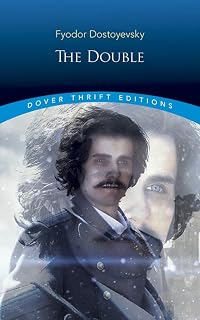
The Double
by Fyodor Dostoyevsky 
On This Page
Description
Simon is a timid man, scratching out an isolated existence in an indifferent world. He is overlooked at work, scorned by his mother, and ignored by the woman of his dreams. He feels powerless to change any of these things. The arrival of a new co-worker, James, serves to upset the balance. James is both Simon's exact physical double and his opposite: confident, charismatic and good with women. To Simon's horror, James slowly starts taking over his life.Tags
Recommendations













Member Recommendations


Member Reviews
Poor Yakov Petrovich Golyadkin. I, too, long had a presentiment of his fate. What a cracking read. Dostoevsky was a master at getting across the feverish hell of madness. I couldn't not read, even though the events that befall Mr Golyadkin at the hands of his double made me uncomfortable in a similar way to Curb Your Enthusiasm. Horrific, exasperating and sad, all at the same time.
When I was seven or eight I remember watching The Parent Trap starring a then young and unproblematic Lindsay Lohan. The prospect of having an identical twin with whom I could go on frivolous escapades with and take on bullies alongside filled my childhood fantasies. And so it was with some horror that I read this fantastic tale.
From the beginning of the story a sense of tension and suspense permeates the story. Mr. Golyadkin, described as the hero of the tale, is a snobbish clumsy but sensitive titular councillor seeks assistance for an ailment that his doctor seems not to understand. Golyadkin's thoughts are muddled, he is riddled with a suspicion for everyone and he finds himself embarrassing himself in social gatherings and shunned show more by society and colleagues.
In his distress, a duplicate of Golyadkin is produced, whom the writer calls Golyadkin Junior. The doppelganger is superior to the original in nearly all aspects. Where the senior irritates, the junior placates. Where the senior is clumsy and slow, the junior is calculating and efficient. Soon Mr. Golyadkin who at first had taken his new twin under his wing warmly, discovers that Golyadkin Junior is on a smearing campaign against his honour, setting him up against his colleagues, benefactors, superiors, acquaintances and his own servant. What follows is an epic tale with quite a twist at the end.
There are several interpretations one could draw from this tale, a self-destructive nature, multiple personality disorder etcetera. I wish I was more equipped with psychological knowledge to be able to delve into that but if anything this book as every Dostoevsky book I have read so far left me in awe of his great mind. I think the most brilliant and disturbing part of his work is that the stranger and more dreadful it gets, the more familiar it seems. show less
From the beginning of the story a sense of tension and suspense permeates the story. Mr. Golyadkin, described as the hero of the tale, is a snobbish clumsy but sensitive titular councillor seeks assistance for an ailment that his doctor seems not to understand. Golyadkin's thoughts are muddled, he is riddled with a suspicion for everyone and he finds himself embarrassing himself in social gatherings and shunned show more by society and colleagues.
In his distress, a duplicate of Golyadkin is produced, whom the writer calls Golyadkin Junior. The doppelganger is superior to the original in nearly all aspects. Where the senior irritates, the junior placates. Where the senior is clumsy and slow, the junior is calculating and efficient. Soon Mr. Golyadkin who at first had taken his new twin under his wing warmly, discovers that Golyadkin Junior is on a smearing campaign against his honour, setting him up against his colleagues, benefactors, superiors, acquaintances and his own servant. What follows is an epic tale with quite a twist at the end.
There are several interpretations one could draw from this tale, a self-destructive nature, multiple personality disorder etcetera. I wish I was more equipped with psychological knowledge to be able to delve into that but if anything this book as every Dostoevsky book I have read so far left me in awe of his great mind. I think the most brilliant and disturbing part of his work is that the stranger and more dreadful it gets, the more familiar it seems. show less
The Double was Dostoevsky’s second book, published in 1846, in the period of his life before being sentenced to hard labor for having been involved in the Petrashevsky circle. He had already been recognized by the important critic Belinsky for his first book, Poor Folk, but was yet to emerge from the ten-year period of penal servitude and exile in Siberia as the man who would crank out the works that he is most known for over the years 1866-1880. Sadly for Dostoevsky, The Double was criticized for being dull and long-winded, which severely hurt the sensitive young author. Happily for us, he took the criticism to heart, and twenty years later, at the height of his powers, significantly revised it. The result is outstanding. The first show more five chapters are stunning, and one wonders wow, where will he go with this? And it’s captivating to the last page.
The Double is about the socially awkward clerk Golyadkin, self-described as “a man apart”, who is surprised on a snowy bridge one night to find his double. This double is a sort of alter ego, and it quickly becomes apparent that he is everything Golyadkin is not. He is perfect in society, acts with grace and elegance, and is the complete opposite of Golyadkin, quickly succeeding in the office and in society where Golyadkin had been frustrated.
Golyadkin becomes confused, disoriented, further isolated, and backed into a corner as his standing is further reduced on all fronts, including with his servant. He reacts alternately with indecision and angst, followed by impulse and somewhat random behavior. We empathize with him but he’s artless and clumsy, constantly second guessing himself, and is never at ease. He continues to fight what seems to be a battle he can’t win, at one point feeling too “annihilated, shrunken, impotent” to go on. He becomes increasingly shunned as he tries to right wrongs that his double is perpetrating.
The book is a study on several levels, and in the most obvious sense shows the struggle between the awkward, isolated individual and society with its schemers. In another sense it could be viewed as all internal, a spiritual struggle with one’s own self to keep hold of one’s principles and core identity intact. The description of events is dreamlike at times and one wonders if it’s possibly a long nightmare, or perhaps better put, allegory for the nightmare of existence, or a descent into madness. It also works straight up as an eerie, creepy tale.
One can clearly see young Dostoevsky in the main character, one who was not like everyone else, those who were smooth, deft, and wore their society masks well. Golyadkin is innocent and wants to trust others, and yet is deceived, scorned, and judged at each turn. The novel is existential and well ahead of its time, prefetching Kafka. Along those lines it was interesting to me that at one point Golyadkin says that next to a tall and handsome fellow at a ball, he feels like a “real little insect”.
Even the narrator feels inadequate (“Oh, if I were a poet! It goes without saying, at least such a one as Homer or Pushkin; with a lesser talent you can’t poke your nose in…”) and is also an outsider, capable of empathy and true understanding of darkness and isolation only (“It goes without saying that my pen is too weak, limp and blunt for a respectable depiction of the ball…”). And one can picture Dostoevsky looking on with a mixture of disgust and envy those who, like the double, fit into the category of being “a mischievous one, a frisky one, a crawly one, a chuckling one, fleet of tongue and foot”, and who “worm their way” through crowds and society.
Great stuff, and underrated. This edition also contained 23 pages of excellent “extra material” at the end, covering Dostoevsky’s life and his works in separate sections, which I never tire of reading.
Just this quote, on winter in St. Petersburg, which is described later as the “final proof of fate’s persecution” against Golyadkin:
“It was an awful November night – wet, misty, rainy, snowy, pregnant with gumboils, head colds, cold sores, sore throats, fevers of all possible types and kinds – in short, with all the gifts of November in St. Petersburg. The wind howled in the deserted streets, raising the black water of the Fontanka higher than the mooring rings and plucking provocatively at the scrawny streetlights of the embankment which, in their turn, echoed its howling with the thin, piercing creaking which composed the endless, squeaking, tinkling concert so familiar to every resident of St. Petersburg. It was raining and snowing all at once. Streams of rainwater with the wind ripping through them were gushing all but horizontally, as if from a fire hose, and pricked and whipped the face of the unfortunate Mr. Golyadkin like thousands of pins and needles.” show less
The Double is about the socially awkward clerk Golyadkin, self-described as “a man apart”, who is surprised on a snowy bridge one night to find his double. This double is a sort of alter ego, and it quickly becomes apparent that he is everything Golyadkin is not. He is perfect in society, acts with grace and elegance, and is the complete opposite of Golyadkin, quickly succeeding in the office and in society where Golyadkin had been frustrated.
Golyadkin becomes confused, disoriented, further isolated, and backed into a corner as his standing is further reduced on all fronts, including with his servant. He reacts alternately with indecision and angst, followed by impulse and somewhat random behavior. We empathize with him but he’s artless and clumsy, constantly second guessing himself, and is never at ease. He continues to fight what seems to be a battle he can’t win, at one point feeling too “annihilated, shrunken, impotent” to go on. He becomes increasingly shunned as he tries to right wrongs that his double is perpetrating.
The book is a study on several levels, and in the most obvious sense shows the struggle between the awkward, isolated individual and society with its schemers. In another sense it could be viewed as all internal, a spiritual struggle with one’s own self to keep hold of one’s principles and core identity intact. The description of events is dreamlike at times and one wonders if it’s possibly a long nightmare, or perhaps better put, allegory for the nightmare of existence, or a descent into madness. It also works straight up as an eerie, creepy tale.
One can clearly see young Dostoevsky in the main character, one who was not like everyone else, those who were smooth, deft, and wore their society masks well. Golyadkin is innocent and wants to trust others, and yet is deceived, scorned, and judged at each turn. The novel is existential and well ahead of its time, prefetching Kafka. Along those lines it was interesting to me that at one point Golyadkin says that next to a tall and handsome fellow at a ball, he feels like a “real little insect”.
Even the narrator feels inadequate (“Oh, if I were a poet! It goes without saying, at least such a one as Homer or Pushkin; with a lesser talent you can’t poke your nose in…”) and is also an outsider, capable of empathy and true understanding of darkness and isolation only (“It goes without saying that my pen is too weak, limp and blunt for a respectable depiction of the ball…”). And one can picture Dostoevsky looking on with a mixture of disgust and envy those who, like the double, fit into the category of being “a mischievous one, a frisky one, a crawly one, a chuckling one, fleet of tongue and foot”, and who “worm their way” through crowds and society.
Great stuff, and underrated. This edition also contained 23 pages of excellent “extra material” at the end, covering Dostoevsky’s life and his works in separate sections, which I never tire of reading.
Just this quote, on winter in St. Petersburg, which is described later as the “final proof of fate’s persecution” against Golyadkin:
“It was an awful November night – wet, misty, rainy, snowy, pregnant with gumboils, head colds, cold sores, sore throats, fevers of all possible types and kinds – in short, with all the gifts of November in St. Petersburg. The wind howled in the deserted streets, raising the black water of the Fontanka higher than the mooring rings and plucking provocatively at the scrawny streetlights of the embankment which, in their turn, echoed its howling with the thin, piercing creaking which composed the endless, squeaking, tinkling concert so familiar to every resident of St. Petersburg. It was raining and snowing all at once. Streams of rainwater with the wind ripping through them were gushing all but horizontally, as if from a fire hose, and pricked and whipped the face of the unfortunate Mr. Golyadkin like thousands of pins and needles.” show less
Not one of my favorite Dostoevsky stories, but interesting nonetheless and of novella length.
It's basically a thriller/horror story of a man (the protagonist) who begins to see his doppelganger, his "double". The double takes over the protagonists job, his friends, his life, until the protagonist descends into madness and is taken away to be institutionalized.
If you've ever feared that society may turn on you in a conspiratorial way, this story is for you. Due to these themes I get Kafka vibes. Themes of pervasive anxiety, a social anxiety. Everyone looking at you, judging you. Conspiratorial discussions, sideways glances. Plotting against you.
The character is somewhat one-dimensional compared to the excellent writing and show more characterization of Dostoevsky's other stories, such as the Brothers Karamazov. It works for this story, and is perhaps done intentionally to gain the effect of contrast against his "double" who acts more confident, jovial, and gets along easily with his peers.
Despite being a horror story it is also somewhat humorous, with the protagonist constantly being referred to as "our hero" despite his pathetic, servile whimpering all the time. Is the narrator being sarcastic? The subjective nature of the narrator makes it feel unreliable, and perhaps a reflection of the protagonist's own inability to see objectively and rationally what is occurring. show less
It's basically a thriller/horror story of a man (the protagonist) who begins to see his doppelganger, his "double". The double takes over the protagonists job, his friends, his life, until the protagonist descends into madness and is taken away to be institutionalized.
If you've ever feared that society may turn on you in a conspiratorial way, this story is for you. Due to these themes I get Kafka vibes. Themes of pervasive anxiety, a social anxiety. Everyone looking at you, judging you. Conspiratorial discussions, sideways glances. Plotting against you.
The character is somewhat one-dimensional compared to the excellent writing and show more characterization of Dostoevsky's other stories, such as the Brothers Karamazov. It works for this story, and is perhaps done intentionally to gain the effect of contrast against his "double" who acts more confident, jovial, and gets along easily with his peers.
Despite being a horror story it is also somewhat humorous, with the protagonist constantly being referred to as "our hero" despite his pathetic, servile whimpering all the time. Is the narrator being sarcastic? The subjective nature of the narrator makes it feel unreliable, and perhaps a reflection of the protagonist's own inability to see objectively and rationally what is occurring. show less
The double by Fyodor Dostoevsky was not an easy book to read. I was "lucky" in the sense that my edition (Great short works of Dostoyevsky) did not have an extensive introduction. However, as a trained philologist, one does not come entirely free from preconceptions to a literary work like this, and these preconceptions do make things easier, at least not while reading.
The story is that of a clerk, whose life is "invaded" by a persona, virtually his double. Especially in the beginning, the introduction of this double is so masterly, that I experienced a loss of orientation, and switch of perspective, which made me uncertain whether I was "seeing" through the eyes of the "original" Golyadkin (later dubbed "senior") or the double (later show more dubbed "junior").
The intrusive Golyadkin junior is perceived by senior as a threat to his position and his existence. Various scenes are played out at the office, in which junior is supposedly trying to replace senior, superseding senior by outstanding performance or making senior look bad in the eyes of his (their) superiors.
Towards the end of this short novel, the reader presented with a logical resolution, namely that Golyadkin has all along been suffering from delusions, and experienced a mental breakdown. The final page superbly reminds us of Philip Roth's Portnoy's complaint.
However, another way of reading is possible. Last year, I read Notes from the underground in which a destitute character refers to himself as an insignificant "insect", a total nobody, as opposed to a "hero". The image of the insect made me think of Kafka's Die Verwandlung. While a mental breakdown, and schizophrenic delusion is the most rational explanation for Golyadkin's behaviour, it would still be possible to interpret his visions subjectively, as an externalised threat. For quite a while, reading The double I felt that Golyadkin senior projected his own image on a new employee, an new clerk at the office, equally insignificant as himself. Many of Golyadkin's fears and frantic behaviour to prove himself worthy, or true, could be explained if he felt threatened in his existence by a newcomer who would try to take his place, or possible even oust him. This type of situation is not uncommon in the work place, and as a phenomenon it may have been novel in the mid-nineteenth century.
A difficult read with a lot to think about, I will probably need to reread it some other time. show less
The story is that of a clerk, whose life is "invaded" by a persona, virtually his double. Especially in the beginning, the introduction of this double is so masterly, that I experienced a loss of orientation, and switch of perspective, which made me uncertain whether I was "seeing" through the eyes of the "original" Golyadkin (later dubbed "senior") or the double (later show more dubbed "junior").
The intrusive Golyadkin junior is perceived by senior as a threat to his position and his existence. Various scenes are played out at the office, in which junior is supposedly trying to replace senior, superseding senior by outstanding performance or making senior look bad in the eyes of his (their) superiors.
Towards the end of this short novel, the reader presented with a logical resolution, namely that Golyadkin has all along been suffering from delusions, and experienced a mental breakdown. The final page superbly reminds us of Philip Roth's Portnoy's complaint.
However, another way of reading is possible. Last year, I read Notes from the underground in which a destitute character refers to himself as an insignificant "insect", a total nobody, as opposed to a "hero". The image of the insect made me think of Kafka's Die Verwandlung. While a mental breakdown, and schizophrenic delusion is the most rational explanation for Golyadkin's behaviour, it would still be possible to interpret his visions subjectively, as an externalised threat. For quite a while, reading The double I felt that Golyadkin senior projected his own image on a new employee, an new clerk at the office, equally insignificant as himself. Many of Golyadkin's fears and frantic behaviour to prove himself worthy, or true, could be explained if he felt threatened in his existence by a newcomer who would try to take his place, or possible even oust him. This type of situation is not uncommon in the work place, and as a phenomenon it may have been novel in the mid-nineteenth century.
A difficult read with a lot to think about, I will probably need to reread it some other time. show less
Not sure what to say about this one. I forced myself to a little over the halfway mark, then stepped away from it for about half a year. After that it was okay. It's hard to tell if I just started to enjoy it more after being more familiar with Dostoevsky when I picked it up again, or if it just got better. Either way, this novella left me feeling like it could have been half its already short length. Wading through Mr. Goliadkin's thought and speech was my greatest difficulty, even in light of trying to evaluate what Dostoevsky was doing with the story. Really, say, that aspect was, if you please, truly nightmarish, sir or madam. It was difficult, but definitely had a cool interplay of ideas. Self, society, perception, guilt, and I'm show more sure many more things–I won't pretend to understand it–are explored through our hero, Mr. Goliadkin, and his friend in The Double. If nothing else its strange composition and plot makes the reader think. show less
An amazing story about obsession and paranoia. It is a psychological miasma that also reflects heavily upon Russia during the time that Dostoevsky lived in. There is so much great literary value in this. It can be interpreted many different ways, and the subtext of many of the themes that keep reiterating themselves, as if cast down by snow, are innumerable.
A thrilling read. Recommended for those interested in classics.
A thrilling read. Recommended for those interested in classics.
Members
- Recently Added By
Lists

Russian Literature
184 works; 32 members

Favourite 19th century fiction
257 works; 60 members

Books set in Saint Petersburg
16 works; 1 member

Books Read in 2022
5,166 works; 114 members

Literature which inspired Pop songs
85 works; 9 members

Bibliografia essenziale
86 works; 2 members

psychological
14 works; 1 member

Books Read in 2024
4,623 works; 126 members

In Our Time books
4,934 works; 2 members

Fyodor Dostoevsky books
17 works; 1 member
Author Information

1,447+ Works 180,161 Members
One of the most powerful and significant authors in all modern fiction, Fyodor Dostoevsky was the son of a harsh and domineering army surgeon who was murdered by his own serfs (slaves), an event that was extremely important in shaping Dostoevsky's view of social and economic issues. He studied to be an engineer and began work as a draftsman. show more However, his first novel, Poor Folk (1846), was so well received that he abandoned engineering for writing. In 1849, Dostoevsky was arrested for being a part of a revolutionary group that owned an illegal printing press. He was sentenced to be executed, but the sentence was changed at the last minute, and he was sent to a prison camp in Siberia instead. By the time he was released in 1854, he had become a devout believer in both Christianity and Russia - although not in its ruler, the Czar. During the 1860's, Dostoevsky's personal life was in constant turmoil as the result of financial problems, a gambling addiction, and the deaths of his wife and brother. His second marriage in 1887 provided him with a stable home life and personal contentment, and during the years that followed he produced his great novels: Crime and Punishment (1886), the story of Rodya Raskolnikov, who kills two old women in the belief that he is beyond the bounds of good and evil; The Idiots (1868), the story of an epileptic who tragically affects the lives of those around him; The Possessed (1872), the story of the effect of revolutionary thought on the members of one Russian community; A Raw Youth (1875), which focuses on the disintegration and decay of family relationships and life; and The Brothers Karamazov (1880), which centers on the murder of Fyodor Karamazov and the effect the murder has on each of his four sons. These works have placed Dostoevsky in the front rank of the world's great novelists. Dostoevsky was an innovator, bringing new depth and meaning to the psychological novel and combining realism and philosophical speculation in his complex studies of the human condition. (Bowker Author Biography) show less
Fyodor Dostoyevsky has a Legacy Library. Legacy libraries are the personal libraries of famous readers, entered by LibraryThing members from the Legacy Libraries group.
Some Editions
Awards and Honors
Awards
Notable Lists
Series
Belongs to Publisher Series
Work Relationships
Common Knowledge
- Canonical title
- The Double
- Original title
- Двойник
- Alternate titles*
- De dubbelganger : een Petersburgs epos : roman
- Original publication date
- 1846
- People/Characters*
- Goljadkien
- Important places
- St. Petersburg, Russia
- First words
- It was a little before eight when Yakov Petrovich Golyadkin, a minor civil servant, came to, yawned, stretched, and finally opened his eyes wide after a long night's rest.
- Original language*
- Russisch
*Some information comes from Common Knowledge in other languages. Click "Edit" for more information.
Classifications
- Genres
- Fiction and Literature, General Fiction
- DDC/MDS
- 891.733 — Literature & rhetoric Literatures of other languages East Indo-European and Celtic literatures Russian and East Slavic languages Russian fiction 1800–1917
- LCC
- PG3326 .D8 — Language and Literature Slavic languages and literatures. Baltic languages. Albanian language Slavic. Baltic. Albanian Russian literature Individual authors and works 1800-1870 Dostoyevsky
- BISAC
Statistics
- Members
- 2,063
- Popularity
- 10,049
- Reviews
- 33
- Rating
- (3.64)
- Languages
- 23 — Arabic, Czech, Danish, Dutch, English, Finnish, French, German, Greek, Hebrew, Hungarian, Icelandic, Italian, Japanese, Norwegian (Bokmål), Polish, Portuguese, Russian, Serbian, Croatian, Spanish, Swedish, Turkish
- Media
- Paper, Audiobook, Ebook
- ISBNs
- 184
- UPCs
- 3
- ASINs
- 67