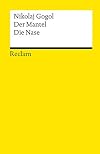
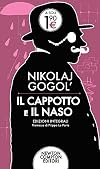
The Overcoat / The Nose
by Nikolai Gogol
On This Page
Description
It is not necessary to say much about this tailor; but, as it is the custom to have the character of each personage in a novel clearly defined, there is no help for it, so here is Petrovitch the tailor. At first he was called only Grigoriy, and was some gentleman's serf; he commenced calling himself Petrovitch from the time when he received his free papers, and further began to drink heavily on all holidays, at first on the great ones, and then on all church festivities without show more discrimination, wherever a cross stood in the calendar. show lessTags
Recommendations


















Member Recommendations

Member Reviews
Some have called The Overcoat the greatest short story ever; certainly it is one of the best from the Russian tradition. It vies in its own way with The Metamorphosis.
These stories are so short that you really need to read them. Gogol is prodigious at the absurd and the everyday; it is not only his wit, but the depth behind his wit, that provokes readers everywhere.
These stories are so short that you really need to read them. Gogol is prodigious at the absurd and the everyday; it is not only his wit, but the depth behind his wit, that provokes readers everywhere.
Nose spites face!
Due racconti russi, bellini, il secondo meglio del primo (forse perchè irrazionale?).
Scritti bene, niente da dire, prolissi quanto basta e con le solite stupende descrizioni di particolari anche minuscoli.
Altro passo (lento e corto) verso i capisaldi russi....
Scritti bene, niente da dire, prolissi quanto basta e con le solite stupende descrizioni di particolari anche minuscoli.
Altro passo (lento e corto) verso i capisaldi russi....
Jan 23, 2021Italian
> Le Manteau a été publié pour la première fois dans les Œuvres complètes de Gogol, en 1843, parmi les nouvelles du recueil intitulé Les Nouvelles de Saint Pétersbourg. Le protagoniste de cette nouvelle est Akaki Akakievitch Bachmatchkine, un petit fonctionnaire très ordinaire, dont la tâche principale consiste à copier des documents officiels. Passionné par son travail, il ne prête aucune attention aux moqueries et vexations de ses camarades. Une catastrophe chamboule un jour sa vie : son manteau est usé jusqu'à la corde. Cet événement transforme l'existence d'Akaki ; il a désormais un but et un rêve dans sa vie : acquérir un nouveau manteau. À travers cette œuvre, Gogol critique durement la société de son show more époque, étouffée par la hiérarchie et obsédée par les biens matériels.
—Pauline Hamon (Culturebox) show less
—Pauline Hamon (Culturebox) show less
Dec 28, 2018 (Edited)French
Nikolai Gogol was born in the Ukraine in 1809. Vladimir Nabokov wrote of his work that "after reading Gogol one's eyes may become gogolized, and one is apt to see bits of his world in the most unexpected places." He died in 1852 after subjecting himself to a severe regime of fasting. "The Overcoat" and "The Nose" are two of Gogol's finest works. "The Nose" is a masterpiece of comic art, and "The Overcoat" is considered one of the greatest short stories ever written.
May 15, 2022Spanish
Indeholder "Næsen", "Kappen".
"Næsen" handler om ???
"Kappen" handler om ???
???
"Næsen" handler om ???
"Kappen" handler om ???
???
Jul 24, 2022Danish
Ratings
Members
- Recently Added By
Author Information

Nikolai Vasilevich Gogol was born in 1809 in the Ukraine. His father was an amateur playwright who had a small estate with a number of serfs. From the ages of 12 to 19, young Gogol attended a boarding school where he became known for his sharp wit and ability to amuse his classmates. After school he worked as a government clerk. He soon began show more writing memories of his childhood. His quaint depictions of the Ukrainian countryside marked his style and helped to make him famous. Gogol quickly gained fame and formed a friendship with the influential poet, Aleksandr Pushkin. Gogol is largely remembered for his realistic characterizations, his rich imagination, and his humorous style. His works include Mirgorod, a collection of short stories including Taras Bulba. Gogol's wit is evident in his short story, The Nose, where a man's nose wanders off around town in a carriage. Gogol's masterpiece is the novel Dead Souls. In this work, a swindler plots to buy from landowners their dead serfs. Towards the end of Gogol's life, his creative powers faded and he fled to Moscow. Here, he came under the power of a fanatical priest. Ten days before his death he burned some manuscripts of the second part of Dead Souls. He died of starvation in 1852, on the cusp of madness. (Bowker Author Biography) show less
Some Editions
Series
Belongs to Publisher Series
Work Relationships
Contains
Common Knowledge
- Canonical title
- The Overcoat / The Nose
- Original publication date
- 1842
- People/Characters
- Akaky Akakievich
Classifications
- Genres
- General Fiction, Fiction and Literature
- DDC/MDS
- 813 — Literature & rhetoric American literature in English American fiction in English
- LCC
- PG3333 .S513 — Language and Literature Slavic languages and literatures. Baltic languages. Albanian language Slavic. Baltic. Albanian Russian literature Individual authors and works 1800-1870 Gogol'
- BISAC
Statistics
- Members
- 426
- Popularity
- 72,115
- Reviews
- 6
- Rating
- (3.67)
- Languages
- 9 — Dutch, English, Finnish, French, German, Italian, Japanese, Russian, Swedish
- Media
- Paper, Ebook
- ISBNs
- 24
- ASINs
- 8