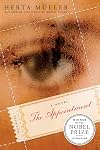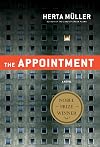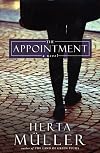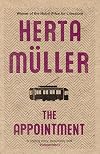
The Appointment
by Herta Müller
On This Page
Description
From the winner of the IMPAC Award and the Nobel Prize, a fierce novel about a young Romanian woman's discovery of betrayal in the most intimate reaches of her life "I've been summoned. Thursday, ten sharp." Thus begins one day in the life of a young clothing-factory worker during Ceaucescu's totalitarian regime. She has been questioned before; this time, she believes, will be worse. Her crime? Sewing notes into the linings of men's suits bound for Italy. "Marry me," the notes say, with her show more name and address. Anything to get out of the country. As she rides the tram to her interrogation, her thoughts stray to her friend Lilli, shot trying to flee to Hungary, to her grandparents, deported after her first husband informed on them, to Major Albu, her interrogator, who begins each session with a wet kiss on her fingers, and to Paul, her lover, her one source of trust, despite his constant drunkenness. In her distraction, she misses her stop to find herself on an unfamiliar street. And what she discovers there makes her fear of the appointment pale by comparison. Herta Müller pitilessly renders the humiliating terrors of a crushing regime. Bone-spare and intense, The Appointment confirms her standing as one of Europe's greatest writers. show lessTags
Recommendations

























Member Reviews
The unnamed narrator of this novel is taking a tram journey from her home to the office where she has been summoned - yet again - to be interviewed about her alleged crimes against the Romanian state. Along the way, she reflects on the other passengers in the tram, on her current and previous husbands, her family and in-laws, her neighbours, and the circumstances that led her to the point of making a small and rather futile gesture against the authority of the régime. Her observation of the small details of everyday life is almost brutally sharp in its focus, as the stream-of-consciousness builds up a composite picture of the way living under a corrupt authoritarian government distorts and coarsens everything in life, down to the most show more trivial level, with madness, alcohol and suicide appearing as the only viable ways out.
It's an interesting contrast with Herztier, the other of her novels that I've read: there the character was a young intellectual who was driven to write, whilst here it's a woman who strongly distrusts the written word (or anything else that leaves a record), but has nonetheless started to note down details of the physical world around her because her faith in reality is so shaken that she no longer trusts that there will be the same number of lampposts along the street from one day to the next. Magnificent, but very painful writing.
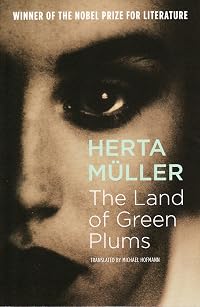
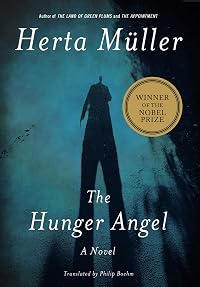
(I wonder why it is that Müller's titles so rarely survive translation to English? The plain ones become extravagant - Herztier -> The land of green plums, Atemschaukel -> The hunger angel - and the extravagant ones plain Heute wär ich mir lieber nicht begegnet -> The Appointment, Der Mensch ist ein großer Fasan auf der Welt -> The Passport) show less
It's an interesting contrast with Herztier, the other of her novels that I've read: there the character was a young intellectual who was driven to write, whilst here it's a woman who strongly distrusts the written word (or anything else that leaves a record), but has nonetheless started to note down details of the physical world around her because her faith in reality is so shaken that she no longer trusts that there will be the same number of lampposts along the street from one day to the next. Magnificent, but very painful writing.
(I wonder why it is that Müller's titles so rarely survive translation to English? The plain ones become extravagant - Herztier -> The land of green plums, Atemschaukel -> The hunger angel - and the extravagant ones plain Heute wär ich mir lieber nicht begegnet -> The Appointment, Der Mensch ist ein großer Fasan auf der Welt -> The Passport) show less
'Strange, lyrical and disturbing'
By sally tarbox on 10 Feb. 2013
Format: Kindle Edition
The unnamed narrator of this work is a young woman working in a clothing factory in Ceaucescu's Romania. From the first sentence we know that she has been 'summoned' for further interrogation on her 'crime' of smuggling out notes in the clothing consignments in the hope of getting an Italian husband and escaping. As she awaits the appointment and then as she makes the tram journey to the place of interrogation, we follow her thoughts and recollections. She thinks of her current partner, Paul; recalls her dead friend Lilli; looks at the world around her:
'The park was a sheer wall of blackish green, the sky clutching at the trees.'
Without Ms Muller show more giving us too much explicit detail about what went on, she manages to create an immensely chilling book. The constantly watching other people, wondering if they are spies... The way that false crimes could be attributed to you by anyone you upset...An entire society, many members of whom are paying lip service to a regime they don't support, through fear and hope of 'moving up the ladder' if they comply:
'First he was a fascist; later he said he'd been in the Communist underground...Anyone poor became a Communist. So did many rich people who didn't want to end up in a camp. Now my father's dead and if there's a heaven up there, you can be sure he's claiming to be a Christian.'
Absolutely rivetting book which I would say needs a second read to help you pick up on all the symbols and motifs that pepper the pages. show less
By sally tarbox on 10 Feb. 2013
Format: Kindle Edition
The unnamed narrator of this work is a young woman working in a clothing factory in Ceaucescu's Romania. From the first sentence we know that she has been 'summoned' for further interrogation on her 'crime' of smuggling out notes in the clothing consignments in the hope of getting an Italian husband and escaping. As she awaits the appointment and then as she makes the tram journey to the place of interrogation, we follow her thoughts and recollections. She thinks of her current partner, Paul; recalls her dead friend Lilli; looks at the world around her:
'The park was a sheer wall of blackish green, the sky clutching at the trees.'
Without Ms Muller show more giving us too much explicit detail about what went on, she manages to create an immensely chilling book. The constantly watching other people, wondering if they are spies... The way that false crimes could be attributed to you by anyone you upset...An entire society, many members of whom are paying lip service to a regime they don't support, through fear and hope of 'moving up the ladder' if they comply:
'First he was a fascist; later he said he'd been in the Communist underground...Anyone poor became a Communist. So did many rich people who didn't want to end up in a camp. Now my father's dead and if there's a heaven up there, you can be sure he's claiming to be a Christian.'
Absolutely rivetting book which I would say needs a second read to help you pick up on all the symbols and motifs that pepper the pages. show less
[The Appointment] was one of the works taken into consideration when [[Herta Muller]] was given the Nobel Prize in 2009. Muller was born in Romania in 1953 and emigrated to Germany in 1987. Her work, including [The Appointment] deals with life in Romania under communist rule.
In many ways this book reminds me of other works of German literature in that there is very little (almost no) plot. The entire story takes place during a 90 minute tram ride the main character takes from her home to her appointment with a secret police officer for interrogation and consists of her mental wanderings through her recent life. The book is difficult to read because the life it described is numbingly difficult and dreary but also because the story moves show more so slowly and doesn't go much of any where. I think, though, that it is one of the book's strengths because it causes the reader to get more of a sense of the emotional state of the characters than a more vivid description would. In the end the main character concludes "The trick is not to go mad" and I could really understand that she would feel that way. show less
In many ways this book reminds me of other works of German literature in that there is very little (almost no) plot. The entire story takes place during a 90 minute tram ride the main character takes from her home to her appointment with a secret police officer for interrogation and consists of her mental wanderings through her recent life. The book is difficult to read because the life it described is numbingly difficult and dreary but also because the story moves show more so slowly and doesn't go much of any where. I think, though, that it is one of the book's strengths because it causes the reader to get more of a sense of the emotional state of the characters than a more vivid description would. In the end the main character concludes "The trick is not to go mad" and I could really understand that she would feel that way. show less
A challenging book about Romania under Ceauşescu where suspicion and secret police are slowly driving most of the citizens mad including the narrator. Had it not been a book club selection, I would not have persevered. I am glad I finished but reluctant to start another by this Nobel-award winning author. Her imagination and prose mirror well the narrator's distraction and fear and resignment. It would be interesting to read in the original German.
Very well-written, very strange and forboding in a Kafkaesque way. She's being interrogated by a powerful person in the government; on her way to her appointment we find out many details of her life, meticulously observed; but we never find out what happens to her, which of course is deliberate. Too unsettling and unresolved for a 5, but a book that will stay with me for a while.
Like all Muller’s books, this is grim but well worth reading. A woman in Ceaucescu's Romania is summoned, not for the first time, to a meeting with a secret policeman. The whole novel takes place in her head as she travels to the appointment on the tram. Her previous husband and family history, her current husband's descent into alcoholism, the death of her friends and the madness of so many people around her are all gradually brought into focus. The great strength of the book is that it makes her appointment seem not to be the worst of life in that place - the society she lives in is so poisoned that almost everybody is suffering just as badly as she is, albeit in different ways. It's not one I rushed to pick up again, but as an show more effective portrait of a time and place, it's hard to beat. I wish my German was up to reading the original. show less
A conversation on Twitter late one night after I had imbibed a portion or two of wine turned to laureates of the Nobel Prize for Literature (writers, not fucking folk singers), and female laureates in particular, and, well, before I knew it, I’d gone and bought a couple books by female Nobel laureates on the web site of a very large online retailer. The first was this, The Appointment by Herta Müller, a German writer who, despite her name is, er, actually Romanian. Her family belonged to the German-speaking minority in Romania, but in 1987 she was given permission to leave and settle in Germany after many years of trying. Her most successful novel to date has been 2009’s The Hunger Angel, and that same year she was awarded the show more Nobel Prize for Literature. Until prompted to look her up by the aforementioned Twitter conversation, I had not even heard of Müller or her fiction. But I bought The Appointment, and read it on a trip to, and from, Leeds one Saturday. The Appointment was published in Germany – she is, despite her origin, probably best considered a German writer – but the novel is set in Romania, as indeed is apparently much of her fiction. The title refers to the meeting the narrator has with Albu, a major in the Romanian secret police. The narrator used to work in a garment factory, whose products were mostly destined for export – and in a shipment of trousers destined for Italy, she hid a series of notes, asking to be rescued, through marriage, by an Italian man. But the notes were found and she was reported to management. Unfortunately, she had a bad relationship with her manager, and when a later series of notes were found, critical of the regime, she was blamed and sacked. And forced to attend interrogation sessions with Major Albu. It’s grim stuff. I’ve visited Romania – it’s a lovely country, full of lovely people – but the Ceaucescu regime was brutal and Müller pulls no punches in depicting how it impacted the lives of ordinary people. I’m in two minds whether to read more Müller – she writes in a style I like, present tense and slightly distant, and while I’m not especially keen on first-person narratives it works extremely well here; but the story is punishingly hard to read. Having said that, writing about the book for this blog post is sort of persuading me to try something else by her… show less
Members
- Recently Added By
Published Reviews
ThingScore 25
The narrator's isolation and the numbing way in which she walks through life while wondering, ''Does any of this really mean anything, or is it just there for you to wonder about,'' mean ''The Appointment'' is more a test of endurance than a pleasure. One could argue that this is precisely the point, given the duress and despair Müller seeks to capture, but duress in and of itself does not show more make a novel. show less
added by jlelliott
Lists

German Literature
518 works; 56 members

Best public-transport fiction
72 works; 17 members

Allie's Wishlist
217 works; 2 members
Author Information

91+ Works 5,152 Members
Born in Romania in 1953, Herta Müller lost her job as a teacher and suffered repeated threats after refusing to cooperate with Ceausescu's Secret Police. She succeeded in emigrating in 1987 and now lives in Berlin. The recipient of the European Literature Prize, she has also won the International IMPAC Dublin Literary Award for her previous show more novel, The Land of Green Plums. Müller was awarded the Nobel Prize in Literature in 2009. (Publisher Provided) Herta Müller was born in Nitzkydorf, Romania on August 17, 1953 to German parents. She studied German studies and Romanian literature at Timisoara University. While there, she became part of the Aktionsgruppe Banat, a group of idealistic Romanian-German writers seeking freedom of expression under the Ceaucescu dictatorship. After graduation, she worked as a translator in a machine factory, but was fired for refusing to cooperate with the secret police. Her first short story collection, Niederungen, was published in 1982 in a censored form. She immigrated to West Germany in 1987. She is a novelist, poet and essayist whose works depict the harsh conditions of life in Communist Romania under the repressive Nicolae Ceausescu regime. Her works include Herztier or The Land of Green Plums; The Appointment; Der Fuchs War Damals Schon der Jäger or The Passport; and Atemschaukel or Everything I Possess I Carry with Me. She has won numerous awards including the Marieluise-Fleißer Prize in 1990, the Kranichsteiner Literary Prize in 1991, the Kleist Prize in 1994, and the 2009 Nobel Prize in Literature. (Bowker Author Biography) show less
Some Editions
Awards and Honors
Notable Lists
Series
Belongs to Publisher Series
Common Knowledge
- Canonical title
- The Appointment
- Original title
- Heute wär ich mir lieber nicht begegnet
- Original publication date
- 2001 (English translation) (English translation); 1997 (original German) (original German)
- People/Characters
- Nicolae Ceausescu; Major Albu; Nelu; Lilli; Paul (her husband)
- Important places
- Romania
- First words
- Ich bin bestellt.
I've been summoned. (English translation) - Quotations
- Riding in a seat is like walking while you're sitting down.
- Last words
- (Click to show. Warning: May contain spoilers.)Ha, ha, nicht irr werden.
(Click to show. Warning: May contain spoilers.)The trick is not to go mad (English translation) - Original language
- German
Classifications
- Genres
- Fiction and Literature, General Fiction
- DDC/MDS
- 833.914 — Literature & rhetoric German & related literatures German fiction 1900- 1900-1990 1945-1990
- LCC
- PT2673 .U29234 .H4813 — Language and Literature German, Dutch and Scandinavian literatures German literature Individual authors or works 1961-2000
- BISAC
Statistics
- Members
- 817
- Popularity
- 33,928
- Reviews
- 29
- Rating
- (3.40)
- Languages
- 13 — Danish, Dutch, English, Finnish, French, German, Italian, Norwegian (Bokmål), Polish, Portuguese, Spanish, Swedish, Turkish
- Media
- Paper, Audiobook, Ebook
- ISBNs
- 38
- ASINs
- 10