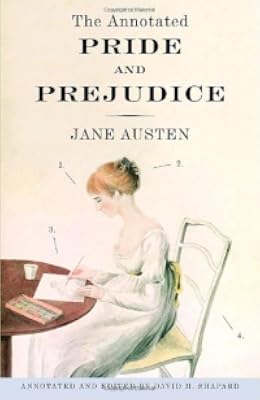
The Annotated Pride and Prejudice
by David M. Shapard (Editor), Jane Austen (Author)
Jane Austen novels annotated by David M. Shapard
On This Page
Description
This first-ever fully annotated edition of one of the most beloved novels in the world is a sheer delight for Jane Austen fans. Here is the complete text of Pride and Prejudice with more than 2,300 annotations on facing pages, including:- Explanations of historical context
- Citations from Austen's life, letters, and other writings
- Definitions and clarifications
- Literary comments and analyses
- Maps and illustrations
- An introduction, a bibliography, and a detailed chronology of events
From the Trade Paperback edition.. show less
Tags
Recommendations



Member Reviews
I get it. I completely get that Austen was a genius. Writing P&P when she was 20 years old; her intuitive, almost unearthly understanding of class and families and relationships; the way her prose was so much more direct and economical than her contemporaries; the humor, the sarcasm (Miss Bingley was snarky nearly 200 years before bloggers existed!)... all of it. I am wholly appreciative of her genius.
Zzzzzzzzzzzzzzzzz. Can't do it. I've tried, more than once, but I just don't care if Mr. Darcy has 10,000 a year.
Zzzzzzzzzzzzzzzzz. Can't do it. I've tried, more than once, but I just don't care if Mr. Darcy has 10,000 a year.
Pride and Prejudice is one of my top five all-time novels. Elizabeth Bennett is in my top three favorite women characters in all of literature. She is also in my top five favorite characters…period!
I can not count the number of times I have read P&P, nor can I count the books and articles I have read about Jane Austen and her work.
Despite the distance, this story is still absorbing, the characters engaging, the dialogue sparkles, and the settings and sounds transport the reader directly to Regency England. My only regret is that it has been a few years since I last read it, and I must keep it “closer to hand,” as Mr. Bennett might say.
The version I read this time is a new one for me. Anchor Books has published an annotated edition show more this year, and it even feels good to the touch. The text is on the left, and extensive, detailed annotations on the right. Even though I knew what most of the notes were going to say, I could not help myself from reading those as well. This relatively short novel has ballooned to well over 600 pages with a great introduction, maps, chronology, and an excellent bibliography. This particular version is a must for any Austen lover.
--Jim, 10/25/2007 show less
I can not count the number of times I have read P&P, nor can I count the books and articles I have read about Jane Austen and her work.
Despite the distance, this story is still absorbing, the characters engaging, the dialogue sparkles, and the settings and sounds transport the reader directly to Regency England. My only regret is that it has been a few years since I last read it, and I must keep it “closer to hand,” as Mr. Bennett might say.
The version I read this time is a new one for me. Anchor Books has published an annotated edition show more this year, and it even feels good to the touch. The text is on the left, and extensive, detailed annotations on the right. Even though I knew what most of the notes were going to say, I could not help myself from reading those as well. This relatively short novel has ballooned to well over 600 pages with a great introduction, maps, chronology, and an excellent bibliography. This particular version is a must for any Austen lover.
--Jim, 10/25/2007 show less
This almost 800 page book includes not only the text and annotations, but also a chronology of the novel, useful maps, and an extensive bibliography of further reading. It is organized with the text of the novel on the left page and the annotations on the right. These annotations include some drawings, word definitions, plot points, and literary interpretations. The word definitons can get tedious--they are intended to point out where a word has changed since the novel was written, but I found many of them to be pretty obvious. Fortunately, I was able to gloss over these without too much interruption. I did enjoy the other annotations very much--it was like reading along with someone who had great insights. They also helped me to study show more Austen's unique style of writing, which is something that has fascinated me since I read Mansfield Park for university.
As for P&P itself, Austen's writing--her beautiful use of language, her wit and biting social commentary, and the structure she gives the novel--is simply splendid. I noticed on this reading (with the aid of the annotations) that there is not one sentence in the novel that doesn't contribute to either a character or to the development of the story as a whole. It is an amazing achievement and it is clear to me why Pride and Prejudice appears on pretty much every list of best novels.
Recommened for: lovers of Jane Austen and this novel, students, writers studying technique. I do not recommend any novel this heavily annotated for a first time reader. It would be far too distracting and destroy the cadence of the book. show less
As for P&P itself, Austen's writing--her beautiful use of language, her wit and biting social commentary, and the structure she gives the novel--is simply splendid. I noticed on this reading (with the aid of the annotations) that there is not one sentence in the novel that doesn't contribute to either a character or to the development of the story as a whole. It is an amazing achievement and it is clear to me why Pride and Prejudice appears on pretty much every list of best novels.
Recommened for: lovers of Jane Austen and this novel, students, writers studying technique. I do not recommend any novel this heavily annotated for a first time reader. It would be far too distracting and destroy the cadence of the book. show less
As far as this reader is concerned, one of the most amazing things about "Pride and Prejudice" is that it becomes a richer experience each time it is read. It was one of my mother's treasured trove of books that she had carried around the world through her and I attempted reading it with some regularity throughout my teen years. It was not until the sixth or seventh attempt that I finished it -- and then, of course, found that I had to read it again and read every other Austen I could get my hands on. Few books have so richly reward repeated readings.
Since I had read P & P at least a dozen times and was quite familiar with other literature of the same period I was not sure how much Shapard's annotations would add to my enjoyment or show more understanding of the story. To my surprise the annotations and commentary added in a profound way to both.
Shapard does four things very well:
1) he clarifies language. Not only are some words current in the English of Austen's time no longer common use there are many others that are used in a manner that differs in ways not easily realized from context.
2) he clarifies references to things and places. The reader needs to know how much things cost, how long journeys take, what people ate, when people ate and what servants did and did not do.
3) he contextualizes items in both 1) and 2). People from different classes, education and regions used words differently. Ownership of things, dress, presentation and language all had socially relevant meanings.
4) he explores the actions and interactions of characters in the story so that the reader has a sense of Austen's probably intentions, the understandings of her contemporary readers and the different interpretations of academics over the years. show less
Since I had read P & P at least a dozen times and was quite familiar with other literature of the same period I was not sure how much Shapard's annotations would add to my enjoyment or show more understanding of the story. To my surprise the annotations and commentary added in a profound way to both.
Shapard does four things very well:
1) he clarifies language. Not only are some words current in the English of Austen's time no longer common use there are many others that are used in a manner that differs in ways not easily realized from context.
2) he clarifies references to things and places. The reader needs to know how much things cost, how long journeys take, what people ate, when people ate and what servants did and did not do.
3) he contextualizes items in both 1) and 2). People from different classes, education and regions used words differently. Ownership of things, dress, presentation and language all had socially relevant meanings.
4) he explores the actions and interactions of characters in the story so that the reader has a sense of Austen's probably intentions, the understandings of her contemporary readers and the different interpretations of academics over the years. show less
I've read Pride and Prejudice a considerable number of times, many different editions; but from now on I will only read this one. It's like sharing a beloved book with a friend. Mr. Shapard is obviously a fan and it shows thru. From detailed minutiae about period life, to witty asides sure to get a chuckle; every note is well crafted. I was afraid that it would be too much like a "Cliff's Notes" version but it was far different and in my opinion superior. Even if, like me, you have read P&P many times, I urge you to give this edition a try. You will be well rewarded.
When we started this one in class, I thought that Jane Austen books were just a bunch of romantic chick fluff. (No offense intended to the romance fans out there!) As a manly man, I didn't think that there was any way in the world that I would even remotely enjoy it. I'm pleased to report that I was mistaken.
Yes, the main theme of the book is what is commonly referred to as a courtship plot. However, Jane Austen's style is so much more than that. The writing is engaging and very full of social commentary that makes the 1800's literally come alive on the page. The story is filled with very well developed and quirky characters and the story is so much more than just two people going ga-ga over one another and falling head-over-heels in show more love.
If you haven't read any Jane Austen and enjoy classic literature, I would recommend giving Pride and Prejudice a try. Also, for both new readers and old fans alike, I think that all would highly benefit by reading the fully annotated version published by Anchor Books. It has wonderful insight and illustrations that really fill the reader in on the book itself, Austen and the time in which the book was written. There are a few spoilers in the annotations for the first time reader, but they were few and the rest of the information really added to the quality of my reading experience. show less
Yes, the main theme of the book is what is commonly referred to as a courtship plot. However, Jane Austen's style is so much more than that. The writing is engaging and very full of social commentary that makes the 1800's literally come alive on the page. The story is filled with very well developed and quirky characters and the story is so much more than just two people going ga-ga over one another and falling head-over-heels in show more love.
If you haven't read any Jane Austen and enjoy classic literature, I would recommend giving Pride and Prejudice a try. Also, for both new readers and old fans alike, I think that all would highly benefit by reading the fully annotated version published by Anchor Books. It has wonderful insight and illustrations that really fill the reader in on the book itself, Austen and the time in which the book was written. There are a few spoilers in the annotations for the first time reader, but they were few and the rest of the information really added to the quality of my reading experience. show less
On the novel: James Wood says that Austen excels at both caricature and character. True. She is throughout simultaneously light and deep, providing one of the funniest books on earth, a primer on manners, and a (correct, admirable) theory of romantic love. In my Republic of Virtue, reading of Pride and Prejudice will be mandatory at age 14.
On the edition: Most annotated versions serve only to explain the obvious at length. Some of that occurs here, but overall the commentary is useful and restrained. Austen partisans will find much to enjoy here, including selections from her letters. The comments are intrusive enough, however, that no one should read this edition as their first time through)
(in process, 9.2.07)
(finished, 9.8.2007. show more Long week) show less
On the edition: Most annotated versions serve only to explain the obvious at length. Some of that occurs here, but overall the commentary is useful and restrained. Austen partisans will find much to enjoy here, including selections from her letters. The comments are intrusive enough, however, that no one should read this edition as their first time through)
(in process, 9.2.07)
(finished, 9.8.2007. show more Long week) show less
Members
- Recently Added By
Lists

Literature About Social Class
134 works; 19 members
Author Information

Jane Austen's life is striking for the contrast between the great works she wrote in secret and the outward appearance of being quite dull and ordinary. Austen was born in the small English town of Steventon in Hampshire, and educated at home by her clergyman father. She was deeply devoted to her family. For a short time, the Austens lived in the show more resort city of Bath, but when her father died, they returned to Steventon, where Austen lived until her death at the age of 41. Austen was drawn to literature early, she began writing novels that satirized both the writers and the manners of the 1790's. Her sharp sense of humor and keen eye for the ridiculous in human behavior gave her works lasting appeal. She is at her best in such books as Pride and Prejudice (1813), Mansfield Park (1814), and Emma (1816), in which she examines and often ridicules the behavior of small groups of middle-class characters. Austen relies heavily on conversations among her characters to reveal their personalities, and at times her novels read almost like plays. Several of them have, in fact, been made into films. She is considered to be one of the most beloved British authors. (Bowker Author Biography) show less
Some Editions
Series

Work Relationships
Contains
Common Knowledge
- Original publication date
- 2007
- People/Characters
- Elizabeth Bennet; Mr. Darcy; Jane Bennet
- Important places
- England, UK
- Original language
- English
- Disambiguation notice
- the isbn #0679405429 associated with this edition is not annotated.
Classifications
Statistics
- Members
- 1,233
- Popularity
- 20,011
- Reviews
- 24
- Rating
- (4.64)
- Languages
- English, French
- Media
- Paper, Audiobook, Ebook
- ISBNs
- 11
- ASINs
- 10
