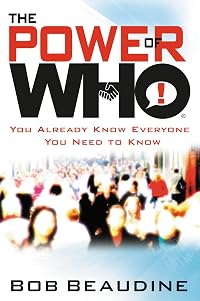
The Power of Who: You Already Know Everyone You Need to Know
by Bob Beaudine
On This Page
Description
"This book shows that you already know everyone you need to know to get anything you need in life"--Provided by the publisher.Tags
Recommendations









Member Reviews
http://theabbotofunreason.blogspot.com/2009/02/power-of-who-bob-beaudine.html
Oh, gosh! For most of the book, I was planning to pretty much just make fun of the exclamation points! This book definitely overuses the bang! It's in the title and on nearly every page. This book is just too dang energetic. That was about the best I could come up with at first.
But then he made me so angry, I could spit. This book represents the absolute worst of self-interested Caucasian Christian Capitalist wealth-mongering. He portrays a life of money-centered calculation: cultivate your friends so you can get stuff, do good things for people because that'll help you get more stuff, make a list so you know what stuff (or wife) you want.
That kind of thing show more irritates me, but it's not unusual. Then he told a story that completely drove me mad (It was not as offensive as the story about the cliched happy black shoe shine man doling out wisdom, but it came first and pushed me over the edge):
Mr. Beaudine told the story of a lease he signed. It turned out that he didn't need the apartment any more and wanted to see if there was a way to break the lease. His request was denied. He writes, "My first thought was crying and then suing, but that's not how I was brought up." I thought that was cool: he understood that he had signed a legal agreement and he was brought up to stick to his word. Cool.
Uh, but, no. That wasn't the point. Instead of suing, he turned to the power of class privilege. He called a frat brother who owned the building and had the contract ripped up. It would be wrong of you prols out there to sue to change a contract, but if you've got the right background and contacts, go ahead and go back on your word. It's what you've been working for.
This book disgusts me. show less
Oh, gosh! For most of the book, I was planning to pretty much just make fun of the exclamation points! This book definitely overuses the bang! It's in the title and on nearly every page. This book is just too dang energetic. That was about the best I could come up with at first.
But then he made me so angry, I could spit. This book represents the absolute worst of self-interested Caucasian Christian Capitalist wealth-mongering. He portrays a life of money-centered calculation: cultivate your friends so you can get stuff, do good things for people because that'll help you get more stuff, make a list so you know what stuff (or wife) you want.
That kind of thing show more irritates me, but it's not unusual. Then he told a story that completely drove me mad (It was not as offensive as the story about the cliched happy black shoe shine man doling out wisdom, but it came first and pushed me over the edge):
Mr. Beaudine told the story of a lease he signed. It turned out that he didn't need the apartment any more and wanted to see if there was a way to break the lease. His request was denied. He writes, "My first thought was crying and then suing, but that's not how I was brought up." I thought that was cool: he understood that he had signed a legal agreement and he was brought up to stick to his word. Cool.
Uh, but, no. That wasn't the point. Instead of suing, he turned to the power of class privilege. He called a frat brother who owned the building and had the contract ripped up. It would be wrong of you prols out there to sue to change a contract, but if you've got the right background and contacts, go ahead and go back on your word. It's what you've been working for.
This book disgusts me. show less
 This review was written for LibraryThing Early Reviewers.
I'm not sure who Beaudine is targeting with this book, but it clearly is not me. My gut says this is a grand branding campaign for his recruiting and lecturing businesses. Anyone reasonably successful enough to make use of his 'Who!' concept doesn't need the low-level advice dolled out therein, and anyone who really needs a career pep talk has already heard similar versions of this crap from every know-it-all selling career snake oil, and doesn't have anything approaching the valuable 'Who!' network Beaudine assures us we already have.
The book can be boiled down to 'utilize your friends and family, ask for what you want, adjust to changes, don't give up.' Aren't there enough of those books out there? The auther cries 'We're not designed show more to go it alone' and tells us we already have a vast network of 'Who!' people who will row our dream ships up the river for us. Hogwash. Beaudine uses exceptional stories of lucky or determined people to convince us that all of us can do the same. This is the same exact tactic that TV diet pill slingers use to convince us that their products will make us look great in a bikini or will help us hook up with the chick who looks great in a bikini. As the fine print usually echoes, 'Exceptional results. Your results may vary.'
The early reference to Beaudine's discussion with George W. Bush about possibly being MLB Commish rather than running for Governor ship made me want to gag. After describing how 'Bobby Boy' (Bush's nick for the author) advised Bush that the time was not right to pursue the Commish job, and how Bush was unsure that he would be successful in his first run for Governor of Texas, Beaudine lectures the reader: "Listen, if the guy who became president almost missed the clues to his destiny, it's easy to see how we could make the same mistake." Same mistake? The mistake was not convincing that fool to do something other than run his state (and later the nation) into the ground.
After swallowing my revulsion (and setting the book aside for a few days), I finished the rest and felt like my middle management boss had just given me the worst "There's no I in Team" pep talk of all time. What a waste of a couple hours. show less
The book can be boiled down to 'utilize your friends and family, ask for what you want, adjust to changes, don't give up.' Aren't there enough of those books out there? The auther cries 'We're not designed show more to go it alone' and tells us we already have a vast network of 'Who!' people who will row our dream ships up the river for us. Hogwash. Beaudine uses exceptional stories of lucky or determined people to convince us that all of us can do the same. This is the same exact tactic that TV diet pill slingers use to convince us that their products will make us look great in a bikini or will help us hook up with the chick who looks great in a bikini. As the fine print usually echoes, 'Exceptional results. Your results may vary.'
The early reference to Beaudine's discussion with George W. Bush about possibly being MLB Commish rather than running for Governor ship made me want to gag. After describing how 'Bobby Boy' (Bush's nick for the author) advised Bush that the time was not right to pursue the Commish job, and how Bush was unsure that he would be successful in his first run for Governor of Texas, Beaudine lectures the reader: "Listen, if the guy who became president almost missed the clues to his destiny, it's easy to see how we could make the same mistake." Same mistake? The mistake was not convincing that fool to do something other than run his state (and later the nation) into the ground.
After swallowing my revulsion (and setting the book aside for a few days), I finished the rest and felt like my middle management boss had just given me the worst "There's no I in Team" pep talk of all time. What a waste of a couple hours. show less
This review was written for LibraryThing Early Reviewers.Bob Beaudine's book The Power of Who! opens with a very personable introduction, followed by sentence that is marked out in block-quote style, as if to suggest that it above all else is worth remembering. That sentence is, and I quote, "Take everything you have ever heard or learned about networking and just throw it out" (xiv). It's a radical and memorable idea. The presentation of that idea, however, is a microcosm of his entire book. Beaudine has some fresh, new ideas, and he presents them clearly and convincingly, but the vast majority of the book falls into typical self-help territory -- though, admittedly, it's an awfully fun read.
The essential premise of the book is, according to its subtitle, that you already know everyone you show more need to know. Beaudine suggests that if you consciously think about your friends and relations, you can come up with a circle of about 100 people and 40 goals/steps towards achieving the success and satisfaction you've always dreamed of. After outlining these ideas, and giving some pretty compelling reasons for their legitimacy, Beaudine uses them to introduce a new model of networking that involves not random, possibly-well-placed strangers, but the friends you already know and love -- friends that are willing to help you just because you are you. Understanding this and using it to your advantage, according to Beaudine, is the key to realizing your dreams.
At first glance -- and especially because I tend to write in a fairly jaded, unconvinced voice -- it may seem as if Beaudine's plan is a whole lot of self-help hoo-hah. But I have to confess that the first half of the book, in which he explains and illustrates this plan, is actually the best part. Beaudine argues rather convincingly for the inefficacy of networking, and while he tends to lean on words like "fate" and "destiny" a little too strongly for the pragmatist's liking, the simple logic of his reasoning is surprisingly strong. Not only does it make sense, but it's fun to read, interspersed with anecdotes and situations that make you feel less like a member of a large audience and more like a friend.
While The Power of Who! starts out very strongly, however, its effects begin to wane as time goes on. As the book progresses, Beaudine opts to shift towards business advice mode, dispensing his time-tested wisdom on such things as interview skills and the people with whom you should surround yourself to guarantee success. And while much of this information is, like the first part, practical and well thought out, it's also the kind of thing that one can find in almost any business or self-help book. After all, how many times can one be expected to read that the best thing one can do in an interview is to "be yourself" before it gets a little tiresome. Whereas the book starts off on a rather unusual and refreshing foot, it slips into tedious redundancy as it approaches its end.
Even more disconcerting is the fact that Beaudine's examples betray one of the weaknesses in his argument that he only very briefly considers: the placement and position of your "Who!" is what makes them so effective -- i.e., if your "Who!" are CEOs and presidents, you're likely to find that they will, in fact, take care of most any job problem you face. Unfortunately for the rest of us -- and yes, that includes the younger crowd, whom Beaudine mentions for a short moment in a later chapter but otherwise glosses over -- we may not have "Who!" friends that are nearly as well-connected. And sure, the argument rests upon circles intersecting with other circles, but I don't think Beaudine acknowledges fully enough the plain fact that some people's circles are just going to be objectively better than others'.
While that notion threatens to derail the book and send it face-first into accusations of elitism, Beaudine wisely tempers these notions by telling amusing and witty stories about his own life. Stories that, yes, involve very highly-connected people (the first one involves a gentleman named George W., and I'll give you two guesses as to who he is), but stories that are told in a very personable, down-to-earth style that tempers the highfalutin nature of their subjects. Beaudine's storytelling style truly helps ground the book, and while his constant interjections of "Big Mistake!" may occasionally get tiresome, you never get the sense that you're reading the work of a man who's out of touch with hard work, no matter how wealthy and successful he may be.
All told, if the self-help thing is up your alley, it's hard to say no to The Power of Who! When you think about Beaudine's theory completely, it's a low-pressure and very practical idea that, even at its simplest level, is easy to execute. (And if you're not finding success, it can't really hurt, can it?) I only wish that the whole book was as lucid and enlightening as the first half, because then it would have really been worth the strong recommendation. Regardless, it's at the very least worth a gander. show less
The essential premise of the book is, according to its subtitle, that you already know everyone you show more need to know. Beaudine suggests that if you consciously think about your friends and relations, you can come up with a circle of about 100 people and 40 goals/steps towards achieving the success and satisfaction you've always dreamed of. After outlining these ideas, and giving some pretty compelling reasons for their legitimacy, Beaudine uses them to introduce a new model of networking that involves not random, possibly-well-placed strangers, but the friends you already know and love -- friends that are willing to help you just because you are you. Understanding this and using it to your advantage, according to Beaudine, is the key to realizing your dreams.
At first glance -- and especially because I tend to write in a fairly jaded, unconvinced voice -- it may seem as if Beaudine's plan is a whole lot of self-help hoo-hah. But I have to confess that the first half of the book, in which he explains and illustrates this plan, is actually the best part. Beaudine argues rather convincingly for the inefficacy of networking, and while he tends to lean on words like "fate" and "destiny" a little too strongly for the pragmatist's liking, the simple logic of his reasoning is surprisingly strong. Not only does it make sense, but it's fun to read, interspersed with anecdotes and situations that make you feel less like a member of a large audience and more like a friend.
While The Power of Who! starts out very strongly, however, its effects begin to wane as time goes on. As the book progresses, Beaudine opts to shift towards business advice mode, dispensing his time-tested wisdom on such things as interview skills and the people with whom you should surround yourself to guarantee success. And while much of this information is, like the first part, practical and well thought out, it's also the kind of thing that one can find in almost any business or self-help book. After all, how many times can one be expected to read that the best thing one can do in an interview is to "be yourself" before it gets a little tiresome. Whereas the book starts off on a rather unusual and refreshing foot, it slips into tedious redundancy as it approaches its end.
Even more disconcerting is the fact that Beaudine's examples betray one of the weaknesses in his argument that he only very briefly considers: the placement and position of your "Who!" is what makes them so effective -- i.e., if your "Who!" are CEOs and presidents, you're likely to find that they will, in fact, take care of most any job problem you face. Unfortunately for the rest of us -- and yes, that includes the younger crowd, whom Beaudine mentions for a short moment in a later chapter but otherwise glosses over -- we may not have "Who!" friends that are nearly as well-connected. And sure, the argument rests upon circles intersecting with other circles, but I don't think Beaudine acknowledges fully enough the plain fact that some people's circles are just going to be objectively better than others'.
While that notion threatens to derail the book and send it face-first into accusations of elitism, Beaudine wisely tempers these notions by telling amusing and witty stories about his own life. Stories that, yes, involve very highly-connected people (the first one involves a gentleman named George W., and I'll give you two guesses as to who he is), but stories that are told in a very personable, down-to-earth style that tempers the highfalutin nature of their subjects. Beaudine's storytelling style truly helps ground the book, and while his constant interjections of "Big Mistake!" may occasionally get tiresome, you never get the sense that you're reading the work of a man who's out of touch with hard work, no matter how wealthy and successful he may be.
All told, if the self-help thing is up your alley, it's hard to say no to The Power of Who! When you think about Beaudine's theory completely, it's a low-pressure and very practical idea that, even at its simplest level, is easy to execute. (And if you're not finding success, it can't really hurt, can it?) I only wish that the whole book was as lucid and enlightening as the first half, because then it would have really been worth the strong recommendation. Regardless, it's at the very least worth a gander. show less
This review was written for LibraryThing Early Reviewers.The Power of Who is an energetic motivational approach on how to use your friends and family to help you advance your lifestyle. It explains that everything you want in life is attainable by using your family and friends to help you along the way. It explains that anything that you want out of life is attainable if you ask your family and friends to help you gain it. It comes across as being strictly an "upper class" mindset on how to get what you want out of life. There are a few good ideas followed by more instructions on using people to get what you want. At one point in the book he even tells you to ask your friends to ask their friends to help you and explains that since your friends "really" like you they will be more than happy show more to do it. show less
This review was written for LibraryThing Early Reviewers.Bob Beaudine wants you to know that you can get by with a little help from your friends. Not just any friends though – your “Who!” friends.
Beaudine is the president and CEO of Eastman and Beaudine, an executive search company. In the first chapter he describes how he convinced George W. Bush to run for governor of Texas by telling him the timing was wrong to try for the job of commissioner of baseball. With his book “The Power of Who!” he wants to help you utilize the people who mean the most to you to live out your destiny. Depending on your views of how successful George W. was, you’ll have to judge how much you’re willing to follow Beaudine’s method.
His main point is that traditional networking doesn’t work. Why show more should you depend on the questionable kindness of strangers when you can turn to the people you already know? Apparently these folks have been holding out on you. They know people who know people who know the one person who can get you that interview, that dream job or set you on the path to redemption. “Don’t attempt to do life on your own,” he warns. Your loved ones are waiting to help you achieve all your dreams, if you would just ask.
I can’t help but feel that someone who knows people like Troy Aikman, Max Lucado, Wayne Gretzky and the commissioner of the NFL is going to have a lot more success with this method than the average person will - especially when bank bailouts and bankruptcy are rampant. If any of us had a way to help our friends and family who’ve been affected by our damaged economy, I’m sure we would be using it.
He also makes sure to remind us not to forget to get a mentor, visualize our destinies, make a list, have confidence in ourselves and not to be discouraged by rejection. The same things most other business/self help books will tell you. Sports Illustrated described Beaudine as “the most influential man in sports you’ve never heard of.” If he doesn’t have anything more original than this to share he should stick to what he does best. show less
Beaudine is the president and CEO of Eastman and Beaudine, an executive search company. In the first chapter he describes how he convinced George W. Bush to run for governor of Texas by telling him the timing was wrong to try for the job of commissioner of baseball. With his book “The Power of Who!” he wants to help you utilize the people who mean the most to you to live out your destiny. Depending on your views of how successful George W. was, you’ll have to judge how much you’re willing to follow Beaudine’s method.
His main point is that traditional networking doesn’t work. Why show more should you depend on the questionable kindness of strangers when you can turn to the people you already know? Apparently these folks have been holding out on you. They know people who know people who know the one person who can get you that interview, that dream job or set you on the path to redemption. “Don’t attempt to do life on your own,” he warns. Your loved ones are waiting to help you achieve all your dreams, if you would just ask.
I can’t help but feel that someone who knows people like Troy Aikman, Max Lucado, Wayne Gretzky and the commissioner of the NFL is going to have a lot more success with this method than the average person will - especially when bank bailouts and bankruptcy are rampant. If any of us had a way to help our friends and family who’ve been affected by our damaged economy, I’m sure we would be using it.
He also makes sure to remind us not to forget to get a mentor, visualize our destinies, make a list, have confidence in ourselves and not to be discouraged by rejection. The same things most other business/self help books will tell you. Sports Illustrated described Beaudine as “the most influential man in sports you’ve never heard of.” If he doesn’t have anything more original than this to share he should stick to what he does best. show less
This review was written for LibraryThing Early Reviewers."Depend on your friends, choose the right friends, show who you are not what you are..." Bob Beaudine's book is reminiscent of WHAT COLOR IS YOUR PARACHUTE or Barbara Sher's classic WISHCRAFT, as written by a Texas motivational guy who really likes sports. He does spend a lot of time on himself, and his admiration for George W. Bush is to gag a maggot. Still, it's far from horrible advice. I would give a young college graduate who has a big dream and needs focus to achieve it. (Translation: It probably won't stay in my library.)
This review was written for LibraryThing Early Reviewers.I am in a field where networking, or using my "who friends" is absolutely necessary. Bob Beaudine's "The Power of Who," made me want to turn around and avoid the situation entirely. The tone of the book made me feel like I was at a motivational seminar for children, which may be helpful for some but it was not so for me. Sure his experiences bode well for his suggestions, though his personality may play a larger role.
Beaudine suggests forgoing traditional networking and advance based on the people you know, who know people, who know people. Great concept, similar to traditional networking however though it takes a step backward. If you know amazing, famous and successful people, they probably know similar people, which is great. show more Traditional networking takes advantage of the people you know and the people you should be meeting. I've found that attending networking functions, where I don't know anyone, has led to amazing contacts. In addition traditional networking has led to one of Beaudine's major tips, get a mentor. Meeting people who are passionate about your field, who work in the same field, should become your mentors. If you meet them through networking events or complete strangers, or even your who friends, tatke advantage of them.
Beaudine has some great tips, nothing new however. Don't disregard traditional methods however! Also, if you can get through this book without feeling like your mind has reverted, I congratulate you, because I could barely get through it. show less
Beaudine suggests forgoing traditional networking and advance based on the people you know, who know people, who know people. Great concept, similar to traditional networking however though it takes a step backward. If you know amazing, famous and successful people, they probably know similar people, which is great. show more Traditional networking takes advantage of the people you know and the people you should be meeting. I've found that attending networking functions, where I don't know anyone, has led to amazing contacts. In addition traditional networking has led to one of Beaudine's major tips, get a mentor. Meeting people who are passionate about your field, who work in the same field, should become your mentors. If you meet them through networking events or complete strangers, or even your who friends, tatke advantage of them.
Beaudine has some great tips, nothing new however. Don't disregard traditional methods however! Also, if you can get through this book without feeling like your mind has reverted, I congratulate you, because I could barely get through it. show less
This review was written for LibraryThing Early Reviewers.Members
- Recently Added By
Author Information
3 Works 190 Members
Common Knowledge
- Original publication date
- 2009
Classifications
Statistics
- Members
- 95
- Popularity
- 339,487
- Reviews
- 15
- Rating
- (2.43)
- Languages
- English
- Media
- Paper, Audiobook, Ebook
- ISBNs
- 7
- ASINs
- 1