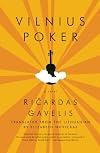
Vilnius Poker
by Ricardas Gavelis
On This Page
Description
The ""turning point in Lithuanian literature,"" Vilnius Poker is the best Lithuanian Zombie novel ever. (According to Green Apple Books.)Tags
Recommendations





































Member Recommendations
Member Reviews
Vile. Repugnant. Putrid. Disturbing. Depraved.
All words that describe my experience with this Lithuanian novel, which I received through LT's Early Reviewer program. I was excited when this book came in the mail, because I enjoy reading fiction from other parts of the world - they always have a different perspective on things, and since I am 1/4th Latvian, I thought "Huzzah! A book by a neighbor!" and eagerly cracked it open when it arrived.
I lasted 100 pages. One hundred pages where I slogged, fell asleep and had to re-read, complained to anyone near me, and often felt ill at the disgusting imagery used throughout the narrative. But before I get to that, I'll talk about the book in general. The main character is paranoid, seemingly due show more to his experiences during the war where he was tortured. The narrative is from a first-person perspective and very difficult to follow and understand, primarily because it follows a stream-of-consciousness format where we're treated to the present, the past, and random observations all at the same time. Fair enough - books have been written this way in the past and succeeded. Evidently around page 300, the narration shifts from the main character to several other characters' first person perspectives, wherein the reader can try and make sense of the events of the story through multiple eyes. I didn't make it that far.
I read 50 pages and stopped. The main character had engaged in sexual acts four times, and while I'm not a prude, they weren't exactly written in an appealing way, nor were they described with erotic language. Instead, it was base, disjointed, sometimes violent, and degrading. I gave the story another 50 pages, and had to stop. Yes, I know that the main character experienced horrendous things during the war, but is that really any reason why the author needs to portray women as nothing more than a pair of breasts and a "va-jay-jay" on legs? The MC constantly pictures the women around him naked, even as they sit on the couch and have a conversation with him (whereupon he'll begin talking about her as just a naked body). He fantastizes about their breasts and sleeping with these women, in degrading terms that don't refer to them as people, more like "damp, wet places"...
And we're treated to some of the most vile imagery about his own anatomy. I won't repeat some of the worst ones here, simply because I am dismayed at reading it myself and the imagery will now stay in my mind for all time. I don't want to subject someone else to that, but I will say, one of the more putrid descriptions involves a man's private parts, a woman's private parts, and cockroaches. Yes, that's right. It's absolutely sickening.
The misogyny in this book, as well as its depraved imagery, is astounding. I am amazed that anyone could get past it and read the entire thing. It's a real shame, as it was something I had been looking forward to. Please, do not read this book. There are many other wonderful pieces of world literature out there... I have high hopes that this is not representative of all Lithuanian authors. show less
All words that describe my experience with this Lithuanian novel, which I received through LT's Early Reviewer program. I was excited when this book came in the mail, because I enjoy reading fiction from other parts of the world - they always have a different perspective on things, and since I am 1/4th Latvian, I thought "Huzzah! A book by a neighbor!" and eagerly cracked it open when it arrived.
I lasted 100 pages. One hundred pages where I slogged, fell asleep and had to re-read, complained to anyone near me, and often felt ill at the disgusting imagery used throughout the narrative. But before I get to that, I'll talk about the book in general. The main character is paranoid, seemingly due show more to his experiences during the war where he was tortured. The narrative is from a first-person perspective and very difficult to follow and understand, primarily because it follows a stream-of-consciousness format where we're treated to the present, the past, and random observations all at the same time. Fair enough - books have been written this way in the past and succeeded. Evidently around page 300, the narration shifts from the main character to several other characters' first person perspectives, wherein the reader can try and make sense of the events of the story through multiple eyes. I didn't make it that far.
I read 50 pages and stopped. The main character had engaged in sexual acts four times, and while I'm not a prude, they weren't exactly written in an appealing way, nor were they described with erotic language. Instead, it was base, disjointed, sometimes violent, and degrading. I gave the story another 50 pages, and had to stop. Yes, I know that the main character experienced horrendous things during the war, but is that really any reason why the author needs to portray women as nothing more than a pair of breasts and a "va-jay-jay" on legs? The MC constantly pictures the women around him naked, even as they sit on the couch and have a conversation with him (whereupon he'll begin talking about her as just a naked body). He fantastizes about their breasts and sleeping with these women, in degrading terms that don't refer to them as people, more like "damp, wet places"...
And we're treated to some of the most vile imagery about his own anatomy. I won't repeat some of the worst ones here, simply because I am dismayed at reading it myself and the imagery will now stay in my mind for all time. I don't want to subject someone else to that, but I will say, one of the more putrid descriptions involves a man's private parts, a woman's private parts, and cockroaches. Yes, that's right. It's absolutely sickening.
The misogyny in this book, as well as its depraved imagery, is astounding. I am amazed that anyone could get past it and read the entire thing. It's a real shame, as it was something I had been looking forward to. Please, do not read this book. There are many other wonderful pieces of world literature out there... I have high hopes that this is not representative of all Lithuanian authors. show less
 This review was written for LibraryThing Early Reviewers.
Although I was engaged and rewarded almost constantly by Ričardas Gavelis's Vilnius Poker (translated by Elizabeth Novickas), I know the book is not for everyone. In particular Vytautas Vargalys, its delusional, pathologically misogynist labor-camp survivor protagonist whose PTSD-spurred paranoia presents him with a nameless group of nameless but italicized Them lurking around every corner, makes a challenging companion throughout the first 300 pages of the book. There is, undeniably, darkness and the grotesque around every corner, in a way genuinely challenging to witness; furthermore, if a reader doesn't connect with Vargalys's voice, those 300 pages will be a hard slog. And yet, the section narrated by Vargalys is the book's show more backbone, its primary strength; and while the following three narrators all add dimensions to Vargalys's demented, self-centered account of the events leading up to a murder in an overgrown Vilnius garden one autumn twilight, the soul of Vilnius Poker lies with Vargalys.
So too, the very things that make these first 300 pages trying are the things that make them unique, even exhilarating. Vargalys's section, for example, takes the idea of a "circular narration" to new heights: not only does it end in the same place and time it began, ranging far and wide in between (a fairly common narrative technique), but the interim takes the form less of a line and more of a kind of fugue, with a whole host of recurring themes that weave around each other, coming together in different combinations as Vargalys's mind roves over past, present and future. Birds, fog, dead leaves, human shit, disfigured genitalia, stray dogs, eyes and clandestine observation, cockroaches, the river and Them: all weave in and out of each other in Vargalys's mind, forming bridges from one experience to another and one theme to the next. At times one of these notes will sound alone, isolated from the rest; at other times, three or four of them will build on top of each other, marking a particular crescendo in the narrative: fog and stray dogs will come together in a scene of clandestine observation; or rotten leaves and cockroaches will announce Their presence; the birds will be mysteriously absent when the cockroaches conspicuously appear; or a series disfigured sexual organs will become conflated with sinister watching eyes. It is these combinations and recombinations that drive Vargalys's narrative, rather than a separation between "now" and "then" or "dream" and "reality."
As demonstrated in this passage, the free association of themes as an organizing principle means that Vargalys's narrative can flow easily from one time and/or place to another: in this instance, he begins the paragraph walking through the streets of Vilnius, and ends up sitting down to a coffee break with his co-workers. As a reader, I found this a very atmospheric and well-executed experience, and sometimes even darkly funny; as a human whose consciousness actually works this way, however, Vargalys is locked in a kind of nightmare, with little to grab hold of as his life careens by, out of his control.
This feeling of disjointed perception, in which the past is clearer than the present, other people are hazy phantoms, and time and space act unpredictably, goes a long way to fuel Vargalys's compulsion to amass "facts" about Them. It also explains Gavelis's decision to include other perspectives on the story. Vargalys is working so hard to just hold himself together that he barely notices the people around him, and when he does, they appear as sinisterly distorted caricatures. I particularly appreciated the deepening of Stefa's character: appearing in Vargalys's narrative as an annoying sexpot always underfoot, she is presented by the second narrator (their co-worker Martynas) as a devoted helpmeet who takes care of Vargalys's everyday wants and needs. The third narrator is Stefa herself, who discloses still more and greater connections with Vargalys's past, as well as becoming a fleshed-out human in her own right, with her own sets of fears, compulsions, and identity crises. (Although, I was slightly disappointed in Gavelis's decision to render the only female narration in a Molly Bloom-like stream-of-consciousness style; this struck me as crossing the line from "Joycean" to "derivative." Whence this idea that women are innately opposed to punctuation?)
And yet, the multiple narrators confuse each other's accounts as much as they enrich or clarify them. In multiple places, they directly contradict one another in ways that can't be explained by Vargalys's insanity or someone else's mistaken impression. Is Vargalys's ex-wife, for example, a lonely alcoholic caring for her dying mother, as Martynas claims, or remarried to a flashy nouveau-riche businessman, as Stefa says? Which woman was actually present the night that Vargalys and his friend Gediminas brought home the Circe of Old Town? And then there are the multiple, conflicting eyewitness reports from the scene of the crime in the garden: how many people actually were spying on Vargalys and Lolita that night, and what did they really see? These questions are never answered, and the novel seems to imply that in Vilnius, such conflicting reports can somehow coexist, despite being, to all "outside" logic, mutually exclusive. Similarly, the narrator Martynas writes of a seeming contradiction that is actually perfectly consistent:
Vilnius Poker consistently asks us to reexamine what constitutes a contradiction. We can probably all conceptualize conflicting value judgments or relative perceptions—one person thinks of an object as "large" whereas someone else finds it "small," for example—without too much mental strain, but there comes a point when differing reports are impossible to reconcile. Or does there? If two people witness the same incident and see a different woman in the lead role, can both, in some way, be correct? If two people witness a murder and see with their own eyes a different perpetrator, is one of them necessarily wrong?
One last note: throughout the novel I struggled with Vargalys's violently distorted view of women and sexuality, and judging from some of the reviews on LibraryThing, I'm not alone. He perceives sexual partners (of both genders, actually, but the majority are women) to be basically predatory; in his mind they are reduced to disembodied parts (eyes, mouths, vaginas) attempting to suck out his humanity. This is genuinely very disturbing to read. However, I do feel that within the greater context of the novel, it is treated as part of Vargalys's pathology, not as Gavelis's own worldview; and furthermore, it's presented as a byproduct of the sexual torture Vargalys himself endured in the Gulag's labor camps. Imprisoned away from women from age 17 to 28, he matures in this cruel and distorted environment. He is released with an intact desire to achieve closeness with other people, but with a severely warped perception of how to go about it and how to read others' signals. It's a sobering reminder that human rights abuses leave a long legacy of trauma on the societies they affect, and that when people are victimized long enough they tend inevitably to victimize others (and themselves) in their turn. A difficult yet haunting read. show less
So too, the very things that make these first 300 pages trying are the things that make them unique, even exhilarating. Vargalys's section, for example, takes the idea of a "circular narration" to new heights: not only does it end in the same place and time it began, ranging far and wide in between (a fairly common narrative technique), but the interim takes the form less of a line and more of a kind of fugue, with a whole host of recurring themes that weave around each other, coming together in different combinations as Vargalys's mind roves over past, present and future. Birds, fog, dead leaves, human shit, disfigured genitalia, stray dogs, eyes and clandestine observation, cockroaches, the river and Them: all weave in and out of each other in Vargalys's mind, forming bridges from one experience to another and one theme to the next. At times one of these notes will sound alone, isolated from the rest; at other times, three or four of them will build on top of each other, marking a particular crescendo in the narrative: fog and stray dogs will come together in a scene of clandestine observation; or rotten leaves and cockroaches will announce Their presence; the birds will be mysteriously absent when the cockroaches conspicuously appear; or a series disfigured sexual organs will become conflated with sinister watching eyes. It is these combinations and recombinations that drive Vargalys's narrative, rather than a separation between "now" and "then" or "dream" and "reality."
I walk slowly through a dream called Vilnius, while the weird sensation that all of this has already been pierces my brain. Once I went down the street in exactly the same way, in exactly the same way I considered what the dream—the yellowish leaves, blown about by the wind, and the old house in the depths of a garden—could mean...The exact same pair of dazed pigeons have already perched by the announcement post. Lolita has already waited for me in the corridor, rocking her waist back and forth in exactly the same way...Everything has already been, everything, everything, has already been. I know it's just déja vu, but all the same a sense of fear stabs right through me. In exactly the same way Stefa's hips sway before my eyes, the hips of all the women in the world, Virgilishly leading me ever closer to the secret...The exact same shabby dog with a huge head and still larger sexual organs and a long body like a rat's sniffs the ground outside the window...The coffee break table seems just as unreal as it has seemed many times before.
As demonstrated in this passage, the free association of themes as an organizing principle means that Vargalys's narrative can flow easily from one time and/or place to another: in this instance, he begins the paragraph walking through the streets of Vilnius, and ends up sitting down to a coffee break with his co-workers. As a reader, I found this a very atmospheric and well-executed experience, and sometimes even darkly funny; as a human whose consciousness actually works this way, however, Vargalys is locked in a kind of nightmare, with little to grab hold of as his life careens by, out of his control.
This feeling of disjointed perception, in which the past is clearer than the present, other people are hazy phantoms, and time and space act unpredictably, goes a long way to fuel Vargalys's compulsion to amass "facts" about Them. It also explains Gavelis's decision to include other perspectives on the story. Vargalys is working so hard to just hold himself together that he barely notices the people around him, and when he does, they appear as sinisterly distorted caricatures. I particularly appreciated the deepening of Stefa's character: appearing in Vargalys's narrative as an annoying sexpot always underfoot, she is presented by the second narrator (their co-worker Martynas) as a devoted helpmeet who takes care of Vargalys's everyday wants and needs. The third narrator is Stefa herself, who discloses still more and greater connections with Vargalys's past, as well as becoming a fleshed-out human in her own right, with her own sets of fears, compulsions, and identity crises. (Although, I was slightly disappointed in Gavelis's decision to render the only female narration in a Molly Bloom-like stream-of-consciousness style; this struck me as crossing the line from "Joycean" to "derivative." Whence this idea that women are innately opposed to punctuation?)
And yet, the multiple narrators confuse each other's accounts as much as they enrich or clarify them. In multiple places, they directly contradict one another in ways that can't be explained by Vargalys's insanity or someone else's mistaken impression. Is Vargalys's ex-wife, for example, a lonely alcoholic caring for her dying mother, as Martynas claims, or remarried to a flashy nouveau-riche businessman, as Stefa says? Which woman was actually present the night that Vargalys and his friend Gediminas brought home the Circe of Old Town? And then there are the multiple, conflicting eyewitness reports from the scene of the crime in the garden: how many people actually were spying on Vargalys and Lolita that night, and what did they really see? These questions are never answered, and the novel seems to imply that in Vilnius, such conflicting reports can somehow coexist, despite being, to all "outside" logic, mutually exclusive. Similarly, the narrator Martynas writes of a seeming contradiction that is actually perfectly consistent:
Once I nearly choked with laughter listening to a Harvard professor on the radio defending this Muscovite psychiatrist. The world accused this psychiatrist of stuffing dissidents into secret nuthouses. That's not true, it can't be, the Harvard professor railed, that Muscovite is a true scholar; he's published serious work. I even fell out of my chair laughing. No Harvard professor would be able to understand that a perfectly serious scholar could, of his own free will, be a complete butcher. No American or Frenchman would understand that the manager of a gas chamber in Hitler's Germany could have played the piano like a virtuoso and worshipped Chopin. No, they won't understand it. Those American and French brains aren't constructed right.
Vilnius Poker consistently asks us to reexamine what constitutes a contradiction. We can probably all conceptualize conflicting value judgments or relative perceptions—one person thinks of an object as "large" whereas someone else finds it "small," for example—without too much mental strain, but there comes a point when differing reports are impossible to reconcile. Or does there? If two people witness the same incident and see a different woman in the lead role, can both, in some way, be correct? If two people witness a murder and see with their own eyes a different perpetrator, is one of them necessarily wrong?
One last note: throughout the novel I struggled with Vargalys's violently distorted view of women and sexuality, and judging from some of the reviews on LibraryThing, I'm not alone. He perceives sexual partners (of both genders, actually, but the majority are women) to be basically predatory; in his mind they are reduced to disembodied parts (eyes, mouths, vaginas) attempting to suck out his humanity. This is genuinely very disturbing to read. However, I do feel that within the greater context of the novel, it is treated as part of Vargalys's pathology, not as Gavelis's own worldview; and furthermore, it's presented as a byproduct of the sexual torture Vargalys himself endured in the Gulag's labor camps. Imprisoned away from women from age 17 to 28, he matures in this cruel and distorted environment. He is released with an intact desire to achieve closeness with other people, but with a severely warped perception of how to go about it and how to read others' signals. It's a sobering reminder that human rights abuses leave a long legacy of trauma on the societies they affect, and that when people are victimized long enough they tend inevitably to victimize others (and themselves) in their turn. A difficult yet haunting read. show less
Vilnius Poker is probably the most difficult book I’ve read in years. Most of the books I’ve read are plot or character driven. Some use setting very adroitly, as does Gavelis’ book. While setting, Vilnius specifically, is integral to the work, mood seems to drive the work more than anything else. The prose reads very dream-like. I don’t mean ethereal. Scenes and situations and times blend from one to another.
Told in four parts ever decreasing in size, the first from the perspective of Vytautas Vargalis. As the later parts describe, everyone recognizes Vytautas greatness. But his narrated section reads more like madness. It was the hardest to follow. For instance, Vytautas Vargalys has a conversation with his deceased father show more followed by his friend Gediminas Riauba gathering together musicians to play a concert in an abandoned cathedral for Vytautas sole benefit. The transitions are smooth. I often had to re-read portions to see how one scene grew from another.
The Kirkus Reviews blurb on the back cover calls this The Matrix behind the Iron Curtain. I think that description does the book a disservice, for The Matrix was very clear as to what was “real” and what was generated. Or at least that there was a reality and a veneer. Vilnius Poker does not make things so clear. While it’s obvious that Vytautas does not exist in the humdrum world, I’m not so certain that reality is important. Gavelis’ story isn’t so much about peeling back the layers as it is about blending them to set a mood.
Central to the story is Vilnius, Lithuania, and the people of Lithuania. Vytautas sees the hand of Them everywhere. They rob Lithuania of a vital essence, but it doesn’t seem like Gavelis is certain that its people had much to start with. Vytautis muses constantly about why They are present in Lithuania to begin with. He seems quite bitter at a lost greatness, or at least the lost possibility of greatness.
The "story", what I can make of it, is a big complicated affair. I don’t mean lots of intricate plot turns. Affairs of the kind that married people have with each other. In this case, the men chase after Lolita Banye-Žilienė, a beautiful vain girl. Having never read Nabokov’s work, I can’t say how Lolita compares to her obvious namesake. She certainly doesn’t represent youth and vitality here! Nothing good comes from bedding her.
The shorter parts that follow Vytautas’ are much easier to follow. Each subsequent narrator described the same events from their perspective. Not that they are always recognizable as the same events. Everything becomes subject to ones own demons that haunt them. But all of them give a different, none positive, take on what it is to be Vilniutian and Lithuanian. The word "despair" comes to mind whenever one of them gets to a monologue about Vilnius.
So to sum up: Vilnius, Lithuania, madness, despair. Too much stuff for me to wrap my head around.
One last thing though. It’s not all deep muddled thinking. Gavelis (or perhaps his translater Elizabeth Novickas) certainly has a flair for language and for a subtle wry kind of humor. I bookmarked dozens of pithy writings that resonated with me: "the fundamental question of philosophy: do you kill someone else, or yourself?" or "The Buddhist theory of inescapable pain doesn’t explain anything, it’s merely an observation." Depressingly funny.
Originally published at my blog show less
Told in four parts ever decreasing in size, the first from the perspective of Vytautas Vargalis. As the later parts describe, everyone recognizes Vytautas greatness. But his narrated section reads more like madness. It was the hardest to follow. For instance, Vytautas Vargalys has a conversation with his deceased father show more followed by his friend Gediminas Riauba gathering together musicians to play a concert in an abandoned cathedral for Vytautas sole benefit. The transitions are smooth. I often had to re-read portions to see how one scene grew from another.
The Kirkus Reviews blurb on the back cover calls this The Matrix behind the Iron Curtain. I think that description does the book a disservice, for The Matrix was very clear as to what was “real” and what was generated. Or at least that there was a reality and a veneer. Vilnius Poker does not make things so clear. While it’s obvious that Vytautas does not exist in the humdrum world, I’m not so certain that reality is important. Gavelis’ story isn’t so much about peeling back the layers as it is about blending them to set a mood.
Central to the story is Vilnius, Lithuania, and the people of Lithuania. Vytautas sees the hand of Them everywhere. They rob Lithuania of a vital essence, but it doesn’t seem like Gavelis is certain that its people had much to start with. Vytautis muses constantly about why They are present in Lithuania to begin with. He seems quite bitter at a lost greatness, or at least the lost possibility of greatness.
The "story", what I can make of it, is a big complicated affair. I don’t mean lots of intricate plot turns. Affairs of the kind that married people have with each other. In this case, the men chase after Lolita Banye-Žilienė, a beautiful vain girl. Having never read Nabokov’s work, I can’t say how Lolita compares to her obvious namesake. She certainly doesn’t represent youth and vitality here! Nothing good comes from bedding her.
The shorter parts that follow Vytautas’ are much easier to follow. Each subsequent narrator described the same events from their perspective. Not that they are always recognizable as the same events. Everything becomes subject to ones own demons that haunt them. But all of them give a different, none positive, take on what it is to be Vilniutian and Lithuanian. The word "despair" comes to mind whenever one of them gets to a monologue about Vilnius.
So to sum up: Vilnius, Lithuania, madness, despair. Too much stuff for me to wrap my head around.
One last thing though. It’s not all deep muddled thinking. Gavelis (or perhaps his translater Elizabeth Novickas) certainly has a flair for language and for a subtle wry kind of humor. I bookmarked dozens of pithy writings that resonated with me: "the fundamental question of philosophy: do you kill someone else, or yourself?" or "The Buddhist theory of inescapable pain doesn’t explain anything, it’s merely an observation." Depressingly funny.
Originally published at my blog show less
This review was written for LibraryThing Early Reviewers.To be, for once, succinct, I was not at all ready for this book. Vilnius Poker is a deep, difficult read that I will absolutely return to. For whatever reason, however, I couldn’t muster the focus the writing demands of the reader. Realizing this, I set it aside and will try again at some point down the road.
That said, even though I struggled with it, I knew I was reading, or trying to read, something very special. Gavelis’ writing is, in a word, stunning. It is also packed with big, huge, tremendous ideas as the main character, Vytautus Vargalis, struggles to maintain what little grasp of reality he has left after being imprisoned and tortured in a Soviet prison camp.
In some ways I shared that struggle, as I found myself, more show more often than not, confused as to what was happening to Vytuatus. I never felt as though I had a firm stance on where the story started out, what the baseline was, and that left me frustrated and continually flipping pages backwards and rereading in an effort to clear things up for myself. I do not think, however, that this is indicative of a flaw in the writing itself. It is a result of the perspective of Vytautus and, I think, extremely important to the overall tone of even the short bit I struggled through.
Vilnius Poker is not for the casual reader or the faint of heart, and, now that I better understand that, I’ll approach it much differently when I next pick it up and start at page 1.
~~~ Read the rest at www.robbflynn.com ~~~ show less
That said, even though I struggled with it, I knew I was reading, or trying to read, something very special. Gavelis’ writing is, in a word, stunning. It is also packed with big, huge, tremendous ideas as the main character, Vytautus Vargalis, struggles to maintain what little grasp of reality he has left after being imprisoned and tortured in a Soviet prison camp.
In some ways I shared that struggle, as I found myself, more show more often than not, confused as to what was happening to Vytuatus. I never felt as though I had a firm stance on where the story started out, what the baseline was, and that left me frustrated and continually flipping pages backwards and rereading in an effort to clear things up for myself. I do not think, however, that this is indicative of a flaw in the writing itself. It is a result of the perspective of Vytautus and, I think, extremely important to the overall tone of even the short bit I struggled through.
Vilnius Poker is not for the casual reader or the faint of heart, and, now that I better understand that, I’ll approach it much differently when I next pick it up and start at page 1.
~~~ Read the rest at www.robbflynn.com ~~~ show less
This review was written for LibraryThing Early Reviewers.Vilnius Poker is the story of a tragic love affair that unfolds during the 1970s in the Lithuanian capital city of Vilnius, then suffering under the oppression of Soviet rule. The novel is presented from four different points of view. The first 300 pages of this 500-page novel are told from the perspective of Vytautas Vargalys, a brilliant but unstable 53-year-old library clerk in love with a co-worker in her 20's, aptly named Lolita. As a survivor of the Soviet labor camps, Vytautas is troubled by a pervading sense of paranoia that gradually leads to madness and tragedy.
After Vytautas's tragic tale ends, the point of view switches to that of Martynas Poška, Vytautas's co-worker from the library who narrates his story via an show more “mlog”—a kind of stream-of-consciousness electronic diary. Martynas describes many of the same people and events that appeared in Vytautas's narrative but without the filter of Vytautas's lunacy. This new perspective reveals many of the novel's truths to be relative, and the tragic end to Vytautas's and Lolita's love becomes murkier. The final two narratives, one of which is told in a voice from the afterlife, continue the obfuscation and suggest that life in Vilnius is nothing more than "a giant poker game, played by madmen."
Vilnius Poker is dense with ideas, literary allusions, historic events, mythological references, symbolism, and linguistic and philosophical theories. It invites and rewards careful study. Elizabeth Novickas's nimble translation delivers the stylistic diversity that must have been intended by Gavelis. Just as beautiful and brutal elements coexist in the narrative, the prose is alternately poetic and crude.
The novel's highly constrained physical and temporal scope provides a dramatic contrast to its sweeping intellectual scope. The action involves just a few primary characters acting within a single city over the course of only a month. Despite these limitations, the novel's unique approach to time expands its reach. In Vilnius Poker, time does not progress linearly but instead loops through and over itself, creating worlds within worlds in a space that initially seems small.
Reading Vilnius Poker is a serious undertaking that will not appeal to casual readers. Certain parts of the book, particularly the first 300 pages, are repetitive and sometimes tedious. The resulting effect is a highly believable portrayal of deteriorating rationality, an effect that might drive some readers towards their own kind of madness. Those willing to devote the required mental energy, however, will be rewarded with a supremely interesting literary experience. In the words of Martynas: "Never forget that we are all, in a certain sense a bit Albanian. All of us are just a tad Lithuanian. And worst of all--every one of us, in the depths of our hearts, is a Vytautas Vargalys."
This review also appears on my blog Literary License. show less
After Vytautas's tragic tale ends, the point of view switches to that of Martynas Poška, Vytautas's co-worker from the library who narrates his story via an show more “mlog”—a kind of stream-of-consciousness electronic diary. Martynas describes many of the same people and events that appeared in Vytautas's narrative but without the filter of Vytautas's lunacy. This new perspective reveals many of the novel's truths to be relative, and the tragic end to Vytautas's and Lolita's love becomes murkier. The final two narratives, one of which is told in a voice from the afterlife, continue the obfuscation and suggest that life in Vilnius is nothing more than "a giant poker game, played by madmen."
Vilnius Poker is dense with ideas, literary allusions, historic events, mythological references, symbolism, and linguistic and philosophical theories. It invites and rewards careful study. Elizabeth Novickas's nimble translation delivers the stylistic diversity that must have been intended by Gavelis. Just as beautiful and brutal elements coexist in the narrative, the prose is alternately poetic and crude.
The novel's highly constrained physical and temporal scope provides a dramatic contrast to its sweeping intellectual scope. The action involves just a few primary characters acting within a single city over the course of only a month. Despite these limitations, the novel's unique approach to time expands its reach. In Vilnius Poker, time does not progress linearly but instead loops through and over itself, creating worlds within worlds in a space that initially seems small.
Reading Vilnius Poker is a serious undertaking that will not appeal to casual readers. Certain parts of the book, particularly the first 300 pages, are repetitive and sometimes tedious. The resulting effect is a highly believable portrayal of deteriorating rationality, an effect that might drive some readers towards their own kind of madness. Those willing to devote the required mental energy, however, will be rewarded with a supremely interesting literary experience. In the words of Martynas: "Never forget that we are all, in a certain sense a bit Albanian. All of us are just a tad Lithuanian. And worst of all--every one of us, in the depths of our hearts, is a Vytautas Vargalys."
This review also appears on my blog Literary License. show less
“On days like that, the lightest things weigh more than the heaviest, and compasses show directions for which there are no names”
I read this book to page 167 before giving up. I loved the bleak, lyrical lunacy of the (apparently first, though I never reached any other) narrator, the deep, cheap, beautiful eroticism, the echoes of the family, camp and town that have slowly undone his mind… however, 167 pages is quite enough of it, and the story seems to be going nowhere; his paranoia shifts and grows like a tide coming in and out, and there is, seemingly, nothing but this and the oppression under which he lives and his obsession with the oddly unappealing Lolita. Despite wanting to warm to it, it is simply too heavy and I am – show more after two weeks – putting it aside. I may come back and try again, but it will be in the spirit of a challenging classic rather than a compelling read. show less
I read this book to page 167 before giving up. I loved the bleak, lyrical lunacy of the (apparently first, though I never reached any other) narrator, the deep, cheap, beautiful eroticism, the echoes of the family, camp and town that have slowly undone his mind… however, 167 pages is quite enough of it, and the story seems to be going nowhere; his paranoia shifts and grows like a tide coming in and out, and there is, seemingly, nothing but this and the oppression under which he lives and his obsession with the oddly unappealing Lolita. Despite wanting to warm to it, it is simply too heavy and I am – show more after two weeks – putting it aside. I may come back and try again, but it will be in the spirit of a challenging classic rather than a compelling read. show less
This review was written for LibraryThing Early Reviewers.This is a dense, challenging novel and I didn't quite give it the attention it deserved. The increasingly paranoid narration in the first and longest section of the novel was hard work at times but had its rewarding moments, too. I did feel, however, that a more adequate knowledge of Lithuanian history than mine would have been helpful in giving more depth to the musings on the nature of Vilnius and Lithuania--Vilnius Poker is just as much about the city of Vilnius and the people of Lithuania (once great, then a small Baltic state with a seemingly random collection of Lithuanians, Poles and Russians placed within its borders) as it is about its protagonist and the narrator of the first section, Vytautas Vargalys. The three shorter show more sections of the novel that follows his are narrated by his friends and give differing interpretations to events and relationships as described by Vytautas. show less
This review was written for LibraryThing Early Reviewers.Members
- Recently Added By
Author Information

11+ Works 270 Members
Awards and Honors
Common Knowledge
- Canonical title
- Vilnius Poker
- Original title
- Vilniaus pokeris
- Original publication date
- 1989
- People/Characters
- Vytautas Vargalys; Lolita Banytė-Žilienė; Martynas Poška; Stefanija Monkevičiūtė
- Important places
- Vilnius, Lithuania
- First words
- A narrow crack between two high-rises, a break in a wall encrusted with blind windows: a strange opening to another world; on the other side children and dogs scamper about, while on this side -- only an empty street and tuft... (show all)s of dust chased by the wind.
- Original language
- Lithuanian
Classifications
- Genres
- Fiction and Literature, General Fiction
- DDC/MDS
- 891.921308 — Literature & rhetoric Literatures of other languages East Indo-European and Celtic literatures Baltic and other Indo-European languages Lithuanian Lithuanian poetry 1900–1990
- LCC
- PG8722.17 .A84 .V5513 — Language and Literature Slavic languages and literatures. Baltic languages. Albanian language Slavic. Baltic. Albanian Baltic Lithuanian
- BISAC
Statistics
- Members
- 219
- Popularity
- 149,093
- Reviews
- 17
- Rating
- (3.55)
- Languages
- 5 — English, Finnish, French, German, Lithuanian
- Media
- Paper, Ebook
- ISBNs
- 11
- ASINs
- 3