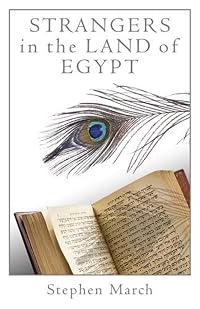
Strangers in the Land of Egypt
by Stephen March
On This Page
Tags
Recommendations















Member Reviews
There’s much to like in Stephen March’s Strangers in the Land of Egypt. The protagonist is that likable high-schooler who somehow is much more self-aware and wise than his peers but who still has lots to learn. The crises in the story don’t stretch our credulity. And the epiphanies in the end are profound, but they don’t promise to solve everything in a neat little package.
What keeps me from loving this book is that it doesn’t seem to know who its audience is, whether it’s aiming for a traditional Young Adult crowd or a literary adult audience. It’s the difference between Cecil Castellucci’s Beige or Sara Zarr’s Story of a Girl and Robert Clark’s Love Among the Ruins, between a coming of age story in which the show more narrator is developing along with story and one in which an adult narrator—with adult understanding—looks back on youth. Where this comes out most strongly to me is in the exposition. After passages of deep understanding probing the emotions and psyche of our main character, we’ll get expositions of the basics of Judaism or the Holocaust that might be fitting in an After School Special. Castellucci’s Katy learns things she doesn’t know in natural interactions with her environment; Jesse listens to the kind of lectures I’d like to give the teens in my life but know they’ll never hear.
Blurbs pasted on the back of my reviewer’s copy praising March's previous work claim that “March has successfully captured the feel of Southern angst as only…Faulkner or Flannery O’Connor can.” I generally ignore blurbs, and its probably unfair to compare anyone living to the crown royalty of Southern fiction. I can certainly see how an overzealous blurber could make the connection. Does Strangers feature an agnostic protagonist being confronted with a moment of supernatural grace? Yes. Does the story take place in a small town where everyone knows everyone, and everyone has a colorful backstory? Yes. But for my money, this town could have been placed in any of a number of struggling Northern towns. Maybe the hegemony of consumerism has erased some of the unique qualities that made the South of Faulkner and O’Connor distinct from the Hawthorne’s New England or Sandberg’s Chicago.
I began this review saying there’s much to like in Strangers in the Land of Egypt. What made me keep turning the pages was the developing relationship between a self-aware, clueless boy and an odd Jewish Holocaust survivor. That Jesse (as in “the tree of”) is redeemed by the ministrations of a man named Ebban, the helpful stone carved with holy text, perhaps puts too fine a point on the transformation of the teen, but it is perhaps the only heavy-handed aspect to a subtle conversion in which we don’t see a fully renewed soul but rather a man set on the path of grace. show less
What keeps me from loving this book is that it doesn’t seem to know who its audience is, whether it’s aiming for a traditional Young Adult crowd or a literary adult audience. It’s the difference between Cecil Castellucci’s Beige or Sara Zarr’s Story of a Girl and Robert Clark’s Love Among the Ruins, between a coming of age story in which the show more narrator is developing along with story and one in which an adult narrator—with adult understanding—looks back on youth. Where this comes out most strongly to me is in the exposition. After passages of deep understanding probing the emotions and psyche of our main character, we’ll get expositions of the basics of Judaism or the Holocaust that might be fitting in an After School Special. Castellucci’s Katy learns things she doesn’t know in natural interactions with her environment; Jesse listens to the kind of lectures I’d like to give the teens in my life but know they’ll never hear.
Blurbs pasted on the back of my reviewer’s copy praising March's previous work claim that “March has successfully captured the feel of Southern angst as only…Faulkner or Flannery O’Connor can.” I generally ignore blurbs, and its probably unfair to compare anyone living to the crown royalty of Southern fiction. I can certainly see how an overzealous blurber could make the connection. Does Strangers feature an agnostic protagonist being confronted with a moment of supernatural grace? Yes. Does the story take place in a small town where everyone knows everyone, and everyone has a colorful backstory? Yes. But for my money, this town could have been placed in any of a number of struggling Northern towns. Maybe the hegemony of consumerism has erased some of the unique qualities that made the South of Faulkner and O’Connor distinct from the Hawthorne’s New England or Sandberg’s Chicago.
I began this review saying there’s much to like in Strangers in the Land of Egypt. What made me keep turning the pages was the developing relationship between a self-aware, clueless boy and an odd Jewish Holocaust survivor. That Jesse (as in “the tree of”) is redeemed by the ministrations of a man named Ebban, the helpful stone carved with holy text, perhaps puts too fine a point on the transformation of the teen, but it is perhaps the only heavy-handed aspect to a subtle conversion in which we don’t see a fully renewed soul but rather a man set on the path of grace. show less
 This review was written for LibraryThing Early Reviewers.
Jesse Terrill, at the age of 16, has had more trials than most people twice his age. After his brother dies, his parents divorce, and his mom abandons Jesse and his dad. Then his dad is mugged and severely beaten, leaving him brain-damaged to the extent that Jesse and his uncle cannot care for him at home. Is Jesse angry? Yes, he is. Does he want to lash out at the world? Yes, he does. So one moonlit night he unthinkingly goes along with his pals to vandalize the nearby Jewish temple. Unfortunately for Jesse, he is the only one who is caught. His punishment is many community service hours reading to and helping a wheelchair-bound Holocaust survivor. The characters in this novel are so real you could meet them on the street, even the show more secondary characters are fully fleshed out. Jesse's uncle tries so hard and lovingly to tame Jesse, to get him through his difficult adolescence. But Jesse burns with rage. More than anything he wants to find and kill the man who beat his father. Will he succeed? Or will he be hurt in the risky game he's playing?
The reader is frustrated along with Jesse as he makes one bad decision after another, knowing full well that it can only make matters worse. Jesse knows what he wants to do is wrong, and it's fascinating to watch his internal struggle. Mr. Ebban also sees the struggle and, through the Torah and conversation, tries to help Jesse see the better way.
Strangers in the Land of Egypt is a real page-turner--with a huge heart. I strongly recommend it for readers over the age of fourteen! show less
The reader is frustrated along with Jesse as he makes one bad decision after another, knowing full well that it can only make matters worse. Jesse knows what he wants to do is wrong, and it's fascinating to watch his internal struggle. Mr. Ebban also sees the struggle and, through the Torah and conversation, tries to help Jesse see the better way.
Strangers in the Land of Egypt is a real page-turner--with a huge heart. I strongly recommend it for readers over the age of fourteen! show less
Jesse Terrill, a troubled 17-year-old somewhere in North Carolina, joins some friends in vandalizing a Jewish Synagogue. He’s caught, and sentenced to, among other things, do community service by assisting an elderly Holocaust survivor Mendel Ebban.
The book lost me in the opening scene. Jesse, the narrator, doesn’t manage to come across as a believable character. He’s simplified, and inconsistent. He doesn’t spend a lot of time describing scenes, so the atmosphere, emotions, smells etc. are generally missing. And, as the story moves along, he seems to adjust his personality, becoming smarter or dumber as needed for the plot - or the author’s sense of didacticism. (For example, as Jesse heads toward his lowest point, he pauses show more to ponder a well-developed thesis on the Civil War.)
In some ways the whole book felt dumbed down, or just over simplified. The story was actually OK, maybe even good. The novelistic structure is there, and I was able to keep reading with some interest, and find the ending rather well done. But I was constantly bothered by a number of things, such as how Mendel seemed underdeveloped, only potentially a great character; and how his main care taker, Varden Story, always seemed to appear when needed – either to save Jesse or the story-line. (Varden has some sort of symbolic meaning that may justify him to a point).
Clearly this was the wrong book for me. All my criticism is very personal in nature and to a large extent could be an intentional stylistic choice by the author - an intentional simplification of the story. Perhaps it's a good book for another audience.
2009
http://www.librarything.com/topic/54129#1022840 show less
The book lost me in the opening scene. Jesse, the narrator, doesn’t manage to come across as a believable character. He’s simplified, and inconsistent. He doesn’t spend a lot of time describing scenes, so the atmosphere, emotions, smells etc. are generally missing. And, as the story moves along, he seems to adjust his personality, becoming smarter or dumber as needed for the plot - or the author’s sense of didacticism. (For example, as Jesse heads toward his lowest point, he pauses show more to ponder a well-developed thesis on the Civil War.)
In some ways the whole book felt dumbed down, or just over simplified. The story was actually OK, maybe even good. The novelistic structure is there, and I was able to keep reading with some interest, and find the ending rather well done. But I was constantly bothered by a number of things, such as how Mendel seemed underdeveloped, only potentially a great character; and how his main care taker, Varden Story, always seemed to appear when needed – either to save Jesse or the story-line. (Varden has some sort of symbolic meaning that may justify him to a point).
Clearly this was the wrong book for me. All my criticism is very personal in nature and to a large extent could be an intentional stylistic choice by the author - an intentional simplification of the story. Perhaps it's a good book for another audience.
2009
http://www.librarything.com/topic/54129#1022840 show less
This review was written for LibraryThing Early Reviewers.My first impression was that the lead character is rather stock in nature - a teenager, who is basically good but runs with a much-less-good crowd, is assigned community service at a nursing home. It seemed relatively easy to see where the story was going as far as theme. Yet, I was enjoying the interesting quirks of the characters and the twists in the plot so far while I was reading.
After finishing though, I realized I truly enjoyed this book. I assumed the story was going to focus more on the Holocaust due to the fact that the main character is a boy (Jesse) arrested for breaking into a synagogue and sentenced to spend time in a nursing home with a Holocaust survivor (Mendel). I expected a coming of age story focused on Jesse's show more realization of lives more fraught with horror and loss than his own. Instead, I found a book focused on the details of Jesse's life, more so than Mendel's. Mendel is an influence but a quiet one, affecting change through an intense presence rather than a series of sermons. I am pained by the story, but in way which causes remembrance and reflection rather than frustration and sadness.
My only disappointment was in the ending. On the one hand, I felt the quick wrap-up was appropriate; afterall, reality doesn't end in a well organized, neatly packaged narrative. On the other hand though, I found myself frustrated by how quickly the story ended. show less
After finishing though, I realized I truly enjoyed this book. I assumed the story was going to focus more on the Holocaust due to the fact that the main character is a boy (Jesse) arrested for breaking into a synagogue and sentenced to spend time in a nursing home with a Holocaust survivor (Mendel). I expected a coming of age story focused on Jesse's show more realization of lives more fraught with horror and loss than his own. Instead, I found a book focused on the details of Jesse's life, more so than Mendel's. Mendel is an influence but a quiet one, affecting change through an intense presence rather than a series of sermons. I am pained by the story, but in way which causes remembrance and reflection rather than frustration and sadness.
My only disappointment was in the ending. On the one hand, I felt the quick wrap-up was appropriate; afterall, reality doesn't end in a well organized, neatly packaged narrative. On the other hand though, I found myself frustrated by how quickly the story ended. show less
This review was written for LibraryThing Early Reviewers.Jesse Terrill could be pegged as the stereotypical 'troubled teen' -- his older brother has been killed, his mother has abandoned his family, and his father has suffered brain damage as a result of being attacked in an alley -- and in the opening of Strangers in the Land of Egypt, he's feeling restless. That restlessness translates into trouble after he's caught vandalizing his town's Jewish temple. The judge assigned to his case lets him off relatively easy; instead of being sent to the state reformatory, Jesse is assigned as an aide to Mr. Ebban, a Holocaust survivor currently living in a nursing home. Mr. Ebban and his unwavering faith are alien to Jesse, who is rather (understandably) jaded. Through his duty to Mr. Ebban -- which show more includes reading to the gentleman from both the Bible and the Torah -- Jesse begins to understand the old man's way of life, and that understanding impacts his own.
This book has a great cast of characters, and the interactions between them are enjoyable to read. I'll admit that Varden Story, Jesse's supervisor at the nursing home, is my favorite -- he's got some great dialogue. Mr. Ebban is wonderful in his own right; he has an impact on both Jesse and the reader. The only complaint I have about this novel is that it feels too short. The story's threads all get tied up in the last twenty pages, and that just seems unreal -- a little too neat to be believable-- to me. This book is certainly worth reading, though. show less
This book has a great cast of characters, and the interactions between them are enjoyable to read. I'll admit that Varden Story, Jesse's supervisor at the nursing home, is my favorite -- he's got some great dialogue. Mr. Ebban is wonderful in his own right; he has an impact on both Jesse and the reader. The only complaint I have about this novel is that it feels too short. The story's threads all get tied up in the last twenty pages, and that just seems unreal -- a little too neat to be believable-- to me. This book is certainly worth reading, though. show less
This review was written for LibraryThing Early Reviewers.I received this book as part of the Early Reviewers program, having requested it mostly because I thought the title sounded interesting. If I were to decide whether or not I wanted to continue reading the book based solely on the first few pages, or even the first chapter, I probably would not have finished the book. It seemed a bit too much like urban fiction for my taste. However, I persevered and the story did improve, as did the likability of the protagonist. The dynamics between Jesse & Mr. Ebbans were interesting, if a bit "Tuesdays With Morrie"-ish. The ending felt a bit anticlimactic to me, as if many threads were left hanging, particularly as far as relationships between different characters were concerned. Overall it was a show more speedy read, though probably not something I would read again. show less
This review was written for LibraryThing Early Reviewers.A decent Librarything Early Reviewer offering, about a troubled young man who gets in trouble with the law when he is caught vandalizing a synagogue. The judge puts him on probation with community service and restitution, part of the community service being to become a reader and assistant for an elderly Jewish man, Mr. Ebban, who retains a deep faith despite the horrors he endured as a young man during the Holocaust. Jesse's life threatens to spin further out of control as he deals with his brother's death, his mother's abandonment, and the pursuit of the man who mugged his father, inflicting injuries that have forced him into a nursing home. Through it all, Mr. Ebban's quiet and sturdy faith is there, eventually rescuing the lad in show more what could have been his darkest hour. There are many stories and movies about troubled young men being guided by a wise old man ("Tuesdays With Morrie" and "On Golden Pond" come to mind). This is a pretty good representative of the genre, not badly written, but not a particular standout either. show less
This review was written for LibraryThing Early Reviewers.Members
- Recently Added By
Author Information
4 Works 28 Members
A graduate of both the University of North Carolina at Chapel Hill and the University of North Carolina at Greensboro, where he earned an M.F.A. in creative writing, Stephen March is a professor of English at Elizabeth City State University in Elizabeth City, North Carolina
Common Knowledge
- Original publication date
- 2009
Classifications
Statistics
- Members
- 21
- Popularity
- 1,237,331
- Reviews
- 10
- Rating
- (3.17)
- Languages
- English
- Media
- Paper, Ebook
- ISBNs
- 1
- ASINs
- 1