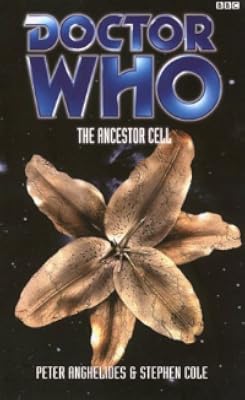
The Ancestor Cell
by Peter Anghelides
War in Heaven (Whoniverse) (11), Doctor Who: Eighth Doctor Adventures (36), Doctor Who {non-TV} (Novels — EDA Novel)
On This Page
Description
Compassion has finally been tracked down by the Time Lords and two TARDISes are moving in to attack and disable here. She disgorges the Doctor and Fitz in a dark, mysterious, Gallifreyan location, where they are attacked by a gigantic spider, that only the Doctor can see.Tags
Recommendations





















Member Reviews
One of the things I always struggle with with this series of Doctor Who tie-in novels is that there's a lot of mostly nonsensical technobabble that I mostly just let wash over me because it's, well, nonsensical—but then every so often it turns out that some of the nonsensical technobabble is brought back as an "aha! gotcha! twist!" moment, which leaves me confused and/or shrugging. This happened quite a bit here, though there were some good character moments and a conclusion to the Faction Paradox arc which drew a line under things in a mostly satisfying way. That's enough to bump my rating up from a 2.5 to a 3, despite the slightly ropy prose/dialogue.
What I really didn't like was the sexism embedded in the narrative and the framing show more of the female characters. It's not the worst I've ever read but it's persistent and irritating, of the kind that makes me think the authors never imagined a woman reading their work. show less
What I really didn't like was the sexism embedded in the narrative and the framing show more of the female characters. It's not the worst I've ever read but it's persistent and irritating, of the kind that makes me think the authors never imagined a woman reading their work. show less
__________________________________
__________________________________
__________________________________
__________________________________
__________________________________
__________________________________
__________________________________
__________________________________
__________________________________
__________________________________
__________________________________
__________________________________
__________________________________
__________________________________
__________________________________
__________________________________
This novel, the climax of the Faction Paradox and future war story arc, is epic but enormously sadistic. It makes the original series Doctor Who episode "Resurrection of the Daleks" look
Comments, or aspects that interested me most:
The current incarnation of Romana, now president of Gallifrey, has no redeeming qualities. She is vain and arrogant (like the original played by Mary Tamm), but a cold, calculating politician. Her interaction with the Doctor in the story is actually fairly limited; but she feels no affection whatsoever toward him.
I believe many reviewers have noted this--the hero of the story is the TARDIS. Prefiguring the new series episode "The Doctor's Wife" but actually taking its theme further (while not presenting the TARDIS as a woman), the novel suggests the TARDIS intelligence loves the Doctor and would put itself to a great deal of suffering to save him.
The novel is poorly edited, with a few embarrassing typos; and the writing is just okay. For one thing, the book is full of not gratuitous pop-culture references (only a few, thankfully) but gratuitous restatements of famous lines from the original series.
Gallifrey faces not one but two enemies: Faction Paradox, and an unidentified "Enemy" the Time Lords have been preparing for with the handicap of knowing nothing about. The Enemy are revealed to be a race of extremely powerful alien organisms from outside the universe, believed to be the ancestors of all life therein.
Gallifrey's defeat is indirectly caused by what is essentially an accident. The Time Lords have a miniature universe in a bottle, which they had apparently stolen from someone else (in some previous novel) intending to use the miniature universe as an emergency bolthole from their unidentified Enemy. The bottle gets broken, and the energy released from it disturbs the Enemy (I have no idea why), who release an unstoppable energy wave that brutally destroys large numbers of people, crippling Gallifrey (already under siege by a fifth column of Faction Paradox-allied Gallifreyans) and allowing Faction Paradox to win the war.
Different authors have interpreted the Time Lords in different ways, but these authors' depiction of Gallifrey is implausible and inappropriate. In order to shoehorn their social criticism into a story it doesn't naturally belong in, the authors depict Gallifrey as having a highly pollutive industrial sector and rampant poverty and homelessness. That's absurd unless viewed as one of the time distortions caused by the Edifice: a society so advanced as to control time travel can't fulfill material needs and can't function without heavy industry?
This story very obviously influenced the Time War of the new series; some aspects of the Time War's conclusion are identical. The Doctor destroys Gallifrey in order to prevent Faction Paradox from taking over it and ruling time and space. But what happens in this book is much too violent to be be shown on television in its original form, only a massively sanitized version. The Time War replaced the Faction with the Daleks, for essentially commercial reasons.
There has probably never been a materially nastier, more graphically horrifying Doctor Who novel than this. I actually found Lawrence Miles' Alien Bodies even more unpleasant, but in a creepy and ineffable way I never understood. (I never finished it, and made no serious attempt to read Miles' postmodern filth Interference.)
Whovian readers have wondered why the editors chose to reset the novel's continuity with this book, purging it of the elements introduced by Lawrence Miles. The likely reason is obvious enough to me. It's almost certainly because Miles had made the series too postmodern; the editors' purge of the Miles elements was an attempt to pull it back in a somewhat more traditional direction while preserving the result they established in The Ancestor Cell: Gallifrey is gone, as it was in the modern television series until late 2013.
The novel may be disgusting, but I like doomsday stories, and got what I expected in this novel.
http://nwhyte.livejournal.com/2018088.html
This is the first of the books setting up the Faction Paradox timeline which I have enjoyed. The Doctor and Fitz return to Gallifrey in Compassion-as-Tardis, and find themselves implicated in a power struggle between President Romana and one of her predecessors, resurrected by the Faction Paradox. It contains the seeds of numerous ideas which we have seen in later stories, particularly the Gallifrey audios (though they of course feature Romanas I and II, whereas here it's clearly another Romana), and ends with the original Tardis regenerating itself and the Doctor stuck on Earth with amnesia - both picked up more recently in Big Finish continuity. Most importantly it rounds off a significant show more story arc, going back to the start of the BBC Eighth Doctor series in some ways, and does so very satisfactorily. Sometimes Who stories playing with Gallifreyan drama and temporal paradoxes get too clever for their own good, but this is just about right. Very satisfying. show less
This is the first of the books setting up the Faction Paradox timeline which I have enjoyed. The Doctor and Fitz return to Gallifrey in Compassion-as-Tardis, and find themselves implicated in a power struggle between President Romana and one of her predecessors, resurrected by the Faction Paradox. It contains the seeds of numerous ideas which we have seen in later stories, particularly the Gallifrey audios (though they of course feature Romanas I and II, whereas here it's clearly another Romana), and ends with the original Tardis regenerating itself and the Doctor stuck on Earth with amnesia - both picked up more recently in Big Finish continuity. Most importantly it rounds off a significant show more story arc, going back to the start of the BBC Eighth Doctor series in some ways, and does so very satisfactorily. Sometimes Who stories playing with Gallifreyan drama and temporal paradoxes get too clever for their own good, but this is just about right. Very satisfying. show less
I enjoyed Ancestor Cell quite a bit. At first I didn't care for the 3rd incarnation of Romana, but she grew on me as the story progressed. The Doctor is left out of the action a bit and is quite powerless through a good part of the book, but I thought it was a fitting end to the arc. I enjoyed Fitz in Ancestor Cell more than I usually do. Not that I dislike Fitz. I liked Faction Paradox as the baddies. It ended with a bang, kept me riveted the whole read and furhtered the 8th Doctors story.
I liked the part where it just barely made sense. No, really. I liked it.
I really ought to re-read these 8th Doctor books in order.
Ratings
Members
- Recently Added By
Author Information

80+ Works 1,960 Members
Series


Common Knowledge
- Canonical title
- The Ancestor Cell
- Original publication date
- 2000-07-03
- People/Characters
- The Doctor (8th); Fitz Kreiner; Compassion; Romana (3rd); K-9 (Mark II); Father Kreiner (show all 18); Mali; Nivet; Grandfather Paradox; Greyjan the Sane; Mother Tarra; Kellen; Kaufima; Eton; Kristeva; Ressadriand; Timon; Vozarti
- Important places
- Gallifrey
- Important events
- War in Heaven
- Dedication
- For my parents, Margaret and Allan Anghelides.
PA
For Theresa Shiban, with love.
SC - First words
- Lady Withycombe had remained for some twenty minutes on the carriage seat, lounging in that warm and comfortable state in which, half asleep, half awake, consciousness begins to return after a sound slumber.
- Last words
- (Click to show. Warning: May contain spoilers.)Whoever he is.
Classifications
Statistics
- Members
- 211
- Popularity
- 154,760
- Reviews
- 6
- Rating
- (3.45)
- Languages
- English
- Media
- Paper
- ISBNs
- 1