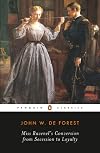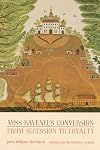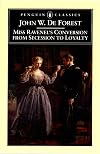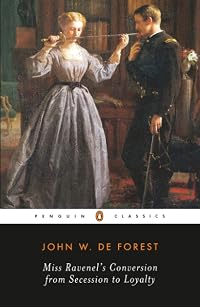
Miss Ravenel's Conversion from Secession to Loyalty
by John W. De Forest
On This Page
Description
More panoramic in scope and more realistic in its details than Crane's Red Badge of Courage, this is one of the first and best novels ever written about the American Civil War Drawing on his own combat experience with the Union forces, John W. De Forest crafted a war novel like nothing before it in the annals of American literature. His first-hand knowledge of "the wilderness of death" made its way on to the pages of his riveting novel with devastating effect. Whether depicting the tedium show more before combat, the unspoken horror of battle, or the grisly butchery of the field hospital, De Forest broke new ground, anticipating the realistic war writings of Ernest Hemingway, Norman Mailer, and Tim O'Brien. A commercial failure in its own day, De Forest's story was praised by Henry James and William Dean Howells, who, comparing it favorably to War and Peace, acclaimed the book "one of the best American novels ever written." For more than seventy years, Penguin has been the leading publisher of classic literature in the English-speaking world. With more than 1,700 titles, Penguin Classics represents a global bookshelf of the best works throughout history and across genres and disciplines. Readers trust the series to provide authoritative texts enhanced by introductions and notes by distinguished scholars and contemporary authors, as well as up-to-date translations by award-winning translators. show lessTags
Recommendations






















Member Reviews
The only "realist" novel about the Civil War written by someone who actually fought in the conflict. Its LONG arc encompasses a lot of boring marriage plot nonsense at the beginning and end, all designed to show us that good and right eventually win out. But it's all too clear that the author, well known as a nonfiction writer, is longing to get us back to the front. And when he's at the battle lines, this book is almost unequaled in 19th century fiction about war. Took me longer than it should to finish. I think he was going for something sprawling and Dickensian but it just doesn't feel tight enough to really be successful as a novel.
From GoodReads: Miss Ravenel’s Conversion is important in American literary history as the first novel to depict the Civil War with realism. Its battlefield scenes owe much to John De Forest’s own experience as a captain in that conflict. But in 1867 genteel readers were affronted by De Forest’s frank view of war and sex. Though praised by William Dean Howells, the novel was forgotten after De Forest’s death in 1906. It was later rediscovered by Van Wyck Brooks and other critics. Modern readers will enjoy this story of a southern woman who comes to New Boston with her father in 1861, opposes his views on secession and abolition, and is changed forever by the great war. Some critics have called the charming Lillie Ravenel the show more first realistic heroine in American fiction.
My review: Does this novel depict the Civil War realistically? Yes. Is Lillie Ravenel the strong heroine described by the GoodReads description? No. She comes off as a bit silly, actually. Miss Ravenel's Conversion is less about Miss Ravenel's conversion and more about life during the Civil War (wait, I'm in the South...War of Northern Aggression) and domestic affairs at the time. The first half of the book was rather boring, being mostly about Lillie's friendship with two military men, the drinking, philandering Carter and the gentle lawyer Colborne, and how she eventually decides which of the two she'll marry. It sounds kind of Jane Austen-esque, but De Forest fails to make it very interesting. The second half of the novel picks up some, however, with descriptions of battles and military life, Lillie's father's plantation experiment with free black labor, and Carter's eventual dissolution into political corruption and adultery. While De Forest's characterizations of women and Southerners seemed rather degrading, he doesn't glorify the Union, either (again with Carter's corruption, and there's some comical bits about drunk and/or cowardly commanders). After all, the novel is considered a work of realist literature. show less
My review: Does this novel depict the Civil War realistically? Yes. Is Lillie Ravenel the strong heroine described by the GoodReads description? No. She comes off as a bit silly, actually. Miss Ravenel's Conversion is less about Miss Ravenel's conversion and more about life during the Civil War (wait, I'm in the South...War of Northern Aggression) and domestic affairs at the time. The first half of the book was rather boring, being mostly about Lillie's friendship with two military men, the drinking, philandering Carter and the gentle lawyer Colborne, and how she eventually decides which of the two she'll marry. It sounds kind of Jane Austen-esque, but De Forest fails to make it very interesting. The second half of the novel picks up some, however, with descriptions of battles and military life, Lillie's father's plantation experiment with free black labor, and Carter's eventual dissolution into political corruption and adultery. While De Forest's characterizations of women and Southerners seemed rather degrading, he doesn't glorify the Union, either (again with Carter's corruption, and there's some comical bits about drunk and/or cowardly commanders). After all, the novel is considered a work of realist literature. show less
Outstanding battle description by a talented writer who was actually on the scene of Civil War actions. I wish more DeForest were available today.
Fair/Poor Charles W Boltwood"
Ratings
Members
- Recently Added By
Lists

Fiction (Mostly) in Selective Bibliography of American Literature 1775-1900
431 works; 3 members
Author Information

23+ Works 325 Members
John William De Forest was a writer. His major novel, Miss Ravenel's Conversion from Secession to Loyalty (1867), and two works, A Volunteer's Adventures (published posthumously in 1946) and A Union Officer in the Reconstruction (published posthumously in 1948), which originally appeared in the Atlantic Monthly and Putnam's magazines, show show more detailed pictures of the society and manners of the South during and after the Civil War. De Forest was born in Seymour, Connecticut, and his first published work was the History of the Indians of Connecticut from the Earliest Known Period to 1850 (1851). He lived with his brother in Syria for several years and traveled widely through the Near East and Europe. He married and settled in the South but served with the Connecticut Volunteers in the Civil War. (Bowker Author Biography) show less
Series
Belongs to Publisher Series
Common Knowledge
- Canonical title
- Miss Ravenel's Conversion from Secession to Loyalty
- Original publication date
- 1867
- Important places
- New Orleans, Louisiana, USA
- Important events
- American Civil War
- First words
- It was shortly after the capitulation of loyal Fort Sumter to rebellious South Carolina that Mr. Edward Colburne of New Boston made the acquaintance of Miss Lillie Ravenel of New Orleans.
- Last words
- (Click to show. Warning: May contain spoilers.)Colburne listened, happily smiling, conscious of a loved and loving wife, of a growing balance in bank, of surroundings which he would not have exchanged for a field of victory.
Classifications
- Genres
- Fiction and Literature, General Fiction, Historical Fiction
- DDC/MDS
- 813.3 — Literature & rhetoric American literature in English American fiction in English Middle 19th Century 1830-1861
- LCC
- PS1525 .D5 .M5 — Language and Literature American literature American literature Individual authors 19th century
- BISAC
Statistics
- Members
- 172
- Popularity
- 190,913
- Reviews
- 4
- Rating
- (4.13)
- Languages
- English
- Media
- Paper, Ebook
- ISBNs
- 11
- ASINs
- 10