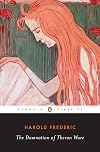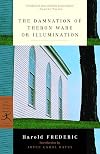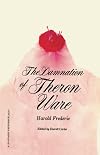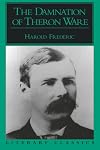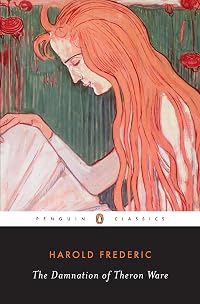
The Damnation of Theron Ware
by Harold Frederic
On This Page
Description
Although it languished in relative obscurity for several decades, the novel The Damnation of Theron Ware has recently experienced a revival in popularity as it has been identified as one of the earliest examples of realism in American fiction. An idealistic young minister finds himself facing a profound crisis of faith, and he succumbs to a series of temptations. Can he put things right before it's too late?.
Tags
Recommendations



















Member Reviews
“[Y]ou see, there is nothing new. Everything is built on the ruins of something else. Just as the material earth is made up of countless billions of dead men’s bones, so the mental world is all alive with the ghosts of dead men’s thoughts and beliefs” (71)
I suppose that I would describe this novel as one of attempted intellectual discovery. A rank and file Methodist minister, Theron Ware, is working his way up through the church hierarchy, and his professional ambitions are comfortably constrained by his limited worldview, which hardly extends past the boundaries of his congregation. Ware is good, but not great, at what he does, and he resignedly moves to a new town, Octavius, with his wife Alice to make the best of things. show more
Despite being set in the Adirondack Mountains, which I would find reason enough to be happy, Ware is disappointed and he finds his congregation to be collectively dull, miserly, and intellectually stultifying. His fortune appears to turn, however, when he happens upon and was drawn into the orbit of a non-practicing Irish Catholic priest (Father Forbes), a non-practicing physician (Ledmar), and an Irish woman who is is pianist and church organist. These three figures seem to represent intellectual pursuits (theology/philosophy, science, arts) that Ware identifies as missing from his life. These people are also sources of Ware’s damnations or punishments - as promised by the title of the book.
In each of these three people, Ware finds the allure of people, culture, and intellectual pursuits that are both outside the norm for a Methodist minister and even at the edge of what would be deemed socially acceptable. Ware is convinced, however, that his brief engagement with these people “had lifted him bodily out of the slough of ignorance, of contact with low minds and sordid, narrow things, and put him on solid ground” (131). This might have felt true to Ware, but I think Forbes, Ledmar, and Celia deemed Ware to be irretrievably mired in the brackish pond of his social and professional circles. It’s not a fair judgement, I think, and it feels a little like an ethical shortcoming if Forbes, Ledmar, and Celia have misjudged the shallowness of the pond in which Theron thought himself to be drowning. However, Ware helps himself not one bit by inviting punishment on himself by pretending to transformative intellectual rebirth after mere days, only to show himself to be the misinformed bore that he can’t help but be.
Ware, fortified by the illusion of his intellectual and cultural salvation, uses his presumed faculties to drive a wedge that alienates himself from his congregation. This is where Sister and Brother Soulsby arrive, to bring equal measures of illumination and punishment. These two characters come from a checkered background in which they honed their skills of manipulation. The illumination they provide is that Ware’s natural ability to persuade, combined with the authority of his position makes him naturally suited to his work a minister in all of its aspects, including what Ware sees as its more dubious applications. Sister Soulsby argues the moral rectitude of these actions with sophistical skill, attempting to assure Theron that his exercise of power is appropriate “[t]o them the profession of entire sanctification is truly a genuine thing […] don’t you see, when people just know that they’re saved, it doesn’t seem to them to matter so much what they do.” (175). The conflict between who Ware is but doesn’t want to be and who he wants to be but isn’t does far reaching damage.
I’m not sure what the message here might be, but because the Soulsbys turn out to be the most sympathetic characters in the book, it seems to follow that a message is that we are who we are inclined to be, according to the nature of our inherent capabilities. This is certainly one view of human nature, not one that I fully subscribe to. It is a sort of human-as-monad outlook in which it is possible, through reflection, to be aware of our nature, and to work against that nature will surely heap punishments upon us. Illumination (the author’s preferred title for the book) seems to come from a true realization of self and one’s circumscribed potential.
This was an enjoyable book. The writing tended toward a Victorian style of florid elaboration but it was often held in check. Maybe this was the author’s background as a journalist doing its magic for clarity. The author, Harold Frederic was new to me, and I will look up some of his other books. show less
Frederic's feat is a precise holding and adjusting of perspective, one that builds and ultimately crescendos in a vein so awkward and uncomfortable it left me squirming. The theological discussions too, are robust and would be right at home in discourse of 2019...which isn't such a great thing.
This is a hella book! It's my current unanswered prayer to HBO for a miniseries. Our father and board chair, give us next season....a period piece, like Deadwood, with a religious twist, like Big Love...a torrid tale of Methodism in fin de siecle upstate New York.
To cut to the chase - I'm actually an unabashed anti-clerical curmudgeon, so I was rooting for my young Galahad, Theron Ware, to break out of his moldy Methodist mold. I was swooning right along with him as Celia turned on the Chopin, as he got hip to George Sand, as the filter in my reading glasses turned from sepia to henna.
That's not to say I didn't appreciate the ample religious and philosophical digressions. At one point, I thought I had wandered into a chapter of the show more Brothers Karamazov - Dr. Ledmar, expounding on the religiosity of women, explains they require "miracles, mystery...and their dogma embodied in a man" Yo, 'sup Dostoyevsky? Duh, Grand Inquisitor!
But still, I was plowing along for the pure romance novel thrill, except maybe with Celia in the open chested pirate shirt, and Theron draped on her arm. And so I more or less was sucker-punched by the Turn-of -the-Screw ending. What I thought was a finish line victory tape to this puddle-leaping hill-climbing motocross of a spiritual thrill ride turned out to be piano wire. Thwappp! thump-thump thump.
Seriously, this masterpiece is a leather dog bone for literary types. You can gum and slobber it all day long, savoring stuff like Adamic Myth themes, 19th century realism, Faustian downfalls, the role of the ministry in American literature, Catholic and Protestant culture clashes and on and on. And you should. I suggest http://helios.acomp.usf.edu/~rrogers/index.html
But beware, I daresay this is the kind of obscure but gripping work that could turn an unsuspecting underclassman into an English major. One is intrigued and then enamored. One does research and becomes illuminated. One begins a thesis and continues to grad school. And one is damned...to a cash register in a Barnes and Noble in Oregon. Fated by intellectual pride. show less
To cut to the chase - I'm actually an unabashed anti-clerical curmudgeon, so I was rooting for my young Galahad, Theron Ware, to break out of his moldy Methodist mold. I was swooning right along with him as Celia turned on the Chopin, as he got hip to George Sand, as the filter in my reading glasses turned from sepia to henna.
That's not to say I didn't appreciate the ample religious and philosophical digressions. At one point, I thought I had wandered into a chapter of the show more Brothers Karamazov - Dr. Ledmar, expounding on the religiosity of women, explains they require "miracles, mystery...and their dogma embodied in a man" Yo, 'sup Dostoyevsky? Duh, Grand Inquisitor!
But still, I was plowing along for the pure romance novel thrill, except maybe with Celia in the open chested pirate shirt, and Theron draped on her arm. And so I more or less was sucker-punched by the Turn-of -the-Screw ending. What I thought was a finish line victory tape to this puddle-leaping hill-climbing motocross of a spiritual thrill ride turned out to be piano wire. Thwappp! thump-thump thump.
Seriously, this masterpiece is a leather dog bone for literary types. You can gum and slobber it all day long, savoring stuff like Adamic Myth themes, 19th century realism, Faustian downfalls, the role of the ministry in American literature, Catholic and Protestant culture clashes and on and on. And you should. I suggest http://helios.acomp.usf.edu/~rrogers/index.html
But beware, I daresay this is the kind of obscure but gripping work that could turn an unsuspecting underclassman into an English major. One is intrigued and then enamored. One does research and becomes illuminated. One begins a thesis and continues to grad school. And one is damned...to a cash register in a Barnes and Noble in Oregon. Fated by intellectual pride. show less
2635 The Damnation of Theron Ware, by Harold Frederic (read 7 Aug 1994) I was inspired to read this 1896 novel by my reading on April 29, 1994, of The London Yankees by Stanley Weintraub. I found I liked it very well, not for the reasons suggested by modern critics but for a much more atavistic reason: it tells of a Methodist minister (Theron Ware) who makes a fool of himself when he, a married man, falls in love with a Catholic girl. The girl, and the Catholic priest (Father Forbes), who figures prominently in the story, are not exemplary figures, but I reacted favorably to the fall of the preacher. The climax is on page 331:
"It is all in a single word, Mr. Ware," she proceeded, in low tones, "I speak for others as well as myself, show more mind you,--we find that you are a bore."
I, contrary to more tender-hearted souls, richly enjoyed the denouement involving the frustration of the minister's desire for adultery. Frederic was born 1858, died 1898. His book, Into the Valley, has an entry in my 1958 Encyclopedia Americana. If I could find the book I might read it. show less
"It is all in a single word, Mr. Ware," she proceeded, in low tones, "I speak for others as well as myself, show more mind you,--we find that you are a bore."
I, contrary to more tender-hearted souls, richly enjoyed the denouement involving the frustration of the minister's desire for adultery. Frederic was born 1858, died 1898. His book, Into the Valley, has an entry in my 1958 Encyclopedia Americana. If I could find the book I might read it. show less
Illumination (1896) has been an underground classic among serious writers and readers since its publication. Although it sold well in its day, it was largely lost to mainstream attention for most of the 20th century. Only in the 1980s did it first start appearing in school settings with the first critical edition by Nebraska Press (and Penguin Press editions around the same time). It has been called an "American classic" by more than one critic and writer.
First, an explanation of the odd title. Frederic intended the title to be simply "Illumination", which it was indeed published as in England, but due to some mis-communication at his (soon to be bankrupt) American publishers - a working draft had the internal working name of show more "damnation" - it was mistakingly published as "The Damnation of Theron Ware". Later publishers in the 1930s then combined the two into the full title "The Damnation of Theron Ware, Or, Illumination".
This is an important novel and can be critically approached from a number of perspectives. Probably most important and timeless (c.f. Richard Dawkins "The God Delusion" (2006)) is Theron Ware's "Illumination" about truth in religion. Is the value of religion based on the belief in a real God, or just a belief in a god that may not even exist - the existence of which doesn't matter - the value in religion comes from _pretending_ to believe. It is unclear in the end if Sister Soulsby, Forbes and others truly believe, or just pretend to believe, and if it even matters.
The narrative technique of writing from Theron's perspective, hearing in the first person about his own "Illumination" and personal growth (a positive healthy thing it seems to him) - which is then re-played at the end of the novel from other peoples perspective, is very powerful and well crafted. It really makes the reader examine times in their own lives when they thought they were on the right and true path. It has a certain Rashomon theme of subjectivity and what is the truth of events from multiple perspectives. show less
First, an explanation of the odd title. Frederic intended the title to be simply "Illumination", which it was indeed published as in England, but due to some mis-communication at his (soon to be bankrupt) American publishers - a working draft had the internal working name of show more "damnation" - it was mistakingly published as "The Damnation of Theron Ware". Later publishers in the 1930s then combined the two into the full title "The Damnation of Theron Ware, Or, Illumination".
This is an important novel and can be critically approached from a number of perspectives. Probably most important and timeless (c.f. Richard Dawkins "The God Delusion" (2006)) is Theron Ware's "Illumination" about truth in religion. Is the value of religion based on the belief in a real God, or just a belief in a god that may not even exist - the existence of which doesn't matter - the value in religion comes from _pretending_ to believe. It is unclear in the end if Sister Soulsby, Forbes and others truly believe, or just pretend to believe, and if it even matters.
The narrative technique of writing from Theron's perspective, hearing in the first person about his own "Illumination" and personal growth (a positive healthy thing it seems to him) - which is then re-played at the end of the novel from other peoples perspective, is very powerful and well crafted. It really makes the reader examine times in their own lives when they thought they were on the right and true path. It has a certain Rashomon theme of subjectivity and what is the truth of events from multiple perspectives. show less
I read this book in a 19th C. American lit class & I wasn't too impressed by it. Harold Frederic does write some good short stories, but this book was pretty dull.
Project Gutenberg, 19th century, American Fiction, Realistic Fiction, Decadence, Gender Roles, Religion
Members
- Recently Added By
Lists

Books Read in 2016
4,666 works; 199 members

Harold Bloom - The Western Canon: C. The Democratic Age
336 works; 15 members

Trinity College Booklist (1951): Class Ten, English Literature
358 works; 5 members

Fiction (Mostly) in Selective Bibliography of American Literature 1775-1900
431 works; 3 members

Publisher's Weekly Bestsellers Part I - 1895-1939
399 works; 8 members

Books Read in 2026
1,950 works; 66 members
Author Information

14+ Works 702 Members
Journalist and author Harold Frederic was born in Utica, New York on August 19, 1856. He decided to become a journalist and was editor of the Albany Evening Journal by 1882. In 1884, he became a London correspondent for the New York Times. He covered the cholera epidemic in France and Italy and went to Russia to investigate the persecution of the show more Jews. Besides working as a journalist, he wrote numerous novels that dealt with such topics as the Revolutionary War, the Civil War, New York state, and English life. The Damnation of Theron Ware or Illumination, about the decline and fall of a Methodist minister, was his most famous work. He died in England on October 19, 1898 following a summer of illness that ended with a stroke. After his death, his mistress Kate Lyon and Athalie Mills, were arrested and charged with manslaughter for trying to heal him through faith instead of calling for a doctor. They were later acquitted. (Bowker Author Biography) show less
Some Editions
Awards and Honors
Series
Belongs to Publisher Series
Work Relationships
Has as a student's study guide
Common Knowledge
- Canonical title
- The Damnation of Theron Ware
- Original title
- The Damnation of Theron Ware
- Alternate titles
- Illumination
- Original publication date
- 1896
- First words
- No such throng had ever before been seen in the building during all its eight years of existence. People were wedged together most uncomfortably upon the seats; they stood packed in the aisles and overflowed the galleries; at... (show all) the back, in the shadows underneath these galleries, they formed broad, dense masses about the doors, through which it would be hopeless to attempt a passage.
Classifications
Statistics
- Members
- 637
- Popularity
- 45,526
- Reviews
- 8
- Rating
- (3.81)
- Languages
- English, German
- Media
- Paper, Audiobook, Ebook
- ISBNs
- 75
- ASINs
- 18