Moment in Peking
by Yutang Lin
On This Page
Tags
Recommendations






















Member Reviews
This book starts in 1900, during the Boxer Rebellion, and ends in 1937, presumably during the Rape of Nanking (which is not referred to in those terms). It follows the life of Yao Mulan, the eldest daughter of a wealthy merchant, and the lives of members of her extended family.
2 Bände
Sep 17, 2017German
Ratings
Members
- Recently Added By
Lists

Trinity College Booklist (1951): Class Five, Travel and Geography
52 works; 2 members
Author Information

168+ Works 3,332 Members
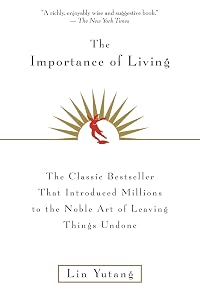
Though he was never considered to be a serious original thinker or a leading writer in his native China, Lin Yu-t'ang's role as an essayist and popularizer of things Chinese in the West is worthy of attention. He was a native of Changchow in Amoy, son of a Presbyterian minister, and third-generation Christian. He was brought up in a strict show more household and prepared for the ministry, and after middle school he was sent to the Protestant College of Amoy. In 1911 he entered the famous St. John's University in Shanghai, and it was during his time there that he became disillusioned with the choice of a religious career and renounced Christianity. After graduation (with a rather weak academic record), Lin Yu-t'ang became a professor of English at Tsinghua University because his grounding in foreign languages was much stronger than in classical Chinese. In 1919 he decided to pursue further study in the United States, where he spent one year at Harvard University and then went on to France where he worked for the YMCA. He moved to Germany for a term, and at last in 1923 earned a Ph.D. in Leipzig in the field of archaic Chinese phonology. Lin Yu-t'ang then returned home and tried out various teaching posts, and in 1927 became secretary to the Ministry of Foreign Affairs in the Wuhan government. But politics was not to his liking, and he resigned in the following year. In 1932 he founded the Analects Fortnightly, a magazine of wit and satire that proved to be an instant popular success. Two years later he began another periodical, This Human World, which contained short essays. Unfortunately, his satire angered intellectuals on both the Left and the Right, and this was the beginning of his lifelong friction with Chinese literary and academic circles. In 1936, feeling hostility at home but an increased demand for his writings in the West, Lin Yu-t'ang went to New York City and remained there until 1943, when he went back home to lecture briefly and again became embroiled in controversy. However, in the United States, his essays and ideas were greeted with great enthusiasm. Early in 1954 he was appointed chancellor of the new Chinese University in Singapore, but, because of a disagreement with the trustees on policy, he and his staff left early in 1955 before the university opened its doors. Not long after this, in New York, he and his wife publicly announced their reconversion to Christianity. In addition to his many books of essays, Lin Yu-t'ang published a novel, Moment in Peking, a saga about a Chinese family spanning the years 1900--38. He also published a number of translations of classical Chinese works, the best of which is perhaps Shen Fu's Six Chapters of a Floating Life, the moving autobiographical account of a happy marriage marred by parental disapproval and the tragic early death of the wife. Lin Yu-t'ang's writings are marked by an appreciation of both Eastern and Western culture, and their sparkling, idiomatic English style has endeared him to thousands of Western readers. (Bowker Author Biography) show less
Common Knowledge
- Canonical title*
- Episod i Peking
- Original publication date
- 1939
- Important places
- Peking, China; Beijing, China
- Important events
- Boxer Rebellion (1899 | 1901); First Sino-Japanese War (1894-08-01 | 1895-04-17)
*Some information comes from Common Knowledge in other languages. Click "Edit" for more information.
Classifications
- Genres
- General Fiction, Fiction and Literature, Historical Fiction
- DDC/MDS
- 895.135 — Literature & rhetoric Literatures of other languages Literatures of East and Southeast Asia Chinese Chinese fiction Modern period 1912–2010
- LCC
- PZ3 .L6367 — Language and Literature Fiction and juvenile belles lettres Fiction and juvenile belles lettres Fiction in English
Statistics
- Members
- 215
- Popularity
- 152,245
- Reviews
- 2
- Rating
- (4.00)
- Languages
- Chinese, English, Hungarian, Swedish
- Media
- Paper
- ISBNs
- 9
- ASINs
- 10