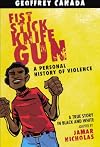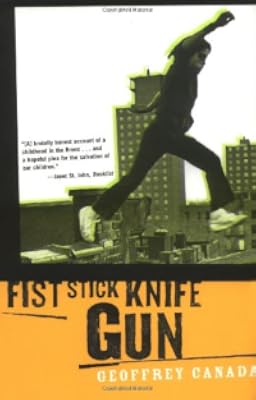
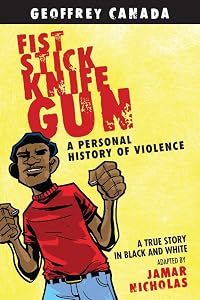
Fist Stick Knife Gun: A Personal History of Violence in America
by Geoffrey Canada
On This Page
Description
A new edition, including the story of the founding of the Harlem Children's ZoneLong before the avalanche of praise for his work--from Oprah Winfrey, from President Bill Clinton, from President Barack Obama--long before he became known for his talk show appearances, Members Project spots, and documentaries like Waiting for "Superman", Geoffrey Canada was a small boy growing up scared on the mean streets of the South Bronx. His childhood world was one where "sidewalk boys" learned the codes show more of the block and were ranked through the rituals of fist, stick, and knife. Then the streets changed, and the stakes got even higher. In his candid and riveting memoir, Canada relives a childhood in which violence stalked every street corner.
. show less
Tags
Recommendations













Member Recommendations
Member Reviews
Canada gives the reader a glimpse into the life of a poor African American growing up in the inner city in the 60's and 70's. His experiences on Union Street shaped his life and his understanding of the the connection between violence and poverty. He tells a tale full of struggle and hardship, as he literally fought to survive his childhood, and later fought against violence – eventually founding the Harlem Children's Zone. Canada has become a national figure in recent years, for his work with this organization, and his memoir should, perhaps, be on required reading lists. America has some real problems with violence, drugs, and poverty, but to treat the people exposed to these issues in their day to day life like some sort of disease show more (like the media and society at large tends to do) is unconscionable. Subjective accounts, such as this book, could be helpful in further shifting the discourse, and helping people understand and, just maybe, start to work toward figuring out some more actual solutions by working with people in troubled situations rather than declaring policy “wars” on societal issues. If possible I will use parts of this book in my high school social studies classes, and I will likely suggest it to other teachers I know, as well. show less
I found this book fascinating because it articulated a social dynamic which I had previously been unaware existed. When confronted with the spectre of violence within the inner city, or amongst the impoverished in general, the first and only reaction by those outside of that situation is to dismiss it as an "epidemic." However, this violence within the streets is beyond a simple disease that can be cured. Rather, it served (in the author's childhood) as a means by which a social order/hierarchy is established. From there, violence as normalized behavior would accompany his peers as they progressed through life and as they "upgraded" the weapons with which they asserted their dominance. The proliferation of firearms into this show more environment, according to Canada, would have a profound effect upon violence within the inner city.
I found that his personal history of violence could almost be taught alongside such "mirrors of princes" as "The Prince," and "The Book of the Courtier."
In general, I liked the issue of violence being presented with greater nuance than simply addressing it as inherently race mixed with poverty. show less
I found that his personal history of violence could almost be taught alongside such "mirrors of princes" as "The Prince," and "The Book of the Courtier."
In general, I liked the issue of violence being presented with greater nuance than simply addressing it as inherently race mixed with poverty. show less
A memoir by Geoffrey Canada, the book describes the conditions that he faced as he grew up in South Bronx. As an adult he opened the Beacon schools to reverse the trend of violence that he faced when he was growing up. The book describes the actual problems happening in our cities. It shows how Geoffrey went from an innocent kid to fighting with the big boys and then becoming a leader to fight against violence. The book is filled with stories from his childhood and his work. The book starts when one of his brothers lost a coat and their mother commanded him to get it back and beat the offender. The kids were scared but the strategy worked. So the children learned that violence gets what they want. From then on at every stage of their show more lives they learned the same lesson again and again. Violence earns respect and that is the most important commodity that a person might have. The turning point in the story came when drug trade switched to crack and gun from fists and knives. There were no more rules of conduct. The person with the biggest weapon rules everyone. It seemed glamorous and powerful to young men and women to carry guns. With no role models, this was a disaster in the making. The book then goes on to describe how the Rockefeller Laws and the drug explosion led to an epidemic of gun violence in our country.
The one thing that made this book stood out for me was the fact that Canada talked about the problems and then gave a solution through the creation of Harlem children’s zone. “The reality is that we pay more to incarcerate kids across this nation than we do to educate them” (p.133) instead of putting them away in jails we should get our kids off the streets. The whole community should be involved in this process.
The book has conversational tone and precise language. The author tells his story in matter-of-fact way. The contents are clearly organized in twenty-five chapters. The target audience can easily understand the language used. I believe that every student should read this book. It is especially relevant to our students, as New Orleans has one of the highest crime rates in the country. show less
The one thing that made this book stood out for me was the fact that Canada talked about the problems and then gave a solution through the creation of Harlem children’s zone. “The reality is that we pay more to incarcerate kids across this nation than we do to educate them” (p.133) instead of putting them away in jails we should get our kids off the streets. The whole community should be involved in this process.
The book has conversational tone and precise language. The author tells his story in matter-of-fact way. The contents are clearly organized in twenty-five chapters. The target audience can easily understand the language used. I believe that every student should read this book. It is especially relevant to our students, as New Orleans has one of the highest crime rates in the country. show less
The author has a lot of personal experience growing up tough with toughs on the mean streets. The title refers to the arms race of criminals on those streets. Look back from today's Uzis to the J.D. with a switchblade of the '50s. Looking back at his own journey from youth to taekwondo master and force for positive change giving teens alternative, healthy activities he recalls forming forces. One is the Rockefeller Drug Laws. These statutes dealing with the sale and possession of "narcotic" drugs in the New York State Penal Law adopted during a period of mounting national anxiety about drug use and crime were "tough on crime" while the author sees them as creating a role for youths to hold the drugs and thus enroll in crime college. At show more the same, the burgeoning market due to crack cocaine emerging made for a lot of new, youthful recruits with weaponry and stealing from/killing each other with the goods they spent their new income on: clothes, shoes. and more guns.
The author's view is that the stricter Rockefeller drug laws meant adult drug dealers didn't want the risk of drugs in their pocket due to the strict penalties. So, it is a child who holds the drugs physically. "Crime college" means the kid holding the drugs is now learning the drug trade. I am fine with seeing those who are obviously dealers being given sentences and/or financial charges.
I also think one-sided approaches of merely increasing penalties and or strictness has at times historically been seen to increase crime. Think of the strict alcohol prohibition which actually increased crime resulting in gangsters, sketchy speakeasies, unregulated (unsafe) "bathtub gin", etc. Congress placed cannabis on Schedule I of the Controlled Substances Act (CSA) in 1970. This was based on the advice of Assistant Secretary of Health Roger O. Egeberg, who indicated that the classification was intended to be temporary. It feels to me like the effect of enforcing or half-enforcing such laws. The John Sinclair Freedom Rally was a protest and concert in response to the imprisonment of John Sinclair for possession of marijuana held on December 10, 1971, in the Crisler Arena at the University of Michigan in Ann Arbor, Michigan. The event was filmed and released as Ten For Two. The reason behind the concert was the sentencing of Sinclair to ten years in prison for the possession of two marijuana cigarettes. While he was freed, many others without such a high profile languish(ed) in jail.
The author doesn't say the penalties are too harsh. He tries to balance by offering educational programs, marital arts training, and positive community involvement to increase legal opportunities and being an example and role model in direct interaction with at-risk youth. show less
The author's view is that the stricter Rockefeller drug laws meant adult drug dealers didn't want the risk of drugs in their pocket due to the strict penalties. So, it is a child who holds the drugs physically. "Crime college" means the kid holding the drugs is now learning the drug trade. I am fine with seeing those who are obviously dealers being given sentences and/or financial charges.
I also think one-sided approaches of merely increasing penalties and or strictness has at times historically been seen to increase crime. Think of the strict alcohol prohibition which actually increased crime resulting in gangsters, sketchy speakeasies, unregulated (unsafe) "bathtub gin", etc. Congress placed cannabis on Schedule I of the Controlled Substances Act (CSA) in 1970. This was based on the advice of Assistant Secretary of Health Roger O. Egeberg, who indicated that the classification was intended to be temporary. It feels to me like the effect of enforcing or half-enforcing such laws. The John Sinclair Freedom Rally was a protest and concert in response to the imprisonment of John Sinclair for possession of marijuana held on December 10, 1971, in the Crisler Arena at the University of Michigan in Ann Arbor, Michigan. The event was filmed and released as Ten For Two. The reason behind the concert was the sentencing of Sinclair to ten years in prison for the possession of two marijuana cigarettes. While he was freed, many others without such a high profile languish(ed) in jail.
The author doesn't say the penalties are too harsh. He tries to balance by offering educational programs, marital arts training, and positive community involvement to increase legal opportunities and being an example and role model in direct interaction with at-risk youth. show less
Canada is a favorite of my wife's. It's a little nearer and dearer to her since she was a teacher and later, an assistant principal in public schools in Brooklyn and the Bronx. So, I gave this a go - I found it fascinating and depressing. In just a few decades, the whole environment of inner-city childhood has become far deadlier. Although Canada tries to offer some message of hope in the epilogue, I don't hold out much hope that those that need to make the changes will do so.
The book itself is about Canada's own childhood and learning the rules of the street. Learning about respect and standing up for yourself. In the past, it wasn't necessarily a bad thing - sure, people might get hurt now and then, but the consequences were much less show more likely to be deadly. Today, with guns so readily available, it's a different story.
The one thing I had a problem with though - Canada talks about how his mother insisted that he and his brothers stand up for themselves. But as he grew up, it seems he was pretty much running around unsupervised. It also seems he was lucky to get onto the right path in life. His mother instilled good values to a point, but it was still some near misses and him growing up to be a positive role model seemed to hinge on more luck than he acknowledges. In the epilogue, he's talking about how society needs to turn the tide on inner city violence, but he's not calling parents into account. The first lessons we learn are at home...that sets the stage. show less
The book itself is about Canada's own childhood and learning the rules of the street. Learning about respect and standing up for yourself. In the past, it wasn't necessarily a bad thing - sure, people might get hurt now and then, but the consequences were much less show more likely to be deadly. Today, with guns so readily available, it's a different story.
The one thing I had a problem with though - Canada talks about how his mother insisted that he and his brothers stand up for themselves. But as he grew up, it seems he was pretty much running around unsupervised. It also seems he was lucky to get onto the right path in life. His mother instilled good values to a point, but it was still some near misses and him growing up to be a positive role model seemed to hinge on more luck than he acknowledges. In the epilogue, he's talking about how society needs to turn the tide on inner city violence, but he's not calling parents into account. The first lessons we learn are at home...that sets the stage. show less
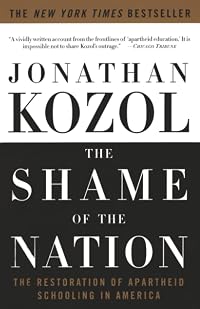
Fist, Stick, Knife, Gun immediately reminded me of Jonathan Kozol's book The Shame of the Nation, where Kozol describes the restoration of segregation in schools. Canada's book provides a first-hand account of what it means to, not only grow up in that culture of violence in America's ghettos (or projects), but also what it means to really earn an education. What I most liked about his book was the fact that he presented a solution to this problem through the creation and promotion of his Harlem Children's Zone. What he does, essentially, is rebuild the community around a school in order to create a safe environment for children to be just that - children. There are just a couple of things I would have loved to see in this book: 1) more show more examples of how educators could create their own "Harlem Children's Zone" in their community. Even just small things that would help re-establish that community feel that seems to be such a strong component of his project would help motivate educators reading the text on ways they can make a difference themselves; 2) some citation for statistical evidence provided. While I understand that this book is autobiographical in nature, Canada could have provided at the back a list of informational sources to support the data and numbers that he seems to pull out of thin air.
I would definitely recommend this book to all teachers, but especially to those working in urban schools where they're faced with violence on (occasionally) a daily basis. This would be a great resource for just getting students interested in reading, and then taking it to another level from there. show less
I would definitely recommend this book to all teachers, but especially to those working in urban schools where they're faced with violence on (occasionally) a daily basis. This would be a great resource for just getting students interested in reading, and then taking it to another level from there. show less
An eye-opening view into a culture I cannot hope to understand, this book is a must read for any educator who will be working in the "tough" schools of their respective cities. The old adage of "violence begets violence" is one that people who have never really experienced it like to spout, helping themselves feel superior to those consumed by it. I have always been aware that the violence depicted in movies was simply a reflection and continuation of a violent undercurrent that has always existed in the poverty-stricken areas ofthe United States. I have been fortunate enough to avoid the consequences of this, but am aware of its existence and the consequences of everyone having a gun in a society where "won't back down, dont know how" show more is more than just the fun cry of the Mardi Gras Indians. I will never be able to understand this world fully, but the book does allow me a glimpse into it. Canada, having grown up in the tough streets before the rise of the drugs and guns that permeate the streets of today, gives readers the perspective of a survivor of one era of the war IN povery and his consternation at the current state of that conflict. show less
Members
- Recently Added By
Lists

Adult Books for YA Readers
194 works; 6 members
Author Information

3+ Works 591 Members
Awards and Honors
Work Relationships
Has the adaptation
Common Knowledge
- Canonical title*
- Canada, Geoffrey
- Blurbers
- St. John, Janet
*Some information comes from Common Knowledge in other languages. Click "Edit" for more information.
Classifications
- Genre
- Nonfiction
- DDC/MDS
- 305.23 — Society, government, & culture Social sciences, sociology & anthropology Social group - Age, Gender, Ethnicity Age groups Young people up to 20
- LCC
- HQ784 .V55 .C36 — Social sciences The family. Marriage, Women and Sexuality The Family. Marriage. Women The family. Marriage. Home Children. Child development
- BISAC
Statistics
- Members
- 410
- Popularity
- 75,478
- Reviews
- 18
- Rating
- (3.79)
- Languages
- English, French
- Media
- Paper, Audiobook, Ebook
- ISBNs
- 13
- UPCs
- 1
- ASINs
- 5