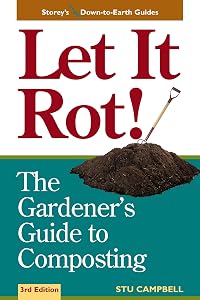
Let it Rot!: The Gardener's Guide to Composting
by Stu Campbell
On This Page
Description
Transform leaves, grass, and kitchen scraps into gardener's gold! This easy-to-use guide shows you how to turn household garbage and backyard refuse into nutrient-filled compost that can nourish your soil and promote a thriving garden. You'll soon be saving money, minimizing waste, and enjoying bountiful harvests..
Tags
Recommendations










Member Reviews
I am not much of a gardener but this book got me out in our compost heap turning things over and mixing things. Campbell presents a practical spectrum of composting activities - to start with, one can just pile up a bunch of organic material, and eventually it will decompose. At the other end, one can send samples to soil labs and get C/N, NPK, and pH measured, to get fast decomposition to a ideal compost product. In between, one can watch how water and air get into the pile, and how heat dissipates.
Probably my biggest practical take-away is that I should occasionally add some manure to the pile.
But the book got me out there with the pitch fork and looking at the leaves, branches, clippings, and peels that we have & experimenting with show more how the mix . Maybe I can help the process work better - step one is just to get involved! show less
Probably my biggest practical take-away is that I should occasionally add some manure to the pile.
But the book got me out there with the pitch fork and looking at the leaves, branches, clippings, and peels that we have & experimenting with show more how the mix . Maybe I can help the process work better - step one is just to get involved! show less
Originally published in 1975. Just a little too technical and troublesome for me. I don't have the desire or the patience to make sure my ratios of nutrients are exact or the temperature is just right. I literally just throw all my vegetable kitchen scraps into a pile with some mulched grass, and just keep adding to that, and let the thing work or not. I'll usually give it a turn with the tractor when I see tall grass weeds growing in it...lol So far, at the end of the day, I've ended up with fresh dirt to add to my garden every single time.
If you are serious about composting "perfectly", then this really might be the book for you.
If you are serious about composting "perfectly", then this really might be the book for you.
A good introduction to composting for gardeners. It discusses various composting systems, their advantages and disadvantages. Bins and tumblers. How to build a bin, where to locate it. What to put on your pile, what to avoid. How to layer. Drainage and aeration. Bacteria and organisms. How to activate your pile to speed decomposition. What to do with the finished product.
Recommended if you are looking to make good compost for your garden. May disappoint if you are mainly seeking a way to dispose of kitchen wastes without attracting vermin. The author says that “we have no rats around our place.” How many other people can say the same? The compost bins he recommends are not rodent proof. There are no index entries under “rats” or show more “rodents” or “vermin.” He regards them as non-issues. But compost piles can and do attract vermin.
Indexed, with bibliography. Includes sources for buying composting supplies. show less
Recommended if you are looking to make good compost for your garden. May disappoint if you are mainly seeking a way to dispose of kitchen wastes without attracting vermin. The author says that “we have no rats around our place.” How many other people can say the same? The compost bins he recommends are not rodent proof. There are no index entries under “rats” or show more “rodents” or “vermin.” He regards them as non-issues. But compost piles can and do attract vermin.
Indexed, with bibliography. Includes sources for buying composting supplies. show less
This is a book for people with a _lot_ of composting to do, not people like me who are just getting rid of kitchen scraps in a "Green Machine". it has some tips on gardening and how to use one's compost, which may come in handy in another few years when I have enough compost to make it worth my time to try to spread it on the garden or even the yard. My compost, which was inoculated with horse manure this spring is breaking down surprisingly well, even though it certainly doesn't have the volume to heat up like some composts due. The author advises paying attention to the pH of soil and compost. This is no doubt a good plan, but he does not give any attention to means, other than taking a sample and sending it to university extension, show more to do so.
The illustrations in the book were intended to be humorous; not surprisingly therefore, a few were sexist.
The book has a few tables and charts of information that is close to useless to me whereas its list of various types of compostables and their C/N ratios was just buried in the text.
It had a fair amount of helpful information about the organisms that inhabit your compost. It has a brief chapter on the history of composting and also a somewhat helpful chapter on constructing compost heaps and bins. show less
The illustrations in the book were intended to be humorous; not surprisingly therefore, a few were sexist.
The book has a few tables and charts of information that is close to useless to me whereas its list of various types of compostables and their C/N ratios was just buried in the text.
It had a fair amount of helpful information about the organisms that inhabit your compost. It has a brief chapter on the history of composting and also a somewhat helpful chapter on constructing compost heaps and bins. show less
I really enjoyed the balance of experiential information and scientific/technical information in this book. There is a lot of information, but not an overload. It left me feeling like I had a pretty good overview of the subject, but it will also be very easy to use as a reference book in the future. I would have liked a few color pictures, but hey--with such good information at hand, I'm not going to complain about aesthetics.
Composting is simply the practice of allowing waste matter to rot and decompose until it's fit to be tilled right into the soil. However, while the basic concept is as old as mother nature and often very easy to execute, it also helps to know more about it. What materials should you compost, and which should you avoid? Do you have to worry about animals or flies in your compost? How do you make sure your compost will turn into dirt and not a slimy, stinky sludge?
While nearly every gardening book these days has a section on composting and most of these are enough to get you by, Stu Campbell's Let It Rot! is an entertaining, folksy and in-depth take on the art that will see you through nearly any foreseeable difficulty. I was certainly show more able to successfully compost with the simpler directions in other books, but there's information in here I wish I'd had back when I first started. For instance, now I know the cobweb-like stuff that I feared was mold was the natural activity of Actinomycetes, a part-bacteria, part-fungus organism that aids decomposition in certain parts of a compost pile.
Mr. Campbell's book introduces a great many different types of composting methods. He also suggests many ways to use compost in and around your garden, and how to get the most out of it. I'm glad I picked up Mr. Campbell's book, because I learned an incredible amount of new material!
View full review at ErrantDreams. show less
While nearly every gardening book these days has a section on composting and most of these are enough to get you by, Stu Campbell's Let It Rot! is an entertaining, folksy and in-depth take on the art that will see you through nearly any foreseeable difficulty. I was certainly show more able to successfully compost with the simpler directions in other books, but there's information in here I wish I'd had back when I first started. For instance, now I know the cobweb-like stuff that I feared was mold was the natural activity of Actinomycetes, a part-bacteria, part-fungus organism that aids decomposition in certain parts of a compost pile.
Mr. Campbell's book introduces a great many different types of composting methods. He also suggests many ways to use compost in and around your garden, and how to get the most out of it. I'm glad I picked up Mr. Campbell's book, because I learned an incredible amount of new material!
View full review at ErrantDreams. show less
From "Why compost?" to "How to use compost" this is an excellent book for all of those who are new to home composting as I am. I planted a new garden and wanted it to be a organic as possible. This book helped me get started. Thank you.
Members
- Recently Added By
Lists

Storey
50 works; 1 member
Author Information
11 Works 1,023 Members
Common Knowledge
- Canonical title
- Let it Rot!: The Gardener's Guide to Composting
- Original publication date
- 1975
- Epigraph
- "One aker well compast, is worth akers three..." - Tusser (1557)
"Now I am terrified at the Earth, it is that calm and patient,/ It grows such sweet things out of such corruptions,/ It turns harmless and stainless on its axis, with such/ endless succession of diseased corpses,/ It distills... (show all) exquisite winds out of such infused fetor,/ It gives such divine materials to men, and accepts such/ leavings from them at last." - Walt Whitman, "This Compost" - Dedication
- To Gregory - May he, like his father, have the chance to pursue what interests him most.
- First words
- Somewhere, thousands and thousands of years ago, some hairy and slouched cave dwellers who groveled in the dirt with sticks and who managed to grow some food may have discovered that seeds grew better near the place where the... (show all)y piled the apparently useless refuse from their cave.
Classifications
- Genres
- Home & Garden, Nonfiction, General Nonfiction
- DDC/MDS
- 631.875 — Applied science & technology Agriculture Specific techniques; apparatus, equipment, materials Fertilizers, soil conditioners, growth regulators Vegetable manures and converted household garbage Compost
- LCC
- S661 .C35 — Agriculture Agriculture (General) Fertilizers and improvement of the soil
- BISAC
Statistics
- Members
- 644
- Popularity
- 44,949
- Reviews
- 14
- Rating
- (3.62)
- Languages
- English
- Media
- Paper, Ebook
- ISBNs
- 6
- UPCs
- 1
- ASINs
- 5