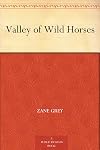
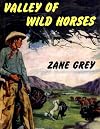
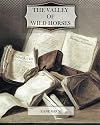
Valley of Wild Horses
by Zane Grey
On This Page
Description
Set against the dramatic background of a wild-horse roundup, the plot leads to the inevitable clash between two strong and stubborn men.Tags
Recommendations






















Member Reviews
Valley of Wild Horses is one of Zane Grey’s most satisfying westerns. Everything that was wonderful about Zane Grey — his magnificent storytelling, his vivid descriptions of the landscape and horses, the sheer excitement of a roundup, and the thrill of gunplay — are on display so vibrantly in Valley of Wild Horses that the reader is rarely annoyed by some stilted dialog which creeps in, and some slight awkwardness in the romance department — which are also Grey trademarks.
There is great beauty here in Valley of Wild Horses, a purity of the human spirit. On its pages exists a love for decency and what is right, even if it must be administered with a gun. Even then, there is always regret, a wish that it hadn't come to that. Grey show more never painted a better portrait of those with checkered pasts trying to find a place they belong, than he did in Valley of Wild Horses. The simplicity of Grey’s narrative is deceptive, because it is a rich and beautiful portrait of a young man named Panhandle Smith, who represents a time and place in history as well as any Grey ever painted.
For a western, it begins somewhat languidly, because it is the story of Panhandle as he grows up. We get to see the cowboys and cattle, the excitement and the harshness of these times, all circumstances which shape Pan’s life as a young man. At the age of twelve, Pan is already riding in the roundup, and loses one of the cowboys around him when he is taken away for stealing horses. Schoolteacher Amanda Hill is his first crush, Dick Hardman his first enemy, a situation which will play out over the years in their love for Lucy. Lucy is the young girl he helps deliver in a barn one snowy day, when he himself is but a boy. As she grows up, Pan’s feelings for her become romantic, as Lucy’s do for Pan, but Dick Hardman proves to always be in the way.
Once his beloved horse Curly is gone, and a terrible scrape with Dick mars the future, Panhandle drifts to Montana and Arkansas at the age of twenty, and that’s where this tale switches gears, and become one of Grey’s greatest achievements. As Panhandle becomes a name known by many, sometimes for the wrong reasons, he never forgets Lucy, or his beloved family. It is when he meets up with old pals Blinky Moran and Gus, and returns to discover his father has been swindled, and Lucy is being blackmailed into marrying Dick Hardman in order to save her father, that the pieces which make this a great western saga all fall into place. There is a softhearted saloon girl named Louise whom Blinky loves that has ties to Dick, a corrupt sheriff named Matthews, and Dick’s powerful father and his dangerous men for Panhandle to deal with. But not before one of the most thrilling roundups you’ll ever read, as Pan and his pals seek to find the wild horses and make a new start in Arizona.
There will be some treachery, some gunplay, and some twists and turns where Lucy and Louise are concerned. Louise in fact, is one of Grey’s best-drawn characters, and what happens is not only exciting, but quite moving. Throughout the book, there is a sense of family, and decency, and the hope of pioneers as they sought to carve out a new life. The storytelling is old-fashioned, to be sure, the dialog sometimes awkward, as Grey writes it phonetically as they speak it. But this is a lush, beautiful work, surprisingly layered and more complex than the premise suggests. The ending of Valley of Wild Horses is as lovely as any western you’ll ever read. It is simple, and pure, and hopeful. The reader will be imagining their lives going forward, and smiling.
The first portion of the novel, as Grey focuses on Panhandle’s childhood, is too lengthy and makes the narrative move more slowly than it should. That said, there is a rich reward waiting for those who forge on, and a pot of western gold when they reach the final page. This is Zane Grey at his finest, which is to say warts and all. It may be too old-fashioned for a great many modern readers, its narrative style too different for them to accept and enjoy, but it’s as romantic and lovely as any western you’ll ever read, the ending pure. A great achievement by Grey that fans of traditional westerns of old will appreciate more than most modern readers. Highly recommended! show less
There is great beauty here in Valley of Wild Horses, a purity of the human spirit. On its pages exists a love for decency and what is right, even if it must be administered with a gun. Even then, there is always regret, a wish that it hadn't come to that. Grey show more never painted a better portrait of those with checkered pasts trying to find a place they belong, than he did in Valley of Wild Horses. The simplicity of Grey’s narrative is deceptive, because it is a rich and beautiful portrait of a young man named Panhandle Smith, who represents a time and place in history as well as any Grey ever painted.
For a western, it begins somewhat languidly, because it is the story of Panhandle as he grows up. We get to see the cowboys and cattle, the excitement and the harshness of these times, all circumstances which shape Pan’s life as a young man. At the age of twelve, Pan is already riding in the roundup, and loses one of the cowboys around him when he is taken away for stealing horses. Schoolteacher Amanda Hill is his first crush, Dick Hardman his first enemy, a situation which will play out over the years in their love for Lucy. Lucy is the young girl he helps deliver in a barn one snowy day, when he himself is but a boy. As she grows up, Pan’s feelings for her become romantic, as Lucy’s do for Pan, but Dick Hardman proves to always be in the way.
Once his beloved horse Curly is gone, and a terrible scrape with Dick mars the future, Panhandle drifts to Montana and Arkansas at the age of twenty, and that’s where this tale switches gears, and become one of Grey’s greatest achievements. As Panhandle becomes a name known by many, sometimes for the wrong reasons, he never forgets Lucy, or his beloved family. It is when he meets up with old pals Blinky Moran and Gus, and returns to discover his father has been swindled, and Lucy is being blackmailed into marrying Dick Hardman in order to save her father, that the pieces which make this a great western saga all fall into place. There is a softhearted saloon girl named Louise whom Blinky loves that has ties to Dick, a corrupt sheriff named Matthews, and Dick’s powerful father and his dangerous men for Panhandle to deal with. But not before one of the most thrilling roundups you’ll ever read, as Pan and his pals seek to find the wild horses and make a new start in Arizona.
There will be some treachery, some gunplay, and some twists and turns where Lucy and Louise are concerned. Louise in fact, is one of Grey’s best-drawn characters, and what happens is not only exciting, but quite moving. Throughout the book, there is a sense of family, and decency, and the hope of pioneers as they sought to carve out a new life. The storytelling is old-fashioned, to be sure, the dialog sometimes awkward, as Grey writes it phonetically as they speak it. But this is a lush, beautiful work, surprisingly layered and more complex than the premise suggests. The ending of Valley of Wild Horses is as lovely as any western you’ll ever read. It is simple, and pure, and hopeful. The reader will be imagining their lives going forward, and smiling.
The first portion of the novel, as Grey focuses on Panhandle’s childhood, is too lengthy and makes the narrative move more slowly than it should. That said, there is a rich reward waiting for those who forge on, and a pot of western gold when they reach the final page. This is Zane Grey at his finest, which is to say warts and all. It may be too old-fashioned for a great many modern readers, its narrative style too different for them to accept and enjoy, but it’s as romantic and lovely as any western you’ll ever read, the ending pure. A great achievement by Grey that fans of traditional westerns of old will appreciate more than most modern readers. Highly recommended! show less
An expressive Western novel, with sharp characterizations of the good and evil people involved. Pan (for the Texas Panhandle) Smith’s story is uppermost. He develops a wild free life as a cowboy until homesickness and a longing for his childhood sweetheart, Lucy, leads him to find them moved to Marco, a town in New Mexico. His childhood enemy Dick Hardman is ensconced there with his grasping father and their power seems invincible. The story, well told in scenic description and authentic conversation, leads to a chance for Pan and his friends to make their fortune capturing and selling the herds of wild horses that are in the area. The action escalates toward the end, but as in most of Zane’s novels, the good folk finally win out show more and the man gets his girl, finally. show less
Great!
Great!
A quick and entertaining read. I only wish that the story could go on for another hundred pages or so, I feel such a connection to the characters and wish I could watch them start their new homesteads.
Great!
A quick and entertaining read. I only wish that the story could go on for another hundred pages or so, I feel such a connection to the characters and wish I could watch them start their new homesteads.
I think I'm done for westerns for a while. This was a thick read for little payoff.
Ratings
Members
- Recently Added By
Lists

Best Horse Stories or "Back in the Saddle Again"
82 works; 17 members
Author Information

438+ Works 20,902 Members
Zane Grey was born Pearl Zane Gray in 1872, in Zanesville, Ohio. He studied dentistry at the University of Pennsylvania, married Lina Elise Roth in 1905, then moved his family west where he began to write novels. The author of 86 books, he is today considered the father of the Western genre, with its heady romances and mysterious outlaws. Riders show more of the Purple Sage (1912) brought Grey his greatest popular acclaim. Other notable titles include The Light of Western Stars (1914) and The Vanishing American (1925). An extremely prolific writer, he often completed three novels a year, while his publisher would issue only one at a time. Twenty-five of his novels were published posthumously. His last, The Reef Girl, was published in 1977. Zane Grey died of heart failure on October 23 in Altadena, California, in 1939. (Bowker Author Biography) show less
Common Knowledge
- Original publication date
- 1927
- People/Characters
- Bill Smith; Margaret Smith; Panhandle Smith; Lucy Blake; Dick Hardman; Alice Smith (show all 13); Jard Hardman; Jim Blake; Handy Mac New; Frank Somers (Blinky Moran); Gus Hans; Charley Brown; Louise Melliss
- Important places
- Texas Panhandle, USA; Marco, New Mexico, USA; Siccane, Arizona, USA
- First words
- The Panhandle was a lonely purple range land, unfenced and wind swept.
- Last words
- (Click to show. Warning: May contain spoilers.)And so on into the rich grass where no wheel track showed—on into the sage toward the lonely beckoning walls.
Classifications
Statistics
- Members
- 228
- Popularity
- 143,206
- Reviews
- 4
- Rating
- (3.66)
- Languages
- Czech, English, Spanish
- Media
- Paper, Audiobook, Ebook
- ISBNs
- 42
- ASINs
- 20