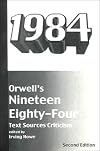
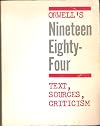
Orwell's Nineteen Eighty-Four: Text, Sources, Criticism (Harbrace Sourcebooks)
by George Orwell  , Irving Howe (Editor)
112 Members (4.63)
On This Page
Description
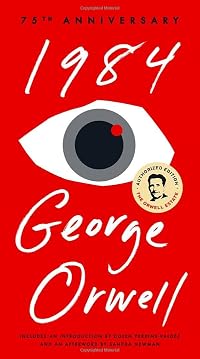
Among the seminal texts of the 20th century, Nineteen Eighty-Four is a rare work that grows more haunting as its futuristic purgatory becomes more real. Published in 1949, the book offers political satirist George Orwell's nightmare vision of a totalitarian, bureaucratic world and one poor stiff's attempt to find individuality. The brilliance of the novel is Orwell's prescience of modern life--the ubiquity of television, the distortion of the language--and his ability to construct such a show more thorough version of hell. Required reading for students since it was published, it ranks among the most terrifying novels ever written. --Amazon.com. show lessTags
Recommendations















Member Reviews
Members
- Recently Added By
Author Information

388+ Works 221,149 Members
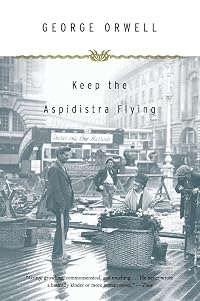
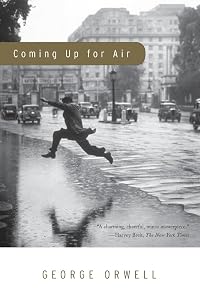
George Orwell was born Eric Arthur Blair on June 25, 1903 in Motihari in Bengal, India and later studied at Eton College for four years. He was an assistant superintendent with the Indian Imperial Police in Burma. He left that position after five years and moved to Paris, where he wrote his first two books: Burmese Days and Down and Out in Paris show more and London. He then moved to Spain to write but decided to join the United Workers Marxist Party Militia. After being decidedly opposed to communism, he served in the British Home Guard and with the Indian Service of the BBC during World War II. After the war, he wrote for the Observer and was literary editor for the Tribune. His best known works are Animal Farm and 1984. His other works include A Clergyman's Daughter, Keep the Aspidistra Flying, The Road to Wigan Pier, Homage to Catalonia, and Coming Up for Air. He died on January 21, 1950 at the age of 46. (Bowker Author Biography) show less
George Orwell has a Legacy Library. Legacy libraries are the personal libraries of famous readers, entered by LibraryThing members from the Legacy Libraries group.

Irving Howe was born in the Bronx, New York on June 11, 1920. He became a socialist at the age of 14. He graduated from City College in 1940. During World War II, he served in the Army. After the war, he began writing book reviews and essays for several magazines including Commentary, The Nation, and Partisan Review. For four years, he earned a show more living writing book reviews for Time magazine. He taught English at several colleges including Brandeis University, Stanford University, Hunter College, and City University, which he retired from in 1986. In 1954, he and a group of close friends founded the radical journal Dissent. He was the editor for nearly four decades. Also in the 1950's, he met a Yiddish poet named Eliezer Greenberg and the two began a long project to translate Yiddish prose and poetry into English, eventually publishing six collections of stories, essays, and poems. He wrote several books including Decline of the New, Politics and the Novel, and an autobiography entitled A Margin of Hope. World of Our Fathers won the National Book Award in 1976. He wrote critical studies of William Faulkner and Sherwood Anderson and a biography of Leon Trotsky. He died of cardiovascular disease on May 5, 1993 at the age of 72. (Bowker Author Biography) show less
Classifications
Statistics
- Members
- 112
- Popularity
- 290,085
- Rating
- (4.63)
- Languages
- English
- Media
- Paper
- ISBNs
- 1
- ASINs
- 8