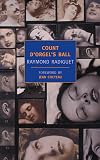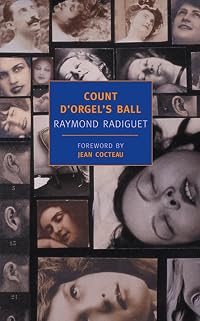
Count d'Orgel's Ball
by Raymond Radiguet
On This Page
Description
Count d'Orgel is handsome, charming, and carefree, a model of cool aristocratic aplomb. His wife, the Countess, is beautiful and pure and loves her husband more than anything in the world. But from the moment the d'Orgels meet and befriend the clever young François de Séryeuse backstage at the circus, all three of these supremely civilized and witty people are caught up in an ever more intricate and seductive dance of deception and self-deception. At Count d'Orgel's masquerade ball, the show more real disguises are those of the human heart. Completed just before Raymond Radiguet's death at the age of twenty, Count d'Orgel's Ball is a love story that is as disturbing as it is delicious. show lessTags
Recommendations













Member Reviews
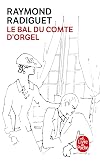
Radiguet avait vingt ans quand il écrivit Le Bal du comte d'Orgel. Le sujet? Impossible de trouver plus conventionnel: le mari, la femme et l'ami de la famille. Mais la convention et la bienséance, ici, couvrent la plus trouble et la plus licencieuse des chastetés. Mme d'Orgel aime son mari qui lui retourne une aimable indifférence, mais qui va commencer de l'aimer "comme s'il avait fallu une convoitise pour lui en apprendre le prix". Et c'est l'amour que François éprouve pour sa femme qui amène le comte d'Orgel à le préférer à tous ses autres amis. A partir de là, les sentiments évoluent, subtils, feutrés, étranges et comme étrangers aux êtres qu'ils habitent." On s'effraie d'un enfant de vingt ans qui publierait un show more livre qu'on ne peut écrire à cet âge ", dit Cocteau. A quoi Radiguet a répondu d'avance: "L'âge n'est rien... Les plus grands sont ceux qui parviennent à le faire oublier."
François de Séryeuse, jeune homme tranquille et raffiné, fait par hasard la connaissance du comte d'Orgel, mondain à la frivolité grandiose » et de sa femme, Mahaut. Il devient leur ami mais François aime Mahaut. Ayant jusqu'ici mené de front le devoir et l'amour, Mahaut, de son côté, se méprend d'abord sur le sentiment que lui inspire François. Couvé, nourri,
grandi dans l'ombre, ce sentiment finit par se faire reconnaître; elle doit s'avouer, non sans effroi, qu'elle aime François...
Dans ce roman d'amour chaste, aussi scabreux que le roman le moins chaste, selon l'auteur lui-même, les coeurs humains sont percés à jour avec une implacable lucidité.
Raymond Radiguet est mort à vingt ans, ayant écrit deux romans:
"Le Diable au corps, chef-d'oeuvre de promesses, et les promesses tenues : Le Bal du comte d'Orgel. Le seul honneur que je réclame est d'avoir donné pendant sa vie à Raymond Radiguet la place illustre que lui vaudra sa mort..
Jean Cocteau show less
François de Séryeuse, jeune homme tranquille et raffiné, fait par hasard la connaissance du comte d'Orgel, mondain à la frivolité grandiose » et de sa femme, Mahaut. Il devient leur ami mais François aime Mahaut. Ayant jusqu'ici mené de front le devoir et l'amour, Mahaut, de son côté, se méprend d'abord sur le sentiment que lui inspire François. Couvé, nourri,
grandi dans l'ombre, ce sentiment finit par se faire reconnaître; elle doit s'avouer, non sans effroi, qu'elle aime François...
Dans ce roman d'amour chaste, aussi scabreux que le roman le moins chaste, selon l'auteur lui-même, les coeurs humains sont percés à jour avec une implacable lucidité.
Raymond Radiguet est mort à vingt ans, ayant écrit deux romans:
"Le Diable au corps, chef-d'oeuvre de promesses, et les promesses tenues : Le Bal du comte d'Orgel. Le seul honneur que je réclame est d'avoir donné pendant sa vie à Raymond Radiguet la place illustre que lui vaudra sa mort..
Jean Cocteau show less
I read 'The Devil in the Flesh' and believed it to be a good book, though the work of an eager young man and generally lacking in the distance and maturity one likes to see most in a novelist. 'Count d'Orgel' has both, and is a fascinating story; the love affair is never consumated, but all the attitudes and thoughts and feelings are perfectly rendered in intimate detail: the reader resides in the heads of the protagonists, and rarely has there been a more interesting place to be.
Le bal du comte d'Orgel is fine and precious like a piece of jewellery. A young man falls in love with a married woman (the wife of the count d'Orgel) and she is troubled by him too, but not to the point of adultery. Lots of thinking about feelings. Radiguet was inspired by Mme de Lafayette's La princesse de Cleves and in addition the book bears Cocteau's imprint (he edited the final version, and advised Radiguet from the start), but its subtle spirit, gentle and knowing, is all this marvellous boy.
Segundo Radiguet: Romance de amor casto, mas tão escabroso quanto o romance menos casto.
A cena da festa, em que Mahaut assume a humilhação do marido, e é entendida por Naramouf, é brilhante.
Adoro o final: “De pé sobre a moldura da porta, Anne estava belo. Não cumpria um dever de grandiosa frivolidade quando, retirando-se sempre de frente, empregou sem se dar conta, com um gesto régio de cabeça, a frase dos hipnotizadores:
E agora, Mahaut, durma! Eu o quero.”
A cena da festa, em que Mahaut assume a humilhação do marido, e é entendida por Naramouf, é brilhante.
Adoro o final: “De pé sobre a moldura da porta, Anne estava belo. Não cumpria um dever de grandiosa frivolidade quando, retirando-se sempre de frente, empregou sem se dar conta, com um gesto régio de cabeça, a frase dos hipnotizadores:
E agora, Mahaut, durma! Eu o quero.”
It's a well-written book, but I didn't find it particularly interesting or thought provoking.
Raymond Radiguet, who died when he was 20 years old, was genious. He had a lot of influence on some Japanese writers around World War Ⅱ, and among the most famous writers who adored Radiguet very much was Yukio Mishima. When he was a student in Tokyo under the war, he idolized Radiguet, and thought he also would write a masterpiece like this book of Radiguet's when he was a teenager, and after having written, he was thinking he would die. But, he didn't die and survived the war. Soon he was recovered from the Radiguet disease by reading Ogai Mori's works.
Ratings
Members
- Recently Added By
Lists

Harold Bloom - The Western Canon: D. The Chaotic Age
833 works; 24 members
Author Information

17+ Works 1,836 Members
All Editions
Some Editions
Series
Belongs to Publisher Series
Work Relationships
Is contained in
Common Knowledge
- Canonical title
- Count d'Orgel's Ball
- Original title
- Le Bal du Comte d'Orgel
- Original publication date
- 1924
- People/Characters*
- Mahaut d'Orgel; Anne d'Orgel; Paul Robin; François de Séryeuse
- Important places*
- Paris, Île-de-France, France; Cirque Medrano, Paris, France
- First words
- Zijn gemoedsaandoeningen als die van gravin d'Orgel verouderd?
Les mouvements d'un coeur comme celui de la comtesse d'Orgel sont-ils surannés? - Last words*
- (Click to show. Warning: May contain spoilers.)Dat wil ik.
- Original language
- French
- Disambiguation notice*
- Original title: Le bal du comte d'Orgel
*Some information comes from Common Knowledge in other languages. Click "Edit" for more information.
Classifications
Statistics
- Members
- 457
- Popularity
- 66,736
- Reviews
- 6
- Rating
- (3.74)
- Languages
- 9 — Catalan, Dutch, English, French, German, Greek, Italian, Spanish, Turkish
- Media
- Paper, Audiobook, Ebook
- ISBNs
- 43
- ASINs
- 23