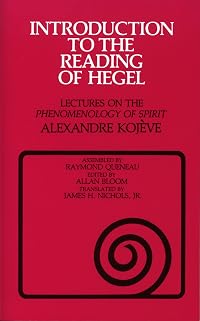
Introduction to the Reading of Hegel: Lectures on the Phenomenology of Spirit
by Alexandre Kojève
On This Page
Description
"This collection of Kojeve's thoughts about Hegel constitutes one of the few important philosophical books of the twentieth century--a book, knowledge of which is requisite to the full awareness of our situation and to the grasp of the most modern perspective on the eternal questions of philosophy."--Allan Bloom (from the Introduction) During the years 1933-1939, the Russian-born and German-educated Marxist political philosopher Alexandre Kojève (1902-1968) brilliantly show more explicated--through a series of lectures--the philosophy of Hegel as it was developed in the Phenomenology of Spirit. This collection of lectures--originally compiled by Raymond Queneau and edited for its English-language translation by Allan Bloom--shows the intensity of Kojève's study and thought and the depth of his insight into Hegel's Phenomenology. More important--for Kojève was above all a philosopher and not an ideologue--this profound and venturesome work on Hegel will expose the readers to the excitement of discovering a great mind in all its force and power. show lessTags
Recommendations



















Member Reviews
Four and a half stars, Five reserved for Hegel, April 18, 2005
What has really been puzzling so many readers of the Introduction is the so-called `Japanization' note (p 159) added to the second edition of the Introduction. It is this perplexing note that I would like to address in this review. This note is where Kojeve first admits that posthistory, as he originally conceived it, was contradictory, that if "Man becomes an animal again, his arts, his loves, and his play must become purely natural again." Humans would "construct their edifices and works of art as birds build their nests and spiders spin their webs, would perform musical concerts after the fashion of frogs and cicadas, would play like young animals, and would indulge in show more love like adult beasts."
Truly frightening. -Men as beasts! It reminds one of the myth of Plato's (269bff) Reversed Cosmos in the Statesman; men living as contented animals, growing ever more ignorant under the care of the gods/who Kojeve would say equal nature. But it gets worse! ""The definitive annihilation of Man properly so-called" also means the definitive disappearance of human Discourse (Logos) in the strict sense." After comparing the ruins of language (in posthistory) to the language of bees Kojeve says "[W]hat would disappear, then, is not only Philosophy or the search for discursive Wisdom, but also that Wisdom itself. For in these post-historical animals, there would no longer be any "[discursive] understanding of the world and of self."" The Wisdom gained for humanity by the correct understanding of the ruses of History - Hegelianism/w Kojeve - would be lost forever. Thus there would be no Sages contemplating the History that could only (perhaps!) have led to them.
Then he goes on to say that this view was mistaken, he came to realize (1948-1958) that posthistory was already here and that Americans(!) most closely embodied it. By posthistory he means that all history, since the publication (1806) of the Phenomenology, has simply been the activity of `backward' nations becoming more like what Hegel envisioned for them (embodying the laws/institutions of the French Revolution) and various anachronisms (in all states) being gradually eliminated. Obviously, since 1806, Logos (discursive understanding) has not disappeared entirely from the face of the earth - even in America! (Kojeve appears long after 1806, and he has American readers, and Kojeve is indeed a Sage. ...Whew!) "I was led to conclude from this that "the American way of life" was the type of life specific to the post-historical period, the actual presence of the United States in the world prefiguring the "eternal present" future of all humanity. Thus Man's return to animality appeared no longer as a possibility that was yet to come, but as a certainty that was already present." The problem and contradictions of his first understanding seem to be solved with this second (Americanization) understanding. Discursive understanding endures, the Sages will come, the Circularity of the Whole will be comprehended (if only by the Sages) and Kojeve will be remembered. - Problem solved.
...But he doesn't end the note with that. He next speaks of Japanization - but why? His `contradictory' understanding has been corrected by the above. The possibility of discursive understanding remains; the Hegelian/Kojevean Sages can continue to discuss the History that leads to Them and Their Understanding. So why does Kojeve continue his note? He doesn't exactly tell us why. We need to ferret it out. "Now, the existence of the Japanese nobles, who ceased to risk their lives (even in duel) and yet did not for that begin to work, was anything but animal." But he had just shown, thanks to the `Americanization' thesis, that, strictly speaking, animality would not occur. Why is the `Japanization' Thesis necessary?
...Hmmm. The Japanese had experienced the End of History by isolating themselves for 300 years. But they kept a nobility! America hasn't done that. (Is this why Japanization is superior to Americanization? It keeps a nobility? Is this merely a sop to 'exceptions' sophists that will not become Sages? But why even bother with a concession? Can History actually be restarted - remember, according to the `Americanization' Thesis History has already ended - again?) How did Japan keep a nobility? Through snobbery! Kojeve says there is no Religion, Morals, Politics in the European or historical (by this he means the dialectically expansive Hegelian) sense in Japan. Are we to understand by this that there is "Religion, Morals, Politics" in some non-European, non-historical sense?
The last sentence made us pause; the next sentence makes us stop. "Bur Snobbery in its pure form created disciplines negating the "natural" or "animal" given which in effectiveness far surpassed those that arose, in Japan or elsewhere, from historical Action - that is, from warlike and revolutionary Fights or from forced work." What exactly does Kojeve mean here by effectiveness? How could Snobbery surpass in effectiveness the "historical Action" so unforgettably understood in Hegel's Phenomenology? ...Examples of Snobbery (which are "peaks equaled nowhere else") listed by Kojeve, which one would hope answer our question about effectiveness, are Noh Theater, the tea ceremony and the art of flower display!
I do not mean to sound like a Snob :-) but all this (Noh Theater, etc) does seem to somewhat lack the drama and import (to say the least!) of Hegel's Phenomenology or even Kojeve's commentary. ...So, what is the effectiveness that Kojeve speaks of? He continues by saying that "all Japanese without exception are currently in a position to live according to totally formalized values-that is, values completely empty of all "human" content in the "historical" sense." What Kojeve is indicating is that some form of humanity (values) is still possible after history ends, after no one any longer Fights or risks their life. There still is perfectly gratuitous suicide - hari-kari - but as Kojeve points out, this suicide "has nothing to do with the risk of life in a Fight waged for the sake of "historical" values that have social or political content."
Again, we ask, why does Kojeve find all this so effective? Japanization seems, if anything, thanks to its ahistorical nature, to be the exact opposite of effectiveness from a Hegelo/Kojevian perspective. Kojeve continues, "This seems to allow one to believe that the recently begun interaction between Japan and the Western World will finally lead not to a rebarbarization[!] of the Japanese but to a "Japanization" of the Westerners (including the Russians)." We need to be more than surprised when Kojeve refers to the Westernization of Japan as a rebarbarization. The rebarbarization that Kojeve is speaking of is the bringing of Japan into line with the Hegelian/Kojevean History. ...One is left wondering if Kojeve believed his theory as little as Leo Strauss did.
...Or perhaps only the human consequences of his theory are what troubled Kojeve, not its correctness. "Now, since no animal can be a snob, every "Japanized" post-historical period would be specifically human." But how can the animal Man, as Snob, remain Human when he no longer Fights or Works? Kojeve, in the penultimate sentence of this note says, "To remain Human, Man must remain a "Subject opposed to the Object," even if "Action negating the given and Error" disappears." For the Sages there is no longer Error in posthistory because there is no more historical change. (Man does not live temporally any longer, now, at the End of History, he lives spatially, he is only another piece of nature.) But how can man live non-temporally?
Kojeve ends this note thusly; "This means that, while henceforth speaking in an adequate fashion of everything that is given to him, post-historical Man must continue to detach "form" from "content," doing so no longer in order actively to transform the latter, but so that he may oppose himself as a pure "form" to himself and to others taken as "content" of any sort." This then, of course, is what Kojeve means by the "effectiveness" of `Japanization.' The Sages keep their discursive understanding of the Circularity of the Concept while the `nobility' (exceptions, sophists) unfortunate enough to live at the End of History will continue to struggle, but fundamentally only with(in) themselves. There will be exactly zero Historical import to these struggles. History has ended but the struggle for recognition, in an entirely non-Historical sense, continues thru Snobbery. Thus we have Absolute Knowledge and (a rather peculiar) Humanity at the same time. Kojeve thus sets the table, in the `eternally present future' of the End of history, for us to always have our cake (our Humanity) while eating it (Knowing this Humanity in a complete, absolute, unchanging and adequate manner) too. ...This is what Kojeve is pleased to call `effectiveness'.
At this point some minor observations may be in order. This note we have been considering is an addendum to a note that began on page 157. The paragraph that the first (or original) note attempted to clarify had at least one remarkable statement (p 156) in it: "The Real resists Action not Thought." If this is true (and I believe it is) we see another example of the effectiveness of the `Japanization' thesis. While material/institutional History may End exactly as Hegel/Kojeve say it will end it would seem there is more than one way to `discursively understand' this End.
Kojeve had indicated something similar to this in an earlier letter to Strauss (Sep 19 1950) that says:
"Historical action necessarily leads to a specific result (hence: deduction), but the ways that lead to this result, are varied (all roads lead to Rome!). The choice between these roads is free, and this choice determines the content of the speeches about the action and the meaning of the result. In other words: materially history is unique, but the spoken story can be extremely varied, depending on the free choice of how to act."
The similarity between this note (in a letter) to Strauss and the remark quoted above is that material history is unique (because the Real resists Action, erroneous action is purged by the very Real process of History) but the difference is that in this letter Kojeve seems to be insisting that speech follows the (material) results of Action. This is in fact contradicted by the statement: The Real resists Action not Thought.
This says, for those that have ears to hear, that even though (or if) History ends exactly as Hegel/Kojeve say it must end there is no guarantee that the discursive (ahem) `understanding' of this unique and necessary End will be `correct' - by `correct' I merely mean Hegelo-Kojevean.
This is perhaps where the `effectiveness' of the `Japanization' Thesis really lies. Whatever `chatter' arises - after the unavoidable Unique Necessary End of History in the Hegel/Kojevean sense - among the non-Sages can be understood as a form of Snobbery! Even a non-historical Religion/Politics/Morals, as Kojeve indicates in the Note (P 161) to the Second Edition, would seem to be possible! Thus the Japanization Thesis is not merely a concession to the exceptions/sophists that cannot (or will not) become Sages; it is also (more profoundly) a concession necessitated by the fantasy-like nature of thought itself. The material (and institutional) End of History, as envisioned by Hegel/Kojeve, may well be unavoidable and unique but, given the fact that the Real doesn't resist Thought, exactly anything can be said (or thought, which inevitably becomes speech) of this unavoidable End. And the Sages, at the end of this Unique History, point to the chattering sophists/exceptions and they say - Snobbery! The only unanswered question these Sages now face is can these thoughtful fantasies, when spoken, restart History? Or to put this another way, is it thru these thoughtful snobbish dreams that Mastery, in the Historical sense, re-enters the world? show less
What has really been puzzling so many readers of the Introduction is the so-called `Japanization' note (p 159) added to the second edition of the Introduction. It is this perplexing note that I would like to address in this review. This note is where Kojeve first admits that posthistory, as he originally conceived it, was contradictory, that if "Man becomes an animal again, his arts, his loves, and his play must become purely natural again." Humans would "construct their edifices and works of art as birds build their nests and spiders spin their webs, would perform musical concerts after the fashion of frogs and cicadas, would play like young animals, and would indulge in show more love like adult beasts."
Truly frightening. -Men as beasts! It reminds one of the myth of Plato's (269bff) Reversed Cosmos in the Statesman; men living as contented animals, growing ever more ignorant under the care of the gods/who Kojeve would say equal nature. But it gets worse! ""The definitive annihilation of Man properly so-called" also means the definitive disappearance of human Discourse (Logos) in the strict sense." After comparing the ruins of language (in posthistory) to the language of bees Kojeve says "[W]hat would disappear, then, is not only Philosophy or the search for discursive Wisdom, but also that Wisdom itself. For in these post-historical animals, there would no longer be any "[discursive] understanding of the world and of self."" The Wisdom gained for humanity by the correct understanding of the ruses of History - Hegelianism/w Kojeve - would be lost forever. Thus there would be no Sages contemplating the History that could only (perhaps!) have led to them.
Then he goes on to say that this view was mistaken, he came to realize (1948-1958) that posthistory was already here and that Americans(!) most closely embodied it. By posthistory he means that all history, since the publication (1806) of the Phenomenology, has simply been the activity of `backward' nations becoming more like what Hegel envisioned for them (embodying the laws/institutions of the French Revolution) and various anachronisms (in all states) being gradually eliminated. Obviously, since 1806, Logos (discursive understanding) has not disappeared entirely from the face of the earth - even in America! (Kojeve appears long after 1806, and he has American readers, and Kojeve is indeed a Sage. ...Whew!) "I was led to conclude from this that "the American way of life" was the type of life specific to the post-historical period, the actual presence of the United States in the world prefiguring the "eternal present" future of all humanity. Thus Man's return to animality appeared no longer as a possibility that was yet to come, but as a certainty that was already present." The problem and contradictions of his first understanding seem to be solved with this second (Americanization) understanding. Discursive understanding endures, the Sages will come, the Circularity of the Whole will be comprehended (if only by the Sages) and Kojeve will be remembered. - Problem solved.
...But he doesn't end the note with that. He next speaks of Japanization - but why? His `contradictory' understanding has been corrected by the above. The possibility of discursive understanding remains; the Hegelian/Kojevean Sages can continue to discuss the History that leads to Them and Their Understanding. So why does Kojeve continue his note? He doesn't exactly tell us why. We need to ferret it out. "Now, the existence of the Japanese nobles, who ceased to risk their lives (even in duel) and yet did not for that begin to work, was anything but animal." But he had just shown, thanks to the `Americanization' thesis, that, strictly speaking, animality would not occur. Why is the `Japanization' Thesis necessary?
...Hmmm. The Japanese had experienced the End of History by isolating themselves for 300 years. But they kept a nobility! America hasn't done that. (Is this why Japanization is superior to Americanization? It keeps a nobility? Is this merely a sop to 'exceptions' sophists that will not become Sages? But why even bother with a concession? Can History actually be restarted - remember, according to the `Americanization' Thesis History has already ended - again?) How did Japan keep a nobility? Through snobbery! Kojeve says there is no Religion, Morals, Politics in the European or historical (by this he means the dialectically expansive Hegelian) sense in Japan. Are we to understand by this that there is "Religion, Morals, Politics" in some non-European, non-historical sense?
The last sentence made us pause; the next sentence makes us stop. "Bur Snobbery in its pure form created disciplines negating the "natural" or "animal" given which in effectiveness far surpassed those that arose, in Japan or elsewhere, from historical Action - that is, from warlike and revolutionary Fights or from forced work." What exactly does Kojeve mean here by effectiveness? How could Snobbery surpass in effectiveness the "historical Action" so unforgettably understood in Hegel's Phenomenology? ...Examples of Snobbery (which are "peaks equaled nowhere else") listed by Kojeve, which one would hope answer our question about effectiveness, are Noh Theater, the tea ceremony and the art of flower display!
I do not mean to sound like a Snob :-) but all this (Noh Theater, etc) does seem to somewhat lack the drama and import (to say the least!) of Hegel's Phenomenology or even Kojeve's commentary. ...So, what is the effectiveness that Kojeve speaks of? He continues by saying that "all Japanese without exception are currently in a position to live according to totally formalized values-that is, values completely empty of all "human" content in the "historical" sense." What Kojeve is indicating is that some form of humanity (values) is still possible after history ends, after no one any longer Fights or risks their life. There still is perfectly gratuitous suicide - hari-kari - but as Kojeve points out, this suicide "has nothing to do with the risk of life in a Fight waged for the sake of "historical" values that have social or political content."
Again, we ask, why does Kojeve find all this so effective? Japanization seems, if anything, thanks to its ahistorical nature, to be the exact opposite of effectiveness from a Hegelo/Kojevian perspective. Kojeve continues, "This seems to allow one to believe that the recently begun interaction between Japan and the Western World will finally lead not to a rebarbarization[!] of the Japanese but to a "Japanization" of the Westerners (including the Russians)." We need to be more than surprised when Kojeve refers to the Westernization of Japan as a rebarbarization. The rebarbarization that Kojeve is speaking of is the bringing of Japan into line with the Hegelian/Kojevean History. ...One is left wondering if Kojeve believed his theory as little as Leo Strauss did.
...Or perhaps only the human consequences of his theory are what troubled Kojeve, not its correctness. "Now, since no animal can be a snob, every "Japanized" post-historical period would be specifically human." But how can the animal Man, as Snob, remain Human when he no longer Fights or Works? Kojeve, in the penultimate sentence of this note says, "To remain Human, Man must remain a "Subject opposed to the Object," even if "Action negating the given and Error" disappears." For the Sages there is no longer Error in posthistory because there is no more historical change. (Man does not live temporally any longer, now, at the End of History, he lives spatially, he is only another piece of nature.) But how can man live non-temporally?
Kojeve ends this note thusly; "This means that, while henceforth speaking in an adequate fashion of everything that is given to him, post-historical Man must continue to detach "form" from "content," doing so no longer in order actively to transform the latter, but so that he may oppose himself as a pure "form" to himself and to others taken as "content" of any sort." This then, of course, is what Kojeve means by the "effectiveness" of `Japanization.' The Sages keep their discursive understanding of the Circularity of the Concept while the `nobility' (exceptions, sophists) unfortunate enough to live at the End of History will continue to struggle, but fundamentally only with(in) themselves. There will be exactly zero Historical import to these struggles. History has ended but the struggle for recognition, in an entirely non-Historical sense, continues thru Snobbery. Thus we have Absolute Knowledge and (a rather peculiar) Humanity at the same time. Kojeve thus sets the table, in the `eternally present future' of the End of history, for us to always have our cake (our Humanity) while eating it (Knowing this Humanity in a complete, absolute, unchanging and adequate manner) too. ...This is what Kojeve is pleased to call `effectiveness'.
At this point some minor observations may be in order. This note we have been considering is an addendum to a note that began on page 157. The paragraph that the first (or original) note attempted to clarify had at least one remarkable statement (p 156) in it: "The Real resists Action not Thought." If this is true (and I believe it is) we see another example of the effectiveness of the `Japanization' thesis. While material/institutional History may End exactly as Hegel/Kojeve say it will end it would seem there is more than one way to `discursively understand' this End.
Kojeve had indicated something similar to this in an earlier letter to Strauss (Sep 19 1950) that says:
"Historical action necessarily leads to a specific result (hence: deduction), but the ways that lead to this result, are varied (all roads lead to Rome!). The choice between these roads is free, and this choice determines the content of the speeches about the action and the meaning of the result. In other words: materially history is unique, but the spoken story can be extremely varied, depending on the free choice of how to act."
The similarity between this note (in a letter) to Strauss and the remark quoted above is that material history is unique (because the Real resists Action, erroneous action is purged by the very Real process of History) but the difference is that in this letter Kojeve seems to be insisting that speech follows the (material) results of Action. This is in fact contradicted by the statement: The Real resists Action not Thought.
This says, for those that have ears to hear, that even though (or if) History ends exactly as Hegel/Kojeve say it must end there is no guarantee that the discursive (ahem) `understanding' of this unique and necessary End will be `correct' - by `correct' I merely mean Hegelo-Kojevean.
This is perhaps where the `effectiveness' of the `Japanization' Thesis really lies. Whatever `chatter' arises - after the unavoidable Unique Necessary End of History in the Hegel/Kojevean sense - among the non-Sages can be understood as a form of Snobbery! Even a non-historical Religion/Politics/Morals, as Kojeve indicates in the Note (P 161) to the Second Edition, would seem to be possible! Thus the Japanization Thesis is not merely a concession to the exceptions/sophists that cannot (or will not) become Sages; it is also (more profoundly) a concession necessitated by the fantasy-like nature of thought itself. The material (and institutional) End of History, as envisioned by Hegel/Kojeve, may well be unavoidable and unique but, given the fact that the Real doesn't resist Thought, exactly anything can be said (or thought, which inevitably becomes speech) of this unavoidable End. And the Sages, at the end of this Unique History, point to the chattering sophists/exceptions and they say - Snobbery! The only unanswered question these Sages now face is can these thoughtful fantasies, when spoken, restart History? Or to put this another way, is it thru these thoughtful snobbish dreams that Mastery, in the Historical sense, re-enters the world? show less
A Brief Note on Tactics, July 23, 2006
This book, an 'Introduction to the Reading of Hegel', is a collection of transcripts and notes collected and edited by Raymond Queneau, that is the true beginning of the contemporary 'End of History' debate. But can there ever be a final reconciliation between the innumerable factions of human history? "...[H]e [i.e., Hegel] definitely reconciles himself with all that is and has been, by declaring that there will never more be anything new on earth. ('Introduction', p 168.)" Hegel, according to Kojeve, thought that History had come to an end; but the question of course is - exactly what does history 'think' - i.e., do? And that boils down to the question: what exactly is humanity doing? There is a show more not minor problem with making predictions in public that I would like to mention in this short note; these predictions become but another factor in human interactions. Kojeve, of course, is quite well aware of this; he regarded his 'philosophy' as little more than propaganda for the Hegelian position. This is no modesty, btw, in our posthistoire one can only make propaganda. (Briefly, according to Kojeve, 'History' properly understood ended with Hegel. We live today in a post-history that is nothing but the actualization of Hegelian philosophy throughout the World. When this actualization is complete the Universal Homogenous State then rises.) Thus Kojeve regards (correctly, given his premises) all 'philosophy' today as propaganda. But he has, in my humble opinion, spoken too soon.
Stanley Rosen, a student of Kojeve, alludes to this possibility in the title essay of 'Hermeneutics as Politics': "Had he remained silent, he could never have been refuted." How does one end History, possess the final knowledge - and then change ones mind? (On Kojeve's changing his mind see, for instance, the enigmatic 'Note to the Second Edition' in the 'Introduction to the Reading of Hegel'.) But there is more to the problem than that. By revealing the 'necessities' of History long before its final consummation (i.e., the rise of the UHS) he has allowed all enemies of the ongoing globalization to rally to any opposed cause, no matter how ephemeral. But it may turn out that these short-lived oppositional movements are well-nigh innumerable. ...So, exactly what should Kojeve, given his intentions, have done? He should have worked in the French Ministry (Kojeve is the true architect of the European Union, a building block of the World State), brought out the unjustly ignored, and posthumously published, 'Outline of a Phenomenology of Right', and told Queneau precisely where he could stick his class notes. By publishing the technical, legal and economic 'Outline' and keeping his philosophical speculations permanently to himself he could have (perhaps!) prevented his followers from squabbling over issues that cannot even be decided until the UHS rises...
For as Kojeve admitted in a letter to Leo Strauss, "Historical action necessarily leads to a specific result (hence: deduction), but the ways that lead to this result, are varied (all roads lead to Rome!). The choice between these ways is free, and this choice determines the content of the speeches about the action and the meaning of the result. In other words: materially history is unique, but the spoken story can be extremely varied, depending on the free choice of how to act." (On Tyranny, p 256). Thus the propaganda (i.e., 'the spoken story', theory) is not essential, and here Kojeve remains true to his (peculiar) Marxism, what is crucial is 'material' History. By this Kojeve means the technical, economic and legal forces that inexorably (or so it seems) drive us towards the World State (i.e., UHS). Thus Kojeve's propaganda and predictions, best embodied in the 'Introduction', were always secondary. ...Would we be closer to the UHS if the 'Introduction' never saw the light of day? Of course we will never know. But this possibility can never be discounted either. show less
This book, an 'Introduction to the Reading of Hegel', is a collection of transcripts and notes collected and edited by Raymond Queneau, that is the true beginning of the contemporary 'End of History' debate. But can there ever be a final reconciliation between the innumerable factions of human history? "...[H]e [i.e., Hegel] definitely reconciles himself with all that is and has been, by declaring that there will never more be anything new on earth. ('Introduction', p 168.)" Hegel, according to Kojeve, thought that History had come to an end; but the question of course is - exactly what does history 'think' - i.e., do? And that boils down to the question: what exactly is humanity doing? There is a show more not minor problem with making predictions in public that I would like to mention in this short note; these predictions become but another factor in human interactions. Kojeve, of course, is quite well aware of this; he regarded his 'philosophy' as little more than propaganda for the Hegelian position. This is no modesty, btw, in our posthistoire one can only make propaganda. (Briefly, according to Kojeve, 'History' properly understood ended with Hegel. We live today in a post-history that is nothing but the actualization of Hegelian philosophy throughout the World. When this actualization is complete the Universal Homogenous State then rises.) Thus Kojeve regards (correctly, given his premises) all 'philosophy' today as propaganda. But he has, in my humble opinion, spoken too soon.
Stanley Rosen, a student of Kojeve, alludes to this possibility in the title essay of 'Hermeneutics as Politics': "Had he remained silent, he could never have been refuted." How does one end History, possess the final knowledge - and then change ones mind? (On Kojeve's changing his mind see, for instance, the enigmatic 'Note to the Second Edition' in the 'Introduction to the Reading of Hegel'.) But there is more to the problem than that. By revealing the 'necessities' of History long before its final consummation (i.e., the rise of the UHS) he has allowed all enemies of the ongoing globalization to rally to any opposed cause, no matter how ephemeral. But it may turn out that these short-lived oppositional movements are well-nigh innumerable. ...So, exactly what should Kojeve, given his intentions, have done? He should have worked in the French Ministry (Kojeve is the true architect of the European Union, a building block of the World State), brought out the unjustly ignored, and posthumously published, 'Outline of a Phenomenology of Right', and told Queneau precisely where he could stick his class notes. By publishing the technical, legal and economic 'Outline' and keeping his philosophical speculations permanently to himself he could have (perhaps!) prevented his followers from squabbling over issues that cannot even be decided until the UHS rises...
For as Kojeve admitted in a letter to Leo Strauss, "Historical action necessarily leads to a specific result (hence: deduction), but the ways that lead to this result, are varied (all roads lead to Rome!). The choice between these ways is free, and this choice determines the content of the speeches about the action and the meaning of the result. In other words: materially history is unique, but the spoken story can be extremely varied, depending on the free choice of how to act." (On Tyranny, p 256). Thus the propaganda (i.e., 'the spoken story', theory) is not essential, and here Kojeve remains true to his (peculiar) Marxism, what is crucial is 'material' History. By this Kojeve means the technical, economic and legal forces that inexorably (or so it seems) drive us towards the World State (i.e., UHS). Thus Kojeve's propaganda and predictions, best embodied in the 'Introduction', were always secondary. ...Would we be closer to the UHS if the 'Introduction' never saw the light of day? Of course we will never know. But this possibility can never be discounted either. show less
Don’t really have a unified review, but some notes:
- Really helpful analysis of the political implications of the master-slave dialectic
- Refreshing to see a reading of Hegel that admits his philosophy of nature is almost certainly nonsense
- Not sure I buy Kojeve’s existentialist approach to the dialectics of mortality and history
- Would have appreciated a more critical treatment of the “constitutional monarchy = end of history” argument, but perhaps that’s beyond the aims of this work
- Really helpful analysis of the political implications of the master-slave dialectic
- Refreshing to see a reading of Hegel that admits his philosophy of nature is almost certainly nonsense
- Not sure I buy Kojeve’s existentialist approach to the dialectics of mortality and history
- Would have appreciated a more critical treatment of the “constitutional monarchy = end of history” argument, but perhaps that’s beyond the aims of this work
In the first part, Kojève is concerned with rendering accessible Hegel's master-slave dialectic and giving a mythical account of it as the first meeting of two persons. My interpretation of Kojève's mythologized account was that the encounter is supposed to represent the inevitable power struggle that happens between peoples with competing interests. Kojève spends quite a few pages developing the master-slave dialectic theme and drawing out its consequences. I was hoping Kojève would give us some insight into understanding Hegel's use of language, but such insights were mostly operational (learning through use rather than explicitly examining the words to get at their meanings). Kojève then proceeds to the relation of Hegel's show more system of absolute knowledge to the systems offered by Parmenides-Spinoza, Aristotle, Plato, and Kant. This part was extremely hand wavy. The characterizations of the various ideas and the reasoning given in support of Hegel is fast and flimsy. It reminded me very much of C.S. Lewis's attempt at philosophy in his “Mere Christianity.” I stopped reading at this point not because the text was uninteresting, but because I felt I could use my reading time more effectivity. show less
Kojeve manages to recapture some of the excitement, the sense of importance, which had seized Hegel when he wrote "The Phenomenology of Spirit" in 1807.
In the Phenomenology, Hegel develops his concepts of Consciousn/Unconscious, dialectic (including the Master-slave dialectic), absolute idealism, ethical life, and sublation.
In the Phenomenology, Hegel develops his concepts of Consciousn/Unconscious, dialectic (including the Master-slave dialectic), absolute idealism, ethical life, and sublation.
An interpretation of Hegel which combines Marxist and existentialist viewpoints. [1961]
100 KOJ 1
Members
- Recently Added By
Lists

Ten books that most shaped your view of history
91 works; 12 members

School Made Us Read It
380 works; 196 members
Author Information

33+ Works 1,107 Members
Alexandre Kojeve taught at the Ecole Pratique des Hautes Etudes (Paris)
Some Editions
Series
Belongs to Publisher Series
Work Relationships
Reference guide/companion to
Common Knowledge
- Canonical title
- Introduction to the Reading of Hegel: Lectures on the Phenomenology of Spirit
Classifications
Statistics
- Members
- 716
- Popularity
- 39,685
- Reviews
- 8
- Rating
- (3.96)
- Languages
- 11 — English, Finnish, French, German, Italian, Norwegian (Bokmål), Polish, Portuguese, Romanian, Spanish, Turkish
- Media
- Paper
- ISBNs
- 13
- ASINs
- 8