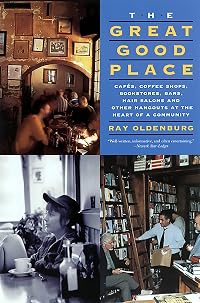
The Great Good Place: Cafes, Coffee Shops, Bookstores, Bars, Hair Salons, and Other Hangouts at the Heart of a Community
by Ray Oldenburg
On This Page
Description
"'Third places,' or 'great good places,' are all those spots where people gather, put aside the concerns of home and work (our first and second places), and hang out simply for the pleasures of good company and lively conversation. Third places are the heart of a community's social vitality, and have long been central to grassroots democracy. Author Ray Oldenburg is renowned for coining the term 'third place.' In this book, he portrays, probes, and promotes these great good places: coffee show more houses, caf?s, bookstores, hair salons, bars, bistros, and more, both past and present - and offers a vision for their revitalization. Eloquent and visionary, this book offers a compelling argument for the importance of informal public and civic life. It explains how third places are essential to community health and individual well-being. In the years since its first appearance in 1989, The Great Good Place has inspired policy makers and entrepreneurs from Seattle to Singapore, Osaka to Oslo. They have opened coffee houses, bookstores, community centers, bars, and other establishments - proudly acknowledging their indebtedness to Ray Oldenburg's ideas" -- publisher's website. show lessTags
Recommendations







Member Reviews
The author points out that commercial space has destroyed our "communities". Even the "invisible hand of the market" which Adam Smith hoped would usher us toward greater social harmony, has failed to do so. [223] Smith did not foresee how "weaponized" by greed the private corporations would become.
Oldenburg is an academic who writes in popular psychology. I loved the title with "Great Good Place", because it invokes the ecclesia of Christ who tells us that the church is our savior: We all know what Heaven on Earth is, and sometimes we get quite close to it. He cites Georg Simmell as the expert on "human sociability" and systemic dynamics.
Oldenburg unwraps the details, exposing the diversity across cultures and places, and showing how show more America has lost gathering places for good company and conversation. Our taverns are declining although drinking has increased.
Paris has sidewalk cafes, London its pubs, Vienna its coffee houses, German its bier gardens, Japan its tea houses, and America once had its Main Street. After probing the bistros and bars, Oldenburg documents the fact that in 1989 the heart of community vitality is being torn out of America. The "great good place" is now gone. We no longer have a social way to avoid idiots. This observation seems prescient looking back from the disasters of 2016-2020.
This book is more than mere documentation, it is also insightful and provides a good basis for ventilating the implications for futurists, the democratic republic, and its religious values. Oldenburg does not mention "Disneyland" or the Wal-mart destruction of rural and urban America, nor does he compass the Internet or the possibility of "virtual communities" of individuals addicted to the preposterous clicks of emoticons. He does comment on the popularity of boules in the cafes, and how the most entertaining games get the most interest. [31] show less
Oldenburg is an academic who writes in popular psychology. I loved the title with "Great Good Place", because it invokes the ecclesia of Christ who tells us that the church is our savior: We all know what Heaven on Earth is, and sometimes we get quite close to it. He cites Georg Simmell as the expert on "human sociability" and systemic dynamics.
Oldenburg unwraps the details, exposing the diversity across cultures and places, and showing how show more America has lost gathering places for good company and conversation. Our taverns are declining although drinking has increased.
Paris has sidewalk cafes, London its pubs, Vienna its coffee houses, German its bier gardens, Japan its tea houses, and America once had its Main Street. After probing the bistros and bars, Oldenburg documents the fact that in 1989 the heart of community vitality is being torn out of America. The "great good place" is now gone. We no longer have a social way to avoid idiots. This observation seems prescient looking back from the disasters of 2016-2020.
This book is more than mere documentation, it is also insightful and provides a good basis for ventilating the implications for futurists, the democratic republic, and its religious values. Oldenburg does not mention "Disneyland" or the Wal-mart destruction of rural and urban America, nor does he compass the Internet or the possibility of "virtual communities" of individuals addicted to the preposterous clicks of emoticons. He does comment on the popularity of boules in the cafes, and how the most entertaining games get the most interest. [31] show less
Few books have had greater influence on the way we perceive communities, community-building, and collaboration than Ray Oldenburg's "The Great Good Place." The terms he introduces have become part of our lexicon: the first place (home), the second place (work), and the third place--the great good place, which is where we meet, socialize, share ideas with, and learn from friends and acquaintances who become part of our personal and extended community. In the first part of his book, Oldenburg describes the history of the third place in America, explores the character of third places, and outlines the "personal benefits" and "greater good" resulting from nurturing and sustaining third places--a tremendous antidote to cynics who claim there show more no longer is a commitment to the idea of public goods. "My interest in those happy gathering places that a community may contain, those 'homes away from home' where unrelated people relate, is almost as old as I am," Oldenburg writes at the beginning of his book (p. ix), and his obvious love and admiration for and commitment to those places serves as inspiration for anyone trying to justify a commitment to community and collaboration. show less
Great read for library professionals.
Great read for library professionals.
Great read for library professionals.
Ratings
Members
- Recently Added By
Author Information
3 Works 729 Members
Common Knowledge
- People/Characters
- Jane Addams; Joseph Addison; Roger Barker; Junius Browne; Charles II, King of England, Scotland, and Ireland; Norm Crosby (show all 18); Ben Davis; Jean Fourastie; Gail Fullerton; Fred Holmes; Violet Hunt; Jane Jacobs; Cara Richards; Arnold Rogow; Tibor Scitovsky; Henry Sedgwick; Georg Simmel; Joseph Wechsberg
- Important places
- Austria; Bavaria, Germany; France; Dresden, Saxony, Germany; Germany; New York, New York, USA (show all 9); New York, USA; River Park, Minnesota, USA; Wisconsin, USA
- Epigraph
- A number of recent American writings indicate that the nostalgia for the small town need not be construed as directed toward the town itself: it is rather a "quest for community" (as Robert Nisbet puts it)--a nostalgia for a... (show all) compassable and integral living unit. The critical question is not whether the small town can be rehabilitated in the image of its earlier strength and growth--for clearly it cannot--but whether American life will be able to evolve any other integral community to replace it. This is what I call the problem of place in America, and unless it is somehow resolved, American life will become more jangled and fragmented than it is, and American personality will continue to be unquiet and unfulfilled
Max Lerner
America as a Civilization
1957 - Dedication
- To Judith and our children Jennie, Maren, and Carl
- First words
- The ensuing years have confirmed Lerner's diagnosis.
- Last words
- (Click to show. Warning: May contain spoilers.)If there is one message I wish to leave with those who despair of suburbia's lifeless streets, of the plastic places along our "strips," or of the congested and inhospitable mess that is "downtown," it is: It doesn't have to be like this!
Classifications
- Genres
- Sociology, Nonfiction, General Nonfiction, Art & Design
- DDC/MDS
- 307.0973 — Society, government, & culture Social sciences, sociology & anthropology Communities Biography And History North America
- LCC
- HT123 .O52 — Social sciences Communities. Classes. Races Communities. Classes. Races Urban groups. The city. Urban sociology
- BISAC
Statistics
- Members
- 611
- Popularity
- 47,753
- Reviews
- 6
- Rating
- (3.95)
- Languages
- English
- Media
- Paper, Ebook
- ISBNs
- 9
- ASINs
- 5