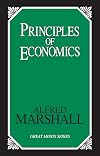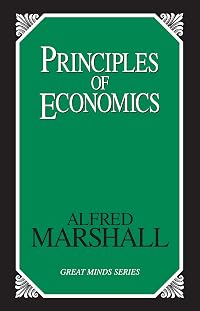
Principles of Economics (Great Minds Series)
by Alfred Marshall
On This Page
Description
Alfred Marshall, Principles of Economics (1890) - Founder of Modern (Neo-classical) Economics. His book Principles of Economics was the dominant textbook in economics for a long time and it is considered to be his seminal work.Tags
Recommendations









Member Reviews
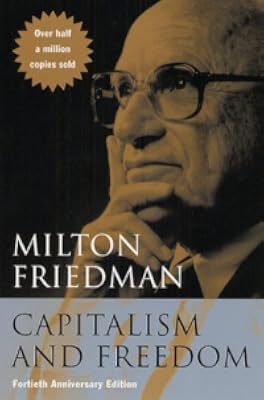
David Friedman (son of the economist Milton Friedman) once told me that of the books of the great economists (Adam Smith, Keynes, etc.) this was the only one that could actually terach a student basic economics. Hence I have felt I should read it, but have not yet done so.
Ratings
Members
- Recently Added By
Lists

Trinity College Booklist (1951): Class Two, Social and Psychological Scienc
60 works; 3 members
Author Information

24 Works 340 Members
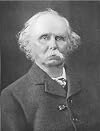
Alfred Marshall, an English economist, is widely regarded as the founder of the neoclassical school of economics. This school of thought, which followed the classical economists (Smith, Ricardo, and Mill, among others), gave a more balanced role to supply and demand as determinants of price, took more of an interest in the role of money, and show more greatly extended the role of marginal analysis. Marshall was born near London. His father, a clerk at the Bank of England, wanted his son to become a clergyman, but young Alfred was more interested in mathematics. After graduating from St. John's College at Cambridge, he lectured there for several years. When he married one of his former students in 1877, he had to leave Cambridge because of the celibacy requirements in force at the time. Marshall taught at University College, Bristol, and then at Oxford University, before returning to Cambridge in 1884 (the celibacy requirement having been lifted). Marshall did not publish extensively, but one book was outstanding. His "Principles of Economics," the first of a planned two-volume work, appeared in 1890. An instant success, it established Marshall as one of the world's leading economists. Its strength lay in its comprehensiveness and the degree to which it incorporated previous developments, along with Marshall's own observations, in a seamless fashion. The book was full of now familiar terms, such as consumer surplus, long- and short-run analysis, and external economies. The second volume, intended to cover the topics of foreign trade, money, trade fluctuations, and taxation, was never published because of Marshall's failing health and his penchant for exhaustive revision. He did, however, publish a less comprehensive volume, "Industry and Trade" (1919). A final volume, "Money, Credit and Commerce" (1923), was less ambitious and less creative. Despite his frail health, which troubled him throughout his career, Marshall lived to the ripe old age of 81. His stature was such that he is credited with founding a "Cambridge School of Economics," and his few publications forever changed the world of economics. (Bowker Author Biography) show less
Series
Belongs to Publisher Series
Common Knowledge
- Original publication date
- 1890
Classifications
Statistics
- Members
- 242
- Popularity
- 135,123
- Reviews
- 1
- Rating
- (3.92)
- Languages
- 6 — Chinese, English, Italian, Korean, Portuguese, Spanish
- Media
- Paper, Ebook
- ISBNs
- 18
- ASINs
- 10