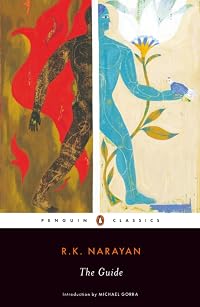
The Guide
by R. K. Narayan
On This Page
Description
Formerly Indiaas most corrupt tourist guide, Rajuajust released from prisonaseeks refuge in an abandoned temple. Mistaken for a holy man, he plays the part and succeeds so well that God himself intervenes to put Rajuas newfound sanctity to the test. Narayanas most celebrated novel, "The Guide" won him the National Prize of the Indian Literary Academy, his countryas highest literary honor.Tags
Recommendations







Member Reviews
As many have noted, R.K. Narayan wasn’t concerned with politics or stories revolving around grand historical movements, despite having lived in turbulent times over his life. Man, he sure does tell a good story though. In The Guide he masterfully interleaves two narratives of a young man’s life, one trying to make his way in the world as a tourist guide, and the other, after he’s been released from prison, being inadvertently taken as a holy man. Part of what makes the novel work is trying to see how these pieces of his life fit together.
We find the young man makes a name for himself but starts getting in over his head when he falls in love with the married wife of a cultural anthropologist traveling for research; she’s a show more “dancing girl.” Narayan may not write epics, but through these characters he subtly comments on class, ambition and corruption in India, and human nature in general. It may sound crazy to say it, but I think you can draw a straight line from Railway Raju, his protagonist, and Aravind Adiga’s Balram Halwai in The White Tiger, despite how much more explicit and wild the latter was. Loved Narayan’s little comedic touches, and it was pretty cool to learn that he wrote this book on his first trip abroad, in a residential hotel in Berkeley, California.
Just one quote:
“I’ve come to the conclusion that nothing in this world can be hidden or suppressed. All such attempts are like holding an umbrella to conceal the sun.” show less
We find the young man makes a name for himself but starts getting in over his head when he falls in love with the married wife of a cultural anthropologist traveling for research; she’s a show more “dancing girl.” Narayan may not write epics, but through these characters he subtly comments on class, ambition and corruption in India, and human nature in general. It may sound crazy to say it, but I think you can draw a straight line from Railway Raju, his protagonist, and Aravind Adiga’s Balram Halwai in The White Tiger, despite how much more explicit and wild the latter was. Loved Narayan’s little comedic touches, and it was pretty cool to learn that he wrote this book on his first trip abroad, in a residential hotel in Berkeley, California.
Just one quote:
“I’ve come to the conclusion that nothing in this world can be hidden or suppressed. All such attempts are like holding an umbrella to conceal the sun.” show less
The novel begins with a peasant gazing reverentially at Raju. Raju has recently been released from prison and having no ties to a particular place or person, has stopped to rest at a shrine. The man, mistaking Raju for a holy man, treats Raju accordingly and Raju "had experienced a feeling of importance. He felt like an actor who was always expected to utter the right sentence." Unwittingly, Raju falls into the role assigned him by Velan, the peasant man, and eventually the role becomes reality. Interspersed with Raju's present is the narrative Raju relates to Velan in an attempt to refute the role thrust upon him.
I thoroughly enjoyed the the present-tense storyline about Raju's transformation into a holy man. The author was able to show more show, not tell, the power of societal expectations to influence and even alter behavior. The dichotomy between Raju's thoughts and his actions subtly raised questions about the nature of faith. The novel ends somewhat abruptly, leaving the reader to choose what happens next and to decide if Raju is a holy man or not. show less
I thoroughly enjoyed the the present-tense storyline about Raju's transformation into a holy man. The author was able to show more show, not tell, the power of societal expectations to influence and even alter behavior. The dichotomy between Raju's thoughts and his actions subtly raised questions about the nature of faith. The novel ends somewhat abruptly, leaving the reader to choose what happens next and to decide if Raju is a holy man or not. show less
R.K. Narayan is one of those rare writers who can make the personalities of his characters exude through the pages, without describing any of their physical features, and heck, even the environment around them.
You have no idea what year it is at any given moment, which places the novel takes place in, and how much time passes between the events. Indeed, Guide, like most of Narayan's work, is timeless - taking place in a time and era of his choosing, with the reader and the character both going through their motions dispassionately. Colonialism, the Partition, politics, sports - all of these might as well not exist for the protagonist, and I found myself liking the novel more and more as it went along.
For him, fate is more or less show more destined, and we are just Shakespeare's actors taking part in a play. Existentialism, absurdism, nihilism - all philosophies are toyed with and thrown out quickly and methodically. Raju makes his own beliefs, and labels are just that - labels.
I never said, "I don't know." Not in my nature, I suppose. If I were inclined to say, "I don't know what you're talking about," my life would have taken a different turn.
You would think that Raju would cynically utter them often reserved for nostalgic baby boomers. Still, Raju speaks them in a dispassionately passionate tone - one that is truly enlightened. He might be a fraudster, but he has the wisdom that actual saints would do well to learn.
The ambiguous ending and the misogyny that was never explicitly addressed made me not as absorbed in the novel as I wanted to be. Still, I can see the praise for Guide, and it is deserving of its status as one of the Indian classics. show less
You have no idea what year it is at any given moment, which places the novel takes place in, and how much time passes between the events. Indeed, Guide, like most of Narayan's work, is timeless - taking place in a time and era of his choosing, with the reader and the character both going through their motions dispassionately. Colonialism, the Partition, politics, sports - all of these might as well not exist for the protagonist, and I found myself liking the novel more and more as it went along.
For him, fate is more or less show more destined, and we are just Shakespeare's actors taking part in a play. Existentialism, absurdism, nihilism - all philosophies are toyed with and thrown out quickly and methodically. Raju makes his own beliefs, and labels are just that - labels.
I never said, "I don't know." Not in my nature, I suppose. If I were inclined to say, "I don't know what you're talking about," my life would have taken a different turn.
You would think that Raju would cynically utter them often reserved for nostalgic baby boomers. Still, Raju speaks them in a dispassionately passionate tone - one that is truly enlightened. He might be a fraudster, but he has the wisdom that actual saints would do well to learn.
The ambiguous ending and the misogyny that was never explicitly addressed made me not as absorbed in the novel as I wanted to be. Still, I can see the praise for Guide, and it is deserving of its status as one of the Indian classics. show less
It took me some time to go through the first 50 pages and I spent weeks postponing it but then I picked it up and I had to read it all in one setting. It was so hard to put down.
If a book is still fresh even after more than 70 yrs and feels like it is written for a person of today's world, you can rest assure that is a brilliant book and must be read by all. Do read it.
If a book is still fresh even after more than 70 yrs and feels like it is written for a person of today's world, you can rest assure that is a brilliant book and must be read by all. Do read it.
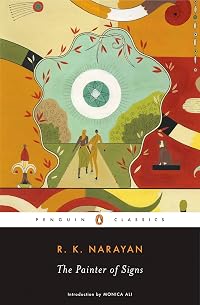
This book was my introduction to R. K. Narayan back in 1989, when I was doing Post-Colonial Lit at Uni (my favourite ever subject, by the way, due in equal parts to the excellence of the authors and the humour and intelligence of Professor Griffiths). I adored it at the time and enjoyed it a lot now, although I wasn't quite so transported. Perhaps that is because I can now recognise recurring themes in Narayan's works and so it doesn't seem quite so fresh. (The Painter of Signs, for example, covers some similar themes.)
An interesting (to me at least) thought crossed my mind during this re-reading: there's something in the nature of Narayan's gentle observation of lives that reminds me of Garrison Keilor's writing, and I can't help show more wondering whether Narayan's Malgudi Days, published in 1943, was in the back of Keilor's mind when he was writing Lake Wobegon Days many decades later. show less
An interesting (to me at least) thought crossed my mind during this re-reading: there's something in the nature of Narayan's gentle observation of lives that reminds me of Garrison Keilor's writing, and I can't help show more wondering whether Narayan's Malgudi Days, published in 1943, was in the back of Keilor's mind when he was writing Lake Wobegon Days many decades later. show less
I have read it a second time after five years. Such was emotion this book evoked in me that I was afraid to continue beyond 60%, because I know what fate awaited the 'Railway Raju', a character I grew fond of. He didn't really do a lot of mistakes, and he is not a bad fellow, all he did was one folly, just one.
It's a beautiful book. That's all I can say. The story just grows, a bit serpentine in it's progress, but it happens right in front of your eyes.
I love R K Narayan. He is a genius.
It's a beautiful book. That's all I can say. The story just grows, a bit serpentine in it's progress, but it happens right in front of your eyes.
I love R K Narayan. He is a genius.
This is a kind of sad book, about a guy who grew up living across the street from where they would one day build a railroad track and railway station. This caused his father's tiny little"store" to flourish, and his father was able to amass some wealth. Eventually getting a contract for a shop in the station, he did even more business, bringing his son into the railway shop to help him. This led to Raju little by little developing a tourist guide business. All very well, except that one day he contracted with a married couple to be their exclusive guide, and that's where all his downfall began.
Members
- Recently Added By
Lists

All Things India
95 works; 21 members

Harold Bloom - The Western Canon: D. The Chaotic Age
833 works; 24 members

Big Jubilee List
70 works; 3 members

A Novel Cure
742 works; 23 members

Allie's Favourite 150 Books
145 works; 3 members

My favourite books
96 works; 3 members

Reading Globally
136 works; 16 members
Author Information

100+ Works 10,410 Members
R. K. Narayan was born Rasipuram Krishnaswami Narayanaswami in Madras, India on October 10, 1906. He graduated from Maharaja College of Mysore with a B.A. degree in 1930. He attempted to teach for a bit but then switched to writing full time. His first book, Swami and Friends, was published in Britain in 1935. During his lifetime, he wrote more show more than 30 novels and hundreds of short stories. His other novels included The Bachelor of Arts, The Dark Room, The English Teacher, The Guide, The Financial Expert, The Man Eater of Malgudi, The Vendor of Sweets, and The World of Nagaraj. He was one of the first Indians to write in English and gain international recognition. He received numerous awards including the Padma Bhushan, India's highest prize. He died on May 13, 2001 at the age of 94. (Bowker Author Biography) show less
Awards and Honors
Awards
Series
Belongs to Publisher Series
Work Relationships
Is contained in
Has the adaptation
Has as a student's study guide
Common Knowledge
Classifications
Statistics
- Members
- 1,093
- Popularity
- 23,305
- Reviews
- 11
- Rating
- (3.73)
- Languages
- 11 — Czech, English, French, German, Greek, Hindi, Italian, Slovenian, Spanish, Swedish, Portuguese (Portugal)
- Media
- Paper, Ebook
- ISBNs
- 23
- ASINs
- 14