On This Page
Description
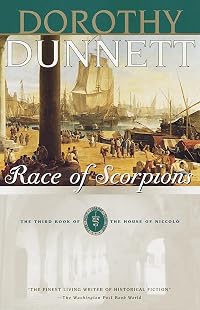
Fiction. Literature. Historical Fiction. HTML:With the bravura storytelling and pungent authenticity of detail she brought to her acclaimed Lymond Chronicles, Dorothy Dunnett presents The House of Niccolò series. The time is the 15th century, when intrepid merchants became the new knighthood of Europe. Among them, none is bolder or more cunning than Nicholas vander Poele of Bruges, the good-natured dyer's apprentice who schemes and swashbuckles his way to the helm of a mercantile empire.show more In 1462, Nicholas is a wealthy 21-year-old. His beloved wife has died. His stepchildren have locked him out of the family business. He and his private army are the target of multiple conspiracies. And both contenders for the throne of Cyprus, the brilliant Queen Carlotta and her charismatic, sexually ambivalent brother James, are demanding his support. Walking a tightrope of intrigue, Dunnett's hero juggles adversaries and allies, from the delectable courtesan Primaflora to the Mameluke commander... show less
Tags
Recommendations










Member Reviews
Enigmatic. Fascinating...
In Race of Scorpions, the place is Cyprus. “Beneath the prettiness, the chivalry, the conceits and scratchings of miniature war, the older gods were still there, threads in the earth, still brooding, still to be pacified.”
Two royal siblings fighting for the crown of Cyprus, Queen Carlotta and James de Lusignan, are also fighting over Nicholas’ services, interrupting his mourning pilgrimage (after the second book, there is a lot to mourn). This is my merchant and military genius! No, mine! As always with Dunnett’s main characters, things require a certain suspension of disbelief. How do they know of Nicholas? Why are they that impressed? I blame the 15th century version of LinkedIn.
Suspension of disbelief show more or no, I am there for the intricate plots, battles, amazing writing, emotional scenes, sharp dialogue, sudden reveals, characters I am still trying to decipher. We are in Nicholas’ head slightly more than in the first two books. Dunnett gives the readers tantalizing glimpses of his true self. (Or is it the self he wants the readers to see? I wouldn’t put it past Nicholas.) How much Nicholas likes to play hasn’t been stated as clearly before. ”Nicholas couldn’t feel entirely happy, in any case, until he knew the last piece of his plan was in place. He produced an expression which he hoped combined simplicity, dignity, and reliability with a hint, maybe of penitence.”
There is a lot of trauma and darkness, for Nicholas and others. Is it the darkest book of the series yet? I don’t think I will forget the siege of Famagusta.
Katelina was a waste of great character through most of the book – neither her hateful obsession with Nicholas nor the other plot lines were believable. I kept wondering where that interesting person I liked to much had gone, and did she leave her brain in book 1? The conclusion of her character arc was riveting, though. ”…had formed out of her obstinacy, it seemed, a frail steely courage that endured where others succumbed.”
I am still very fond of Astorre, the best book mercenary of my reading life; Loppe, who seems to know and see everything. I am still fond of Tobie, despite his constant nagging, because there was this: ”He found he was smiling, and stopped. He was a doctor. A man lay dead behind at this moment. To want to hunt down his killers was natural. One should not, however, start to enjoy it.”
But: ”When about to wring Tobie’s neck, Nicholas always had to remember what a good doctor he was.”
Aaand (drum roll) here is Primaflora. Whoa. That’s… quite a character. I am still scratching my head over her character arc. (And now I am trying very hard not to reveal plot stuff.) I think Primaflora should get a book of her own. I think Primaflora should write a book! “A Courtesan’s Guide to Survival in 15th century Europe”, how about it?
The last twenty percent of the book were so engrossing and emotional! I couldn’t look away.
I am ready for more. Thank you, Melindam, Nastya, Roman Clodia, Ryan, for this buddy read and this book journey.
P.S. While reading, I accumulated four A4’s of notes and quotes. I am very disappointed I could not include it all in one review. show less
In Race of Scorpions, the place is Cyprus. “Beneath the prettiness, the chivalry, the conceits and scratchings of miniature war, the older gods were still there, threads in the earth, still brooding, still to be pacified.”
Two royal siblings fighting for the crown of Cyprus, Queen Carlotta and James de Lusignan, are also fighting over Nicholas’ services, interrupting his mourning pilgrimage (after the second book, there is a lot to mourn). This is my merchant and military genius! No, mine! As always with Dunnett’s main characters, things require a certain suspension of disbelief. How do they know of Nicholas? Why are they that impressed? I blame the 15th century version of LinkedIn.
Suspension of disbelief show more or no, I am there for the intricate plots, battles, amazing writing, emotional scenes, sharp dialogue, sudden reveals, characters I am still trying to decipher. We are in Nicholas’ head slightly more than in the first two books. Dunnett gives the readers tantalizing glimpses of his true self. (Or is it the self he wants the readers to see? I wouldn’t put it past Nicholas.) How much Nicholas likes to play hasn’t been stated as clearly before. ”Nicholas couldn’t feel entirely happy, in any case, until he knew the last piece of his plan was in place. He produced an expression which he hoped combined simplicity, dignity, and reliability with a hint, maybe of penitence.”
There is a lot of trauma and darkness, for Nicholas and others. Is it the darkest book of the series yet? I don’t think I will forget the siege of Famagusta.
Katelina was a waste of great character through most of the book – neither her hateful obsession with Nicholas nor the other plot lines were believable. I kept wondering where that interesting person I liked to much had gone, and did she leave her brain in book 1? The conclusion of her character arc was riveting, though. ”…had formed out of her obstinacy, it seemed, a frail steely courage that endured where others succumbed.”
I am still very fond of Astorre, the best book mercenary of my reading life; Loppe, who seems to know and see everything. I am still fond of Tobie, despite his constant nagging, because there was this: ”He found he was smiling, and stopped. He was a doctor. A man lay dead behind at this moment. To want to hunt down his killers was natural. One should not, however, start to enjoy it.”
But: ”When about to wring Tobie’s neck, Nicholas always had to remember what a good doctor he was.”
Aaand (drum roll) here is Primaflora. Whoa. That’s… quite a character. I am still scratching my head over her character arc. (And now I am trying very hard not to reveal plot stuff.) I think Primaflora should get a book of her own. I think Primaflora should write a book! “A Courtesan’s Guide to Survival in 15th century Europe”, how about it?
The last twenty percent of the book were so engrossing and emotional! I couldn’t look away.
I am ready for more. Thank you, Melindam, Nastya, Roman Clodia, Ryan, for this buddy read and this book journey.
P.S. While reading, I accumulated four A4’s of notes and quotes. I am very disappointed I could not include it all in one review. show less
Out of the three I’ve read so far, this is definitely my least favourite.
This book felt less driven by Nicholas. For once it seemed like all he did was not for some great gain, but mostly to save his own hide and stay alive.
As a result, I think there was more from Nicholas’s point of view than the first two combined. The words “She brought me up. I used to dream that, one day, I would come to her with the girl I was going to marry,” might be the most revealing I’ve read/heard him say.
I’ve been dying to get inside his head, so reasonably, I should have loved it?
Alas.
What I like about this series was still great. Long live Nicholas and his endless schemes, long live the sly manipulative talks and the complex politics with show more ten dozen factions. It’s the parts that I didn’t really like in the previous books that got a bigger role here.
Firstly, the orientalism and treatment of literally anyone not from Europe.
In the first 2 books, this felt like a result of the 1400s setting and the 80s when it was written, but without major disrespect. Loppe was abused and sold, but rose among the ranks of servants until he was treated like a normal secondary character. The Turks of book 2 were the villified enemies of the church, but a faction on war and politics like any other.
Here, there was an unfortunate contrast between the Europeans and the Mamelukes with their Greek fire, which I think could have easily been fixed if there was a devious but not abhorrent Ottoman faction to balance out Tzani-Bey’s outright villainy, OR an outright European villain lacking morals.
Secondly, the romantic subplots.
The one with Katelina in book 1 made sense as a way for her to choose one thing before marriage, something they both did with no strings attached. Her anger at Nicholas about her child, thinking he used her physically and emotionally for his schemes felt logical, so I hoped she would use all her wit to be an interesting major antagonist.
There was an attempt at reconciliation that could have worked, but simply happened far too quickly and was based on some form of romantic feelings and not the acknowledgement that they were both young and fooling around. I would have loved a slow reconciliation arc, or an antagonistic Katelina.
Marian also made sense, maybe not romantically, but I definitely believed they were good friends and business partners who trusted another.
Nicholas and Violante in book 2… honestly added nothing. Her character was great as a political player, the love interest side felt useless?
And then Primaflora. Sigh. I get that it was chivalry (or rather human decency) to care for her safety and they both wanted to sleep around with the ally they had in their situation. Either of them developing romantic feelings was laughable.
For a series that has so many layers and motivations, the excuse 'it was romantic love' in the cases of Katelina, Primaflora and to a lesser extent Marian feels stupidly shallow by comparison.
I get it. Nicholas is smart. That’s why I read these books? To see him manipulate mansplain manslaughter his way to Europe.
I love that he has a small army of followers (Julius, Astorre, Le Grant, Tobie, Godsalc and Loppe) to bamboozle with his schemes.
But why does the one major female character get replaced every book while these men stay around? And why does Nicholas always has some form of romantic thing going on before he beats them at chess politics?
The men get outwitted. Meanwhile women get outwitted AND romantically/sexually humiliated AND written out of the series.
I’ll forgive this series if he sleeps with his greatest critic Tobie next. show less
This book felt less driven by Nicholas. For once it seemed like all he did was not for some great gain, but mostly to save his own hide and stay alive.
As a result, I think there was more from Nicholas’s point of view than the first two combined. The words “She brought me up. I used to dream that, one day, I would come to her with the girl I was going to marry,” might be the most revealing I’ve read/heard him say.
I’ve been dying to get inside his head, so reasonably, I should have loved it?
Alas.
What I like about this series was still great. Long live Nicholas and his endless schemes, long live the sly manipulative talks and the complex politics with show more ten dozen factions. It’s the parts that I didn’t really like in the previous books that got a bigger role here.
Firstly, the orientalism and treatment of literally anyone not from Europe.
In the first 2 books, this felt like a result of the 1400s setting and the 80s when it was written, but without major disrespect. Loppe was abused and sold, but rose among the ranks of servants until he was treated like a normal secondary character. The Turks of book 2 were the villified enemies of the church, but a faction on war and politics like any other.
Here, there was an unfortunate contrast between the Europeans and the Mamelukes with their Greek fire, which I think could have easily been fixed if there was a devious but not abhorrent Ottoman faction to balance out Tzani-Bey’s outright villainy, OR an outright European villain lacking morals.
Secondly, the romantic subplots.
The one with Katelina in book 1 made sense as a way for her to choose one thing before marriage, something they both did with no strings attached. Her anger at Nicholas about her child, thinking he used her physically and emotionally for his schemes felt logical, so I hoped she would use all her wit to be an interesting major antagonist.
There was an attempt at reconciliation that could have worked, but simply happened far too quickly and was based on some form of romantic feelings and not the acknowledgement that they were both young and fooling around. I would have loved a slow reconciliation arc, or an antagonistic Katelina.
Marian also made sense, maybe not romantically, but I definitely believed they were good friends and business partners who trusted another.
Nicholas and Violante in book 2… honestly added nothing. Her character was great as a political player, the love interest side felt useless?
And then Primaflora. Sigh. I get that it was chivalry (or rather human decency) to care for her safety and they both wanted to sleep around with the ally they had in their situation. Either of them developing romantic feelings was laughable.
For a series that has so many layers and motivations, the excuse 'it was romantic love' in the cases of Katelina, Primaflora and to a lesser extent Marian feels stupidly shallow by comparison.
I get it. Nicholas is smart. That’s why I read these books? To see him manipulate mansplain manslaughter his way to Europe.
I love that he has a small army of followers (Julius, Astorre, Le Grant, Tobie, Godsalc and Loppe) to bamboozle with his schemes.
But why does the one major female character get replaced every book while these men stay around? And why does Nicholas always has some form of romantic thing going on before he beats them at chess politics?
The men get outwitted. Meanwhile women get outwitted AND romantically/sexually humiliated AND written out of the series.
I’ll forgive this series if he sleeps with his greatest critic Tobie next. show less
http://nwhyte.livejournal.com/2357757.html
Cyprus is partitioned between feuding rulers, one a proxy of distant Christian Europe, the other beholden to the more local Muslim regional power; the larger part of of the island is controlled by one faction, but the key cities of Famagusta and Kyrenia are in the hands of the minority.
However it's not 1974, or any year since, but 1463, and Dorothy Dunnett's Flemish hero Niccolo gets drawn into the dynastic dispute between the legitimate (but losing) heiress Carlotta, and her very handsome half-brother James. There are beautiful women and fierce battles, and terrific derring-do; there is a brilliant scene with chemically impregnated clothes and a valley filled with snakes; there is show more gut-wrenching, understated tragedy as Niccolo works through his own complex family back-story against the foreground of the Lusignan succession. It's brilliant stuff.
In addition, anyone who actually knows Cyprus will find it particularly attractive. For the same reason as Dunnett's hero, I have an affinity with the Gothic cathedral in Famagusta; much of the rest of the landscape, and a surprising amount of the architecture, is familiar even today - it may be that the same is true of the scenes in Burges or Rhodes, which I know rather less well. It's not essential to enjoying the book, but it adds some much appreciated colour. show less
Cyprus is partitioned between feuding rulers, one a proxy of distant Christian Europe, the other beholden to the more local Muslim regional power; the larger part of of the island is controlled by one faction, but the key cities of Famagusta and Kyrenia are in the hands of the minority.
However it's not 1974, or any year since, but 1463, and Dorothy Dunnett's Flemish hero Niccolo gets drawn into the dynastic dispute between the legitimate (but losing) heiress Carlotta, and her very handsome half-brother James. There are beautiful women and fierce battles, and terrific derring-do; there is a brilliant scene with chemically impregnated clothes and a valley filled with snakes; there is show more gut-wrenching, understated tragedy as Niccolo works through his own complex family back-story against the foreground of the Lusignan succession. It's brilliant stuff.
In addition, anyone who actually knows Cyprus will find it particularly attractive. For the same reason as Dunnett's hero, I have an affinity with the Gothic cathedral in Famagusta; much of the rest of the landscape, and a surprising amount of the architecture, is familiar even today - it may be that the same is true of the scenes in Burges or Rhodes, which I know rather less well. It's not essential to enjoying the book, but it adds some much appreciated colour. show less
Left at a loose end after the shattering conclusion to his Trebizond venture, assorted people seek to induce Nicolas to lend them his talents, and Nicholas refuses all of them, choosing instead to join his company's mercenary leader, Astorre, in fighting the war in Naples. Kidnapped and taken to the island of Cyprus, Nicholas is initially steadfast in his refusal to support either side in the war of succession between Queen Carlotta and the pretender, James, but soon finds various reasons, mostly cynical, one of them plain revenge, to pick a side, assuming he can keep himself and his army alive long enough.
Action, adventure, schemes and plots, high and low romance, family feuds and epic battles and highly devious murder attempts show more enliven his stay in Cyprus, but then these sorts of things tend to follow him around, or lie in wait for him. Brilliantly entertaining. show less
Action, adventure, schemes and plots, high and low romance, family feuds and epic battles and highly devious murder attempts show more enliven his stay in Cyprus, but then these sorts of things tend to follow him around, or lie in wait for him. Brilliantly entertaining. show less
The Perils of Niccolo continue. An ax is buried in his shoulder and yet he survives and perseveres. This is the third installment of the House of Niccolo series and takes place in Greece and Cyprus, where Niccolo is caught between the warring half-siblings, Carlotta and James of Lusignan, who both claim the throne. The Genoese and Venetians are here, scheming, Uzum Hassan's Turkomans are in the background, and the Mamelukes have arrived. The politics and warfare are very twisty and complicated. And so are the personal relationships. Simon St. Pol is mercifully absent, but Katelina is an important character and we meet more people Nicholas seems to be related to.
I had my usual troubles with Dunnett. The overwriting is everywhere and I show more wish her editor had rationed her comma use. More seriously, her treatment of female characters continues to be frustrating and stereotyped. They all labor under their gender disadvantages in ways that feel more 19th/20thC than 15thC. All are frustrated, most are angry, the devious ones survive and the ones who become more sympathetic don't. Why does Dunnett kill off her non-horrible female characters? At this point it's both a feature and a bug.
The ethnic stereotypes are pretty much a given, but they are still unpleasant to read, and the homosexual and ephebophilic plot elements are just as clumsily (and pejoratively) rendered in the narrative viewpoint. The European villains are interesting, the Muslim ones are mostly not. Loppe continues to be a great, if under-specified, character, though. I assume his mysteries will be revealed in later books.
That said, I enjoyed the novel overall. The complexity is fun if you just go with it, Niccolo continues to be intriguingly opaque as he matures, and he's nowhere near as annoying as Lymond. What I like most is that the pursuit of commerce stays front and center, even as royals and aristocrats do battle with each other. It's not just about gaining thrones, it's about gaining trade routes, minerals, and the like. show less
I had my usual troubles with Dunnett. The overwriting is everywhere and I show more wish her editor had rationed her comma use. More seriously, her treatment of female characters continues to be frustrating and stereotyped. They all labor under their gender disadvantages in ways that feel more 19th/20thC than 15thC. All are frustrated, most are angry, the devious ones survive and the ones who become more sympathetic don't. Why does Dunnett kill off her non-horrible female characters? At this point it's both a feature and a bug.
The ethnic stereotypes are pretty much a given, but they are still unpleasant to read, and the homosexual and ephebophilic plot elements are just as clumsily (and pejoratively) rendered in the narrative viewpoint. The European villains are interesting, the Muslim ones are mostly not. Loppe continues to be a great, if under-specified, character, though. I assume his mysteries will be revealed in later books.
That said, I enjoyed the novel overall. The complexity is fun if you just go with it, Niccolo continues to be intriguingly opaque as he matures, and he's nowhere near as annoying as Lymond. What I like most is that the pursuit of commerce stays front and center, even as royals and aristocrats do battle with each other. It's not just about gaining thrones, it's about gaining trade routes, minerals, and the like. show less
It's okay to admit that I still don't have the foggiest idea about much of what goes on in this book, right? Especially in the last third, when the plot twists, revelations and political machinations are coming fast and thick. Still, fast-paced enough to be very enjoyable, though, and I think it's a lot easier to spend six hundred odd pages with Niccolo than it is with Lymond. (Don't get me wrong, I'm very fond of Lymond, but the urge to smack him upside the head is so strong.)
Race of the Scorpions is the third installment in the House of Niccolo series. Nicholas vander Poele is a mere twenty-one years old and already a widower. His stepdaughters want nothing to do with him and summarily locked him out of house and business.
Of course there are interesting character maneuvers as well. Niccolo has a new enemy in Katelina van Borsten. She seduced Claes into taking her virginity and after their second tryst became pregnant. She ended up marrying Simon who's first wife gave birth to Claes. Ultimately, Kate married Claes's stepfather and together they are raising Kate and Claes's child, unbeknownst to Simon. All the while, Nicholas is growing in power. His business sense is blossoming which further irritates his show more enemies.
Dunnett continues to masterfully weave fictional story-lines around real people, places and events. It's what could have happened and probably did.
As an aside, her sex scenes are only hints of trysts and conquests, tastefully done. show less
Of course there are interesting character maneuvers as well. Niccolo has a new enemy in Katelina van Borsten. She seduced Claes into taking her virginity and after their second tryst became pregnant. She ended up marrying Simon who's first wife gave birth to Claes. Ultimately, Kate married Claes's stepfather and together they are raising Kate and Claes's child, unbeknownst to Simon. All the while, Nicholas is growing in power. His business sense is blossoming which further irritates his show more enemies.
Dunnett continues to masterfully weave fictional story-lines around real people, places and events. It's what could have happened and probably did.
As an aside, her sex scenes are only hints of trysts and conquests, tastefully done. show less
Members
- Recently Added By
Lists

Books Read in 2017
4,249 works; 130 members

Global Reads: Books Set in Western Europe
186 works; 10 members
Author Information

35+ Works 18,124 Members
Dorothy Dunnett was born on August 25, 1923 in Dunfermline, Fife, Scotland. She attended Gillespie's High School for Girls. After graduation she attended Edinburgh College of Art, and transferred, upon her marriage, to Glasgow School of Art. From 1940-1955, she worked for the Civil Service as a press officer. Her first novel, The Game of Kings, show more was published in the United States in 1961 and in the United Kingdom the year after. During her lifetime, she wrote over 20 books including King Hereafter, the six-part Lymond Chronicles, and the eight-part House of Niccolo series. She was also a professional portrait painter and exhibited at the Royal Scottish Academy. In 1992 she was awarded the Office of the British Empire for services to literature. She died from cancer on November 9, 2001 at the age of 78. (Bowker Author Biography) show less
Some Editions
Series

Work Relationships
Has as a reference guide/companion
Common Knowledge
- Canonical title
- Race of Scorpions
- Original publication date
- 1989
- People/Characters
- Nicholas vander Poele; Queen Carlotta; Primaflora; James; Tzani-Bey al Ablak
- Important places
- Cyprus
- First words
- That November, God sent snow to north Italy, to the inconvenience of all who had to travel on horseback.
- Last words
- (Click to show. Warning: May contain spoilers.)'You and your island.'
Classifications
Statistics
- Members
- 801
- Popularity
- 34,807
- Reviews
- 15
- Rating
- (4.32)
- Languages
- English, French, German, Italian
- Media
- Paper, Audiobook, Ebook
- ISBNs
- 23
- ASINs
- 14