On This Page
Description
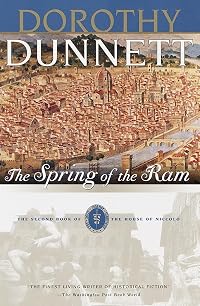
Fantasy. Fiction. Thriller. Historical Fiction. HTML:With the bravura storytelling and pungent authenticity of detail she brought to her acclaimed Lymond Chronicles, Dorothy Dunnett, grande dame of the historical novel, presents The House of Niccolò series. The time is the 15th century, when intrepid merchants became the new knighthood of Europe. Among them, none is bolder or more cunning than Nicholas vander Poele of Bruges, the good-natured dyer's apprentice who schemes and swashbuckles show more his way to the helm of a mercantile empire.In 1461, Nicholas is in Florence. Backed by none other than Cosimo de' Medici, he will sail the Black Sea to Trebizond, last outpost of Byzantium, and the last jewel missing from the crown of the Ottoman Empire. But trouble lies ahead. Nicholas's stepdaughter—at the tender age of thirteen—has eloped with his rival in trade: a Machiavellian Genoese who races ahead of Nicholas, sowing disaster at every port. And time is of the essence: Trebizond may fall to the Turks at any moment. Crackling with... show less
Tags
Recommendations








Member Reviews
I still don’t know where this series is going, and I am loving the journey.
Nicholas is coming into his own. There is a mission for him and the Charetty company (it’s mission of trade, naturally). He gets to assemble a team, and make people into a team. Thoughts on leadership and what people expect from their leader are woven into the book. It’s fascinating.
”For leadership was a dangerous drug. To watch other men’s errors was once an idle amusement; now it was an ache.”
Everything that makes Dunnett novels so special is here: the glories of her descriptive writing; historical details and settings that make you want to read up on so much (or to scour Wikipedia, at the very least); the adventures; the danger; the intrigues; the show more wonderful dialogues; the heartbreak… The villains are great – you love to hate them. Yet Dunnett writes such an unexpectedly poignant scene when one of them meets his end! Just like in the first book, the underlying intrigue is not revealed until the very end. At this point, I felt for Nicholas who wished to be free of both conscience and responsibility.
Games people play is another recurring theme in Dunnett’s books – games and their consequences. Yes, horrible things with overarching consequences may happen, even if you were ”only playing a game”. (Nicholas has now made toys for quite a few people, too. And none of them has had good things happen to them after that. What is this pattern about, I wonder?)
In this book, Nicholas shines a lot more than the supporting characters. I don’t mind this narrative choice, but I wanted to see more of everybody. Catherine de Charetty was an exception, she evolved in interesting ways. The company’s lawyer, Gregorio, had excellent POV chapters as well.
Oh, did I mention that Dunnett took me to Trebizond? To Trebizond! How cool is that? And I could see the city, the Citadel, the Emperor’s court, it was all right in front me. Thank you, book.
”The court spent much of the day making itself beautiful, in order to spend much of the rest of the day in a state of physical gratification.”
”Today, the sun was hazily warm, and the tulips lining the water channels seemed made of scarlet satin: the scent of narcissus and hyacinth was dizzying.”
The latter chapters were thrilling. I guessed some of the events at the very end, but not all, not all… One thing in particular left me reeling – not because I greatly cared for this character, but because of the consequences for all the others. I am guessing we’ll be seeing this play out in the next book!
I have written down too many wonderful quotes not to share at least some of them:
”He went to sea: the earth fell away and instead there was space, into which he sprang vividly whole.”
”Perfection would spoil you,” said John le Grant. ”The passengers knifing the crew, half the galley in holes, two priests and a whistle on board and the Turkish army ahead. It’s not a ship. It’s a nervous wreck, laddie.”
”You’re still planning. You’re up to something, aren’t you?”
”Yes, I am binding my bleeding arm,” said Nicholas.
”Do you not think me altruistic?”
”I didn’t think your highness knew the word,” Nicholas said.
”Nicholas formed the opinion that my lord Simon was untouched by time and probably by experience.”
”He wondered, drawing the new, shining blade, what other skills Simon would force him to master. Finding a method of resurrection, perhaps.”
Melindam, Nastya, Roman Clodia, Ryan – thank you so much for coming along on this journey. Onwards! show less
Nicholas is coming into his own. There is a mission for him and the Charetty company (it’s mission of trade, naturally). He gets to assemble a team, and make people into a team. Thoughts on leadership and what people expect from their leader are woven into the book. It’s fascinating.
”For leadership was a dangerous drug. To watch other men’s errors was once an idle amusement; now it was an ache.”
Everything that makes Dunnett novels so special is here: the glories of her descriptive writing; historical details and settings that make you want to read up on so much (or to scour Wikipedia, at the very least); the adventures; the danger; the intrigues; the show more wonderful dialogues; the heartbreak… The villains are great – you love to hate them. Yet Dunnett writes such an unexpectedly poignant scene when one of them meets his end! Just like in the first book, the underlying intrigue is not revealed until the very end. At this point, I felt for Nicholas who wished to be free of both conscience and responsibility.
Games people play is another recurring theme in Dunnett’s books – games and their consequences. Yes, horrible things with overarching consequences may happen, even if you were ”only playing a game”. (Nicholas has now made toys for quite a few people, too. And none of them has had good things happen to them after that. What is this pattern about, I wonder?)
In this book, Nicholas shines a lot more than the supporting characters. I don’t mind this narrative choice, but I wanted to see more of everybody. Catherine de Charetty was an exception, she evolved in interesting ways. The company’s lawyer, Gregorio, had excellent POV chapters as well.
Oh, did I mention that Dunnett took me to Trebizond? To Trebizond! How cool is that? And I could see the city, the Citadel, the Emperor’s court, it was all right in front me. Thank you, book.
”The court spent much of the day making itself beautiful, in order to spend much of the rest of the day in a state of physical gratification.”
”Today, the sun was hazily warm, and the tulips lining the water channels seemed made of scarlet satin: the scent of narcissus and hyacinth was dizzying.”
The latter chapters were thrilling. I guessed some of the events at the very end, but not all, not all… One thing in particular left me reeling – not because I greatly cared for this character, but because of the consequences for all the others. I am guessing we’ll be seeing this play out in the next book!
I have written down too many wonderful quotes not to share at least some of them:
”He went to sea: the earth fell away and instead there was space, into which he sprang vividly whole.”
”Perfection would spoil you,” said John le Grant. ”The passengers knifing the crew, half the galley in holes, two priests and a whistle on board and the Turkish army ahead. It’s not a ship. It’s a nervous wreck, laddie.”
”You’re still planning. You’re up to something, aren’t you?”
”Yes, I am binding my bleeding arm,” said Nicholas.
”Do you not think me altruistic?”
”I didn’t think your highness knew the word,” Nicholas said.
”Nicholas formed the opinion that my lord Simon was untouched by time and probably by experience.”
”He wondered, drawing the new, shining blade, what other skills Simon would force him to master. Finding a method of resurrection, perhaps.”
Melindam, Nastya, Roman Clodia, Ryan – thank you so much for coming along on this journey. Onwards! show less
Nicholas has been persuaded to travel to the fabulous far-off city of Trebizond, last outpost of an ancient empire. The machinations surrounding this expedition run deeper than the complexities of trade - which Nicholas views as a game - and the politics of European city states and eastern potentates, and are more subtle than the unexpected rivarly of sea-prince Pagano Doria and his apalling marriage, who keeps Nicholas and Co busy with assorted acts of sabotage, some deadlier than others. While lawyer Gregorio and wife Marian try to sort things out at home, Nicholas makes the perilous voyage to the Black Sea and the decadent court of the Emperor, with one eye on the caravans carrying raw silk and another on the army and navy of the show more Ottomans, who can't possibly threaten Trebizond, or so they are assured.
Brilliant, epic, breathtaking, this twists and turns and has heartberaking tragedy and utterly maddening bad guys and characters that aren't actually bad but still quite maddening in their own way, and laugh out loud humour and Dunnet's penchant for characters playing dangerous games that aren't just trade and politics and intrigue, but actual sports, albeit from which the other games are not entirely absent. A confident second volume in which Nicholas embarks on his first great adventure, still callow and with much to learn, and with friends and companions who aren't aways comfortable with what they learn about him. show less
Brilliant, epic, breathtaking, this twists and turns and has heartberaking tragedy and utterly maddening bad guys and characters that aren't actually bad but still quite maddening in their own way, and laugh out loud humour and Dunnet's penchant for characters playing dangerous games that aren't just trade and politics and intrigue, but actual sports, albeit from which the other games are not entirely absent. A confident second volume in which Nicholas embarks on his first great adventure, still callow and with much to learn, and with friends and companions who aren't aways comfortable with what they learn about him. show less
Book 1 was a meandering story with various loose plot threads that are connected by revealing Nicholas’s grand scheme at the very end. This one felt very different.
Nicholas’s cleverness is visible from the first few pages. Everyone knows that from book 1, so the book has various little schemes in succession instead of one big one.
We all know he has plans hidden in other plans hidden in a big plan, like little babushka dolls, so the surprise effect of book 1 has gone. Instead, there’s a certain kind of curiosity and excitement in seeing the babushka dolls open as the book progresses.
It also made the plot more cohesive.
From the start, it is clear what the story is going to be. Nicholas is off to Trebizond to trade for his company show more and the Medici. His rival has charmed the thirteen year old daughter of Nicholas’s boss into marrying him and has his own ship.
They try to outsmart each other at every turn during the sea voyage, which takes up the first half of the book. Then, in the second half, they fight over the trade that is available, and the way home.
The fact that the reader knows Trebizond and the emperor won’t make it gives the book a race-against-the-clock type of suspense.
Again, I enjoyed reading about all Nicholas’s tricks, so I’m moving on to book 3. I am really curious what he will do after taking the heavily significant loss at the end of book 2, because the many third person perspectives reveal little to nothing about Nicholas's real thoughts. show less
Nicholas’s cleverness is visible from the first few pages. Everyone knows that from book 1, so the book has various little schemes in succession instead of one big one.
We all know he has plans hidden in other plans hidden in a big plan, like little babushka dolls, so the surprise effect of book 1 has gone. Instead, there’s a certain kind of curiosity and excitement in seeing the babushka dolls open as the book progresses.
It also made the plot more cohesive.
From the start, it is clear what the story is going to be. Nicholas is off to Trebizond to trade for his company show more and the Medici. His rival has charmed the thirteen year old daughter of Nicholas’s boss into marrying him and has his own ship.
They try to outsmart each other at every turn during the sea voyage, which takes up the first half of the book. Then, in the second half, they fight over the trade that is available, and the way home.
The fact that the reader knows Trebizond and the emperor won’t make it gives the book a race-against-the-clock type of suspense.
Again, I enjoyed reading about all Nicholas’s tricks, so I’m moving on to book 3. I am really curious what he will do after taking the heavily significant loss at the end of book 2, because the many third person perspectives reveal little to nothing about Nicholas's real thoughts. show less
Well! After the boyish rough and tumble of Niccolò Rising, we see Claus become Nicholas, a more sober young man, but still with the habit of utterly ruining people who get in his way. This time, as he is manoeuvred into a trip to Trebizond, Pagano Dorian, a spurious sea prince appears to be crossing him at every turn, and it transpires that he is in the pay of deadly enemy and believed father, Simon de St Pol. Nicholas wishes to best Simon at trade, and it seems he has a revenge closer to home, in Katelijne's son Henry, a son who isnalso a grandson, we are led to believe. The alum monopoly of the first book is revealed even as the Sultan of Constantinople takes Trebizond with hardly a fight. Catherine de Charetty is freed from her show more child marriage to Doria, and they all return back to Venice, sadly too late for Nicholas to meet his wife again, died on the voyage to repudiate the papers of Catherine's marriage.
Tobie and Godscalc hear Nicholas raving with swamp fever, and find out about Henry.
I am confused, no doubt on purpose, as to how much of what happens is coincidence, and how much Nicholas's design, or the design of other players such as Simon and his father, the Naxos princesses, the other men in Nicholas' company... confused but intrigued! show less
Tobie and Godscalc hear Nicholas raving with swamp fever, and find out about Henry.
I am confused, no doubt on purpose, as to how much of what happens is coincidence, and how much Nicholas's design, or the design of other players such as Simon and his father, the Naxos princesses, the other men in Nicholas' company... confused but intrigued! show less
http://nwhyte.livejournal.com/1976169.html
Niccolò, the Flemish apprentice-turned-magnate of the first book, is sent on a mission of cut-throat mercantile competition to Trebizond, the only surviving point of the Byzantine Empire; but the year is 1461, and Trebizond's time is also running out. There's some very skeevy (though not at all explicit) underage sex in this book, though our hero nobly stands aside from it; there's also a lot of appropriately byzantine political conspiracy, with tendrils reaching from Georgia to Scotland in a beautifully drawn pattern of entanglement. It's all very lush and convincing, and just as I was wondering if Niccolò would ever actually lose any of the conflicts he gets involved with, I was blindsided show more by one of the several twists at the end. Good stuff. show less
Niccolò, the Flemish apprentice-turned-magnate of the first book, is sent on a mission of cut-throat mercantile competition to Trebizond, the only surviving point of the Byzantine Empire; but the year is 1461, and Trebizond's time is also running out. There's some very skeevy (though not at all explicit) underage sex in this book, though our hero nobly stands aside from it; there's also a lot of appropriately byzantine political conspiracy, with tendrils reaching from Georgia to Scotland in a beautifully drawn pattern of entanglement. It's all very lush and convincing, and just as I was wondering if Niccolò would ever actually lose any of the conflicts he gets involved with, I was blindsided show more by one of the several twists at the end. Good stuff. show less
Dunnett's novels are masterworks of historical fiction, but that doesn't make them glide down smoothly. She writes for readers of high intelligence who like a novel that offers a bit of a challenge. The Spring of the Ram is #2 in the House of Niccolo series about a young Flemish dyeworker as smart as Dunnett's ideal reader (well, a little more so, perhaps) and just as ambitious. But he has a streak of mischief in him, and more than a streak of passion. It's a mix that makes enemies, and Claes-Nicholas-Niccolo has made some that are truly dangerous. In this episode, he makes an alliance with the Medici family and sets off for Trebizond (now eastern Turkey, then a successor to the collapsed Byzantine Empire). The plot is wickedly twisty, show more full of unexpected developments and doublecrosses. I was about a quarter of the way through reading this when I fell in love, so my brain was pretty addled while I was reading the last three-quarters and not up to its usual powers of concentration. Still, I dare any reader to follow every single twist and turn in this novel. The characters, numerous as they are, are easier to keep track of, because they're so individual and so vividly portrayed. Definitely read the first book in the series, Niccolo Rising, before picking this up. Some series novels don't really have to be read in order to be enjoyed. These do. show less
Book 2 in the Niccolo series. I managed to polish this off in less than a week, thanks to lots of airplane travel. This time Nicholas is making his way to the Empire of Trebizond, trading as a representative of the Medici Florence and also trying to track down his stepdaughter Catherine, who has run off with a man who is Not What He Seems. Intrigue is piled upon intrigue, at every level (personal, professional, international). As in the Lymond series, our hero and his immediate circle are caught up in real-world events, some small, some cataclysmic.
Nicholas is clearly coming into his own in this volume. He's miles ahead of everyone around him in terms of plotting and planning (although not always far enough ahead of his rivals and show more ill-wishers). You can see how much Dunnett enjoys creating a Mythic Hero type, but whereas Lymond arrived basically full-blown, Nicholas is taking his time. After two volumes, I'm finding Nicholas easier to live with than Lymond (who is so theatrically brilliant and wonderful that he becomes exhausting).
The settings are depicted at the level of detail and complexity we expect from a Dunnett novel. This is an era of warring principalities in Italy, imperial clashes between Europe and Asia, and the Ottoman Empire coming to power. It's hard to keep track of the people and the places, but as with other Dunnett books, I just keep reading and eventually I have a pretty good idea of what's going on. I enjoyed the Trebizond setting a lot. The way homosexual/bisexual, non-Christian, and non-white characters are depicted was occasionally discomfiting, and I get the feeling it fits more with 20thC attitudes than with the way people would have behaved in 15thC Europe (I'm talking less about the actual behavior than the way the behavior is processed by POV characters and the narrative).
Nevertheless, the writing is lushly descriptive and the settings themselves are fascinating. I really appreciate seeing this era from the point of view of successful merchants and traders rather than the standard aristocratic and royal perspectives. show less
Nicholas is clearly coming into his own in this volume. He's miles ahead of everyone around him in terms of plotting and planning (although not always far enough ahead of his rivals and show more ill-wishers). You can see how much Dunnett enjoys creating a Mythic Hero type, but whereas Lymond arrived basically full-blown, Nicholas is taking his time. After two volumes, I'm finding Nicholas easier to live with than Lymond (who is so theatrically brilliant and wonderful that he becomes exhausting).
The settings are depicted at the level of detail and complexity we expect from a Dunnett novel. This is an era of warring principalities in Italy, imperial clashes between Europe and Asia, and the Ottoman Empire coming to power. It's hard to keep track of the people and the places, but as with other Dunnett books, I just keep reading and eventually I have a pretty good idea of what's going on. I enjoyed the Trebizond setting a lot. The way homosexual/bisexual, non-Christian, and non-white characters are depicted was occasionally discomfiting, and I get the feeling it fits more with 20thC attitudes than with the way people would have behaved in 15thC Europe (I'm talking less about the actual behavior than the way the behavior is processed by POV characters and the narrative).
Nevertheless, the writing is lushly descriptive and the settings themselves are fascinating. I really appreciate seeing this era from the point of view of successful merchants and traders rather than the standard aristocratic and royal perspectives. show less
Members
- Recently Added By
Lists

Books Read in 2017
4,249 works; 130 members

Animals in the Title
498 works; 11 members
Author Information

35+ Works 18,075 Members
Dorothy Dunnett was born on August 25, 1923 in Dunfermline, Fife, Scotland. She attended Gillespie's High School for Girls. After graduation she attended Edinburgh College of Art, and transferred, upon her marriage, to Glasgow School of Art. From 1940-1955, she worked for the Civil Service as a press officer. Her first novel, The Game of Kings, show more was published in the United States in 1961 and in the United Kingdom the year after. During her lifetime, she wrote over 20 books including King Hereafter, the six-part Lymond Chronicles, and the eight-part House of Niccolo series. She was also a professional portrait painter and exhibited at the Royal Scottish Academy. In 1992 she was awarded the Office of the British Empire for services to literature. She died from cancer on November 9, 2001 at the age of 78. (Bowker Author Biography) show less
Some Editions
Series

Work Relationships
Has as a reference guide/companion
Common Knowledge
- Canonical title
- The Spring of the Ram
- Original publication date
- 1987
- Important places*
- België
- First words
- The spring sign of the Ram is, of course, the earliest in the Zodiac; and Aries relates to the first House in the Wheel.
- Last words
- (Click to show. Warning: May contain spoilers.)But whether in irony or in agony, in defiance or submission she couldn't hear, for the din of the bells.
*Some information comes from Common Knowledge in other languages. Click "Edit" for more information.
Classifications
Statistics
- Members
- 904
- Popularity
- 29,690
- Reviews
- 16
- Rating
- (4.43)
- Languages
- English, French, German, Italian
- Media
- Paper, Audiobook, Ebook
- ISBNs
- 26
- UPCs
- 1
- ASINs
- 10