On This Page
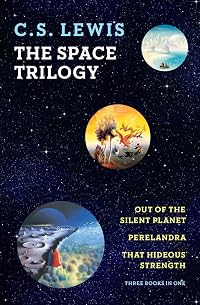
Description
Experience the full journey of C.S. Lewis's beloved Space Trilogy in one volume - including Out of the Silent Planet, Perelandra, and That Hideous Strength. This visionary work of Christian science fiction blends interplanetary adventure with deep spiritual insight, exploring cosmic themes of good and evil, morality, temptation, and redemption. Follow Dr. Elwin Ransom, a humble philologist, as he's drawn into an epic battle across worlds - from the spiritual harmony of Malacandra (Mars), to show more the paradise of Perelandra (Venus) where he must prevent a second fall of man, and finally back to Earth in That Hideous Strength, where dark forces rise through a corrupt scientific regime threatening humanity's soul. Through these interconnected stories, Lewis delivers a richly layered narrative that combines imaginative world-building with profound philosophical and theological reflection. What This Book Offers Readers: Three complete novels in one beautifully curated edition. A compelling blend of science fiction, fantasy, and Christian allegory. Philosophical depth and spiritual insight wrapped in thrilling adventure. A timeless exploration of cosmic good vs. evil, temptation, free will, and redemption. A literary masterpiece by C.S. Lewis, perfect for fans of The Chronicles of Narnia, The Lord of the Rings, and intelligent speculative fiction. show lessTags
Recommendations




Member Recommendations

Member Reviews
That Hideous Strength was published in 1945, the year in which World War II came to its conclusion and is the concluding work of the trilogy that began with Out of the Silent Planet published in 1938, the year of Munich, and continued with Perelandra, published in 1943. It is a great book, but one that will frustrate both the casual science fiction fan because of the absence of anything supernatural, extraterrestrial, or fantastic through roughly the first half of the book. On the other hand, it has been criticized by reviewers, most prominently, George Orwell, who reviewed Lewis' novel for the Manchester Evening News on August 16, 1945 (in the immediate aftermath of the atom bombs dropped on Hiroshima and Nagasaki forcing Japan's show more surrender). Orwell writes "One could recommend this book unreservedly if Mr. Lewis had succeeded in keeping it all on a single level. Unfortunately, the supernatural keeps breaking in, and it does so in rather confusing, undisciplined ways." I cannot judge as to how undisciplined Lewis is, but I can agree with Orwell that it is certainly difficult to follow.
The action takes place in an English university town called Edgestow, more specifically at a college known as Bracton. The college administration decides to sell a part of its property, the Bragdon Wood, to a newly constituted organization called the National Institute for Coordinated Experiments, or the N.I.C.E. for short. The ostensible mission of the N.I.C.E. is to accelerate the development of science-based solutions to the problems that continually beset humanity - hunger, housing, crime, sickness - and to eliminate the "Red Tape" that has hitherto frustrated the activities of scientists and administrators to organize and implement ways and means of improving mankind. In our time there is no shortage of government and non-government organizations dedicated to, in Francis Bacon's famous phrase, "the relief of man's estate". For a very good discussion of what was in the air in Britain between the two world wars by way of fixing what ails humanity (at least the British share of it) see Richard Overy's "The Twilight Years: The Paradox of Britain Between the Wars".
It transpires that the leadership of the N.I.C.E. is not at all focused on the improvement of the human race and the amelioration of the problems that beset it. Rather it is engaged in a conspiracy to subdue humanity and all of nature in what could be characterized as an attempt to make manifest an extreme version of what today we would call transhumanism. As one of the characters, a Reverend Straik, puts it, "It is the beginning of Man Immortal and Man Ubiquitous...Man on the throne of the universe". However, as his colleague Professor Filostrato elaborates "...the power will be confined to a number - a small number - of individual men. those who are selected for eternal life".
When his naive colleague, a sociologist by trade, suggests that it will be extended eventually to all men, Filostrato responds "No, I mean it will be reduced to one man." And in Filostrato's future vision for the Earth all organic life is extinguished, with the barrenness of the Moon being his model for the future of Earth.
Given that the N.I.C.E. has the support of the British establishment including one its higher ups in Parliament, it has little trouble in advancing its agenda. It has its own independent police force which has been given a free hand not only on its own property but in the town of Edgestow beyond the N.I.C.E. offices. The N.I.C.E. leaders eventually gin up a riot in the town that is used to justify the suspension of civil liberties and give the N.I.C.E. police, under the leadership of a nasty, sadistic lesbian, plenary police power from which there is no appeal - a cautionary lesson for our times. Indeed the N.I.C.E. is able to plant accounts of the riot in both highbrow and tabloid papers written in advance of the riot. These articles are presented in full one after the other and it is sobering to reflect on how easy it is to spin reality to shape public opinion for political benefit. Orwell published "Politics and the English Language" in 1946, a year after reviewing Lewis' novel.
Happily for humanity there is a small company of men and women organized around a Director which has understood what it really going on under the auspices of the N.I.C.E. and who are committed to wage war against "That Hideous Strength" a reference to a medieval poem about the Tower of Babel. Both the good guys and the bad guys are in communication with spiritual beings that correspond roughly to the angels who waged battle in Heaven against the angels who rebelled against God. The McGuffin, or the X-factor, in the tale centers around the search for the grave of Merlin, the magician of Arthurian legends. It transpires that Merlin's tomb is located in the Bragdon Wood which is why the N.I.C.E. decided to set up shop in Edgestow and acquire the Wood from the fellows of Bracton. More of the plot than this I will not relate as I don't want to spoil it for any potential reader.
In That Hideous Strength Lewis gives fictional form to the arguments made two years earlier in his classic "The Abolition of Man" which I commend to your attention either as a preface or a postscript to the novel. This work can be read on a standalone basis, although all three books in the trilogy are excellent. Indeed, I would guess that the typical science fiction devotee prefers the first two volumes to the third.
Finally, this is a book that I have had occasion to read multiple times over forty something years since I first purchased it. It never fails to refresh my spirit and give me hope. I feel obliged to let any reader of this review know that in present day Great Britain there is an actual organization called the N.I.C.E., the National Institute for Clinical Excellence that is a part of the National Health Service. Nothing to be concerned with, I'm sure. show less
The action takes place in an English university town called Edgestow, more specifically at a college known as Bracton. The college administration decides to sell a part of its property, the Bragdon Wood, to a newly constituted organization called the National Institute for Coordinated Experiments, or the N.I.C.E. for short. The ostensible mission of the N.I.C.E. is to accelerate the development of science-based solutions to the problems that continually beset humanity - hunger, housing, crime, sickness - and to eliminate the "Red Tape" that has hitherto frustrated the activities of scientists and administrators to organize and implement ways and means of improving mankind. In our time there is no shortage of government and non-government organizations dedicated to, in Francis Bacon's famous phrase, "the relief of man's estate". For a very good discussion of what was in the air in Britain between the two world wars by way of fixing what ails humanity (at least the British share of it) see Richard Overy's "The Twilight Years: The Paradox of Britain Between the Wars".
It transpires that the leadership of the N.I.C.E. is not at all focused on the improvement of the human race and the amelioration of the problems that beset it. Rather it is engaged in a conspiracy to subdue humanity and all of nature in what could be characterized as an attempt to make manifest an extreme version of what today we would call transhumanism. As one of the characters, a Reverend Straik, puts it, "It is the beginning of Man Immortal and Man Ubiquitous...Man on the throne of the universe". However, as his colleague Professor Filostrato elaborates "...the power will be confined to a number - a small number - of individual men. those who are selected for eternal life".
When his naive colleague, a sociologist by trade, suggests that it will be extended eventually to all men, Filostrato responds "No, I mean it will be reduced to one man." And in Filostrato's future vision for the Earth all organic life is extinguished, with the barrenness of the Moon being his model for the future of Earth.
Given that the N.I.C.E. has the support of the British establishment including one its higher ups in Parliament, it has little trouble in advancing its agenda. It has its own independent police force which has been given a free hand not only on its own property but in the town of Edgestow beyond the N.I.C.E. offices. The N.I.C.E. leaders eventually gin up a riot in the town that is used to justify the suspension of civil liberties and give the N.I.C.E. police, under the leadership of a nasty, sadistic lesbian, plenary police power from which there is no appeal - a cautionary lesson for our times. Indeed the N.I.C.E. is able to plant accounts of the riot in both highbrow and tabloid papers written in advance of the riot. These articles are presented in full one after the other and it is sobering to reflect on how easy it is to spin reality to shape public opinion for political benefit. Orwell published "Politics and the English Language" in 1946, a year after reviewing Lewis' novel.
Happily for humanity there is a small company of men and women organized around a Director which has understood what it really going on under the auspices of the N.I.C.E. and who are committed to wage war against "That Hideous Strength" a reference to a medieval poem about the Tower of Babel. Both the good guys and the bad guys are in communication with spiritual beings that correspond roughly to the angels who waged battle in Heaven against the angels who rebelled against God. The McGuffin, or the X-factor, in the tale centers around the search for the grave of Merlin, the magician of Arthurian legends. It transpires that Merlin's tomb is located in the Bragdon Wood which is why the N.I.C.E. decided to set up shop in Edgestow and acquire the Wood from the fellows of Bracton. More of the plot than this I will not relate as I don't want to spoil it for any potential reader.
In That Hideous Strength Lewis gives fictional form to the arguments made two years earlier in his classic "The Abolition of Man" which I commend to your attention either as a preface or a postscript to the novel. This work can be read on a standalone basis, although all three books in the trilogy are excellent. Indeed, I would guess that the typical science fiction devotee prefers the first two volumes to the third.
Finally, this is a book that I have had occasion to read multiple times over forty something years since I first purchased it. It never fails to refresh my spirit and give me hope. I feel obliged to let any reader of this review know that in present day Great Britain there is an actual organization called the N.I.C.E., the National Institute for Clinical Excellence that is a part of the National Health Service. Nothing to be concerned with, I'm sure. show less
AUDIOBOOK REVIEW
Excellent, Excellent, Abysmal.
I have been looking forward to this since I first saw the announcement as I read the trilogy years ago and it has lived in my memory.
The first two books are outstandingly performed by Alex Jennings. He is a very adept voice actor, drawing the listener deep into the story. I’ll be listening to Out of the Silent Planet and Perlandra again and again.
But, oh, the third one … I wish I could rate the three books in the trilogy separately.The dramatist really took liberties with the characters. Ransom and Merlin in particular, and to a large extent Jane, were so unlike the characters that CS Lewis wrote that they were almost unrecognisable. The tenor of the whole work was consequently radically show more changed. What a disappointment. If you haven’t read the book, you may enjoy this dramatisation. As for me, I’ll be hitting stop at the end of Perelandra when I listen again, and listening to an alternative recording (narrated or dramatised) of That Hideous Strength. show less
Excellent, Excellent, Abysmal.
I have been looking forward to this since I first saw the announcement as I read the trilogy years ago and it has lived in my memory.
The first two books are outstandingly performed by Alex Jennings. He is a very adept voice actor, drawing the listener deep into the story. I’ll be listening to Out of the Silent Planet and Perlandra again and again.
But, oh, the third one … I wish I could rate the three books in the trilogy separately.The dramatist really took liberties with the characters. Ransom and Merlin in particular, and to a large extent Jane, were so unlike the characters that CS Lewis wrote that they were almost unrecognisable. The tenor of the whole work was consequently radically show more changed. What a disappointment. If you haven’t read the book, you may enjoy this dramatisation. As for me, I’ll be hitting stop at the end of Perelandra when I listen again, and listening to an alternative recording (narrated or dramatised) of That Hideous Strength. show less
Jack Lewis is often quoted as positing that children's literature is only good if it can be enjoyed by adults equally. I'd like to add a twist. Christian fiction (children's or adult) is only good if it can be enjoyed by non-Christians equally. Lewis is one of the few authors I still find enjoyable, even if I don't agree with his philosophy anymore. He was a master storyteller of which you no longer find within the hallowed halls of Western Religions.
Hiker, Dr Elwin Ransom, on a walking holiday finds himself abducted by Divine and Weston who bring him to the planet Malacandra, where the inhabitants are named Sorns, Hrossa, and Séroni, Pfifltriggi and Oyéresu, and the Eldil. He meets the tutelary spirit of the planet named Oyarsa. Ransom, experiences a profound sense of connection and awareness of higher, spiritual beings which develop the philosophical and theological concepts of solitude and the presence of the divine in nature and intellectual thought throughout the novel.
Although I enjoyed the first book in this trilogy as a well written exciting and inventive story, I felt the next two were a let-down in comparison, rather than continue the excitement of Ransom's travels and show more scientific discoveries, Lewis dwelt more on the religious implications of good and evil present in the universe, using many analogies from Christianity, in particular the book of Genesis.
I loved the neologisms invented by Lewis in this trilogy, alns, Glundantra (Jupiter), The Field of Arbol (the Solar system), and Sulva (the Moon), to name but a few. His main protagonist was a linguist who learned languages quickly, and wanted to create the dictionaries for the worlds he encountered.
Full of references to H. G. Wells, Chaucer, Roman history, Daniel Defoe, Greek mythology, Ludovico Ariosto, Shakespeare, John Buchan, J. W. Dunne, Huxley, Norse mythology, Freud, Merlin and Atlantis.
There is evidence of the author's own shell shock where he uses Ypres Salient as a metaphor in the for hellish conflict on Earth.
I also like the way Lewis incorporated Schiaparelli's astronomical findings about Venus as part of Perelandra's background. "If Schiaparelli is right they'd be perpetual day on one side." Which show the dated aspect of what we knew about Venus at eh time. The protagonist, Elwin Ransom, travels to this world (which is depicted as a floating ocean paradise) and encounters its "Green Lady," the unfallen queen of the planet, where he must battle a demonic version of his former nemesis, Professor Weston.
He describes seeing life through the inner eye, no eating/copulation, a trans-sensuous life is different to a non-sensuous life, and uses the terms Trans-geneder (a different meaning today) and transgastronomic.
Some parts poetic e.g. the Malacandrians called the Asteroids "dancers before the threshold of the Great Worlds".
The best character in the trilogy appears in the last book; Mr Bultitude, a brown bear who spends most of his time in the bathroom.
Below are a few of my notes:
Tellurian/Tellus ruled over by Maleldil. Malacandra (Mars) ruled by Oyarsa.
The last book, That Hideous Strength, describes a corrupt scientific organization (N.I.C.E.) trying to impose order on a university town, clashing with ancient magic and deeper spiritual realities, exploring themes of power, modernity, Christian morality, and the dehumanizing potential of unchecked science. Lewis expands on his theology, "Felix peccatum Adae", questioning what if Eve had resisted? In the story Jane does resist, and ultimately contributes to the forces of good prevailing; he mentions the empirical bogey, a view that the universe is the “mere by-product of essential disorder".
Grave inscription "he was born when Tellus has completed one thousand eight hundred and ninety-six revolutions about Arbol.
Tiny mammals that resembled proto-hippos are mentioned, again possibly related to the time in 1850 when the first hippopotamus to be seen in Europe since Roman times joined London Zoo, and caused a public sensation. show less
Although I enjoyed the first book in this trilogy as a well written exciting and inventive story, I felt the next two were a let-down in comparison, rather than continue the excitement of Ransom's travels and show more scientific discoveries, Lewis dwelt more on the religious implications of good and evil present in the universe, using many analogies from Christianity, in particular the book of Genesis.
I loved the neologisms invented by Lewis in this trilogy, alns, Glundantra (Jupiter), The Field of Arbol (the Solar system), and Sulva (the Moon), to name but a few. His main protagonist was a linguist who learned languages quickly, and wanted to create the dictionaries for the worlds he encountered.
Full of references to H. G. Wells, Chaucer, Roman history, Daniel Defoe, Greek mythology, Ludovico Ariosto, Shakespeare, John Buchan, J. W. Dunne, Huxley, Norse mythology, Freud, Merlin and Atlantis.
There is evidence of the author's own shell shock where he uses Ypres Salient as a metaphor in the for hellish conflict on Earth.
I also like the way Lewis incorporated Schiaparelli's astronomical findings about Venus as part of Perelandra's background. "If Schiaparelli is right they'd be perpetual day on one side." Which show the dated aspect of what we knew about Venus at eh time. The protagonist, Elwin Ransom, travels to this world (which is depicted as a floating ocean paradise) and encounters its "Green Lady," the unfallen queen of the planet, where he must battle a demonic version of his former nemesis, Professor Weston.
He describes seeing life through the inner eye, no eating/copulation, a trans-sensuous life is different to a non-sensuous life, and uses the terms Trans-geneder (a different meaning today) and transgastronomic.
Some parts poetic e.g. the Malacandrians called the Asteroids "dancers before the threshold of the Great Worlds".
The best character in the trilogy appears in the last book; Mr Bultitude, a brown bear who spends most of his time in the bathroom.
Below are a few of my notes:
Tellurian/Tellus ruled over by Maleldil. Malacandra (Mars) ruled by Oyarsa.
The last book, That Hideous Strength, describes a corrupt scientific organization (N.I.C.E.) trying to impose order on a university town, clashing with ancient magic and deeper spiritual realities, exploring themes of power, modernity, Christian morality, and the dehumanizing potential of unchecked science. Lewis expands on his theology, "Felix peccatum Adae", questioning what if Eve had resisted? In the story Jane does resist, and ultimately contributes to the forces of good prevailing; he mentions the empirical bogey, a view that the universe is the “mere by-product of essential disorder".
Grave inscription "he was born when Tellus has completed one thousand eight hundred and ninety-six revolutions about Arbol.
Tiny mammals that resembled proto-hippos are mentioned, again possibly related to the time in 1850 when the first hippopotamus to be seen in Europe since Roman times joined London Zoo, and caused a public sensation. show less
I approached the trilogy in the search for Lewis theological/philosophical writing, and I was baffled with his gift to make me see and almost taste things I have never seen or eaten.
Descriptions of our world that I had to copy and send to my language loving friends, with a happy smile.
I enjoyed the travel in his universe and in his perspective of our beeing, the new ways to look at the world and my existence.
They should have hired him to write the Bible :)
I'm not an experienced science fiction reader, but I imagine that as such, it is rather weak.
Both on account of Lewis delightful written language and his thinking about our existence I will make sure to read more by him.
Descriptions of our world that I had to copy and send to my language loving friends, with a happy smile.
I enjoyed the travel in his universe and in his perspective of our beeing, the new ways to look at the world and my existence.
They should have hired him to write the Bible :)
I'm not an experienced science fiction reader, but I imagine that as such, it is rather weak.
Both on account of Lewis delightful written language and his thinking about our existence I will make sure to read more by him.
This final part of the trilogy is longer than the first two put together. It's a bit of a mixed bag though with more good than bad, certainly much better than the largely tedious Perelandra. The first three quarters are exciting, with a growing sense of foreboding about the amorality of the Institute's activities, with interesting things to say about science and religion and subjective v. objective philosophical viewpoints. But the last 100 pages were somewhat disappointing with the plot being obscured with opaque and rather arbitrary cultural references and seemingly random and inexplicable happenings, leading to a rather unsatisfactory conclusion.
Review based on Out of the Silent Planet only
Out of the Silent Planet
This is an intriguing story of one man's encounter with the intelligent alien life forms on the planet Malacandra, better known to us as Mars. Lewis is very good at creating an alien way of life and a totally different philosophical outlook from that of humans. The religious undertones are well handled and subtly done - those who do not wish to acknowledge that dimension can just treat this as a very good SF novel rather ahead of its time in terms of its treatment of otherness.
Out of the Silent Planet
This is an intriguing story of one man's encounter with the intelligent alien life forms on the planet Malacandra, better known to us as Mars. Lewis is very good at creating an alien way of life and a totally different philosophical outlook from that of humans. The religious undertones are well handled and subtly done - those who do not wish to acknowledge that dimension can just treat this as a very good SF novel rather ahead of its time in terms of its treatment of otherness.
Members
- Recently Added By
Lists

Best Books About Journeys and Quests
117 works; 30 members

The 5 Parsec Shelf
50 works; 7 members

Favorite Series
238 works; 94 members

Religious Science Fiction
70 works; 20 members

CCE 100 Great Books List
145 works; 8 members

Favorite Long Books
330 works; 42 members

Religious Fiction
58 works; 13 members

Necessary & Exquisite
30 works; 4 members

Ambleside Year 8
80 works; 1 member

Read in 2001–2002
29 works; 1 member

HMS: Make Your Child a Lover of Books, Books for Boys
28 works; 2 members
Talk Discussions
Past Discussions
Reading That Hideous Strength in July in The Green Dragon (July 2020)
Reading Perelandra in June in The Green Dragon (July 2020)
Reading Out of the Silent Planet in May in The Green Dragon (June 2020)
Author Information

546+ Works 525,882 Members
C. S. (Clive Staples) Lewis, "Jack" to his intimates, was born on November 29, 1898 in Belfast, Ireland. His mother died when he was 10 years old and his lawyer father allowed Lewis and his brother Warren extensive freedom. The pair were extremely close and they took full advantage of this freedom, learning on their own and frequently enjoying show more games of make-believe. These early activities led to Lewis's lifelong attraction to fantasy and mythology, often reflected in his writing. He enjoyed writing about, and reading, literature of the past, publishing such works as the award-winning The Allegory of Love (1936), about the period of history known as the Middle Ages. Although at one time Lewis considered himself an atheist, he soon became fascinated with religion. He is probably best known for his books for young adults, such as his Chronicles of Narnia series. This fantasy series, as well as such works as The Screwtape Letters (a collection of letters written by the devil), is typical of the author's interest in mixing religion and mythology, evident in both his fictional works and nonfiction articles. Lewis served with the Somerset Light Infantry in World War I; for nearly 30 years he served as Fellow and tutor of Magdalen College at Oxford University. Later, he became Professor of Medieval and Renaissance English at Cambridge University. C.S. Lewis married late in life, in 1957, and his wife, writer Joy Davidman, died of cancer in 1960. He remained at Cambridge until his death on November 22, 1963. (Bowker Author Biography) show less
Some Editions
Awards and Honors
Notable Lists
Series

Work Relationships
Is contained in
Contains
Was inspired by
Common Knowledge
- Canonical title
- The Space Trilogy
- Original title
- The Cosmic Trilogy: Out of the Silent Planet; Perelandra; That Hideous Strength
- Original publication date
- 1938 (Out of the Silent Planet) (Out of the Silent Planet); 1944 (Perelandra) (Perelandra); 1945 (That Hideous Strength) (That Hideous Strength)
- Dedication
- [Out of the Silent Planet]
To my brother W. H. L.
a life-long critic of the space-and-time story
[Perelandra]
To Some Ladies at Wantage
[That Hideous Strength] To J. McNeill - First words
- [Out of the Silent Planet: Note] Certain slighting references to earlier stories of this type which well be found in the following pages have been put there for purely dramatic purposes.
[Out of the Silent Planet] The last drops of the thundershower had hardly ceased falling when the Pedestrian stuffed his map into his pocket, settled hi pack more comfortably on his tired shoulders, and stepped out from the ... (show all)shelter of a large chestnut-tree into the middle of the road.
[Perelandra: Preface] This story can be read by itself but is also a sequel to 'OUt of the Silent Planet' in which some account was given of Ransom's adventures in Mars--or, as its inhabitants call it, 'Malacandra'.
[Perelandra] As I left the railway station at Worchester and set out on the three-mile walk to Ransom's cottage, I reflected that no one on that platform could possibly guess the truth about the man I was going to visit.
[That Hideous Strength: Preface] I have called this a fairy-tail in the hope that no one who dislikes fantasy may be misled by the first two chapters into reading further, and then complain of his disappointment.
[That Hideous Strength] "Matrimony was ordained, thirdly," said Jane Studdock to herself, "for the mutual society, help, and comfort that the one ought to have of the other." - Last words
- (Click to show. Warning: May contain spoilers.)[Out of the Silent Planet] Now that "Weston" has shut the door the way to the planes likes through the past; if there is to be any more space-travelling, it will have to be time-travelling as well . . !
(Click to show. Warning: May contain spoilers.)[Perelandra] Then his consciousness was engulfed.
(Click to show. Warning: May contain spoilers.)[That Hideous Strength] Obviously it was high time she went in.
Classifications
Statistics
- Members
- 3,359
- Popularity
- 5,060
- Reviews
- 23
- Rating
- (4.02)
- Languages
- 7 — English, French, German, Polish, Portuguese, Russian, Spanish
- Media
- Paper, Audiobook, Ebook
- ISBNs
- 31
- ASINs
- 28