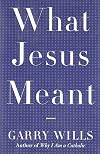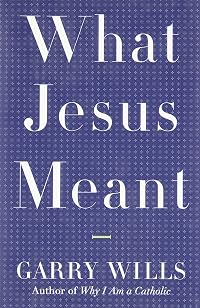
What Jesus Meant
by Garry Wills
On This Page
Description
In what are billed as "culture wars," people on the political right and the political left cite Jesus as endorsing their views. Wills argues that Jesus subscribed to no political program--He was far more radical than that. It is only by dodges and evasions that people misrepresent what Jesus plainly had to say against power, the wealthy, and religion itself. Jesus came from the working class, and he spoke to and for that class. This book will challenge the assumptions of almost everyone who show more brings religion into politics--"Christian socialists" as well as biblical theocrats. But Wills is just as critical of those who would make Jesus a mere ethical teacher, ignoring or playing down his divinity--Jesus without the Resurrection is simply not the Jesus of the gospels. He argues that this does not make people embrace an otherworldliness that ignores the poor or the problems of our time.--From publisher description. show lessTags
Recommendations






Member Recommendations
Member Reviews
Utterly fascinating. I was a bit apprehensive to read Wills' work because he authored a book entitled "Why I Am a Catholic." Uh--really? I just couldn't get behind that, having a recovering Catholic as a mother and one as a husband, and I find Catholicism, as a whole, just problematic. Anyway, I was absolutely stunned by Wills' work in this slim volume. One would, after reading this, think he was as far-left, as ultra-liberal as they come if one didn't know his background. He presents Jesus as the radical that he was, the tough messages he preached, how those words have been contorted and twisted and unconscionably appropriated. And, of course, how millions of poor schlubs have been mislead by those who would alter his life and his show more words. I have dogeared numerous pages in the book and intend to go back and pore over the pages in my journal. But the point is--this is what he said, it was tough to hear, it's even tougher to enact in one's daily life, but don't try to sugarcoat it or twist it to suit your needs. Oh man, was Jesus a badass. show less
The title, "What Jesus Meant," gives the impression that what Garry Wills is going to do here is focus directly on the teachings of Jesus themselves and interpret them for the reader. And indeed he does do that, but it's not all he does. From Jesus' teachings he then goes on to discuss the doctrines of the crucifixion and resurrection, about which Jesus himself had little to say at all. Consequently, what we have in this little book is a compact Christology which could easily carry a subtitle: "What Jesus Meant; and What Jesus Means."
Going back to the earliest sources--the Gospels themselves, and indeed that which precedes the gospels, the letters of Paul (as well as early Church writings)--Wills comes up with much to criticize in the show more contemporary practice of Christianity. The Jesus Wills sees in the gospels is one who, if he appeared today, would probably be crucified again for the way he would confront the forces of wealth, hierarchy, violence, and privilege--including those in the dominant religious establishment--but make no mistake: in all this Wills is unerringly orthodox in his theology. He says from the start that his book is a devotional work. He believes in divinity of Christ. He believes in the Trinitarian mystery. He believes in the Resurrection. But that's all-the-more why understanding what Jesus truly meant matters.
In the end, as fits a devotional work, I found the book inspirational. Especially so because, chasing to make the book a Christology, Wills decides to take on such questions as, "Why must Jesus have been crucified?" The doctrine that has had a stranglehold on much Christian understanding over the centuries is that of "substitutionary atonement," i.e. that Jesus had to die an awful death due to the demands of a God that someone had to suffer as a ransom for all the world's sin. Keeping his feet planted in biblical sources, Wills finds scant support for this argument, and offers an alternative meaning that truly does elevate God as One who embodies love rather than bloodthirsty retribution.
All in all, I would call this a great little Christological primer. show less
Going back to the earliest sources--the Gospels themselves, and indeed that which precedes the gospels, the letters of Paul (as well as early Church writings)--Wills comes up with much to criticize in the show more contemporary practice of Christianity. The Jesus Wills sees in the gospels is one who, if he appeared today, would probably be crucified again for the way he would confront the forces of wealth, hierarchy, violence, and privilege--including those in the dominant religious establishment--but make no mistake: in all this Wills is unerringly orthodox in his theology. He says from the start that his book is a devotional work. He believes in divinity of Christ. He believes in the Trinitarian mystery. He believes in the Resurrection. But that's all-the-more why understanding what Jesus truly meant matters.
In the end, as fits a devotional work, I found the book inspirational. Especially so because, chasing to make the book a Christology, Wills decides to take on such questions as, "Why must Jesus have been crucified?" The doctrine that has had a stranglehold on much Christian understanding over the centuries is that of "substitutionary atonement," i.e. that Jesus had to die an awful death due to the demands of a God that someone had to suffer as a ransom for all the world's sin. Keeping his feet planted in biblical sources, Wills finds scant support for this argument, and offers an alternative meaning that truly does elevate God as One who embodies love rather than bloodthirsty retribution.
All in all, I would call this a great little Christological primer. show less
Excellent writing with cogent examples. Good for thinking. A fresh perspective.
On the whole I enjoyed reading this book. It certainly presented a few new ways of looking at certain passages of Scripture. However, I do have a few issues with it.
Willis, near the beginning, decries those such as Thomas Jefferson who tried to remove anything smacking of the super-natural (miracles, healing, the Resurrection, etc.) and in that I agree with him, but he then proceeds to symbolically interpret almost every miracle event in the gospels. "Satan" is merely a symbolic representation of collective human badness; "Hell" is merely the fact that Jesus felt abandoned on the cross; the virgin birth, Mary being faithful; the temptations in the desert, Jesus' early years being trained (inexplicably) by the Essenes and then Jon the show more Baptist (remember Satan doesn't exist); those "possessed" were merely sick; and so on. I was a bit curious as to how he would explain the Resurrection, but that managed to be the one super-natural event he retains; why, I don't know.
He presents a Jesus who is anti-clerical, anti-liturgy, anti-religion; basically a mix of pietistic Quaker and "spiritual" hippie. He denies the validity of any Church (let alone the Roman Catholic Church), states that apostolic succession is a lie, that there is no Real Presence in the Sacrament (he doesn't even give baptism the time of day), etc. The strange thing is that this comes from a man who considers himself a Roman Catholic, and even has written a book entitled (apparently somewhat ironically) Why I am Catholic, which he doesn't seem to be at all.
Now, do not misunderstand me. I am not a "bible literalist" and agree that many of the stories in the Bible should be taken on a metaphorical level. What bothers me, then, is that, to me, Willis appears to do exactly what e spends a chapter condemning others of: namely creating a "Jesus" that sounds remarkably like he is. As a theologian, I can safely say that one should ALWAYS beware of a "Jesus" who agrees it you in every way.
So, worth a read, but probably not more than one. show less
Willis, near the beginning, decries those such as Thomas Jefferson who tried to remove anything smacking of the super-natural (miracles, healing, the Resurrection, etc.) and in that I agree with him, but he then proceeds to symbolically interpret almost every miracle event in the gospels. "Satan" is merely a symbolic representation of collective human badness; "Hell" is merely the fact that Jesus felt abandoned on the cross; the virgin birth, Mary being faithful; the temptations in the desert, Jesus' early years being trained (inexplicably) by the Essenes and then Jon the show more Baptist (remember Satan doesn't exist); those "possessed" were merely sick; and so on. I was a bit curious as to how he would explain the Resurrection, but that managed to be the one super-natural event he retains; why, I don't know.
He presents a Jesus who is anti-clerical, anti-liturgy, anti-religion; basically a mix of pietistic Quaker and "spiritual" hippie. He denies the validity of any Church (let alone the Roman Catholic Church), states that apostolic succession is a lie, that there is no Real Presence in the Sacrament (he doesn't even give baptism the time of day), etc. The strange thing is that this comes from a man who considers himself a Roman Catholic, and even has written a book entitled (apparently somewhat ironically) Why I am Catholic, which he doesn't seem to be at all.
Now, do not misunderstand me. I am not a "bible literalist" and agree that many of the stories in the Bible should be taken on a metaphorical level. What bothers me, then, is that, to me, Willis appears to do exactly what e spends a chapter condemning others of: namely creating a "Jesus" that sounds remarkably like he is. As a theologian, I can safely say that one should ALWAYS beware of a "Jesus" who agrees it you in every way.
So, worth a read, but probably not more than one. show less
Wills has an interesting perspective on who and what Jesus was. He believes, as his foreword states, that Christ was not a Christian. ". . . he is not just like us, he has higher rights and powers, he has an authority as arbitrary as God's in the Book of Job. He is a divine mystery walking among men. The only way we can directly imitate him is to act as if we were gods ourselves - yet that is the very thing he forbids. He tells us to act as the last, not the first, as the least, not the greatest. And this accords with the common sense of mankind. Christians cannot really be 'Christlike.' As Chesterton said, 'A great man knows he is not God and the greater he is the better he knows it.' The thing we have to realize is that Christ, show more whoever and whatever he was, was certainly not a Christian."
Wills offers some thought provoking analysis of what the Gospels really have to say about Jesus. His is an anti-establishment view. He claims that religion killed Jesus, that Jesus was opposed to religion as it existed in his day and that he "did not found a church."
Don't read this book if you don't want to question your preconceptions. show less
Wills offers some thought provoking analysis of what the Gospels really have to say about Jesus. His is an anti-establishment view. He claims that religion killed Jesus, that Jesus was opposed to religion as it existed in his day and that he "did not found a church."
Don't read this book if you don't want to question your preconceptions. show less
Unambiguously, Garry Wills cuts to the heart of the gospel in his book “What Jesus Meant.”
As in “Lincoln at Gettysburg” and “Nixon Agonistes” (my two favorite Wills books) the author looks at a familiar set of facts and draws startling insights. In this book I was fascinated by Wills’- a former Greek professor at Johns Hopkins University - ability to draw insightful and nuanced meaning from his personal translations of familiar New Testament verses.
Like Jesus, Wills subscribes to no later day political as he explores the meaning of the “resign of heaven” promised by God’s son. Like Jesus, he speaks plainly and bluntly about power, wealth and even religion itself.
Able to be read in a single sitting, “What Jesus show more Meant” is sure to spark a personal internal debate over your understand of Jesus and the Scriptures. Finish it and you will join me in thanking Wills for enhancing your understanding of religion’s role in our society today. show less
As in “Lincoln at Gettysburg” and “Nixon Agonistes” (my two favorite Wills books) the author looks at a familiar set of facts and draws startling insights. In this book I was fascinated by Wills’- a former Greek professor at Johns Hopkins University - ability to draw insightful and nuanced meaning from his personal translations of familiar New Testament verses.
Like Jesus, Wills subscribes to no later day political as he explores the meaning of the “resign of heaven” promised by God’s son. Like Jesus, he speaks plainly and bluntly about power, wealth and even religion itself.
Able to be read in a single sitting, “What Jesus show more Meant” is sure to spark a personal internal debate over your understand of Jesus and the Scriptures. Finish it and you will join me in thanking Wills for enhancing your understanding of religion’s role in our society today. show less
Wills surprised me--I have long had the basic conclusion of which he writes: Jesus began no church. While I was irritated at his section on the Jesus Seminar, it's okay - it is his opinion - and I disagree with him. But the book was well done!!
Members
- Recently Added By
Lists

Nonfiction
41 works; 1 member
Author Information

69+ Works 13,303 Members
Garry Wills, 1934 - Garry Wills was born in Atlanta, Georgia in 1934. Wills received a B.A. from St. Louis University in 1957, an M.A. from Xavier University of Cincinnati in 1958, an M.A. (1959) and a Ph.D. (1961) in classics from Yale. Wills was a junior fellow of the Center for Hellenic Studies from 1961-62, an associate professor of classics show more and adjunct professor of humanities at Johns Hopkins University from 1962-80. Wills was the first Washington Irving Professor of Modern American History and Literature at Union College, and was also a Regents Professor at the University of California in Santa Barbara, Silliman Seminarist at Yale, Christian Gauss Lecturer at Princeton, W.W. Cook Lecturer at the University of Michigan Law School, Hubert Humphrey Seminarist at Macalester College, Welch Professor of American Studies at Notre Dame University and Henry R. Luce Professor of American Culture and Public Policy at Northwestern University (1980-88). Wills is also a member of the American Academy of Arts and Sciences and the American Academy of Arts and Letters, and his articles appear frequently in The New York Review of Books. Wills is the author of "Lincoln at Gettysburg," which won the Pulitzer Prize for General Nonfiction in 1993 and the NEH Presidential Medal, "John Wayne's America," "A Necessary Evil: A History of American Distrust of Government" and "The Kennedy Imprisonment." Other awards received by Wills include the National Book Critics Award, the Merle Curti Award of the organization of American Historians, the Wilbur Cross Medal from Yale Graduate School, the Harold Washington Book Award and the Peabody Award for excellence in broadcasting, which was for writing and narrating the 1988 "Frontline" documentary "The Candidates." (Bowker Author Biography) Garry Wills is a Pulitzer-prize winning historian and cultural critic. A former professor of Greek at Yale University, his many books include Lincoln at Gettysburg, Reagan's America, Witches and Jesuits, and a biography of Saint Augustine. He lives in Evanston, Indiana. (Publisher Provided) Garry Wills is a frequent contributor to The New York Times Magazine and The New York Review of Books. He lives in Evanston, Illinois. (Publisher Provided) show less
Awards and Honors
Distinctions
Common Knowledge
- Canonical title
- What Jesus Meant
- Original publication date
- 2006
- Dedication
- To Celine, best of sisters
- Blurbers
- Carroll, James; Gomes, Peter
Classifications
Statistics
- Members
- 940
- Popularity
- 28,362
- Reviews
- 18
- Rating
- (3.83)
- Languages
- English
- Media
- Paper, Audiobook, Ebook
- ISBNs
- 11
- UPCs
- 1
- ASINs
- 4