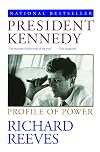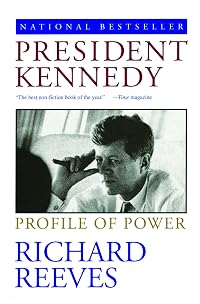
President Kennedy: Profile of Power
by Richard Reeves
On This Page
Description
The author offers an excellent study of Kennedy as crisis manager. He presents Kennedy as neither an amoral playboy nor the ruler of Camelot but a poorly prepared president with mediocre congressional experience. Each chapter presents a different day in the administration--a unique format that effectively reveals how Kennedy responded to simultaneous harrowing issues. The Berlin Wall, the Cuban Missile Crises, Vietnam, and the diplomacy of arms reduction illustrate how Kennedy was show more constrained by the unshakable Cold War fear of monolithic communism. This approachable investigation of Kennedy's use of power provides a thorough, even-handed review of the Kennedy years. show lessTags
Recommendations
















Member Reviews
I’ve been marching through bios of the U.S. Presidents in chronological order and of the 40+ read so far, Profile of Power is definitely one of the best. What sets it apart is that Reeves puts you right next to Kennedy to see government “being made” day-in and day-out during his presidency. Much more realistic than the usual “Camelot” fairy tale, it gives a clear portrait of JFK as the man — and politician — he was. I’ll definitely include his Nixon and Reagan books on my reading list.
The narrative provided a significant addition to what one already knows or believed about John Kennedy. Insightful surrounding his use of power and influence.
President Kennedy Profile of Power, by Richard Reeves (read in 2023)
Ratings
Members
- Recently Added By
Author Information

18+ Works 2,128 Members
Richard Reeves is a syndicated columnist and teaches at the Annenberg School for Communication at the University of Southern California. He lives in Washington, D.C. and New York. (Bowker Author Biography)
Awards and Honors
Awards
Common Knowledge
- Canonical title
- President Kennedy: Profile of Power
- Original publication date
- 1993
- People/Characters
- Fidel Castro; Ngo Dinh Diem; Dwight D. Eisenhower; Charles de Gaulle; J. Edgar Hoover; Lyndon Baines Johnson (show all 29); John F. Kennedy; Robert F. Kennedy; Martin Luther King, Jr.; Nikita Khrushchev; Harold Macmillan; Robert S. McNamara; Marilyn Monroe; McGeorge Bundy; Judith Campbell Exner; Averell Harriman; Caroline Kennedy; Edward M. Kennedy; Jacqueline Kennedy Onassis; John F. Kennedy, Jr.; Joseph P. Kennedy, Sr.; Henry Cabot Lodge; Kenneth O'Donnell; Arthur Schlesinger Jr.; Ted Sorensen; Adlai Stevenson II; Pierre Salinger; Maxwell Taylor; Theodore H. White
- Important places
- Hyannis, Massachusetts, USA; Washington, D.C., USA
- Epigraph
- John F. Kennedy's favorite book was Melbourne by David Cecil, the biography of William Lamb, Viscount Melbourne, who was prime minister of Great Britain for seven years, from 1834 to 1841, serving as the political m... (show all)entor of Queen Victoria. The book was published in 1939 and this is part of Cecil's description of the young William Lamb:
"To be a thinker one must believe in the value of disinterested thought. William's education had destroyed his belief in this, along with all other absolute beliefs, and in doing so removed the motive force necessary to set his creative engery working. The spark that should have kindled his fire was unlit, with the result that he never felt moved to make the effort needed to discipline his intellectual process, to organize his sporadic reflections into a coherent system of thought. He had studied a great many subjects, but none thoroughly; his ideas were original, but they were fragmentary, scattered, unmatured. This lack of system meant further that he never overhauled his mind to set its contents in the light of a considered standard of value - so that the precious and the worthless jostled each other in its confused recesses; side by side with fresh and vivid thoughts lurked contradictions, commonplaces and relics of the conventional prejudices of this rank and station. Even his scepticism was not consistent; though he doubted the value of virtue, he never doubted the value of being a gentleman. Like so many aristocratic persons he was an amateur.
"His amateurishness was increased by his hedonism. For it led him to pursue his thought only in so far as the process was pleasant. He shirked intellectual drudgery. Besides, the life he lived was all too full of distracting delights. If he felt bored reading and cogitating, there was always a party for him to go to where he could be perfectly happy without having to make and effort. Such temptations were particularly hard to resist for a man brought up in the easygoing, disorderly atmosphere of Melbourne House, where no one was ever forced to be methodical or conscientious and where there was always something entertaining going one. If virtue was hard to acquire there, pleasure came all to easily." - First words
- In the weeks between his election and inauguration as the thirty-fifth President of the United States, John F. Kennedy spent as much time as he could relaxing in the sun at his father's house in Palm Beach, Florida.
- Last words
- (Click to show. Warning: May contain spoilers.)The President was declared dead at 1 P.M. at the Parkland Hospital in Dallas.
Classifications
- Genres
- Nonfiction, History, Biography & Memoir, General Nonfiction
- DDC/MDS
- 973.922092 — History & geography History of North America United States 1901- Cold War, Vietnam War, Digital Age (1953-2001) Dwight D. Eisenhower, 2nd Term (1953-1961) Sputnik Crisis, Little Rock Crisis, National Aeronautics and Space Act Biography
- LCC
- E842 .R358 — History of the United States United States Later twentieth century, 1961-2000 Kennedy's administration, 1961-November 22, 1963 Assassination, funeral, memorial services, etc.
- BISAC
Statistics
- Members
- 557
- Popularity
- 53,314
- Reviews
- 3
- Rating
- (3.98)
- Languages
- English, Russian
- Media
- Paper, Ebook
- ISBNs
- 5
- ASINs
- 5