
Terminal World
by Alastair Reynolds
On This Page
Description
Fiction. Literature. Science Fiction. Spearpoint, the last human city, is an atmosphere-piercing spire of vast size. Clinging to its skin are the zones, a series of semi-autonomous city-states, each of which enjoys a different-and rigidly enforced-level of technology. Following an infiltration mission that went tragically wrong, Quillon has been living incognito, working as a pathologist in the district morgue. But when a near-dead angel drops onto his dissecting table, Quillon's world is show more wrenched apart one more time. If Quillon is to save his life, he must leave his home and journey into the cold and hostile lands beyond Spearpoint's base, starting an exile that will take him further than he could ever imagine. But there is far more at stake than just Quillon's own survival, for the limiting technologies of the zones are determined not by governments or police but by the very nature of reality-and reality itself is showing worrying signs of instability. show lessTags
Recommendations
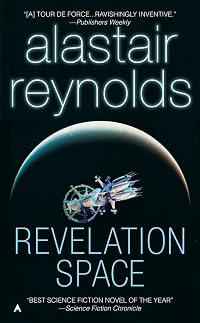




Member Reviews
Zeppelins. A steam-powered cyborg. Mad Max-style savages. Angels! And a city on a spire of--something--rising into the sky, on a cooling Earth.
Overlaying everything are the zones, little understood but very carefully mapped, because what technology works depends on what zone you are in. Highest up on the spire of Spearpoint are the Celestial Levels, where the angels dwell, modified humans who can fly and who are heavily loaded with nanotech inside them. Because the nanotech won't work at any lower level, angels can't leave the Celestial Levels. At the bottom is Horse Town, where the tech is about the level of the American Wild West.
Quillon lives in Neon Heights, just below Circuit City and just above Steamville. He's the last survivor show more of an infiltration mission from Celestial Heights, his wings and nanotech removed, under a false identity, working as a pathologist.
Until a barely-alive angel fallen from the Heights is brought to him, with the message that the faction that sent Quillon to Neon Heights now wants him and the knowledge hidden in his head back--and they don't need him to be alive to get what they need. Quillon has to run, out of Spearpoint altogether, and right now. He turns to Fray, who might be considered a local fixer, and one of the few friends Quillon has made. Fray quickly plans his escape, with a guide, Meroka, foul-mouthed, impatient, but very, very capable. Oh, and she hates angels, for reasons buried in her past, so it's just as well that Fray doesn't tell her Quillon is an angel in disguise.
What could go wrong?
Along the way to getting shanghaied into the dirigible fleet called Swarm, they meet the steam-powered cyborg, ruthless, drug-addicted savages, a woman who might be a techtomancer and her five-year-old daughter, and the "vorgs," really nasty cyborgs who survive in part by harvesting human organs. Especially brains.
And in the midst of all this, there's a major zone shift, the result of which is really exciting for everyone who isn't killed by it.
I really enjoyed this one. The characters are multi-leveled and compelling, and everyone you care about has a fundamental decency, albeit sometimes very deeply buried and expressed in quixotic ways. The pacing is great, and the world is a fascinating one.
Reynolds does not believe he needs to give us all the answers. There's plenty of room for a sequel, and I'm a bit surprised that there apparently isn't one. (If I'm wrong, please correct me!)
Recommended.
I bought this book. show less
Overlaying everything are the zones, little understood but very carefully mapped, because what technology works depends on what zone you are in. Highest up on the spire of Spearpoint are the Celestial Levels, where the angels dwell, modified humans who can fly and who are heavily loaded with nanotech inside them. Because the nanotech won't work at any lower level, angels can't leave the Celestial Levels. At the bottom is Horse Town, where the tech is about the level of the American Wild West.
Quillon lives in Neon Heights, just below Circuit City and just above Steamville. He's the last survivor show more of an infiltration mission from Celestial Heights, his wings and nanotech removed, under a false identity, working as a pathologist.
Until a barely-alive angel fallen from the Heights is brought to him, with the message that the faction that sent Quillon to Neon Heights now wants him and the knowledge hidden in his head back--and they don't need him to be alive to get what they need. Quillon has to run, out of Spearpoint altogether, and right now. He turns to Fray, who might be considered a local fixer, and one of the few friends Quillon has made. Fray quickly plans his escape, with a guide, Meroka, foul-mouthed, impatient, but very, very capable. Oh, and she hates angels, for reasons buried in her past, so it's just as well that Fray doesn't tell her Quillon is an angel in disguise.
What could go wrong?
Along the way to getting shanghaied into the dirigible fleet called Swarm, they meet the steam-powered cyborg, ruthless, drug-addicted savages, a woman who might be a techtomancer and her five-year-old daughter, and the "vorgs," really nasty cyborgs who survive in part by harvesting human organs. Especially brains.
And in the midst of all this, there's a major zone shift, the result of which is really exciting for everyone who isn't killed by it.
I really enjoyed this one. The characters are multi-leveled and compelling, and everyone you care about has a fundamental decency, albeit sometimes very deeply buried and expressed in quixotic ways. The pacing is great, and the world is a fascinating one.
Reynolds does not believe he needs to give us all the answers. There's plenty of room for a sequel, and I'm a bit surprised that there apparently isn't one. (If I'm wrong, please correct me!)
Recommended.
I bought this book. show less
This book is a weird, weird read. I'm pretty sure there's two ways to read this. One is pretty much as a fantasy novel, with airships and odd magic and everything, and one is as a science fiction novel. But to read it as science fiction, you have to be able to figure out the (extremely speculative) science behind this on your own; no one in the book knows all of it, and the vast majority know none of it. It's odd to read a science fiction book that leaves the science as an exercise for the reader, but also weirdly fun. Reynolds sprinkles clues throughout the book, and if you want to, you can pick them up and put them together yourself. He's not gonna tell you.
This whole book is kind of like that. It's a post-post-post apocalyptic story, show more where the apocalypse happened in the extremely distant past, and at the start of teh book, no one has any idea what happened or even that an apocalypse happened. They're figuring it out as they go along, with exactly as much ease as you'd expect from people trying to solve an ancient puzzle from few clues while dealing with a much more immediate crisis. And you're figuring it out along with them, although you have quite a few advantages they don't.
So I found reading this delightful fun, but I also had to take breaks to try to figure out what was happening and if it was even possible for the world to work like this. This book requires a lot of thinking if you want to read it as science fiction.
But if you're reading it as fantasy, it's just a story, and it's a pretty good one. I loved some of the side characters -- Curtana, the airship captain, and Meroka, the lesbian mercenary/smuggler with a grudge, were probably my favorites. But probably my favorite part of the story itself was how each character comes into this story with their own set of cultural biases and blind spots, and the story requires every single one of them to change, to change their minds, to change their beliefs, to accept something alien or impossible to them. In that, it's weirdly hopeful, for a post-apocalyptic story, because of them manage to make that change, manage to make progress -- to become more than they were, or get closer to who they need to be, or get closer to the truth.
So I thoroughly enjoyed this, on both a science fiction and a fantasy level. (I'm taking off one star, though, because the pacing is uneven, and there were a couple of plot points where I was like, nope, this is not happening, this is STUPID and also RIDICULOUS. I worked through it, and it all came out okay, but still.) show less
This whole book is kind of like that. It's a post-post-post apocalyptic story, show more where the apocalypse happened in the extremely distant past, and at the start of teh book, no one has any idea what happened or even that an apocalypse happened. They're figuring it out as they go along, with exactly as much ease as you'd expect from people trying to solve an ancient puzzle from few clues while dealing with a much more immediate crisis. And you're figuring it out along with them, although you have quite a few advantages they don't.
So I found reading this delightful fun, but I also had to take breaks to try to figure out what was happening and if it was even possible for the world to work like this. This book requires a lot of thinking if you want to read it as science fiction.
But if you're reading it as fantasy, it's just a story, and it's a pretty good one. I loved some of the side characters -- Curtana, the airship captain, and Meroka, the lesbian mercenary/smuggler with a grudge, were probably my favorites. But probably my favorite part of the story itself was how each character comes into this story with their own set of cultural biases and blind spots, and the story requires every single one of them to change, to change their minds, to change their beliefs, to accept something alien or impossible to them. In that, it's weirdly hopeful, for a post-apocalyptic story, because of them manage to make that change, manage to make progress -- to become more than they were, or get closer to who they need to be, or get closer to the truth.
So I thoroughly enjoyed this, on both a science fiction and a fantasy level. (I'm taking off one star, though, because the pacing is uneven, and there were a couple of plot points where I was like, nope, this is not happening, this is STUPID and also RIDICULOUS. I worked through it, and it all came out okay, but still.) show less
There's a scene towards the end of Terminal World that perfectly encapsulates the book: Our heroes on a desperate rescue mission back to the city that betrayed them, in a Zeppelin losing its high tech defenses bit by bit, being strafed and boarded by suicidal pirates in wingsuits. It's steampunk, pretty cool, and makes no damn sense. Reynolds does his best with Big Ideas, and in this case the Big Idea (some sort of disaster that creates Zones that limit technology, the survivors clustered around some a mysterious mega-structure), just isn't big enough to hold together the rather flat and amoral characters.
This is easily Reynolds' weakest novel to-date. It opens with one of Neal Stephenson's favourite technical crimes - a protagonist switch. Grrr! It would have been more difficult to pull off but the novel could have opened with the intended main protagonist finding an angel on his pathology bench. Instead there is a long scene from the point of view of two characters who are never heard from again - and you know from the outset that they are going to disappear once they've delivered the angel. So, not a good start.
A chase ensues not too long after but I had an odd reaction to it; I felt like I was reading a distillation of the generic "hero and heroine on a train are chased by pursuers intent on their murder" scene from umpteen show more Hollywood movies. I suppose it just felt old hat.
Things get more interesting later, but then airships turned up and I spent considerable time trying to get Philip Reeves' Mortal Engines books out of my head. I wasn't really successful until the approaching denouement. Then the denouement failed to explain enough of what had been going on. Now, Reynolds routinely ends matters with revelations of bigger mysteries and unexplored realms, but this time too many things were left unresolved for my taste - and sequels are not Reynolds' favourite things.
There is much to admire in terms of the SF setting and characters but this is a very disappointing effort, particularly coming immediately after the excellent House of Suns.
PS. Did I mention that there's a guy who's had his memories over-written - again! show less
A chase ensues not too long after but I had an odd reaction to it; I felt like I was reading a distillation of the generic "hero and heroine on a train are chased by pursuers intent on their murder" scene from umpteen show more Hollywood movies. I suppose it just felt old hat.
Things get more interesting later, but then airships turned up and I spent considerable time trying to get Philip Reeves' Mortal Engines books out of my head. I wasn't really successful until the approaching denouement. Then the denouement failed to explain enough of what had been going on. Now, Reynolds routinely ends matters with revelations of bigger mysteries and unexplored realms, but this time too many things were left unresolved for my taste - and sequels are not Reynolds' favourite things.
There is much to admire in terms of the SF setting and characters but this is a very disappointing effort, particularly coming immediately after the excellent House of Suns.
PS. Did I mention that there's a guy who's had his memories over-written - again! show less
It's really quite amazing how much imagination can be crammed into these books.
It begins like a heist novel exploring a tower-of-babel-like city full of the fascinating inventions and unexplained forced-technological restrictions. The topmost layers allow for the most impressive levels of high-tech used by "angels" that can be real bastards all the way down to the lowest levels that only allow for horse-drawn simple tech. Passing through these zones can be very painful and usually life-threatening. Special drugs to help you acclimatize are in high demand. The heist portion begins with a doctor who used to be a full angel but is now on the run from the rest of his kind, but instead of leaving us here in this city, the novel becomes a show more full-blown steampunk novel with aerial battles, biological/machine constructs, and a full-out terraforming attempt gone very wrong.
This is Reynolds, of course, so expect fully-thought-out worldbuilding, awesome technologies and reasons for these technologies, a bit of tongue-in-cheek, and a lot of great action when it suits the tale. My only complaint is in a few slow bits in the center, but that was very nicely mitigated by a courtroom battle sandwiched between mutiny, murder, and a thousand-year strife in the skies. The later surprises are rather awesome and better still... CONSISTENT. All those reasons for the technological strata come clear. :)
As a regular SF, it still stands out a full head above most, especially when it comes to ... you get it ... IMAGINATION. ;) show less
It begins like a heist novel exploring a tower-of-babel-like city full of the fascinating inventions and unexplained forced-technological restrictions. The topmost layers allow for the most impressive levels of high-tech used by "angels" that can be real bastards all the way down to the lowest levels that only allow for horse-drawn simple tech. Passing through these zones can be very painful and usually life-threatening. Special drugs to help you acclimatize are in high demand. The heist portion begins with a doctor who used to be a full angel but is now on the run from the rest of his kind, but instead of leaving us here in this city, the novel becomes a show more full-blown steampunk novel with aerial battles, biological/machine constructs, and a full-out terraforming attempt gone very wrong.
This is Reynolds, of course, so expect fully-thought-out worldbuilding, awesome technologies and reasons for these technologies, a bit of tongue-in-cheek, and a lot of great action when it suits the tale. My only complaint is in a few slow bits in the center, but that was very nicely mitigated by a courtroom battle sandwiched between mutiny, murder, and a thousand-year strife in the skies. The later surprises are rather awesome and better still... CONSISTENT. All those reasons for the technological strata come clear. :)
As a regular SF, it still stands out a full head above most, especially when it comes to ... you get it ... IMAGINATION. ;) show less
Fans of Alastair Reynolds Revelation Space series and his other vastly atmospheric space operas are in for a bit of a surprise in his latest novel, which owes more to China Mieville's Bas-Lag books and Jack Vance's Dying Earth stories than to the Clarke/Asimov tradition.
That doesn't mean it's bad, though -- far from it! While the lingering disappointment that there will be no hyperspace chase scenes or stars being sung apart via mind-bogglingly ancient and malign intelligences never wholly leaves the die-hard Reynolds fan reading this book, if that reader is also a fan of steampunk, as I am, there will still be much to enjoy in the story of Quillion, a fallen "angel", and his perilous journey across a barely-recognizable planet Earth in show more the extremely distant future.
Reynolds has long been classed in with China Mieville and others as part of science fiction's "New Weird" movement, largely, I think, due to his taste for the baroque and the grotesque he shares with Mieville (the Melding Plague that forms -- or deforms -- so much of the Revelation Space universe still creeps and grosses me out). With Terminal World he draws much closer to Mieville, especially to the Mieville of The Scar, most of which takes place on a floating city of hundreds of ships and boats lashed together to sail the oceans of Bas-Lag. Reynolds' counterpart is Swarm, the airship-based breakway military arm of "Earth's"* last city, Spearpoint. That's right: a flying city composed of hundreds of airships (not blimps, as we're disdainfully reminded several times by Swarm's residents). I defy any steampunk fan not to swoon at the thought.
Quillion's world has been the victim of a mysterious calamity, to create which Reynolds has taken the notion of a holographic universe and run with it to strange places. The planet is now riddled with zones of differing "resolution," which only allow certain levels of technology to work. Spearpoint is the nexus of this crisis and as travelers descend its downward spiral they proceed from "Circuit City" (which seems to enjoy our own present level of development at least) to "Neon Heights" (which seems to be in the 1940s or 1950s) down to "Steamtown" (!) and even to the point of "Horsetown" where nothing more complex and sophisticated than animal muscle seems to work. How this state of affairs has come to be is never fully explained but it has something to do with Spearpoint's original function as something radically different from just a corkscrewing platform on which to build a city. We learn only a little of this original function as it is lost, all but ancient history, close to completely forgotten.
If I give the impression that the world steals the thunder of the story and characters, that's largely the case, but that's not to say that there are not some compelling individuals populating the story. Curtana, female airship captain, can swash the buckler with any maritime hero of yore; Meroka, Quillion's guide out of Spearpoint, is tough and complex, as is Quillion himself in a different way. While he is out of his depth for most of the story, and often kind of helpless, he is sympathetic rather than annoying, and more than earns his keep before the tale is told.
I like to see Reynolds stretching beyond the space opera-or sci-fi/noir genres he's been comfortably writing in so far, and really wondering if there's anything he can't do. Do recommend.
*People refer to this planet as "Earth" but there are tons of hints within the novel that indicate this is actually a terraformed Mars slowly reverting to its original state, which I find utterly fascinating. show less
That doesn't mean it's bad, though -- far from it! While the lingering disappointment that there will be no hyperspace chase scenes or stars being sung apart via mind-bogglingly ancient and malign intelligences never wholly leaves the die-hard Reynolds fan reading this book, if that reader is also a fan of steampunk, as I am, there will still be much to enjoy in the story of Quillion, a fallen "angel", and his perilous journey across a barely-recognizable planet Earth in show more the extremely distant future.
Reynolds has long been classed in with China Mieville and others as part of science fiction's "New Weird" movement, largely, I think, due to his taste for the baroque and the grotesque he shares with Mieville (the Melding Plague that forms -- or deforms -- so much of the Revelation Space universe still creeps and grosses me out). With Terminal World he draws much closer to Mieville, especially to the Mieville of The Scar, most of which takes place on a floating city of hundreds of ships and boats lashed together to sail the oceans of Bas-Lag. Reynolds' counterpart is Swarm, the airship-based breakway military arm of "Earth's"* last city, Spearpoint. That's right: a flying city composed of hundreds of airships (not blimps, as we're disdainfully reminded several times by Swarm's residents). I defy any steampunk fan not to swoon at the thought.
Quillion's world has been the victim of a mysterious calamity, to create which Reynolds has taken the notion of a holographic universe and run with it to strange places. The planet is now riddled with zones of differing "resolution," which only allow certain levels of technology to work. Spearpoint is the nexus of this crisis and as travelers descend its downward spiral they proceed from "Circuit City" (which seems to enjoy our own present level of development at least) to "Neon Heights" (which seems to be in the 1940s or 1950s) down to "Steamtown" (!) and even to the point of "Horsetown" where nothing more complex and sophisticated than animal muscle seems to work. How this state of affairs has come to be is never fully explained but it has something to do with Spearpoint's original function as something radically different from just a corkscrewing platform on which to build a city. We learn only a little of this original function as it is lost, all but ancient history, close to completely forgotten.
If I give the impression that the world steals the thunder of the story and characters, that's largely the case, but that's not to say that there are not some compelling individuals populating the story. Curtana, female airship captain, can swash the buckler with any maritime hero of yore; Meroka, Quillion's guide out of Spearpoint, is tough and complex, as is Quillion himself in a different way. While he is out of his depth for most of the story, and often kind of helpless, he is sympathetic rather than annoying, and more than earns his keep before the tale is told.
I like to see Reynolds stretching beyond the space opera-or sci-fi/noir genres he's been comfortably writing in so far, and really wondering if there's anything he can't do. Do recommend.
*People refer to this planet as "Earth" but there are tons of hints within the novel that indicate this is actually a terraformed Mars slowly reverting to its original state, which I find utterly fascinating. show less
A major disappointment, Reynolds is just not suited to this setting. The first chapter is very good, showing great promise and a potentially epic story, but momentum is lost very quickly and soon (about the time Swarm shows up) everything turns into a major drudge. When Reynolds isn't space-bound his mundane prose is laid out to bear, and it's not pretty. There are no characters, there is very little real conflict and the ending is anti-climactic even by his standards. After the brilliance of 'House of Suns' I am very disappointed.
Members
- Recently Added By
Lists

Top Five Books of 2013
1,562 works; 721 members

Books Read in 2024
4,727 works; 128 members
Talk Discussions
Past Discussions
[[Alistair Reynolds']] [Terminal World] in Science Fiction Fans (July 2011)
Author Information

142+ Works 40,193 Members
Some Editions
Awards and Honors
Awards
Distinctions
Common Knowledge
- Canonical title*
- Unendliche Stadt
- Original publication date
- 2010-03
- People/Characters
- Quillon; Meroka; Fray; Kalis; Nimcha
- Important places
- Spearpoint
- Epigraph
- "And Earth is but a star, that once had shone." The Golden Journey to Samarkand, James Elroy Flecker
- First words
- The call came in to the Department of Hygiene and Public Works just before five in the afternoon.
- Last words
- (Click to show. Warning: May contain spoilers.)Everything else. The universe.
- Original language
- English
*Some information comes from Common Knowledge in other languages. Click "Edit" for more information.
Classifications
Statistics
- Members
- 1,222
- Popularity
- 20,351
- Reviews
- 38
- Rating
- (3.51)
- Languages
- English, Finnish, German
- Media
- Paper, Audiobook, Ebook
- ISBNs
- 20
- UPCs
- 1
- ASINs
- 13