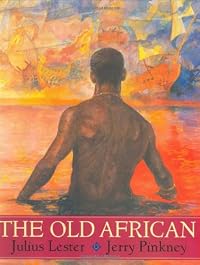
The Old African
by Julius Lester
On This Page
Description
An elderly slave uses the power of his mind to ease the suffering of his fellow slaves and eventually lead them back to Africa. Based on an actual incident from black history.Tags
Recommendations







Member Reviews
This is a heart-wrenching depiction of slavery from Julius Lester and Jerry Pinkney, who also gave us the awesome revisionist "Sam and the Tigers." It is reminiscent of African and Caribbean folk tales that show how when Africans were forcibly brought to the Americas their magic, their monsters and their gods came too. It also shares the constant theme of the enslaved folks' stories: although they are enslaved, that doesn't mean they don't possess power. The illustrations are majestic multi-page spreads of Pinkney's incredible painting that depict scenes of power, cruelty, and emotion.
Lester's afterword explains that the book grew out of a legend he read about -- of slaves who walked into the ocean and back to Africa. The story starts off in the antebellum South with a slave boy being whipped and the old African using his powers to take away the boys' pain -- and later causing lightening to strike the house of the evil master so the slaves can escape. The old African is one of the few who remember how they came over from Africa -- how they were stolen from their homes by other Africans and put aboard a ship. Interesting example of describing experience from Africans' point of view (e.g., what they might have thought of the ships and the ocean). Horrific details of the slaves' crossing. Beautiful paintings by Jerry show more Pinkney. Definitely a picture book for older kids (grade 6 or 7). Magic realism of the walking underwater back to Africa. Very powerful. show less
Breathtaking!
Debora Brown
EDE 3343
February 4, 2012
Picture Book-The Old African
Title: The Old African
Author: Julius Lester
The slaves are at the mercy of their cruel master. Master Riley tries to prove a point by whipping a runaway slave. Then he makes some of the slaves look at this young man being whipped, but the slaves do not let Master Riley control their minds. The slaves find a way to escape and that is through their mind. The Old African uses his magical powers by helping the slaves. The Old African can read the minds of the slaves. The Old African has magical power to help his people. The slaves are brought over to a new land, but some of them die by jumping overboard. The cruel plantation owner, Master Riley, does not have any compassion show more on the slaves. At the beginning of the story, a slave boy, Paul, is tied to an oak tree, while he is being beaten. The Old African helps the people to endure during their suffering by controlling their minds. The runaway slave sees the ocean, but the Old African sees this as a way to freedom. Obasi had taught the Old African not to abuse his power. When Master Riley pulled his pistol on them because they were picking up the whipped boy, the Old African looked at Master Riley just above the eyes, and he heard the tree talk. The oak tree told Master Riley to put the gun down. As Master Riley raised his gun to shoot the Old African his arm became as heavy as a rock, and he could not move his body. Master Riley was very terrified because trees could not talk. He tried to sell the Old African man many times, but he could not sell him. The Old African turned into a hawk, then, he flew away. He made the clouds roll in from the ocean. A bolt of lightning hit Master Riley’s house and the house erupted in flames. The slaves made their way to the ocean, and the Old African and May went into the water. The slaves thought they had drowned, but when they looked May and the Old African was back. Then, the slaves walked on the bottom of the ocean and two sharks help led them to Africa. There were rows and rows of skeletons on the ocean’s floor. Then, the skeletons were walking behind the slaves. However, as they approached land, the skeleton’s bodies were returned to them. The bottom of the ocean welcomed them back home. The Old African could speak again and he did. He called his wife’s name, and they were happy again. show less
EDE 3343
February 4, 2012
Picture Book-The Old African
Title: The Old African
Author: Julius Lester
The slaves are at the mercy of their cruel master. Master Riley tries to prove a point by whipping a runaway slave. Then he makes some of the slaves look at this young man being whipped, but the slaves do not let Master Riley control their minds. The slaves find a way to escape and that is through their mind. The Old African uses his magical powers by helping the slaves. The Old African can read the minds of the slaves. The Old African has magical power to help his people. The slaves are brought over to a new land, but some of them die by jumping overboard. The cruel plantation owner, Master Riley, does not have any compassion show more on the slaves. At the beginning of the story, a slave boy, Paul, is tied to an oak tree, while he is being beaten. The Old African helps the people to endure during their suffering by controlling their minds. The runaway slave sees the ocean, but the Old African sees this as a way to freedom. Obasi had taught the Old African not to abuse his power. When Master Riley pulled his pistol on them because they were picking up the whipped boy, the Old African looked at Master Riley just above the eyes, and he heard the tree talk. The oak tree told Master Riley to put the gun down. As Master Riley raised his gun to shoot the Old African his arm became as heavy as a rock, and he could not move his body. Master Riley was very terrified because trees could not talk. He tried to sell the Old African man many times, but he could not sell him. The Old African turned into a hawk, then, he flew away. He made the clouds roll in from the ocean. A bolt of lightning hit Master Riley’s house and the house erupted in flames. The slaves made their way to the ocean, and the Old African and May went into the water. The slaves thought they had drowned, but when they looked May and the Old African was back. Then, the slaves walked on the bottom of the ocean and two sharks help led them to Africa. There were rows and rows of skeletons on the ocean’s floor. Then, the skeletons were walking behind the slaves. However, as they approached land, the skeleton’s bodies were returned to them. The bottom of the ocean welcomed them back home. The Old African could speak again and he did. He called his wife’s name, and they were happy again. show less
Signed edition
Ratings
Members
- Recently Added By
Author Information

56+ Works 11,000 Members
Julius Bernard Lester was born in St. Louis, Missouri on January 27, 1939. He received a bachelor's degree in English from Fisk University in 1960. He moved to New York to become a folk singer. He performed on the coffeehouse circuit as a singer and guitarist. He released two albums entitled Julius Lester in 1965 and Departures in 1967. His first show more published book, The Folksinger's Guide to the 12-String Guitar as Played by Leadbelly written with Pete Seeger, was published in 1965. In the 1960s, Lester was closely involved as a writer and photographer with the Student Nonviolent Coordinating Committee. He traveled to the South to document the civil rights movement and to North Vietnam to photograph the effects of American bombardment. He also hosted radio and television talk shows in New York City. He wrote more than four dozen nonfiction and fiction books for adults and children. His books for adults included Look Out, Whitey!: Black Power's Gon' Get Your Mama, Revolutionary Notes, All Is Well, Lovesong: Becoming a Jew, and The Autobiography of God. His children's books included To Be a Slave, Sam and the Tigers, and Day of Tears: A Novel in Dialogue, which won the American Library Association's Coretta Scott King Award in 2006. He also wrote reviews and essays for numerous publications including The New York Times Book Review, The Boston Globe, The Village Voice, Dissent, The New Republic, and the Los Angeles Times Book Review. After teaching for two years at the New School for Social Research in New York, Lester joined the faculty of the University of Massachusetts, Amherst in 1971. He originally taught in the Afro-American studies department, but transferred to the Judaic and Near Eastern studies department when Lester criticized the novelist James Baldwin for what he felt were anti-Semitic remarks. He died from complications of chronic obstructive pulmonary disease on January 18, 2018 at the age of 78. (Bowker Author Biography) show less
All Editions
Awards and Honors
Classifications
- Genre
- Children's Books
- DDC/MDS
- 398.20973 — Social sciences Customs, etiquette & folklore Folklore Folk literature History, geographic treatment, biography North American folktales United States
- LCC
- PZ7 .L5629 .O — Language and Literature Fiction and juvenile belles lettres Fiction and juvenile belles lettres Juvenile belles lettres
- BISAC
Statistics
- Members
- 140
- Popularity
- 232,614
- Reviews
- 6
- Rating
- (4.61)
- Languages
- English
- Media
- Paper
- ISBNs
- 2