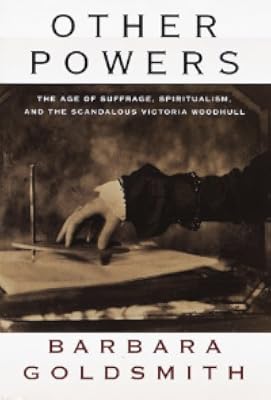
Other Powers: The Age of Suffrage, Spiritualism, and the Scandalous Victoria Woodhull
by Barbara Goldsmith
On This Page
Description
From the author of Little Gloria . . . Happy at Last, a stunning combination of history and biography that interweaves the stories of some of the most important social, political, and religious figures of America's Victorian era with the courageous and notorious life of Victoria Woodhull, to tell the story of her astonishing rise and fall and rise again. This is history at its most vivid, set amid the battle for woman suffrage, the Spiritualist movement that swept across the nation (10 show more million strong by midcentury) in the age of Radical Reconstruction following the Civil War, and the bitter fight that pitted black men against white women in the struggle to win the right to vote. "From the Hardcover edition." show lessTags
Recommendations










Member Reviews
This book taught me a lot about a period of post-Civil War society I knew very little about. I had read about the suffragettes and how they divided over whether to support black suffrage unaccompanied by female suffrage. But I never knew much about the personal relationships and spiritual ideas that motivated and inspired them, and about how their hypocrisies set their cause back an entire generation. Woodhull is a fascinating character, in some ways a throwback to the Great Awakening, in others a rebel against Victorian conservatism. Henry Ward Beecher emerges as the great viilian of the period.
Victoria Woodhull is one of the most fascinating people I've ever read about. The first woman to run for president, she was an incredibly intelligent woman with opinions and views far ahead of her time. And because of the great double-standard of society against women of that time, she was shunned because of them.
Woodhull lived the same kind of life that many men did at that time, but her reputation suffered because of it, while most men got off with just a slap on the hand. She was jailed for the stupidest reasons and lost all her money because of it.
Her strong views in a society that viewed wives as property of their husbands made men afraid of her. So, they used her past against her to discredit her. Heaven forbid women think for show more themselves! They might suddenly realize that the standards society has set for them are a load of crap.
If she lived in a different time, and didn't have a psychotic family or live in a hypocritical world, she could have done some amazing things. And even though she was shunned by society and eventually moved to London, the upheaval she left behind during the late 1860s and most of the 70s did have an effect on some woman. Unfortunately, because of her so-called controversial and scandalous reputation, we won't know just how so.
This book is extremely useful for learning about Victoria before she moved to London in the 1870s. Once she moved there, she changed her background and ancestors so much, that we don't know much except for her life in America. The book also includes some of the major players in the world around Woodhull: Susan B. Anthony, Elizabeth Cady Stanton, Henry Bowen, Henry Tilton, Henry Ward Beecher, among others. A few chapters covered the infamous Tilton-Beecher trials.
Fascinating book that plays out almost like a fiction book, but who could make this up? show less
Woodhull lived the same kind of life that many men did at that time, but her reputation suffered because of it, while most men got off with just a slap on the hand. She was jailed for the stupidest reasons and lost all her money because of it.
Her strong views in a society that viewed wives as property of their husbands made men afraid of her. So, they used her past against her to discredit her. Heaven forbid women think for show more themselves! They might suddenly realize that the standards society has set for them are a load of crap.
If she lived in a different time, and didn't have a psychotic family or live in a hypocritical world, she could have done some amazing things. And even though she was shunned by society and eventually moved to London, the upheaval she left behind during the late 1860s and most of the 70s did have an effect on some woman. Unfortunately, because of her so-called controversial and scandalous reputation, we won't know just how so.
This book is extremely useful for learning about Victoria before she moved to London in the 1870s. Once she moved there, she changed her background and ancestors so much, that we don't know much except for her life in America. The book also includes some of the major players in the world around Woodhull: Susan B. Anthony, Elizabeth Cady Stanton, Henry Bowen, Henry Tilton, Henry Ward Beecher, among others. A few chapters covered the infamous Tilton-Beecher trials.
Fascinating book that plays out almost like a fiction book, but who could make this up? show less
Universal suffrage! Spiritualism! Scandal!
OK, rather more suffrage and scandal than Spiritualism, which was a bit of a disappointment. Still, a fascinating read of a very turbulent time in history, with lots of detail about a couple of related circles of influence, mostly in New York City and Boston.
OK, rather more suffrage and scandal than Spiritualism, which was a bit of a disappointment. Still, a fascinating read of a very turbulent time in history, with lots of detail about a couple of related circles of influence, mostly in New York City and Boston.
What a great read! Victoria Woodhull was Cornelius Vanderbilt's lover, a spiritualist, and the first woman to run for President of the United States. It doesn't get juicier than that.
The Age of Suffrage, Spiritualism, and the Scandalous Victoria Woodhull.
Ratings
Members
- Recently Added By
Lists

Nonordinary States of Consciousness
184 works; 7 members

Books in the Bibliography of Freethinkers by Susan Jacoby
155 works; 1 member
Author Information

8+ Works 1,125 Members
Barbara Goldsmith was born Barbara Joan Lubin on May 18, 1931 in Manhattan, New York. She received a bachelor's degree in English and art history from Wellesley College in 1953. After college, she worked for Art News as a critic before becoming an editor at Woman's Home Companion, where she created an entertainment section. Later, she worked at show more Town and Country, where she started a series called The Creative Environment, for which she interviewed important figures in the arts. She wrote for The New York Herald Tribune and then became one of the founding editors of New York magazine. She was a senior editor at Harper's Bazaar in the early 1970s, but soon left to write the novel The Straw Man. Her account of the 1934 custody battle over Gloria Vanderbilt entitled Little Gloria ¿ Happy at Last was published in 1980 and was turned into an NBC mini-series in 1982. Her other non-fiction works included Johnson v. Johnson; Other Powers: The Age of Suffrage, Spiritualism and the Scandalous Victoria Woodhull; and Obsessive Genius: The Inner World of Marie Curie. She died from heart failure on June 26, 2016 at the age of 85. (Bowker Author Biography) show less
Awards and Honors
Awards
Common Knowledge
- Original publication date
- 1998
- People/Characters
- Victoria Woodhull; Tennessee Claflin; Henry Ward Beecher; Lib Tilton; Elizabeth Cady Stanton; Anna Dickinson (show all 8); Horace Greeley; Anthony Comstock
- Important places
- Seneca Falls, New York, USA; USA; New York, USA
- Epigraph
- To preach the doctrine you must live the life. - Victoria Woodhull
Do as I do. Consult the Spirits. - Commodore Cornelius Vanderbilt
Orthodoxy is my doxy and heterodoxy is your doxy. . . . - the Reverend Henry Ward Beecher - Dedication
- To my dearest friend
- First words
- (Introduction) "Do as I do. Consult the Spirits!" Commodore Vanderbilt told a Tribune reporter in 1870, when asked how he'd made his millions.
(Prologue) May 5, 1892: As the delegates to the National American Woman Suffrage Association convention filed into the Auditorium Theatre in Chicago, they found on the seats a leather-bound pampthlet titled "A Page of History... (show all)."
Roxy Claflin stood on the frozen, rutted road, shivering in her threadbare calico dress as the late December winds lashed the frosted fields of Homer, Ohio, and resolutely awaited the messenger of God. - Last words
- (Click to show. Warning: May contain spoilers.)Whoever I am, whatever I have done, belongs to the spirits.
- Blurbers
- Caro, Robert A.; Steinem, Gloria; Schlesinger, Arthur, Jr.; Gay, Peter; Davis, Peggy Cooper; Browne, Mary T. (show all 7); Wilentz, Sean
Classifications
- Genres
- Nonfiction, History, Biography & Memoir, General Nonfiction, Sexuality and Gender Studies, Religion & Spirituality
- DDC/MDS
- 305.42092 — Society, government, & culture Social sciences, sociology & anthropology Social group - Age, Gender, Ethnicity Women Social role and status of women Standard subdivisions History, geographic treatment, biography Biography
- LCC
- HQ1413 .W66 .G65 — Social sciences The family. Marriage, Women and Sexuality The Family. Marriage. Women Women. Feminism
- BISAC
Statistics
- Members
- 383
- Popularity
- 81,918
- Reviews
- 5
- Rating
- (3.88)
- Languages
- English
- Media
- Paper, Ebook
- ISBNs
- 7
- ASINs
- 6