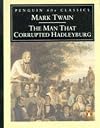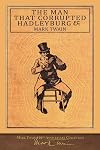
The Man That Corrupted Hadleyburg [short story]
by Mark Twain 
On This Page
Description
Based on one of Mark Twain's best known short stories. A mysterious stranger who was slighted by the people of Hadleyburg reappears to disprove the town's reputation.Tags
Recommendations






















Member Reviews
“The weakest of all weak things is a virtue which has not been tested in the fire.
Hadleyburg is famed for its reputation for honesty even teaching its children about it. However, when Hadleyburg offends a passing stranger he resolves to revenge himself on the town, rather than any individuals, by exposing its artificial virtue. He leaves a sack supposedly containing forty thousand dollars in gold with Mary and Edward Richards, asking them to find an unknown benefactor. This person had given him twenty dollars and advice. Whoever correctly repeats that advice can claim the money.
Two central themes to this tale are appearance versus reality and more importantly human vanity. The stranger deliberately sets out to expose the town’s show more lies. Hadleyburg prides itself on its honesty, but all its leading citizens are willing to lie for the gold. There is no real virtue in Hadleyburg, only show.
This book is more of an extended essay than a even novella really only running to roughly 60 pages and is reported to have been originally written on hotel stationary during a stopover. It is beautifully crafted and the language succinct that its depth of meaning far out weighs its number of pages. This is so a charming tale that left me if not laughing out loud at least with a permanent smile on my face as it cruelly exposed such basic human failings as self-interest and greed. It was a joy to read and I would thoroughly recommend reading it. show less
Hadleyburg is famed for its reputation for honesty even teaching its children about it. However, when Hadleyburg offends a passing stranger he resolves to revenge himself on the town, rather than any individuals, by exposing its artificial virtue. He leaves a sack supposedly containing forty thousand dollars in gold with Mary and Edward Richards, asking them to find an unknown benefactor. This person had given him twenty dollars and advice. Whoever correctly repeats that advice can claim the money.
Two central themes to this tale are appearance versus reality and more importantly human vanity. The stranger deliberately sets out to expose the town’s show more lies. Hadleyburg prides itself on its honesty, but all its leading citizens are willing to lie for the gold. There is no real virtue in Hadleyburg, only show.
This book is more of an extended essay than a even novella really only running to roughly 60 pages and is reported to have been originally written on hotel stationary during a stopover. It is beautifully crafted and the language succinct that its depth of meaning far out weighs its number of pages. This is so a charming tale that left me if not laughing out loud at least with a permanent smile on my face as it cruelly exposed such basic human failings as self-interest and greed. It was a joy to read and I would thoroughly recommend reading it. show less
Oof. Twain pulls no punches when he feels like it. A scornful laugh against greed and hypocrisy.
Some books have a way of coming back. They are not of their time necessarily. But at their core is the human comedy which never grows stale or loses its relevance. Shakespeare's MacBeth is such a work. After all, the hunger for power and the willingness to murder in order to obtain it are universal in the human experience. The Man That Corrupted Hadleyburg retains its luster for very similar reasons.
I've often believed there are two Mark Twains. I won't argue that one of them is Samuel Clemens. But the Twain who wrote Tom Sawyer and The Adventures of Huckleberry Finn was not the same man who had been hardened by financial troubles and the death of several family members later in life. That Twain was a bitter, cynical bloke who had a show more bone to pick with the world. And damn me if you will, but I love that Twain much better.
Maybe it's because my favorite works by Twain are not the perfectly rendered classics he penned at the height of his career. I read both Tom Sawyer and Huckleberry Finn as part of my school curriculum. I found them interesting and well written. I do consider them to be classics. But in some ways, I never quite connected with those novels. Much like The Adventures of Augie March or Anna Karenina, I respected the writer and the works, but neither sunk into my soul.
My connection with Twain started with Pudd'nhead Wilson. Twain's satirical take on racial problems in America possesses a great sense of wit, but also a razor-sharp dissection of what makes humans tick. It is not a beautiful portrait of America. Nor is The Man That Corrupted Hadleyburg. Once again, this was not a content man, but one who had literally fled the country to escape his creditors. Twain actually scrawled out ...Hadleyburg on hotel stationary from his various stops in Europe.
The visceral anger that Twain felt towards his homeland and his hatred for human greed in general bleeds off the pages of ...Hadleyburg. That, however, is what makes it such a joy to read. Much like Pudd'nhead Wilson, this novella comes across more as a punk anthem, a short series of jabs at our guts, rather than an epic tale. And in spite of its imperfections (the lack of subtlety, the forgone conclusion that the citizens of Hadleyburg will get theirs), you enjoy every bit of the town's downward spiral. It is a wonderful adult fable that benefits from Twain's sense of humor, especially in the town hall scene once the supposed upstanding nineteen are revealed as charlatans.
In fact, if you've been paying attention to the massive global economic crisis, ...Hadleyburg is the perfect companion to our current state of the world. After all, rampant greed was the cause of our financial system's downfall. Twain's tale of a supposedly incorruptible town, whose reputation made them the envy of citizens far and wide, and their ultimate downfall due to the simple sin of greed, still plays exceptionally well. Having experienced the harsh reality of being in debt, Twain was given a first hand lesson in the effects of greed.
One could never argue that ...Hadleyburg is a classic work of American fiction. That is often reserved for Twain's earlier novels. But you can argue that it retains its own enduring allure, if for no other reason than its belief that, at our core, we are all capable of being tempted and corrupted.
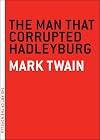
Of course, I would be a bastard for not complementing Melville House Classics for publishing "The Art of the Novella" series which keeps works such as The Man That Corrupted Hadleyburg, Melville's Benito Cereno, and Dostoevsky's The Eternal Husband in print as stand-alone entities (rather than being lumped into anthologies). They are publishing the novellas in a style worthy of Blue Note Records, with similar cover treatments, and a sense of dedication that usually is only found at smaller presses. Cheers to them. show less
I've often believed there are two Mark Twains. I won't argue that one of them is Samuel Clemens. But the Twain who wrote Tom Sawyer and The Adventures of Huckleberry Finn was not the same man who had been hardened by financial troubles and the death of several family members later in life. That Twain was a bitter, cynical bloke who had a show more bone to pick with the world. And damn me if you will, but I love that Twain much better.
Maybe it's because my favorite works by Twain are not the perfectly rendered classics he penned at the height of his career. I read both Tom Sawyer and Huckleberry Finn as part of my school curriculum. I found them interesting and well written. I do consider them to be classics. But in some ways, I never quite connected with those novels. Much like The Adventures of Augie March or Anna Karenina, I respected the writer and the works, but neither sunk into my soul.
My connection with Twain started with Pudd'nhead Wilson. Twain's satirical take on racial problems in America possesses a great sense of wit, but also a razor-sharp dissection of what makes humans tick. It is not a beautiful portrait of America. Nor is The Man That Corrupted Hadleyburg. Once again, this was not a content man, but one who had literally fled the country to escape his creditors. Twain actually scrawled out ...Hadleyburg on hotel stationary from his various stops in Europe.
The visceral anger that Twain felt towards his homeland and his hatred for human greed in general bleeds off the pages of ...Hadleyburg. That, however, is what makes it such a joy to read. Much like Pudd'nhead Wilson, this novella comes across more as a punk anthem, a short series of jabs at our guts, rather than an epic tale. And in spite of its imperfections (the lack of subtlety, the forgone conclusion that the citizens of Hadleyburg will get theirs), you enjoy every bit of the town's downward spiral. It is a wonderful adult fable that benefits from Twain's sense of humor, especially in the town hall scene once the supposed upstanding nineteen are revealed as charlatans.
In fact, if you've been paying attention to the massive global economic crisis, ...Hadleyburg is the perfect companion to our current state of the world. After all, rampant greed was the cause of our financial system's downfall. Twain's tale of a supposedly incorruptible town, whose reputation made them the envy of citizens far and wide, and their ultimate downfall due to the simple sin of greed, still plays exceptionally well. Having experienced the harsh reality of being in debt, Twain was given a first hand lesson in the effects of greed.
One could never argue that ...Hadleyburg is a classic work of American fiction. That is often reserved for Twain's earlier novels. But you can argue that it retains its own enduring allure, if for no other reason than its belief that, at our core, we are all capable of being tempted and corrupted.
Of course, I would be a bastard for not complementing Melville House Classics for publishing "The Art of the Novella" series which keeps works such as The Man That Corrupted Hadleyburg, Melville's Benito Cereno, and Dostoevsky's The Eternal Husband in print as stand-alone entities (rather than being lumped into anthologies). They are publishing the novellas in a style worthy of Blue Note Records, with similar cover treatments, and a sense of dedication that usually is only found at smaller presses. Cheers to them. show less
It isn't my favorite Twain story, but TMTCH is a great little yarn about greed and hypocrisy. Essentially the story revolves around a town of people with a reputation for virtue, but whose virtue has never really been tested. When a stranger delivers the test, all bets are off. Throughout, Twain pulls no punches as he harpoons the people of the town and through them the values of American society.
'A work of bitter cynicism' is in the Goodreads description of this story. Yes, that. Exactly that.
I did enjoy it though. There was a finger pointing schadenfreude feel to it, particularly at the end.
I did enjoy it though. There was a finger pointing schadenfreude feel to it, particularly at the end.
Written on hotel stationary in Europe while he was near the end of his career, growing cynical, and suffering depression from the death of his daughter – and it shows. Not funny, and nothing profound here about the human condition (yes, yes, money corrupts). I love Twain, but skip this one.
A wonderful short story; was one that I use to teach every year in my former carreer as English teacher.
Members
- Recently Added By
Author Information

2,748+ Works 208,560 Members
Mark Twain was born Samuel L. Clemens in Florida, Missouri on November 30, 1835. He worked as a printer, and then became a steamboat pilot. He traveled throughout the West, writing humorous sketches for newspapers. In 1865, he wrote the short story, The Celebrated Jumping Frog of Calaveras County, which was very well received. He then began a show more career as a humorous travel writer and lecturer, publishing The Innocents Abroad in 1869, Roughing It in 1872, and, Gilded Age in 1873, which was co-authored with Charles Dudley Warner. His best-known works are The Adventures of Tom Sawyer, Mississippi Writing: Life on the Mississippi, and The Adventures of Huckleberry Finn. He died of a heart attack on April 21, 1910. (Bowker Author Biography) show less
Mark Twain has a Legacy Library. Legacy libraries are the personal libraries of famous readers, entered by LibraryThing members from the Legacy Libraries group.
Series
Belongs to Publisher Series
Work Relationships
Is contained in
Has the adaptation
Has as a student's study guide
Common Knowledge
- Canonical title
- The Man That Corrupted Hadleyburg; The Man that Corrupted Hadleyburg; The Man That Corrupted Hadleyburg [short story]
- Original title
- The Man that Corrupted Hadleyburg
- Original publication date
- 1899-12; 1899
- First words
- It was many years ago.
- Last words
- (Click to show. Warning: May contain spoilers.)It is an honest town once more, and the man will have to rise early that catches it napping again.
- Disambiguation notice
- This work contains the single story The Man that Corrupted Hadleyburg and should not be combined with larger collections.
This is the short story "The Man That Corrupted Hadleyburg". Please do not combine with any work containing additional pieces.
Classifications
Statistics
- Members
- 318
- Popularity
- 100,033
- Reviews
- 7
- Rating
- (3.73)
- Languages
- 6 — Dutch, English, French, Italian, Portuguese, Spanish
- Media
- Paper, Audiobook, Ebook
- ISBNs
- 50
- UPCs
- 1
- ASINs
- 23