On This Page
Description
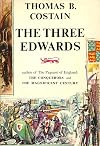
THE THREE EDWARDS, third in Thomas B. Costain's survey of Britain under the Plantagenets, covers the years between 1272 and 1377 when three Edwards ruled England. Edward I brought England out of the Middle Ages. Edward II had a tragic reign but gave his country Edward III, who ruled gloriously, if violently..
Tags
Recommendations



















Member Recommendations

bjappleg8 Cashelmara is a fictionalized retelling of the same Plantagenet kings that Costain details. Both works are gripping and bring their subjects to vivid life.
Member Reviews
I really enjoyed this read. I've long been fascinated with the complex monarchical history of England, but have been intimidated by it as a reader. Costain's series was popular for a reason: they're accessible, readable, and interesting. I picked up The Three Edwards, the third in the series, because, strangely enough, the rest of Costain's Plantagenet series remains hard to find in the Hennepin County Library System. But I didn't feel lost. This book looks at Edward I, Edward II, and Edward III, with side trips to meet William Wallace, Robert the Bruce, Phillip the Bad, and several knights whom, Costain theorizes, served as inspiration to Cervantes as he wrote Quixote. Because of its accessibility, the prose was engaging and the show more narrative mostly swift (though it slowed down dramatically at the end in the lengthy discussions of "non-Edward" topics, such as the initial stirrings of the Reformation, a couple of towering paladins, etc). The drama of the Scottish wars, of Isabella's machinations to get her feckless husband off the throne, of the Black Prince's heroics, were well-relayed.
I will say that the book lacks a certain rigor of scholarship. A popular history, of course, doesn't require the same depth and meticulous attention to sourcing that a more academic history requires. But Costain makes many assumptions, takes some literary liberties that, while entertaining, made me feel suspicious, and drew some conclusions that I didn't feel were well supported. I'm torn because, as a reader, some of these same sections were among my favorite to read. Anyway, I will be reading the rest of the Plantagenet series, and am grateful to have this easy way to enter into the intricate history of England's monarchy. show less
I will say that the book lacks a certain rigor of scholarship. A popular history, of course, doesn't require the same depth and meticulous attention to sourcing that a more academic history requires. But Costain makes many assumptions, takes some literary liberties that, while entertaining, made me feel suspicious, and drew some conclusions that I didn't feel were well supported. I'm torn because, as a reader, some of these same sections were among my favorite to read. Anyway, I will be reading the rest of the Plantagenet series, and am grateful to have this easy way to enter into the intricate history of England's monarchy. show less
All history books should be written as well as Thomas Costain's "The Three Edwards." A comprehensive guide to the lives and labors of the great warrior kings Edward I and Edward III and the screw-up, Edward II, who ruled in between them, this book unfolds more like an easy-to-read and hard-to-put-down novel. Divided into short, easily manageable and well-organized chapters, it covers everything from the marriages of the kings and their children, the political highs and lows of their reigns, the manner of their deaths and the major battles of their wars. Many books about this era are hard to follow if you don't already have a good working knowledge of the time period. Costain avoids this problem by telling you who the people are, what show more they looked and acted liked, and why they are important to the story, helping you keep track of them by reminding you when he's spoken of them before, and generally describing the people so well that they don't just become a series of names that you can't keep track of. Although he obviously admires Edward I, has disdain for Edward II, and seems to be neutral toward Edward III, to whom about half the book is devoted, he is careful to point out both the good and bad in each of their characters and to place their actions in the context of their times. Plenty of space is given to the kings' ministers, merchants, wives and families, and to those of the Scottish and French rulers with whom the Edwards were at constant war, including Robert the Bruce, William Wallace, John Balliol, Philip the Fair, Jean the Good, and Charles the Bald.
One of the things I love about this book is that Costain shares so many of the great rumors and stories that passed down over the ages (such as Edward I promising the Welsh that he will give them a prince that speaks no English or French and then appointing his newborn son to the post), simply because they are great stories, while taking pains to point out why they can't be true. You can almost feel Costain winking at you as he relates the tales. Another great aspect of the book is that he devotes substantial time to the women of the period, who are generally ignored in most books on the middle ages. Edward II's wife, Isabella of France, is examined in detail, as is Eleanor of Castille, the first and beloved wife of Edward I whose death moved him to erect eleven costly stone crosses to her memory.
This book presents a very comprehensive overview of the lives and works of the three kings and is a great starting place for those who know very little about their lives, or a great review for those who've read much about them. You won't get every tiny bit of detail about Edward III's famous battles of Sluys, Crecy and Poitiers here that is found in, for instance, Jonathon Sumption's books on the Hundred Years War, but they are all well-summarized, and Costain includes many important details such as numbers of foot and mounted soldiers on each side, terrain, battle tactics and formations, and number of casualties as well as political motivations. Given the length of the book, there is a surprising wealth of detail packed into every page, including such wonderful tidbits as the origin of the word "blanket," which came from the name of Thomas Blanket, an early English manufacturer of the item.
In the last few months I have read over two dozen books on the middle ages, and this had been by far the most informative and enjoyable, the one book that really makes the events of the period come alive and the people seem to be actual people of flesh and blood, rather than just an amalgam of their deeds and accomplishments. I can't recommend this book highly enough. show less
One of the things I love about this book is that Costain shares so many of the great rumors and stories that passed down over the ages (such as Edward I promising the Welsh that he will give them a prince that speaks no English or French and then appointing his newborn son to the post), simply because they are great stories, while taking pains to point out why they can't be true. You can almost feel Costain winking at you as he relates the tales. Another great aspect of the book is that he devotes substantial time to the women of the period, who are generally ignored in most books on the middle ages. Edward II's wife, Isabella of France, is examined in detail, as is Eleanor of Castille, the first and beloved wife of Edward I whose death moved him to erect eleven costly stone crosses to her memory.
This book presents a very comprehensive overview of the lives and works of the three kings and is a great starting place for those who know very little about their lives, or a great review for those who've read much about them. You won't get every tiny bit of detail about Edward III's famous battles of Sluys, Crecy and Poitiers here that is found in, for instance, Jonathon Sumption's books on the Hundred Years War, but they are all well-summarized, and Costain includes many important details such as numbers of foot and mounted soldiers on each side, terrain, battle tactics and formations, and number of casualties as well as political motivations. Given the length of the book, there is a surprising wealth of detail packed into every page, including such wonderful tidbits as the origin of the word "blanket," which came from the name of Thomas Blanket, an early English manufacturer of the item.
In the last few months I have read over two dozen books on the middle ages, and this had been by far the most informative and enjoyable, the one book that really makes the events of the period come alive and the people seem to be actual people of flesh and blood, rather than just an amalgam of their deeds and accomplishments. I can't recommend this book highly enough. show less
I was surprised by how enjoyable and readable this book was. Within the first few pages Edward I gets stabbed with a poisoned dagger by a treacherous Muslim, and the history stays at that level of excitement throughout. Costain writes remarkably descriptive prose--he uses a whole lot of adjectives--but never delves into fiction. He doesn't put words or thoughts into the historical figures' heads, unlike all too many historians. I was pleased by Costain's breadth scholarship, as well. He spends literally chapters going over every detail of the Scottish wars for freedom, but doesn't leave out the contents of Princess Eleanor's trousseau (and why she would bring a bed of her own, or pounds of white sugar) or the effects of changing show more fashion. He includes several paragraphs on the invention of buttons!
And yet, despite all this detail, the book is never slowed down. I felt like I got a very comprehensive account of each Edward while also getting a good feel for the times they lived in. Impressive! show less
And yet, despite all this detail, the book is never slowed down. I felt like I got a very comprehensive account of each Edward while also getting a good feel for the times they lived in. Impressive! show less
A very readable introduction to the period of the High Middle ages in England. A popular novelist, Costain's book reads well and invites further excursions into the period. This section of his larger group biographies of all the Plantagenet kings covers 1239 to 1377, when Edward III died. There are scenes of high drama including the coup that forced Edward II to abdicate in favour of Edward III.
This 3rd volume in Costain's history of the Plantagenet dynasty in England features the wise Edward I and his flamboyant, uber-general grandson Edward III. Sandwiched between them is the tentative Edward II, who was deposed by his wife and who, rumor has it, died a horrific death (which Costain plays down.) There's a lot about battles in this, which Costain explains lucidly. History which reads like a novel.
Costain continues his saga of the Plantaganet family, starting here with the three kings of England in the middle ages, Edward I, Edward II, Edward III, covering all the history involved, the politics, the religious twists, the Black Death, wars, civil unrest, the building and tearing down of castles and more, dusted generously with plenty of intrigue, double-crossings, romance, family squables, tournaments, disappointments, beheadings, desposings. What more could you ask for? And it's all history, straightforward, uncontrived, no conjugated characters. Costain puts it all out there with clarity, simply following history as it happened. Some of it may surprise you, and I'm sure you will learn a lot. Filling in and rounding out this show more vision, Costain fills in with other players of the times including generous space allotted to Edward the Black Prince and John of Gaunt, John Wycliffe, and lesser known heroes, Leading into its evolution, the Wars of the Roses is clarified. It's possible you might even remember which House was the white rose [House of York} and which one was red {House of Lancaster} because it so simply explained. As it finishes, the Reformation of religious thought looms on the horizon. And young Richard II is heir to the throne of England. However, it is the final chapter that provides an unexpected twist and leaves the reader clamorous for the next adventure. Excellent narrative involves the reader all the way through and anxious to lay hold of the next one. I am thoroughly enjoying these. show less
Actual Rating : 3.5/5 stars
Review : Fun fact: the copy I had (it belongs to my grandparents) actually has a cigarette ad in it. It is a little dated, given that it’s roughly 50 years old, give or take a few years. However, this was a fun read, and I really enjoyed how Costain presents these three kings.
Review : Fun fact: the copy I had (it belongs to my grandparents) actually has a cigarette ad in it. It is a little dated, given that it’s roughly 50 years old, give or take a few years. However, this was a fun read, and I really enjoyed how Costain presents these three kings.
Members
- Recently Added By
Lists

johnjack fiction
4 works; 1 member
Author Information

Awards and Honors
Distinctions
Series


Work Relationships
Common Knowledge
- Original title
- The Three Edwards
- Original publication date
- 1958 (Doubleday) (Doubleday)
- People/Characters
- Edward I, King of England; Edward II, King of England; Edward III, King of England
- Important events
- Reign of Edward I, King of England (1272-11-16 | 1307-07-07); Reign of Edward II, King of England (1307-07-07 | 1327-01-26); Reign of Edward III, King of England (1327-01-25 | 1377-06-21); Hundred Years' War (1337 | 1453)
- First words
- The Crusades were running down like an unwound clock.
- Last words
- (Click to show. Warning: May contain spoilers.)Then she stole away on noiseless feet.
Classifications
- Genres
- History, Nonfiction, General Nonfiction, Biography & Memoir
- DDC/MDS
- 942.02 — History & geography History of Europe England and Wales England Norman 1066-1154
- LCC
- DA229 .C6 — History of Europe, Asia, Africa and Oceania Great Britain History of Great Britain England History By period Early and medieval to 1485 1154-1485. Angevins. Plantagenets.
- BISAC
Statistics
- Members
- 631
- Popularity
- 46,245
- Reviews
- 9
- Rating
- (3.90)
- Languages
- English, Italian, Polish
- Media
- Paper, Audiobook, Ebook
- ISBNs
- 15
- ASINs
- 19