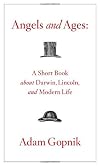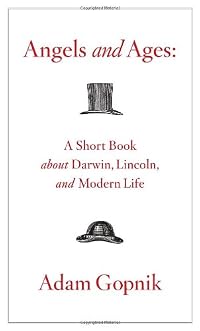
Angels and Ages: A Short Book About Darwin, Lincoln, and Modern Life
by Adam Gopnik
On This Page
Description
On February 12, 1809, two men were born an ocean apart: Abraham Lincoln in a one-room Kentucky log cabin; Charles Darwin on an English country estate. Each would see his life's work inspire a stark change in mankind's understanding of itself. In this bicentennial twin portrait, Adam Gopnik shows how these two giants, who never met, altered the way we think about death and time--about the very nature of earthly existence.Tags
Recommendations

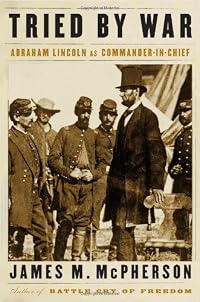

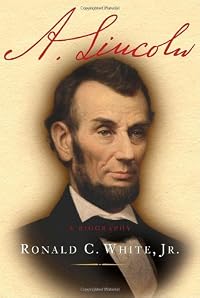
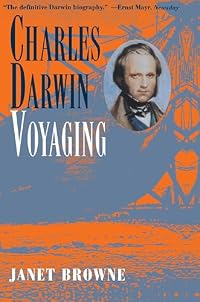


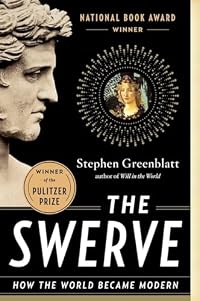
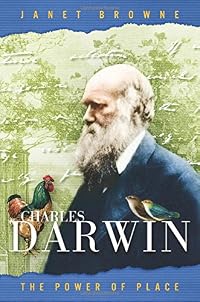

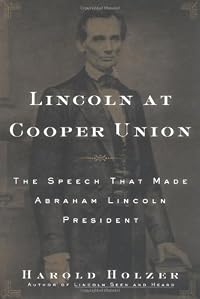
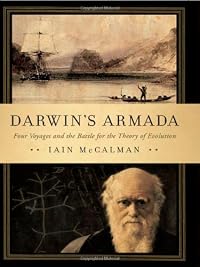




Member Recommendations

Othemts Two books that examine the thoughts and words of three men who influenced the course of modernity: Lincoln, Darwin, and Freud.
Member Reviews
Darwin and Lincoln, born on the very same day, remade the world. In this book Adam Gopnik delineates their lives and tries to explain his view of Modern Life. He's much better with the literary and biographical analysis than he is with the Big Theories. (Just an idea -- if you're going to expound a Big Theory in a book, best not to invite comparisons with Charles Darwin.)
Gopnik gets big points for noticing one important way in which Lincoln and Darwin were alike, as men and as writers: they built grand ideas on solid foundations of carefully accumulated detail. People came to accept Darwin's theory because he presented such a mass of closely-observed evidence to back it up. Lincoln could remake American law and society so thoroughly show more because he could, like the lawyer he was, buttress his arguments with citations of precedent and history, arranged in a coldly logical manner no one could deny. Accept his premise, and you had to accept his conclusion -- that was true of both the Emancipator and the shy Mr. Darwin.
Gopnik spends a lot of time talking about the words spoken by Lincoln's War Secretary just after Abe died: did Stanton say "Now he belongs to the ages," or did he utter "Now he belongs to the angels?" Frankly, I don't care, and we'll never now. It seems like the kind of angels-on-the-head-of-a-pin question that neither Darwin nor Lincoln would have dawdled with for long. show less
Gopnik gets big points for noticing one important way in which Lincoln and Darwin were alike, as men and as writers: they built grand ideas on solid foundations of carefully accumulated detail. People came to accept Darwin's theory because he presented such a mass of closely-observed evidence to back it up. Lincoln could remake American law and society so thoroughly show more because he could, like the lawyer he was, buttress his arguments with citations of precedent and history, arranged in a coldly logical manner no one could deny. Accept his premise, and you had to accept his conclusion -- that was true of both the Emancipator and the shy Mr. Darwin.
Gopnik spends a lot of time talking about the words spoken by Lincoln's War Secretary just after Abe died: did Stanton say "Now he belongs to the ages," or did he utter "Now he belongs to the angels?" Frankly, I don't care, and we'll never now. It seems like the kind of angels-on-the-head-of-a-pin question that neither Darwin nor Lincoln would have dawdled with for long. show less
My annual Lincoln/Darwin Day reading is a short book published for the bicentennial of their birth. This book is an extended rumination on the lives of two men born on the same day who helped create the modern world. Gopnik sees both Lincoln and Darwin as men of words, Lincoln with speech and rhetoric and Darwin with his novelistic prose. The title and a major issue upon which Gopnik builds his narrative is the debate of Edward Stanton's eulogy for Lincoln, whether he said "Now he belongs to the angels" or "Now he belongs to the ages." This book is an interesting but not essential addition to the literature about these two fascinating men.
Favorite Passages:
Favorite Passages:
"The thesis is that literary eloquence is essential to liberal civilization; ourshow more
heroes should be men and women possessed by the urgency of utterance, obsessed by the need to see for themselves and to speak for us all. Authoritarian societies can rely on an educated elite; mere mass society, on shared dumb show. Liberal cities can't. A commitment to persuasion is in itself a central liberal principle. New ways of thinking demand new kinds of eloquence. Our world rests on science and democracy, on seeing and saying; it rests on thinking new thoughts and getting them heard by a lot of people." p. 22
"The attempt to make Lincoln into just one more racist is part of the now common attempt to introduce a noxious equilibrium between minds and parties: liberals who struggle with their own prejudices are somehow equal in prejudice to those who never took the trouble to make the struggle. Imperfect effort at being just is no different from perfect indifference to it." -p. 49
"... for the first time, and despite much conventional religious piety -- there's a nascent sence throughout the liberal world that the deaths of young men in war will never be justified in the eyes of a good God, and never compensated for by a meeting in another world. Their deaths can be made meaningful only through a vague idea of Providence and through the persistence of a living ideal." - p. 120show less
This is a great read, especially on Lincoln. Gopnik understands what Lincoln's view of life was, and how important the law and Shakespeare was to his rhetoric. This is a splendid read for me who has visited the Soldiers Home in Washington,where Lincoln spent the summer months, and Springfield Illinois, where the parks service has a great tour of the man's house and outbuildings. As far as Darwin is concerned, I knew nothing of him or his works, and now will read some, influenced by Gopnik. The author seems to argue that the individual religious experience can control life, while science goes its merry way. He does not like fundamentalists, nor do I, and he argues persuasively that they are crazy.
Starts out poorly, gets more and more interesting, and then concludes fatuously. I listened to an audiobook, the author reads his own work. He makes Darwin sound very pert, and as far as I can remember, gives Lincoln no special voice at all. I think he is trying to sneak up on his thesis just like Darwin did in the "Origin of Species", but, because his thesis is pretty much empty, that does not work so well. The parallels that are drawn between the two famous contemporaries are not nearly as forced as one would expect them to be.
Gopnik takes a simple conceit, the fact that Abraham Lincoln and Charles Darwin were born on the same day, and uses this as a launching point for a discursive, free form essay, about each man's contribution to the age of modernity. Gopnik praises Lincoln for his ability to distil complex legal arguments into a simple message any man could grasp. Too bad he cannot emulate his hero in this respect. Gopnik says his book is short, but at 200 pages it's a hundred pages too long. This would have been much better had it remained a New Yorker essay. The book rambles and Gopnik wears his erudition on his sleeve. Not an author I will be revisiting.
The thesis of this book seems to be that both Abraham Lincoln and Charles Darwin contributed to modern life in ways beyond the obvious. This book reads like an essay...no footnotes...and pursues various related ideas about religion, war, masterful use of language and society.
This is the kind of book that frustrates me because it appears to be written to show what the writer knows rather than to engage the reader. I'm an expert neither in Lincoln/American History nor Darwin/science. I had trouble following the author's points because he dropped in names or other references without explaining them or giving any context.
This is the kind of book that frustrates me because it appears to be written to show what the writer knows rather than to engage the reader. I'm an expert neither in Lincoln/American History nor Darwin/science. I had trouble following the author's points because he dropped in names or other references without explaining them or giving any context.
Very nice book. I care a lot more about Darwin than Lincoln, but I learned about both and it was interesting to see them compared. The last summary chapter was a little too abstract and hand-wavy for me, but overall a fine book.
Members
- Recently Added By
Lists

Five star books
1,755 works; 108 members
Author Information

46+ Works 6,608 Members
Adam Gopnik is the author of Paris to the Moon and Through the Children's Gate and is a contributor to The New Yorker. He lives in New York City with his wife and two children. His most recent book is Angels and Ages: A Short Book About Darwin, Lincoln and Modern Life, a comparison about how those men changed our nation with their history-making show more actions. (Bowker Author Biography) show less
Common Knowledge
- Alternate titles
- Angels and Ages
- Original publication date
- 2009
- People/Characters
- Abraham Lincoln; Charles Darwin [Charles Robert: 1809-1882]
- Important places
- USA; England, UK
- Dedication
- For my mother and father—onlie begetters and first professors
- First words
- We are all pebbles dropped in the sea of history, where the splash strikes one way and the big tides run another, and though what we feel is the splash, the splash takes place only within those tides.
- Quotations
- Subsequent editions of the first Epistle [of the Essay on Man] exhibited two memorable corrections. At first, the poet and his friend "Expatiate freely o'er this scene of man, A mighty maze of walks without a plan." For which... (show all) he wrote afterwards "A mighty maze, but not without a plan": for, if there were no plan, it was in vain to describe or to trace the maze.
-Samuel Johnson, "Life of Pope"
"Yes!" said the fairy, solemnly, half to herself, as she closed the wonderful book. "Folks say now that I can make beasts into men, by circumstance, and selection, and competition, and so forth. Well, perhaps they are right; ... (show all)and perhaps, again, they are wrong. That is one of the seven things which I am forbidden to tell, till the coming of the Cocqcigrues; and, at all events, it is no concern of theirs. Whatever their ancestors were, men they are; and I advise them to behave as such, and act accordingly."
- Charles Kingsley, The Water-Babies
Science - scientific reasoning - seems to me an instrument that will lag far, far behind. For look here, the earth has been thought to be flat. It was true, so it still is today, for instance, between Paris and Asnieres. Whic... (show all)h however does not prevent science from proving that the earth is principally round. Which no one contradicts nowadays.
But notwithstanding this they persist nowadays in believing that life is flat and runs from birth to death. However, life too is probably round, and very superior in expanse and capacity to the hemisphere we know at present.
- Vincent van Gogh, June 1888
Whoever put on a tallis when he was young will never forget:
taking it out of the soft velvet bag, opening the folded shawl,
spreading it out, kissing the length of the neckband (embroidered
or trimmed in gold). Then... (show all) swinging it in a great swoop overhead
like a sky, a wedding canopy, a parachute. And then winding it
around his head as in hide-and-seek, wrapping
his whole body in it, close and slow, snuggling into it like the cocoon
of a butterfly, then opening would-be wings to fly.
- Yehuda Amichai
Americans seemed to fascinate Picasso. Once, in Paris, he invited the Murphys to his apartment, on the Rue de la Boetie, for an aperitif, and, after showing them through the place, in every room of which were pictures in vari... (show all)ous stages of completion, he led Gerald rather ceremoniously to an alcove that contained a rather tall cardboard box. "It was full of illustrations, photographs, engravings, and reproductions clipped from newspapers. All of them dealt with a single person - Abraham Lincoln. 'I've been collecting them since I was a child,' Picasso said, 'I have thousands, thousands!' He held up one of Brady's photographs of Lincoln, and said with great feeling, 'There is the real American elegance!' "
- Calvin Tomkins, Living Well is the Best Revenge
The middleweight champion [of the early twentieth century, Stanley Ketchel] was stunned by [Wilson] Mizner's recitation of the Langdon Smith classic that starts "When you were a tadpole and I was a fish, In the Palaeozoic tim... (show all)e" and follows the romance of two lovers from one geological age to another, until they wind up in Delmonico's. Ketchel had a thousand questions about the tadpole and the fish, and Mizner, a pedagogue at heart, took immense pleasure in wedging the whole theory of evolution into the fighter's untutored head. Ketchel became silent and thoughtful. He declined an invitation to see the town that night with Mizner and [Willus] Britt. When they rolled in at 5 a.m., Ketchel was sitting up with his eyes glued on a bowl of goldfish. "That evolution is all bunk!" he shouted angrily, "I've been watching those fish nine hours and they haven't changed a bit." Mizner had to talk fast; one thing Ketchel couldn't bear was to have anybody cross him.
Alva Johnston, The Legendary Mizners - Last words
- (Click to show. Warning: May contain spoilers.)There is more to man than the breath in his body, if only the hat on his head, and the hope in his heart.
- Blurbers
- Marr, Andrew; Cowley, Jason; Aspden, Peter; Beer, Gillian; Poole, Steven
Classifications
- Genres
- History, Nonfiction, Biography & Memoir, General Nonfiction, Science & Nature
- DDC/MDS
- 973.7092 — History & geography History of North America United States Administration of Abraham Lincoln, 1861-1865 Civil War
- LCC
- E457.2 .G67 — History of the United States United States Civil War period, 1861-1865 Lincoln's administrations, 1861-April 15, 1865
- BISAC
Statistics
- Members
- 488
- Popularity
- 61,653
- Reviews
- 14
- Rating
- (3.68)
- Languages
- English, Italian
- Media
- Paper, Audiobook, Ebook
- ISBNs
- 11
- ASINs
- 8