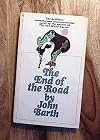
The End of the Road
by John Barth
On This Page
Description
As young Jake Horner's mind became an increasingly paralyzing cobweb of dark thoughts, he turned for help to an extraordinary doctor--part saint, part evil-genius, a weird combination of faith healer, magician, and devil. And in so doing Jake found himself following a drastic prescription that was to draw him into a strange, compulsive relationship. It is around the startling results of Jake Horner's "cure" and its amazing mastermind--a doctor almost surely designed to become one of the most show more remarkable characters in modern fiction--that this brilliant, imaginative novel hinges. John Barth is a young writer of unusual talent whose uncanny insight into the dark mazes of the human mind has given The End of the Road a haunting and troubling reality. show lessTags
Recommendations















Member Reviews
By a strange coincidence I read this right after Bernard Malamud's A New Life, which is, like this one, a very bitter comedy about a grammar teacher in a small college becoming part of a love triangle. Unlike Malamud's hopeful dreamers, Barth's guy is a different and difficult creature: sort of an existentialist narrator, but one who doesn't assume that his own apathy says anything about the world in general. His life has been short-circuited by manic depression, but since he knows he can't trust his feelings, he sometimes ends up being the most clear-sighted and humane character around. Barth indulges in some vicious satire of Objectivist supermen, and of behaviorist psychiatry: the narrator's doctor prescribes meaningless activities show more just to ensure that he doesn't stop moving. show less
הפעם השלישית שאני קורא את הספר. זכרתי את הקריאה הראשונה לפני כשישים שנה אבל לא זכרתי שקראתי אותו שנית לפני כשבע שנים. רק להדגים מה קורה לזכרון שלי בשנים האחרונות. אין לי הרבה מה להוסיף על הביקורת הקודמת ועל השפעתו של ג'ון בארט עלי. אומר רק שגם בקריאה השלישית נהניתי מכל רגע ונראה לי שהערכתי יותר מאשר קודם את הוירטואוזיות של בארט. את המעברים שלו מדיון פילוזופי אקזיסטנציאליסטי, לסלפסטיק מאני ולבסוף לטרגדיה אמתית show more שמביאה דמעות לעיניים. סופר גדול. show less
Sometimes buying a book because you like the cover just.... doesn't work out. John Barth's second novel, written in the late 1950s, mashes together black comedy, nihilism, ham-fisted philosophical positions, and brutal treatment of women into a weirdly readable book that will make you feel gross and unsatisfied at its conclusion.
Jacob Horner, our narrator, is a graduate student who has a bit of a break with reality and finds himself with all his possessions in a train station, unable to decide which ticket to buy. He is paralyzed there for days when The Doctor finds him and brings him to his unorthodox "farm" for psychological treatment. Part of this treatment involves getting a job as a grammar teacher at a small town teacher's show more college in Maryland (I said this was unorthodox). Jacob becomes friends with another teacher at the college, Joe Morgan, and his wife, Rennie, despite an initially bumpy meeting. So far so good. The Ripley-esque nature of Jacob's disconnection from society and the dark comedy and very mid-century psychiatrist business is all fine.
We quickly learn that Joe Morgan is a walking philosophical experiment in absolute rationalism. This also makes him very boring and boorish. He has also pretty much traumatized Rennie with a combination of philosophical and literal beat downs into questioning her every feeling and bending herself into his world view. Although Jacob has no personality of his own, can't make choices, and sees both sides of every question, he and Rennie are practically pushed into having an affair. Prior to and concurrent with his affair with Rennie, Jacob also somehow manages to start up a relationship with a teacher at the local high school, whom he seduces, sleeps with, insults, assaults, ignores, uses, and then hits. When Rennie discovers she is pregnant and either man could be the father, Joe's philosophical and the Doctor's psychological experiments collide in an awful and graphic ending that I really could have done without.
This was made into a movie in 1970 with Stacey Keach as Jacob Horner and James Earl Jones as the Doctor. Much like the book, the movie seems to be a pretty dated and dreary time capsule dabbling in philosophy, disaffection, and sexism, and dropping in abortion to add a little sensationalism and "currency."
Not a great one. I do still love this cover, though. show less
Jacob Horner, our narrator, is a graduate student who has a bit of a break with reality and finds himself with all his possessions in a train station, unable to decide which ticket to buy. He is paralyzed there for days when The Doctor finds him and brings him to his unorthodox "farm" for psychological treatment. Part of this treatment involves getting a job as a grammar teacher at a small town teacher's show more college in Maryland (I said this was unorthodox). Jacob becomes friends with another teacher at the college, Joe Morgan, and his wife, Rennie, despite an initially bumpy meeting. So far so good. The Ripley-esque nature of Jacob's disconnection from society and the dark comedy and very mid-century psychiatrist business is all fine.
We quickly learn that Joe Morgan is a walking philosophical experiment in absolute rationalism. This also makes him very boring and boorish. He has also pretty much traumatized Rennie with a combination of philosophical and literal beat downs into questioning her every feeling and bending herself into his world view. Although Jacob has no personality of his own, can't make choices, and sees both sides of every question, he and Rennie are practically pushed into having an affair. Prior to and concurrent with his affair with Rennie, Jacob also somehow manages to start up a relationship with a teacher at the local high school, whom he seduces, sleeps with, insults, assaults, ignores, uses, and then hits. When Rennie discovers she is pregnant and either man could be the father, Joe's philosophical and the Doctor's psychological experiments collide in an awful and graphic ending that I really could have done without.
This was made into a movie in 1970 with Stacey Keach as Jacob Horner and James Earl Jones as the Doctor. Much like the book, the movie seems to be a pretty dated and dreary time capsule dabbling in philosophy, disaffection, and sexism, and dropping in abortion to add a little sensationalism and "currency."
Not a great one. I do still love this cover, though. show less
זה הספר השני שבארט כתב והשני שאני קורא שנית לאחר כחמישים שנה מהקריאה הראשונה. זה ספר יותר טוב מהאופרה הצפה וכנראה שמשום כך גם זכרתי ממנו יותר, בפרט את הסוף המצמרר. זה ספר קר, אכזרי ומצמרר שאני חושב שהשפיע עלי לא מעט. למעשה אני חושב שלבארט היה תפקיד לא טריויאלי כלל בעיצוב האישיות שלי ומה אני חושב על עצמי ועל אנשים ועל איך ולמה הם עושים דברים.
This book was a surprise--a romp for the first hundred pages, and a far more serious story for the rest of the novel. I enjoyed the philosophical discussions of the characters and really got involved in their problems.
This is a dark...very dark comedy, showing how application of extreme existentialism and relativism combined with a will to dominate others can destroy. This is the story of three people: Horner, who is a blank slate, Morgan, who is an extreme existentialist, and Rennie, married to Morgan, and who is a super-rationalist who is easily manipulated. There is a fourth person, as well, the Doctor, who is, in a sense the puppet master, beginning and ending the series of events. This novel is powerfully written, very depressing, and very thought-provoking.
An overall odd book....an odd slightly troubled fellow, treated by a slightly creepy, quacky under-the-radar doctor, makes friends with an obsessive married couple and the further unraveling of their very odd lives picks up the pace. I really did not like any of the characters in this book, and my 3 stars may be generous, yet i still anxiously followed along, wondering where it could possibly be heading - oh.....I get it.....the end of the road.........
Members
- Recently Added By
Lists

Best First Lines
133 works; 8 members

Harold Bloom - The Western Canon: D. The Chaotic Age
833 works; 24 members

The Torchlight List
95 works; 1 member
Author Information

39+ Works 12,223 Members
John Barth taught for many years in the writing program at Johns Hopkins University, and he lives in Chestertown, Maryland. (Publisher Provided) John Simmons Barth was born on May 27, 1930 in Cambridge, Maryland. He is considered to be one of the American writers who introduced a U.S. audience to experimental fiction. Barth began as a conventional show more novelist, exploring existential themes of suicide in The Floating Opera (1956) and the complexity of love in The End of the Road (1958). By the end of the 1950s, however, he was exploring less realistic techniques to keep the reader from being pulled into the story, and thus to make larger points. Those techniques include parody, which Barth first used in The Sot-Weed Factor (1960), to mock the style of the eighteenth-century picaresque novel, and Giles Goat-Boy (1966), which depicts the world as a giant university. In Chimera (1972), for which he won the National Book Award, Barth applied his method to retell classical myths. His later works include Letters (1979), in which Barth himself appears as a character, and Sabbatical (1982), the story of a woman college professor and her novelist husband, both of whom address the reader and author. Barth's other novels include The Tidewater Tales (1987) and The Last Voyage of Somebody the Sailor (1991). For most of his career as a writer, he has also been a professor of English, teaching at Pennsylvania State University, the State University of New York at Buffalo, and The Johns Hopkins University. (Bowker Author Biography) show less
Some Editions
Awards and Honors
Work Relationships
Common Knowledge
- Canonical title
- The End of the Road
- Original title
- The End of the Road
- Original publication date
- 1958
- Related movies
- End of the Road (1970 | IMDb)
- First words
- In a sense, I am Jacob Horner.
- Last words
- (Click to show. Warning: May contain spoilers.)'Terminal.'
- Original language
- English
Classifications
Statistics
- Members
- 672
- Popularity
- 42,584
- Reviews
- 11
- Rating
- (3.58)
- Languages
- 9 — English, Finnish, French, German, Greek, Hungarian, Italian, Lithuanian, Polish
- Media
- Paper, Ebook
- ISBNs
- 23
- ASINs
- 24