On This Page
Description
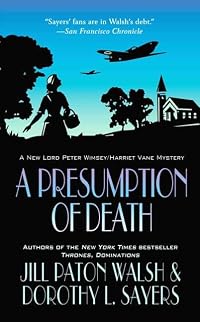
In 1998, Jill Paton Walsh completed Dorothy L. Sayers' last, unfinished Lord Peter Wimsey novel, Thrones, Dominations to widespread praise. Here, using "The Wimsey Papers", in which Sayers described life in Britain during World War II, Walsh devises an irresistible story set in 1940 at the start of the Blitz. While Lord Peter is abroad on a secret mission, Harriet Vane, now Lady Peter Wimsey, takes their children to safety in the country. But there's no escape from war: rumors of spies show more abound, glamorous RAF pilots and flirtatious land-girls scandalize the villagers, and the blackout makes rural lanes as sinister as London's alleys. And when a practice air-raid ends with a young woman's death, it's almost a shock to hear that the cause is not enemy action, but murder. Or is it? With Peter away, Harriet sets out to find out whodunit ... and the chilling reason why. show lessTags
Recommendations
















Member Reviews
New reader for this book -- took some getting used to, but enjoyed it once I did. Harriet on her own at Tallboys in WWII, holding down the fort and keeping the 5 kids of the next generation in the country with her (with nanny and cook and housemaid, of course). She remains a quietly enthralling character, and the story really powerfully relates the harrowing powerlessness of waiting that so many people have endured in times of war and crisis. Beautiful writing, feels true to the original series with perhaps a little more emotional depth.
The outbreak of Second World War finds Lord Peter Wimsey’s family — his wife Harriet Vane and their two toddler sons — and Lord Peter’s nieces and nephew moved from London to the relative security of the village of Paggleham in Hertfordshire.
Lord Peter has moonlighted as a pseudo-diplomat for Her Majesty’s Home Office in several of the novels, but, with the outbreak of the Second World War, he spends more time on the Continent than he does in England. So it is Harriet (now more often called Lady Peter) who bears the brunt of the investigation into the murder of a promiscuous Land Girl named Wendy Percival. The girl’s tarty ways had led to her being called “Wicked Wendy” behind her back, but who would want to kill show more her?
Harriet, asking on the official request of police Superintendent Kirk, begins questioning Wicked Wendy’s fellow Land Girls and her flock of would-be suitors. However, the mentally suspect retired dentist Mrs. Spright insists that the sleepy village of Paggleham provides a superb hiding place for a nest of German spies; he blames them for Wendy Percival’s death. Could this far-fetched claim be true? Or have the pressures of war pushed Mrs. Spright into paranoid delusion?
Author Jill Paton Walsh crafted A Presumption of Death from a series by Dorothy L. Sayers that ran in the Spectator during three months in the winter of 1939–40 purporting to be letters written by one Wimsey family member to another family member or to a character from one of the novels. The “letters” — termed The Wimsey Papers — were the standard morale-boosting fare popular in the Allied press, and they dwell on everyday life, as such letters would in real life: rationing, black-outs, air raid practices, and the exodus of young men; however, the letters also allowed Sayers to opine on the execution of the war and on other political matters. Walsh skillfully uses these threads to weave a most excellent mystery — rather better than Thrones, Dominations, in my opinion. In addition, I loved the glimpse into the Home Front during the so-called Phony War. I also appreciated that Walsh introduces more twists than Sayers usually did in her Lord Peter Wimsey novels — although readers will see one of them coming long before Harriet does.
Some readers decry that Lord Peter comes into the novel so late; however, I loved seeing Harriet practice what she has so long studied for writing her Robert Templeton mystery novels and what she learned working with her husband. Ms. Walsh, don’t listen to the naysayers. We want more Harriet Vane, not less! show less
Lord Peter has moonlighted as a pseudo-diplomat for Her Majesty’s Home Office in several of the novels, but, with the outbreak of the Second World War, he spends more time on the Continent than he does in England. So it is Harriet (now more often called Lady Peter) who bears the brunt of the investigation into the murder of a promiscuous Land Girl named Wendy Percival. The girl’s tarty ways had led to her being called “Wicked Wendy” behind her back, but who would want to kill show more her?
Harriet, asking on the official request of police Superintendent Kirk, begins questioning Wicked Wendy’s fellow Land Girls and her flock of would-be suitors. However, the mentally suspect retired dentist Mrs. Spright insists that the sleepy village of Paggleham provides a superb hiding place for a nest of German spies; he blames them for Wendy Percival’s death. Could this far-fetched claim be true? Or have the pressures of war pushed Mrs. Spright into paranoid delusion?
Author Jill Paton Walsh crafted A Presumption of Death from a series by Dorothy L. Sayers that ran in the Spectator during three months in the winter of 1939–40 purporting to be letters written by one Wimsey family member to another family member or to a character from one of the novels. The “letters” — termed The Wimsey Papers — were the standard morale-boosting fare popular in the Allied press, and they dwell on everyday life, as such letters would in real life: rationing, black-outs, air raid practices, and the exodus of young men; however, the letters also allowed Sayers to opine on the execution of the war and on other political matters. Walsh skillfully uses these threads to weave a most excellent mystery — rather better than Thrones, Dominations, in my opinion. In addition, I loved the glimpse into the Home Front during the so-called Phony War. I also appreciated that Walsh introduces more twists than Sayers usually did in her Lord Peter Wimsey novels — although readers will see one of them coming long before Harriet does.
Some readers decry that Lord Peter comes into the novel so late; however, I loved seeing Harriet practice what she has so long studied for writing her Robert Templeton mystery novels and what she learned working with her husband. Ms. Walsh, don’t listen to the naysayers. We want more Harriet Vane, not less! show less
It's WWII and the Wimsey family is caught up in the all-consuming war effort like the rest of the country. At the start of the Blitz, Harriet and the boys have retreated to their country home of Talboys while Peter and Bunter are doing highly sensitive intelligence work abroad. Working from Dorothy Sayers' "Wimsey Papers," Jill Paton Walsh has created a surprisingly compelling mystery story.
I have always enjoyed wartime stories set "back home" where life must still go on, even as the shadow of the bigger world at war looms over everything (Rilla of Ingleside comes to mind). I think the reason this story works better than Walsh's first effort (Thrones, Dominations) is because Peter is gone most of the time and so I was not constantly show more scrutinizing his and Harriet's relationship and conversations to see if they were authentically Sayerian. The mystery itself is rather better done than that of the previous book. I'd reread this one. show less
I have always enjoyed wartime stories set "back home" where life must still go on, even as the shadow of the bigger world at war looms over everything (Rilla of Ingleside comes to mind). I think the reason this story works better than Walsh's first effort (Thrones, Dominations) is because Peter is gone most of the time and so I was not constantly show more scrutinizing his and Harriet's relationship and conversations to see if they were authentically Sayerian. The mystery itself is rather better done than that of the previous book. I'd reread this one. show less
Paton Walsh was working with much less original material here than in Thrones, Dominations—just a set of letters Dorothy Sayers published in 1939 and 1940 in British periodicals. Ostensibly between members of the Wimsey family, they deal with the adjustment to times of war: rationing’ paternalistic, sometimes misguided and draconian, government policies; families separated. Helen’s insistence that Bredon, Peter’s son, be raised as if he was heir to the dukedom because Jerry, her own son, is a fighter pilot and danger-lover is one of the book’s moving instance of the impact of war. Others were the bond of loyalty between Bunter and Peter, back in action once again as a team and Harriet's regret that she missed out on so many show more years with Peter, and now their happiness is shaken by the war. On the whole, the book was a reasonable facsimile of a Wimsey mystery, but a modern sensibility intruded jarringly a few times—as in the multiple discussions of how the men might return to find their women changed. It just seemed a little saggier than early Wimseys, but much of that is probably not Paton Walsh’s fault. Like a TV show that has “jumped the shark,” (think Friends after Monica and Chandler get married) the Wimsey mystery series naturally starts to run out of steam when Harriet marries Peter. Faithful readers, though, are willing to hang on to “see what happens” to the characters they’ve known and loved. show less
My first Jill Paton Walsh and I wasn't overly impressed by A Presumption of Death.
Pros: It kept me reading until the end, and I'm actually not much of a crime fiction fan outside of Dorothy L and, when I'm feeling like some light reading, the occasional 'Miss Marple' or 'Miss Seeton'; so that's a point in her favour.
Cons: (1) JPW is simply not as good a prose writer as DLS. She doesn't flow so well and I occasionally came upon awkward sentence structures that Dorothy L would never have allowed into print. (2) I haven't checked this out properly as yet (and I probably won't bother), but some of the language she gave people struck me as anachronistic, leaving me thinking that people in that time and place just would not have spoken quite show more like that. (3) I wasn't impressed by some of her characterisation. Just off the top of my head, I don't think she at all accurately captured DLS's depiction of Puffet, the vicar's wife, Miss Twitterton or Helen, and I wasn't really convinced by the Dowager Duchess or Bunter, either (and I dread to think what Dorothy L. would have had to say about having Harriet undressing Bunter). (4) I missed the way DLS liberally peppered Harriet and Peter's speech and thoughts with unacknowledged and almost unsignalled literary quotes and allusions - for me that was one of the delights of the books and, after perhaps a couple of decades of reading, I still haven't chased down the half of them to their sources - always supposing I've actually spotted them all, which is unlikely. They were Dorothy L's way of signalling that Harriet and Peter were kindred spirits and potential soul mates - very important.
I'm sorry, but Jill Paton Walsh is just not Dorothy L. Sayer. show less
Pros: It kept me reading until the end, and I'm actually not much of a crime fiction fan outside of Dorothy L and, when I'm feeling like some light reading, the occasional 'Miss Marple' or 'Miss Seeton'; so that's a point in her favour.
Cons: (1) JPW is simply not as good a prose writer as DLS. She doesn't flow so well and I occasionally came upon awkward sentence structures that Dorothy L would never have allowed into print. (2) I haven't checked this out properly as yet (and I probably won't bother), but some of the language she gave people struck me as anachronistic, leaving me thinking that people in that time and place just would not have spoken quite show more like that. (3) I wasn't impressed by some of her characterisation. Just off the top of my head, I don't think she at all accurately captured DLS's depiction of Puffet, the vicar's wife, Miss Twitterton or Helen, and I wasn't really convinced by the Dowager Duchess or Bunter, either (and I dread to think what Dorothy L. would have had to say about having Harriet undressing Bunter). (4) I missed the way DLS liberally peppered Harriet and Peter's speech and thoughts with unacknowledged and almost unsignalled literary quotes and allusions - for me that was one of the delights of the books and, after perhaps a couple of decades of reading, I still haven't chased down the half of them to their sources - always supposing I've actually spotted them all, which is unlikely. They were Dorothy L's way of signalling that Harriet and Peter were kindred spirits and potential soul mates - very important.
I'm sorry, but Jill Paton Walsh is just not Dorothy L. Sayer. show less
In this outing, the world is at war for the second time in a century and Harriet and the children have retreated to Tallboys, their house out in the country to avoid the blitz, taking with them the children of Peter's sister Mary. Peter is away on a mission and Harriet is settling into country life when, during the first air raid drill, a farm girl is murdered. Asked by the local police to help, Harriet finds a suspect, who the promptly winds up dead. The mystery turns out to be the least interesting part of the story as we get a picture of war time England and of a truely happy marriage
The Wartime Lord Peter Wimsey & Harriet Vane
Review of the Hodder & Stoughton paperback edition (2014) of the original Hodder & Stoughton hardcover (2002).
Dorothy L. Sayers (1893-1957) has a co-writer credit here as some letters by Wimsey's mother, the Dowager Duchess of Denver, are used for the Introduction and the Afterword. These are excerpted from the The Wimsey Papers which were a series of Wimsey family letters that Sayers wrote for The Spectator newspaper in 1939 to document the fictional family's activities in the early stages of World War II.
Just as with the preceding book Thrones, Dominations (1936/1998), Jill Paton Walsh carries on seamlessly from Sayers here. There is a parallel with Sayers' Gaudy Night (1935), as Peter show more Wimsey is off-stage on a spying mission somewhere in the Occupied European Territories for about 2/3rds of the book, and Harriet Vane is the primary detective just as she was in the early part of that Oxford University mystery. Vane is with the Wimsey children and nieces and nephews at Wimsey's Talboy country home to escape the wartime bombing of London. A murder in the local village requires an extra hand for an unofficial investigation, as the local police force is shorthanded due to wartime recruitment.
As with all the Wimsey/Vane books, A Presumption of Death was a delight to read in its Golden Age of Crime stylings. show less
Review of the Hodder & Stoughton paperback edition (2014) of the original Hodder & Stoughton hardcover (2002).
Dorothy L. Sayers (1893-1957) has a co-writer credit here as some letters by Wimsey's mother, the Dowager Duchess of Denver, are used for the Introduction and the Afterword. These are excerpted from the The Wimsey Papers which were a series of Wimsey family letters that Sayers wrote for The Spectator newspaper in 1939 to document the fictional family's activities in the early stages of World War II.
Just as with the preceding book Thrones, Dominations (1936/1998), Jill Paton Walsh carries on seamlessly from Sayers here. There is a parallel with Sayers' Gaudy Night (1935), as Peter show more Wimsey is off-stage on a spying mission somewhere in the Occupied European Territories for about 2/3rds of the book, and Harriet Vane is the primary detective just as she was in the early part of that Oxford University mystery. Vane is with the Wimsey children and nieces and nephews at Wimsey's Talboy country home to escape the wartime bombing of London. A murder in the local village requires an extra hand for an unofficial investigation, as the local police force is shorthanded due to wartime recruitment.
As with all the Wimsey/Vane books, A Presumption of Death was a delight to read in its Golden Age of Crime stylings. show less
Members
- Recently Added By
Lists

Best War Stories
87 works; 16 members

Crime and Mysteries to Read
746 works; 31 members

British Mystery
469 works; 14 members

Used books to buy next
565 works; 1 member
Author Information

59+ Works 8,499 Members
Jill Paton Walsh was born Gillian Bliss on April 29, 1937 in London. She graduated from St. Anne's College in Oxford. She taught at the Enfield Girls' Grammar School for three years and was a permanent visiting faculty member for the Center for Children's Literature at Simmons College in Boston, Massachusetts. She was also an adjunct British board show more member of Children's Literature New England. She has written more than 15 books for children. She has won numerous awards including the Book World Festival Award for Fireweed in 1970, the Whitbread Prize for The Emperor's Winding Sheet in1974, the Universe Prize for A Parcel of Patterns in 1984, and the Smarties Grand Prix for Gaffer Samson's Luck in 1984. She has also written adult novels, including completing an unfinished Dorothy Sayers manuscript. Her adult works include Knowledge of Angels, The Serpentine Cave, and A School for Lovers. She is the author of the Imogen Quy Mystery series and the Lord Peter Wimsey Mystery series. She was elected as fellow of the Royal Society of Literature in 1996. (Bowker Author Biography) show less

276+ Works 70,741 Members
Dorothy Sayers's impressive reputation as a contemporary master of the classic detective story is eclipsed only by Agatha Christie's. Sayers was born in Oxford and attended Somerville College, where she received a B.A. in 1915 and an M.A. in 1920. During that period, Sayers worked as an instructor of modern languages at Hull High School for Girls show more in Yorkshire and as a reader for a publisher in Oxford. Her early literary work was in poetry; she published several volumes and served as an editor for the journal Oxford Poetry from 1917 to 1919. Sayers also worked as a copywriter for a major advertising firm in London. She was president of the Modern Language Association from 1939 to 1945 and of the Detection Club in the 1950s. Around 1920 Sayers developed the idea for her detective hero Lord Peter Wimsey, and she soon published her first mystery, Whose Body? (1923), in which Lord Peter is introduced. For the next dozen or so years, Sayers wrote prolifically about Wimsey, creating in the process what many critics of the genre consider to be the finest detective novels in the English language. Perhaps her most famous Wimsey mystery was The Nine Tailors (1934). Although Sayers essentially followed the classic form in her detective fiction---a formula in which the plot assumes a greater importance than do the characters---Sayers maintained that a detective hero's greatness depended on how effectively the character was portrayed. All but one of Sayers's mysteries feature Lord Peter Wimsey. By the late 1930s, Sayers had apparently tired of writing detective fiction. She stated in 1947 that she would write no more mysteries, that she wrote detective fiction only when she was young and in need of money. Thus saying, Sayers turned her attention to her early loves, medieval and religious literature, spending her remaining years lecturing on and translating Dante (see Vol. 2). (Bowker Author Biography) show less
All Editions
Some Editions
Series

Belongs to Publisher Series
Common Knowledge
- Canonical title
- A Presumption of Death
- Original title
- A Presumption of Death
- Original publication date
- 2002-11-07
- People/Characters
- Mervyn Bunter; Honoria Lucasta Delagardie (Dowager Duchess of Denver); Hope Fanshaw (Hope Bunter); Agnes Twitterton; Harriet Deborah Vane (Lady Peter Wimsey); Viscount St. George (Jerry Wimsey) (show all 7); Peter Death Bredon Wimsey (Lord Peter Wimsey)
- Important places
- England, UK
- Important events
- World War II (1939 | 1945)
- First words
- Honoria Lucasta, Dowager Duchess of Denver, to her
American friend, Cornelia, wife of Lambert B.
Vander-Huysen, of New York.
Bredon Hall, ... (show all) 12th November, 1939
Duke's Denver, Norfolk
Dear Cornelia,
I think I had better write you my usual Christmas letter now, because naturally the war has upset the posts a little; and one can't really expect ships to go quickly when they are convoyed about like a school crocodile, so tedious for them, or keep to Grand Geometry, or whatever the straight course is called, when they have to keep darting about like snipe to avoid submarines, and anyway I like to get my correspondence in hand early and not do it at the last moment with one's mind full of Christmas trees - though I suppose there will be a shortage of those this year, but, as I said to our village school-mistress, so long as the children get their presents I don't suppose they'll mind whether you hang them on a conifer or the Siegfried Line, and as a matter of fact Denver is thinning a lot of little firs out of the plantation, and you'd better ask him for one before he sends them all to the hospitals. - Last words
- (Click to show. Warning: May contain spoilers.)PS: Can your food parcel really include home-made jelly? However did you wrap it up?
Classifications
Statistics
- Members
- 1,065
- Popularity
- 24,001
- Reviews
- 37
- Rating
- (3.66)
- Languages
- English, French, German, Italian
- Media
- Paper, Audiobook, Ebook
- ISBNs
- 24
- UPCs
- 3
- ASINs
- 11