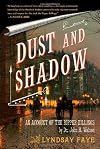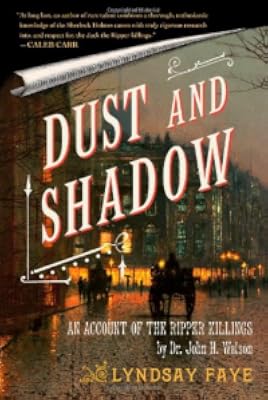
Dust and Shadow: An Account of the Ripper Killings by Dr. John H. Watson
by Lyndsay Faye
On This Page
Description
Breathless and painstakingly researched, this is a stunning debut mystery in which Sherlock Holmes unmasks Jack the Ripper. Lyndsay Faye perfectly captures all the color and syntax of Conan Doyle's distinctive nineteenth-century London.In Dust and Shadow, Sherlock Holmes hunts down Jack the Ripper—the world's first serial killer—with impeccably accurate historical detail and without the advantage of modern forensics or profiling. Sherlock's desire to stop the killer who is terrifying show more the East End of London is unwavering from the start, and in an effort to do so he hires an "unfortunate" known as Mary Ann Monk, the friend of a fellow streetwalker who was one of the Ripper's earliest victims. However, when Holmes himself is wounded in Whitechapel attempting to catch the villain, and a series of articles in the popular press question his role in the crimes, he must use all his resources in a desperate race to find the man known as "The Knife" before it is too late.
Penned as a pastiche by the loyal and courageous Dr. Watson, this debut signals the arrival of a tremendous talent in the mystery and historical fiction genres.
. show less
Tags
Recommendations











Member Reviews
It has occurred to me lately that I might like a good Holmes pastiche more than I like the original stories. This feels almost sacreligious but, there it is all the same.
This one (from my Sherlockian non-expert and American point of view) stayed fairly true to the writing style and characterizations of the canon, but with some elements thrown in that would never have made it into anything by ACD. I like to think this represents Dr. Watson's first draft (I believe he mentions he doesn't mean it for publication) - and that all of his published cases started out in a similar way, to be cleaned up before passing along to The Strand Magazine.
Now must read more by [a:Lyndsay Faye|1894025|Lyndsay show more Faye|https://images.gr-assets.com/authors/1317684103p2/1894025.jpg]. show less
This one (from my Sherlockian non-expert and American point of view) stayed fairly true to the writing style and characterizations of the canon, but with some elements thrown in that would never have made it into anything by ACD. I like to think this represents Dr. Watson's first draft (I believe he mentions he doesn't mean it for publication) - and that all of his published cases started out in a similar way, to be cleaned up before passing along to The Strand Magazine.
Now must read more by [a:Lyndsay Faye|1894025|Lyndsay show more Faye|https://images.gr-assets.com/authors/1317684103p2/1894025.jpg]. show less
As an avid Sherlock Holmes fan, I've found myself disappointed one too many times with modern SH novels. They all seem to lack that certain something, that ability to make you believe you've just time travelled back to late Victorian London, about to pay a visit to Baker Street. They may try, but they don't quite make it.
This isn't to say that these authors don't have talent as mystery writers, just that they don't seem to get it right when it comes to portraying the great detective. Something's missing. But when I took a gamble on Lyndsay Faye's "Dust and Shadow", I soon discovered I'd found it!
Reading her novel is so like reading a book by Doyle, it makes me wonder if she had a genuine ghost writer, perhaps Sir Arthur paid her a show more visit from the afterlife and they collaborated? She just gets it right, without a sense that she's putting effort into it, just flows naturally. Our old friend Dr. Watson is back, not as a pale imitation (which is all too often the case), but as Doyle meant him to be. Ms. Faye has captured - both in narrative and dialog - the style of Doyle with a lightness and ease, so you never feel she's trying too hard. She just naturally got it right.
Ms. Faye did plenty of research, as she went into detail about the cases and lives of the victims, and even linked a separate murder case, with very convincing evidence. Her solution to the Ripper killings was also very probable, one that I hadn't thought of before, but which now makes me wonder.
The novel starts with an earlier case of Holmes' being wrapped up, he solves the puzzle and then the new adventure begins. This gives a feeling of continuity, as if you were watching this on TV and getting the highlights last week's episode before this week's starts. I found that very effective in setting up the proper atmosphere.
This book would have made one terrific TV movie, back in the Jeremy Brett and David Burke days, my favorite Holmes/Watson team.
"Dust and Shadow" gets a well deserved five stars! show less
This isn't to say that these authors don't have talent as mystery writers, just that they don't seem to get it right when it comes to portraying the great detective. Something's missing. But when I took a gamble on Lyndsay Faye's "Dust and Shadow", I soon discovered I'd found it!
Reading her novel is so like reading a book by Doyle, it makes me wonder if she had a genuine ghost writer, perhaps Sir Arthur paid her a show more visit from the afterlife and they collaborated? She just gets it right, without a sense that she's putting effort into it, just flows naturally. Our old friend Dr. Watson is back, not as a pale imitation (which is all too often the case), but as Doyle meant him to be. Ms. Faye has captured - both in narrative and dialog - the style of Doyle with a lightness and ease, so you never feel she's trying too hard. She just naturally got it right.
Ms. Faye did plenty of research, as she went into detail about the cases and lives of the victims, and even linked a separate murder case, with very convincing evidence. Her solution to the Ripper killings was also very probable, one that I hadn't thought of before, but which now makes me wonder.
The novel starts with an earlier case of Holmes' being wrapped up, he solves the puzzle and then the new adventure begins. This gives a feeling of continuity, as if you were watching this on TV and getting the highlights last week's episode before this week's starts. I found that very effective in setting up the proper atmosphere.
This book would have made one terrific TV movie, back in the Jeremy Brett and David Burke days, my favorite Holmes/Watson team.
"Dust and Shadow" gets a well deserved five stars! show less
Of all the Sherlock Holmes homages I've read, this does the best job of replicating the form and style of Conan Doyle. I like most updated, modernized, "new-spin-on" versions; I really liked The Seven-Per-Cent Solution. But when I've just reread some Conan Doyle and find myself wishing for just more of the same, some clever new take on Sherlock simply won't do. I can only hope that Lyndsay Faye comes up with a new Holmes mystery every few years to satisfy my craving for authentic Sherlock Holmes!
This is a Sherlock Holmes "pastiche" novel by Lyndsay Faye which pits Sherlock Holmes against Jack the Ripper. I was actually in the mood for a nonfiction treatment and got this by mistake. While the book is Faye's first novel, it has the blessing of Sir Arthur Conan Doyle's heirs so I gave it a try. I was very well pleased. I am know Holmes fanatic or amateur ripperologies, so I am sure puritans in either camp may have nits to pick. I found it a well-narrated (Simon Vance Narrator). The text itself is from Watson's P.O.V. narrating as Holmes' "biographer" and I picture the Law-Downey pairing from the Guy Ritchie movies. The story has goods twists and turns with Holmes getting closer to the investigation then he wants - as a suspect, as show more a casualty and all too close on the trail. In an alternate reality, this historical novel brings key elements known as the extracted organs, a leather apron, the quick work uncovered by a patrolling constable ( see here) and more all pointing to an inside job by the police in this imagined resolution. show less
It is inevitable that writers feel a deep-seated urge to pit Sherlock Holmes against Jack the Ripper. The murders happened in the midst of Holmes's career; his contemporary readership must have wished he could step out of the pages and hunt down their nightmare for them. So it's no surprise that this is not the first time the idea has been pursued; there have been a couple of films (Murder by Decree with Christopher Plummer and James Mason as Holmes and Watson, and A Study in Terror), a handful of other books (including Michael Dibdin's The Last Sherlock Holmes Story), and a video game. This was my first foray into the mashup.
Half an hour into the audiobook, I had small doubts. Holmes and Watson both faithfully give their solemn word show more that they will never reveal the details of the case the story starts with … but the concept is that the book is one of Watson's memoirs (albeit one he leaves sealed). It seems a bit odd that he'd even write the story down. I wasn't fond of this beginning, this prologue, wondering why it was starting there, with such an extended look at another case … until nearly the very end, when the reason for starting there becomes clear and it all just adds to the brilliance of the book.
First of all, as I commented somewhere, if Simon Vance narrated all audiobooks I would never read another page for myself again. I love this performance – every character is dead on: Watson, warm and a little dusty; Holmes, the famous clear strong tenor; Miss Monk, believably feminine and East End without going falsetto Eloiza Doolittle. And the Welsh accents just made me happy. All the accents made me happy. The reading was a joy.
I loved the Doyle-esque "Several highly publicized investigations that year displayed Holmes's remarkable skills to the public, including the appalling affair of the faulty oil lamp, and the matter of Mrs. Victoria Mendoza's mysteriously vanishing thimble and its consequences." Shades of the Giant Rat of Sumatra … Although perhaps Ms. Faye can be prevailed upon to do what Doyle never did, and give us those stories. (Along with "the affair of the second cellist".) I live in hopes that this is only the first of a new Holmes series.
There was, it seems, an innocence that was lost when Jack the Ripper began his work. It's hard to fathom that before 1888 ordinary folk could not conceive of such atrocities – or at least this is the sentiment Lyndsay Faye puts into the mouths of the gentlemen set to pursue the monster, from Holmes to the lowliest constable. Now, with 24-hour news and CSI and Criminal Minds and true crime novels, it's sadly hard to conceive of such a sweet time. There had been serial killers before the Ripper, but through some confluence of the media and the infancy of modern investigative techniques he became the first one to cause such a tremendous flurry, the first one to make the history books.
It's been some time since I read the actual original stories, but not so much time since I watched the wonderful current BBC series, and something that strikes me throughout Dust and Shadow is that this Holmes is much nicer than Benedict Cumberbatch's. He is much freer in his friendship with Watson than I was expecting – this Holmes is less "sociopathic genius with absolutely no social skills" than "so much smarter than everyone else there's no point in talking to them, with the exception of Watson". He placates Mrs. Hudson and pours tea for his friend and everything.
And this pastiche makes me want to go back and read all of the original work soon (had I world enough, and time). The characterizations of Holmes and Watson, and also LeStrade, are so engaging that part of me wants to hold them up against the originals. The tone of the writing feels very genuinely Watsonian. (Quotes are a right pain to make note of in the audio format – I usually hear lines I wish I could make note of while driving – but there have been several descriptive flourishes which made me smile at their Victorian purple tinge. Ah, there's one: "shafts of lunar illumination": beautiful) This is a Watson I want on my side, a Watson I want more of, staunch and solid and not remotely stupid. I love this Watson.
And I love this Holmes. A great deal of it is, of course, the really gorgeous tone of the narrator – his Holmes just rings out, clarion. But this is a Holmes that fits the template in my head: he feels right. This is one of the reasons I keep reading fan-fiction and pastiche and media tie-ins despite all the garbage that brings: when it's bad it's unconscionable, but when it's good – when the writer captures the voice of a well-known and well-loved character - it's so very much fun.
I also enjoyed the new part-time member of the team, Miss Mary Ann Monk. She's thisclose to being a cliché – but Lyndsay Faye pulls off a young woman toward whom it seems Watson and Holmes both harbor fondness, and indeed admiration – and I don't mind. Non-canon romance, liaisons outside of the bounds of the Official Story, is usually something that raises my hackles, but I found myself mentally nudging one or the other of the duo her way.
I think the only fault I can possibly find is that there's not enough Mrs. Hudson. I can live with it. And honestly, the use of Mrs. Hudson – particularly at the end – was wonderful. So … not a fault, after all.
There is a comeuppance that is received a good ways into the book which was one of the most satisfying examples of just deserts ever. And the final confrontation hit all the right notes. And that's all I'll say about that.
Being me, I looked up Ripper history. Lyndsay Faye was completely faithful to it up to the point of Holmes's growing involvement, and in fact wove him into the reality with enviable skill. And part of the brilliance of this book is the life breathed into a one hundred and twenty-four year old story: new suspense is added with the question of how it would play out. Would Holmes manage to save any of the victims? How would his involvement affect the sequence of events? Would the inconclusive end – the Ripper kills just ending with no real explanation – be worked into the tale? I can't really answer the questions without massive spoilers, so instead I will say simply this:
*standsup*clap*clap*clap*clap* show less
Half an hour into the audiobook, I had small doubts. Holmes and Watson both faithfully give their solemn word show more that they will never reveal the details of the case the story starts with … but the concept is that the book is one of Watson's memoirs (albeit one he leaves sealed). It seems a bit odd that he'd even write the story down. I wasn't fond of this beginning, this prologue, wondering why it was starting there, with such an extended look at another case … until nearly the very end, when the reason for starting there becomes clear and it all just adds to the brilliance of the book.
First of all, as I commented somewhere, if Simon Vance narrated all audiobooks I would never read another page for myself again. I love this performance – every character is dead on: Watson, warm and a little dusty; Holmes, the famous clear strong tenor; Miss Monk, believably feminine and East End without going falsetto Eloiza Doolittle. And the Welsh accents just made me happy. All the accents made me happy. The reading was a joy.
I loved the Doyle-esque "Several highly publicized investigations that year displayed Holmes's remarkable skills to the public, including the appalling affair of the faulty oil lamp, and the matter of Mrs. Victoria Mendoza's mysteriously vanishing thimble and its consequences." Shades of the Giant Rat of Sumatra … Although perhaps Ms. Faye can be prevailed upon to do what Doyle never did, and give us those stories. (Along with "the affair of the second cellist".) I live in hopes that this is only the first of a new Holmes series.
There was, it seems, an innocence that was lost when Jack the Ripper began his work. It's hard to fathom that before 1888 ordinary folk could not conceive of such atrocities – or at least this is the sentiment Lyndsay Faye puts into the mouths of the gentlemen set to pursue the monster, from Holmes to the lowliest constable. Now, with 24-hour news and CSI and Criminal Minds and true crime novels, it's sadly hard to conceive of such a sweet time. There had been serial killers before the Ripper, but through some confluence of the media and the infancy of modern investigative techniques he became the first one to cause such a tremendous flurry, the first one to make the history books.
It's been some time since I read the actual original stories, but not so much time since I watched the wonderful current BBC series, and something that strikes me throughout Dust and Shadow is that this Holmes is much nicer than Benedict Cumberbatch's. He is much freer in his friendship with Watson than I was expecting – this Holmes is less "sociopathic genius with absolutely no social skills" than "so much smarter than everyone else there's no point in talking to them, with the exception of Watson". He placates Mrs. Hudson and pours tea for his friend and everything.
And this pastiche makes me want to go back and read all of the original work soon (had I world enough, and time). The characterizations of Holmes and Watson, and also LeStrade, are so engaging that part of me wants to hold them up against the originals. The tone of the writing feels very genuinely Watsonian. (Quotes are a right pain to make note of in the audio format – I usually hear lines I wish I could make note of while driving – but there have been several descriptive flourishes which made me smile at their Victorian purple tinge. Ah, there's one: "shafts of lunar illumination": beautiful) This is a Watson I want on my side, a Watson I want more of, staunch and solid and not remotely stupid. I love this Watson.
And I love this Holmes. A great deal of it is, of course, the really gorgeous tone of the narrator – his Holmes just rings out, clarion. But this is a Holmes that fits the template in my head: he feels right. This is one of the reasons I keep reading fan-fiction and pastiche and media tie-ins despite all the garbage that brings: when it's bad it's unconscionable, but when it's good – when the writer captures the voice of a well-known and well-loved character - it's so very much fun.
I also enjoyed the new part-time member of the team, Miss Mary Ann Monk. She's thisclose to being a cliché – but Lyndsay Faye pulls off a young woman toward whom it seems Watson and Holmes both harbor fondness, and indeed admiration – and I don't mind. Non-canon romance, liaisons outside of the bounds of the Official Story, is usually something that raises my hackles, but I found myself mentally nudging one or the other of the duo her way.
I think the only fault I can possibly find is that there's not enough Mrs. Hudson. I can live with it. And honestly, the use of Mrs. Hudson – particularly at the end – was wonderful. So … not a fault, after all.
There is a comeuppance that is received a good ways into the book which was one of the most satisfying examples of just deserts ever. And the final confrontation hit all the right notes. And that's all I'll say about that.
Being me, I looked up Ripper history. Lyndsay Faye was completely faithful to it up to the point of Holmes's growing involvement, and in fact wove him into the reality with enviable skill. And part of the brilliance of this book is the life breathed into a one hundred and twenty-four year old story: new suspense is added with the question of how it would play out. Would Holmes manage to save any of the victims? How would his involvement affect the sequence of events? Would the inconclusive end – the Ripper kills just ending with no real explanation – be worked into the tale? I can't really answer the questions without massive spoilers, so instead I will say simply this:
*standsup*clap*clap*clap*clap* show less
For a debut novel, this book was OK. Yes, I said OK as I had a love hate relationship with this book from the very first chapter.
For anyone to take on writing about the characters of Sherlock Holmes and Dr. Watson takes guts, but if it is pulled off well as in the case of the [b:The House of Silk: A Sherlock Holmes Novel|11093329|The House of Silk A Sherlock Holmes Novel|Anthony Horowitz|https://d.gr-assets.com/books/1327877129s/11093329.jpg|16015218] it can be a glorious thing, that was not the case here. Despite a valiant effort, this Author was unable to capture all the character nuances that combine to make the detective readers of other Holmes missives have come to know and expect. By writing the book from the perspective of Dr. show more Watson a lot of the internal debates and musings Holmes has with himself are lost along with a lot of his eccentric qualities. In this book Holmes comes across as an arrogant, pretentious ass that has no lovable qualities to his name at all. Unfortunately, Dr. Watson does not come out of this novel unscathed; as a character I’ve always seen as being the stable and steadying force behind Holmes, here he is depicted as bumbling fool who would be well pressed to dress himself in the morning. The portrayal of Jack the Ripper was also flimsy, and would have benefitted greatly with a lot more fleshing out and back story.
The novel is extremely dry, the language at times definitely at odds with the era in which it is set. The Author does a good job of portraying Whitechapel at the time of the murders but apart from that there was very little to keep me interested, and this was definitely not the page turner that had been promised. For me there was not enough tension, and the discovery of who the Ripper was became obvious about partway through the book; surely not a mystery worthy of calling in Holmes to solve.
If you like Sherlock Holmes, you may enjoy this book; as for me I don’t think I will be reading anymore by this Author despite their valiant attempts to recreate the works of Arthur Conan Doyle.
Originally reviewed on: http://catesbooknuthut.com/2015/02/09/review-dust-and-shadow-an-account-of-the-r...
This work is licensed under a Creative Commons Attribution-NonCommercial-NoDerivs 3.0 Unported License. show less
For anyone to take on writing about the characters of Sherlock Holmes and Dr. Watson takes guts, but if it is pulled off well as in the case of the [b:The House of Silk: A Sherlock Holmes Novel|11093329|The House of Silk A Sherlock Holmes Novel|Anthony Horowitz|https://d.gr-assets.com/books/1327877129s/11093329.jpg|16015218] it can be a glorious thing, that was not the case here. Despite a valiant effort, this Author was unable to capture all the character nuances that combine to make the detective readers of other Holmes missives have come to know and expect. By writing the book from the perspective of Dr. show more Watson a lot of the internal debates and musings Holmes has with himself are lost along with a lot of his eccentric qualities. In this book Holmes comes across as an arrogant, pretentious ass that has no lovable qualities to his name at all. Unfortunately, Dr. Watson does not come out of this novel unscathed; as a character I’ve always seen as being the stable and steadying force behind Holmes, here he is depicted as bumbling fool who would be well pressed to dress himself in the morning. The portrayal of Jack the Ripper was also flimsy, and would have benefitted greatly with a lot more fleshing out and back story.
The novel is extremely dry, the language at times definitely at odds with the era in which it is set. The Author does a good job of portraying Whitechapel at the time of the murders but apart from that there was very little to keep me interested, and this was definitely not the page turner that had been promised. For me there was not enough tension, and the discovery of who the Ripper was became obvious about partway through the book; surely not a mystery worthy of calling in Holmes to solve.
If you like Sherlock Holmes, you may enjoy this book; as for me I don’t think I will be reading anymore by this Author despite their valiant attempts to recreate the works of Arthur Conan Doyle.
Originally reviewed on: http://catesbooknuthut.com/2015/02/09/review-dust-and-shadow-an-account-of-the-r...
This work is licensed under a Creative Commons Attribution-NonCommercial-NoDerivs 3.0 Unported License. show less
It is August 1888, and a young woman has been stabbed to death in the warrens of Whitechapel, London, but Holmes only pays the newspaper report the most cursory interest. This changes completely when a second victim is found in the district a few weeks later, having been nearly eviscerated. Sherlock Holmes, together with his friend Dr Watson, and being ably assisted by Mary Ann Monk, a young woman fallen on hard times, takes on the case and realises that the killer has turned the Whitechapel murders into a very personal game of cat and mouse.
Lyndsay Faye, a self-confessed Sherlock Holmes aficionado, nails the tone of Conan Doyle's stories and if the pace is somewhat slow to begin with, I feel this is the result of Watson's measured show more biography, not a fault of the plotting. She makes the cross-over between Sherlock Holmes and Jack the Ripper entirely plausible and comes up with her own unique solution, which I didn't see coming until Holmes reveals all to his small circle of confidantes, a solution which is convincing, although I can't quite follow the culprit's motivation, but for a small detail:the killer reveals that he worked with Holmes and Watson on the case mentioned in the prologue, and yet both fail to recognise him; this is the more astonishing as Holmes never seems to forget a face, even if the meeting occurs in passing, like when he recalls having seen Stephen Dunlevy's face in front of the Lambeth Workhouse .
Faye has done her research extremely well, both in terms of Ripperology and local parlance of the time, and the way she mixes established facts of the original investigation and fictional elements makes the novel feel entirely authentic, so that fact and fiction become blurred (something I initially viewed as fiction turned out to be true). The descriptions of the victim's terrible injuries lose nothing of their harrowing impact, even though (or especially because) they are given in Watson's careful and caring prose. The reader gets an impression of the mass panic and general air of suspicion that must have gripped not only the East End, but all of London, and the descriptions of the East End districts of Whitechapel, Spitalfields and Limehouse bring across the area's overpopulation, poverty and cramped topography extremely well, especially as they are set in contrast to the affluent West End surroundings where Holmes and Watson live. To think that this was her debut novel is astonishing. show less
Lyndsay Faye, a self-confessed Sherlock Holmes aficionado, nails the tone of Conan Doyle's stories and if the pace is somewhat slow to begin with, I feel this is the result of Watson's measured show more biography, not a fault of the plotting. She makes the cross-over between Sherlock Holmes and Jack the Ripper entirely plausible and comes up with her own unique solution, which I didn't see coming until Holmes reveals all to his small circle of confidantes, a solution which is convincing, although I can't quite follow the culprit's motivation, but for a small detail:
Faye has done her research extremely well, both in terms of Ripperology and local parlance of the time, and the way she mixes established facts of the original investigation and fictional elements makes the novel feel entirely authentic, so that fact and fiction become blurred (something I initially viewed as fiction turned out to be true). The descriptions of the victim's terrible injuries lose nothing of their harrowing impact, even though (or especially because) they are given in Watson's careful and caring prose. The reader gets an impression of the mass panic and general air of suspicion that must have gripped not only the East End, but all of London, and the descriptions of the East End districts of Whitechapel, Spitalfields and Limehouse bring across the area's overpopulation, poverty and cramped topography extremely well, especially as they are set in contrast to the affluent West End surroundings where Holmes and Watson live. To think that this was her debut novel is astonishing. show less
Members
- Recently Added By
Author Information

14+ Works 5,355 Members
Some Editions
Common Knowledge
- Original publication date
- 2009
- People/Characters
- Jack the Ripper; Sherlock Holmes; John H. Watson; Mary Ann Monk; Inspector G. Lestrade; Mrs. Hudson (show all 19); Inspector Fry; Major Henry Smith; Leslie Tavistock; Stephen Dunlevy; George Lusk; Sir Charles Warren; Mycroft Holmes; Rowland K. Vandervent; Dr Moore Agar; Dr Llewellyn; Matthew Packer; Young Hawkins; Man Jack Hawkins
- Important places
- London, England, UK
- Important events
- Whitechapel Murders (1888)
- Dedication
- For Jim LeMonds
and his Five Easy Pieces - First words
- At first it seemed the Ripper affair had scarred my friend Sherlock Holmes as badly as it had the city of London itself.
Prologue: February 1887. "My dear Doctor, I fear that I shall require your services this evening."
Chapter 1: It has been argued by those who have so far flattered my attempts to chronicle the life and career of Mr. Sherlock Holmes as to approach them in a scholarly manner that I have often been remiss in the arena of pre... (show all)cise chronology. - Last words
- (Click to show. Warning: May contain spoilers.)"Hadn't he?" Holmes smiled. "Then I suppose you'll have to do in his stead; you've a penchant for the dramatic as well. Let me know when you've worked out something better. Come along, my dear fellow." He disappeared down the stairs.
- Publisher's editor
- Kolen, Kerri
- Blurbers
- Klinger, Leslie S.; Conan Doyle Estate; Carr, Caleb; Pearl, Matthew; Margolin, Phillip; Stashower, Daniel
- Original language
- English US
Classifications
Statistics
- Members
- 815
- Popularity
- 34,065
- Reviews
- 41
- Rating
- (3.98)
- Languages
- English, French
- Media
- Paper, Audiobook, Ebook
- ISBNs
- 14
- ASINs
- 9