On This Page
Description
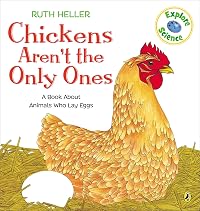
A pictorial introduction to the animals that lay eggs, including chickens as well as other birds, reptiles, amphibians, fishes, insects, and even a few mammals.Tags
Recommendations












Member Reviews
This charming book introduces children to the diversity of animals that lay eggs. Beginning with chickens (since children will know about them), the book turns to other birds, then to eggs of reptiles, including dinosaurs. And in succeeding pages the book explores egg-laying in amphibians, fishes (including those such as sea-horses, with paternal care), then various invertebrates (snail, octopus, insects), and among mammals, the echidna and platypus. The text is written in rhyme, and accompanied by magnificent color drawings. This attractive book is a likely favorite for children. I liked it too, and have just ordered the sequel on live-bearing animals.
This is a great book. It starts off very simple, talking about how chickens lay eggs. From there it jumps off into a widespread study of zoology, looking at oviparous animals in all their diversity. This is an amazing way to connect so many different kind of animals, the simple fact that they all lay eggs. I’m sure after reading this book, kids will have new favorite animals and lots of “did-you-know” factoids to share with others. It even ends in a way that invites further investigation, talking about how all the animals who don’t lay eggs have live births, “…but that’s another story to tell.” Definitely a keeper for any classroom
I disliked this book for three main reasons, the information was poorly organized and lacked flow, the text and images were cluttered and the information gets off topic. The book is intended to be an informational text about animals that lay eggs also known as Oviparous. Although the text remained on topic the placement of the written text on the page is inconsistent and seems to be placed to randomly on every page. On one page a very large illustration of a peacock is displays and the text is squished in the lower left hand corner, difficult to notice. The inconsistent placement of the words in the text negatively effected my reading flow and concentration. Although I am a fan of well created illustrations the ones used in this book show more were scattered randomly or a bit over whelming for my taste. Some pages remained simple and illustrated the animal and its eggs while other pages added extra semi related images that covers the page. Sometimes less is more when working with informational text and illustration. Lastly I was confused by the shift in topic throughout the book. In the beginning the author just named the animals and species that lay eggs, but as the story progressed the author mentions the carrying and protection of the eggs for some species but not all. In order to be a well flowing text i feel as if it is crucial to remain on the topic of oviparous animals rather than breaking off into subsets of egg care. With a few organizational tools and refocusing on the animals that lay eggs, this text could be more appealing. show less
This book is a factual and informational text. It is written for young children, mostly in primary grades. The beginning of the book discusses how chickens are not the only ones that lay eggs. The author, Heller, explains that there are many more animals that lay eggs. For instance, she mentions snakes, crocodiles, frogs, etc. She describes the different animals that live in water and ones that fly through the air. I really liked this book because the illustrations are beautiful and it covers a vast amount of animals. It also has great vocabulary included, such as insects, amphibians, and even describes what a chrysalis is, in relation to butterflies.This would be integrated into a fun lesson about zoology. I think it could be connected show more to some fun activities and/or field trips. show less
This book is a fun-filled book about all the different animals that lay eggs. It gives facts in a way that is very enjoyable to read. It starts out about chickens and works its way through many differnet animals such as the frogs and dinosaurs.
I thought this book was great, because it was full of facts. But it was so much fun for me to read. I am defenitely going to add this book to my classroom collection.
As a classroom extension i am going to have my students create differnt types of eggs we discovered throughout this book out of art supplies. Another one is this is going to become a classroom bullentin board and my students are going to get to add creatures that they know of that lay eggs to our board.
I thought this book was great, because it was full of facts. But it was so much fun for me to read. I am defenitely going to add this book to my classroom collection.
As a classroom extension i am going to have my students create differnt types of eggs we discovered throughout this book out of art supplies. Another one is this is going to become a classroom bullentin board and my students are going to get to add creatures that they know of that lay eggs to our board.
This is a wonderful story about oviparous creatures that live on earth. "Chickens aren't the Only Ones" refers to those who lay eggs and those who don't. This colorful book has many pictures that are useful for the reader when trying to identify different species of animals. I like that this is part of a series that focuses on nature, it is important for children to become familiar with the world around them. The text in this book is also laid out in an artful way that makes it more fun to read. I think this is a great book and it would make a wonderful addition to any classroom.
I love how it goes through all the animals that lay eggs including the duck billed platypus and echidna. It helps children understand that chickens aren't the only animals to lay eggs even though we mostly only eat chicken eggs.
Members
- Recently Added By
Lists

Reading Rainbow
193 works; 10 members

Books Read in 2022
5,226 works; 112 members

Children's Picture Books
188 works; 1 member
Author Information

82+ Works 20,295 Members
Some Editions
Awards and Honors
Distinctions
Series

Common Knowledge
- Original publication date
- 1981
- Dedication
- My special thanks to Margaret G. Bradbury, Ph.D. Professor of Biology San Francisco State University
- First words
- Chickens lay the eggs you buy, the eggs you boil or fry or... dye! or leave alone so you can see what grew inside naturally.
- Last words
- (Click to show. Warning: May contain spoilers.)Animals who don't lay eggs have babies born alive and well, but that's another tale to tell.
- Original language
- English
Classifications
Statistics
- Members
- 2,689
- Popularity
- 6,937
- Reviews
- 20
- Rating
- (4.17)
- Languages
- English, French, Spanish
- Media
- Paper, Audiobook
- ISBNs
- 27
- UPCs
- 1
- ASINs
- 9