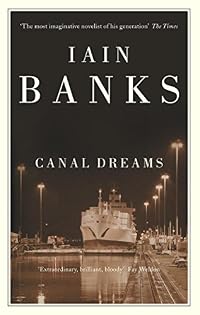
Canal Dreams
by Iain Banks
On This Page
Description
Hisako Onoda, world famous cellist, refuses to fly. And so she travels to Europe as a passenger on a tanker bound through the Panama Canal. But Panama is a country whose politics are as volatile as the local freedom fighters. When Hisako's ship is captured, it is not long before the atmosphere is as flammable as an oxy-acetylene torch, and the tension as sharp as the spike on her cello... CANAL DREAMS is a novel of deceptive simplicity and dark, original power: stark psychological insights show more mesh with vividly realised scenarios in an ominous projection of global realpolitik. The result is yet another major landmark in the quite remarkable career of an outstanding modern novelist. show lessTags
Recommendations
















Member Reviews
Cellist Hisako Onado embarks on a of Europe tour, but due to her intense fear of flying has to travel from Japan by ship. En route through the Panama Canal, the ship finds itself stranded due to political upheaval in Panama. Hisako and the community that has built up across three stranded vessels get down to the serious business of relaxing, with scuba diving, parties and shared meals on the itinerary. But, then things turn dark as heavily armed terrorists take control and hold Hisako and her companions as hostages.
I am a long time fan of Iain Banks in both of his incarnations (Iain M being the SF entity) and I've miss the annual treat of a new novel since his untimely death.Since Christmas I've been giving some of them a long overdue show more re-read. If I had to choose my favourite Banks book I think I'd be hard-pushed to identify it, but Canal Dreams is right up there. This is a fantastic bit of writing which blends the early years of Hisako and her development as a musician, with the description of life on the canal and suddenly explodes into the most marvellous, almost comedic at times, sequence of ultraviolence to round it off. I've read this one maybe six times now and I find something new in it every time. show less
I am a long time fan of Iain Banks in both of his incarnations (Iain M being the SF entity) and I've miss the annual treat of a new novel since his untimely death.Since Christmas I've been giving some of them a long overdue show more re-read. If I had to choose my favourite Banks book I think I'd be hard-pushed to identify it, but Canal Dreams is right up there. This is a fantastic bit of writing which blends the early years of Hisako and her development as a musician, with the description of life on the canal and suddenly explodes into the most marvellous, almost comedic at times, sequence of ultraviolence to round it off. I've read this one maybe six times now and I find something new in it every time. show less
Due to her fear of flying, famous Japanese cellist Hisako Onoda opted to travel to Europe by ship for her European debut tour. However, at a stop in Panama, the ship is held up and caught in the middle of a civil war. At first it seems that the delay will be no more than an inconvenience, possibly necessitating the rescheduling of a few concert dates. But the situation rapidly declines, going from bad to worse...
The story is interspersed with surreal and ominous dream sequences, and flashbacks that explore Hisako's (rather unhappy) life, revealing some unexpected dark secrets...
Beautiful language, explicit violence, and philosophical exploration of situations and motivations are all hallmarks of Banks' writing. Nice, subtle use of show more foreshadowing, too.
Stylistically (& topically) it reminded me quite a bit of J.G. Ballard.
It seems a lot of people (Banks fans) don't really have this as one of their favorites - I'm not sure why. I did think it was a really excellent book.
Banks is one of my favorite current authors (I like both his sf & 'mainstream' fiction), and again, this book did not disappoint. show less
The story is interspersed with surreal and ominous dream sequences, and flashbacks that explore Hisako's (rather unhappy) life, revealing some unexpected dark secrets...
Beautiful language, explicit violence, and philosophical exploration of situations and motivations are all hallmarks of Banks' writing. Nice, subtle use of show more foreshadowing, too.
Stylistically (& topically) it reminded me quite a bit of J.G. Ballard.
It seems a lot of people (Banks fans) don't really have this as one of their favorites - I'm not sure why. I did think it was a really excellent book.
Banks is one of my favorite current authors (I like both his sf & 'mainstream' fiction), and again, this book did not disappoint. show less
Banks becomes more annoying even as I continue to admire his storytelling. In Canal Dreams, there is a haunting portrayal of the central character of Hisako Onoda, who becomes more complex and hence more likeable and interesting as the facets of her life are revealed bit by bit. Apart from Banks' by now stereotypical portrayal of the carefree sex life of a dominant female character (which in itself is a good thing, and yet I can't help feeling there's something not quite right about Banks' return to such characters) we have someone who we care about as a reader, and we care about the people around her and her interactions with them. But at the end a serious of monstrous wrongs are perpetrated and a complete and destructive revenge is show more wreaked. And I'm left wondering what the point of it all is. I don't mind bleak books and I don't demand happy endings but this just feels amoral somehow. show less
It seems to be a love it or hate it, and having read it I now see why. I liked it a lot, but I'm not sure that I'll re-read it.
The surface story is simple enough -- a famous cellist goes on a world tour by ship, because she is so phobic about flying she can't bear to step on a plane. Her ship is caught up in a civil war as it passes through the Panama Canal. Initially there is nothing but tedium, as three stranded ships huddle together for safety -- tedium, and for Hisako the chance of a love affair with an officer from one of the other ships. But then the boats are seized by a group intent on using them in an escalation of the war that has until now not directly touched them. There follows a slow study of the psychology of a hostage show more situation where the hostages are initially well-treated, and then the explosion into violence when the hostages' usefulness comes to an end.
But more than that, it is a study of how someone who suffers from a severe phobia need not be a coward in other things. Hisako remains passive while there are other lives at stake; but the hostage takers fatally underestimate a woman who has more than music in her troubled past.
It's short, dark, and a quite frank revenge fantasy. It's not the best of Banks' work, but if you like his books it's worth trying.
Comments thread: http://julesjones.livejournal.com/122207.html show less
The surface story is simple enough -- a famous cellist goes on a world tour by ship, because she is so phobic about flying she can't bear to step on a plane. Her ship is caught up in a civil war as it passes through the Panama Canal. Initially there is nothing but tedium, as three stranded ships huddle together for safety -- tedium, and for Hisako the chance of a love affair with an officer from one of the other ships. But then the boats are seized by a group intent on using them in an escalation of the war that has until now not directly touched them. There follows a slow study of the psychology of a hostage show more situation where the hostages are initially well-treated, and then the explosion into violence when the hostages' usefulness comes to an end.
But more than that, it is a study of how someone who suffers from a severe phobia need not be a coward in other things. Hisako remains passive while there are other lives at stake; but the hostage takers fatally underestimate a woman who has more than music in her troubled past.
It's short, dark, and a quite frank revenge fantasy. It's not the best of Banks' work, but if you like his books it's worth trying.
Comments thread: http://julesjones.livejournal.com/122207.html show less
World famous cellist Hisako Onoda is terrified of flying. Building her career on recordings and performances in her native Japan, her manager has now finally talked her into doing an extensive European tour. Hisako’s condition is that she goes to Europe by boat. As a passenger on a tanker however, going through the Panama canal, she gets caught up in the country’s political instability. Due to the rebellion of the leftist venceristas, ships are unable to go safely through the canal, and violent riots in the capital make it dangerous to go back there. Hers and two other ships are forced to wait out the unrest in lake Gatún. The few passengers and many crew of the three ships are in a sort of limbo, spending their days with dinner show more parties and scuba diving, while frantic international efforts are made to solve this tense clogging of one of the most important routes in the world.
Of course the ships are taken over by armed men one night. And of course things turn extremely ugly.
It’s pretty interesting what Banks is trying to do here, taking the action film cliché of the lone avenger and telling it as a real story happening to real people. Hisako’s inner journey is interesting to follow, as we descend with her into blind, numb determination. The result is a brutal book indeed – there’s nothing gratifying or liberating about the violence here. I think Banks should also be given credit for being among the very few male authors who often chooses to write female protagonists. I of course have no idea how believable Hisako is to a (Japanese) woman reading her story, but Banks feels very comfortable in giving her voice. It’s sad that this should be such a rare thing.
Iain Banks (with or without M.) is probably my favourite hit-and-miss writer. When he’s good, he’s brilliant. Unfortunately, this book, like several others by him, has a great premise but suffers from lack of dramaturgy. The episodes from Hisako’s past, while often fascinating and moving in themselves, never have any relevance in the book’s present. They remain isolated events, unconnected glimpses. And the ending is blunt and lacking conclusion, making the whole book feel just a little speculative. show less
Of course the ships are taken over by armed men one night. And of course things turn extremely ugly.
It’s pretty interesting what Banks is trying to do here, taking the action film cliché of the lone avenger and telling it as a real story happening to real people. Hisako’s inner journey is interesting to follow, as we descend with her into blind, numb determination. The result is a brutal book indeed – there’s nothing gratifying or liberating about the violence here. I think Banks should also be given credit for being among the very few male authors who often chooses to write female protagonists. I of course have no idea how believable Hisako is to a (Japanese) woman reading her story, but Banks feels very comfortable in giving her voice. It’s sad that this should be such a rare thing.
Iain Banks (with or without M.) is probably my favourite hit-and-miss writer. When he’s good, he’s brilliant. Unfortunately, this book, like several others by him, has a great premise but suffers from lack of dramaturgy. The episodes from Hisako’s past, while often fascinating and moving in themselves, never have any relevance in the book’s present. They remain isolated events, unconnected glimpses. And the ending is blunt and lacking conclusion, making the whole book feel just a little speculative. show less
This was an audiobook and, perhaps not coincidentally, I found it the least engaging of Iain Banks' books that I have read to date. It was worth the effort and there are some captivating moments, but somehow the arc of the story never really gripped me.
This had an interesting central character but failed to fully engage me. The personal story and development of Hisako was well done, but didn't seem to mesh with the thriller type hijacking plot. Intellectually but not emotionally engaging.
Members
- Recently Added By
Lists

living room bookshelf
150 works; 1 member
Author Information

25+ Works 31,796 Members
Some Editions
Series
Belongs to Publisher Series
Work Relationships
Common Knowledge
- Original publication date
- 1989
- People/Characters
- Hisako Onoda
- Important places
- Panama Canal, Panama
- Dedication
- For Ken Macleod
- First words
- tic, tic, tic, tic. . . Tiny noises of compression, sounding through her skull.
- Last words
- (Click to show. Warning: May contain spoilers.)Hisako Onoda watched for a moment, then turned away, and swam on towards the distant falls of light, beneath a burning sky.
- Blurbers
- Weldon, Fay
Classifications
Statistics
- Members
- 1,317
- Popularity
- 18,228
- Reviews
- 16
- Rating
- (3.15)
- Languages
- English, German
- Media
- Paper, Audiobook, Ebook
- ISBNs
- 7
- UPCs
- 1
- ASINs
- 13