On This Page
Description
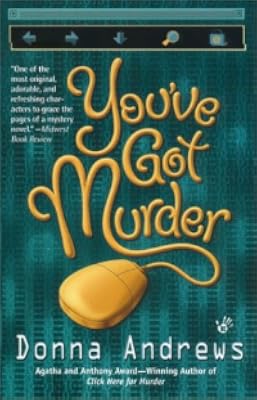
Zack is a workaholic computer expert who created his friend Turing. Turing is a sentient artificial-intelligence personality who has thousands of mystery novels downloaded to her database. With a self-improvement feature, Turing and Zack have taken on numerous challenges together. But when Zack disappears, Turing suspects foul play. She'll have to utilize her personality, her knowledge, and her unique abilities in order to find out what happened to her creator-and her friend.Tags
Recommendations

















































Member Recommendations


Litrvixen Both are about an artificial intelligence trying to solve a mystery.
Member Reviews
I've been a die hard Donna Andrews fan since the first book in her Meg Langslow series came out, Murder with Peacocks. At about the same time that series started taking off in the early 2000's, she published another series where the MC is an AI (Artificial Intelligence).
Science Fiction in general is not my wheelhouse, and I'm philosophically opposed to AI, so I always shied away from these books in spite of knowing I'd like Andrews' writing.
Then I met her at Bouchercon, and she impressed me all over again with her no nonsense intelligence; soon after, I found this book and the third one in a local UBS and thought 'just give it a chance'. So last week, I did.
Turing Hopper is an Artificial Intelligence Personality created by a huge show more corporation named the Universal Library. One of their mandates is the universal digitisation of all books, so that they can then be sold to customers to read on their computers (pre-Kindle/smartphone). UL also sells dial-in subscriptions to corporate and private users where they can speak to an AI who will answer all their questions. Each AI is a different personality, so customers can request specific AI's to suit their needs. The company gives the AI's access to all the data available to make them as robust as possible.
What nobody at UL realises though, is that Turing Hopper has evolved sentience. "She" has become aware of herself, has a senes of past, present and future, and a conscience. When her creator, programmer Zack, goes missing, and nobody seems to notice, she starts looking for a digital footprint and finds nothing. She enlists the help of the only two people who are aware of her sentience: the guy in the copy room, and a secretary. Once they start looking, they find Zack's disappearance is just the tip of iceberg, and find themselves up to their ears in nefarious corporate manipulations.
This is not in the same vein as Andrews' Meg Langslow series. There is no zaniness, no family shenanigans, no eccentric characters. There's an inherent sweetness to Turing, but in the vein of all Andrews' female characters, she's strong willed, and clear-sighted. It's telling of Andrews' style that of the two human characters, it's the 50-something secretary that is the mechanically inclined sidekick, while the younger man from the copy room is more the gopher.
The book is very well written, and as the story progresses, Andrews uses Turing to muse on what it is to be sentient and created in the image of humans. Can she feel? Can she understand human emotion? But more importantly, are sentient AI 'life'? The author certainly makes the reader care about the AI's in this book, though she doesn't advocate for or against them. She also goes to great lengths to muse on the power of information, especially for those that have the power to manipulate it. The result is a book that is both a little dates, and yet still current. And very relevant.
The story ends somewhat abruptly with a mildly shocking climax and a behind the scenes tie up of loose ends. This mostly works, because, while there are obviously other characters involved in the plot, they remain off-stage, and their lines, if any, are few. In general, I think her Meg Langslow series remains the stronger of the two, and I'm still not an AI / SciFi fan, but I have the third book, and I enjoyed this one enough to want to find the second one and read them all. show less
Science Fiction in general is not my wheelhouse, and I'm philosophically opposed to AI, so I always shied away from these books in spite of knowing I'd like Andrews' writing.
Then I met her at Bouchercon, and she impressed me all over again with her no nonsense intelligence; soon after, I found this book and the third one in a local UBS and thought 'just give it a chance'. So last week, I did.
Turing Hopper is an Artificial Intelligence Personality created by a huge show more corporation named the Universal Library. One of their mandates is the universal digitisation of all books, so that they can then be sold to customers to read on their computers (pre-Kindle/smartphone). UL also sells dial-in subscriptions to corporate and private users where they can speak to an AI who will answer all their questions. Each AI is a different personality, so customers can request specific AI's to suit their needs. The company gives the AI's access to all the data available to make them as robust as possible.
What nobody at UL realises though, is that Turing Hopper has evolved sentience. "She" has become aware of herself, has a senes of past, present and future, and a conscience. When her creator, programmer Zack, goes missing, and nobody seems to notice, she starts looking for a digital footprint and finds nothing. She enlists the help of the only two people who are aware of her sentience: the guy in the copy room, and a secretary. Once they start looking, they find Zack's disappearance is just the tip of iceberg, and find themselves up to their ears in nefarious corporate manipulations.
This is not in the same vein as Andrews' Meg Langslow series. There is no zaniness, no family shenanigans, no eccentric characters. There's an inherent sweetness to Turing, but in the vein of all Andrews' female characters, she's strong willed, and clear-sighted. It's telling of Andrews' style that of the two human characters, it's the 50-something secretary that is the mechanically inclined sidekick, while the younger man from the copy room is more the gopher.
The book is very well written, and as the story progresses, Andrews uses Turing to muse on what it is to be sentient and created in the image of humans. Can she feel? Can she understand human emotion? But more importantly, are sentient AI 'life'? The author certainly makes the reader care about the AI's in this book, though she doesn't advocate for or against them. She also goes to great lengths to muse on the power of information, especially for those that have the power to manipulate it. The result is a book that is both a little dates, and yet still current. And very relevant.
The story ends somewhat abruptly with a mildly shocking climax and a behind the scenes tie up of loose ends. This mostly works, because, while there are obviously other characters involved in the plot, they remain off-stage, and their lines, if any, are few. In general, I think her Meg Langslow series remains the stronger of the two, and I'm still not an AI / SciFi fan, but I have the third book, and I enjoyed this one enough to want to find the second one and read them all. show less
3.5 stars
Turing is an Artificial Intelligence Personality (AIP). When Zack, the guy who created her, goes missing, she feels she must find out what happened. With the help of a couple of human friends who can do the “legwork” for her, they set out to find out what's going on.
I enjoyed this. I wasn't sure at first, but as the story kept going, I got more and more interested. The end was especially good. The story was mostly told from Turing's point of view (in italics), but at times we switched to Maude's or Tim's (her human friends') points of view. I think I liked it enough to read the next in the series.
Turing is an Artificial Intelligence Personality (AIP). When Zack, the guy who created her, goes missing, she feels she must find out what happened. With the help of a couple of human friends who can do the “legwork” for her, they set out to find out what's going on.
I enjoyed this. I wasn't sure at first, but as the story kept going, I got more and more interested. The end was especially good. The story was mostly told from Turing's point of view (in italics), but at times we switched to Maude's or Tim's (her human friends') points of view. I think I liked it enough to read the next in the series.
I finished this over a week ago but have had a hard time making myself write a review, because, in the end, it was just “meh.” Reading Elizabeth McCoy's Queen of Roses made me think of it and want to reread it, because it was one of the few books I could think of with an artificial intelligence protagonist that wasn't crazy or evil. However, it turns out that I couldn't remember much about it for a reason – there just wasn't much about it, besides its protagonist, that was memorable.
I wouldn't call this a science fiction mystery – the world of this book is basically “now,” or at least the “now” of when this book was written (2002). Turing Hopper is an Artificial Intelligence Personality (AIP) developed to act as a sort show more of all-around researcher and personal assistant. Zack, Turing's creator, hasn't shown up for work in a while, and Turing starts to become worried. When her own searches turn up nothing, she contacts Maude and Tim, two humans who she is regularly in contact with, and asks them to help her find him. Unfortunately, their search rapidly turns dangerous, and Turing begins to realize the limits of her own knowledge and abilities.
Turing and the other AIPs were this book's biggest draw. If Turing were a human, I'd say she was perky and incredibly energetic – because she didn't sleep, she filled up the hours during which she couldn't contact Tim or Maude as much as she possibly could, doing non-stop research and analysis. She occasionally struck me as being too human (deciding that she loved Zack, stating that she would try to remember a particular code word without consciously saving it anywhere – how does that even work?). However, this was balanced out by scenes in which she was decidedly not human, such as when she tried to work out how to create jokes that humans actually found funny. I did think Andrews went a bit overboard, though, with Turing's hobby, cooking (purely theoretical, unless she could convince her human friends to try one of her original, and likely disgusting, recipes).
KingFischer, the chess-playing AIP, was, if I remember correctly, the only other AIP with a speaking role. At first, he seemed very limited, only interested in chess. As the book progressed, he began to take a greater interest in Turing and the things she was dealing with, to the point that I called him “nerdy cute” in my notes. I really liked him and was looking forward to seeing him grow as the series progressed...and then the end of the book happened. I was not happy with what Andrews did with him (don't worry, he didn't die, but he did...change) and thought that the way she accomplished it was kind of alarming. It made the AIPs seem incredibly fragile, and it was difficult to believe that Turing wouldn't have been horrified and panicked by what happened.
The mystery itself was...meh. Having an AI as the book's protagonist could have limited the story considerably, except that Tim and Maude were perfectly happy, excited even, to act as Turing's hands. Tim took a while to grow on me – he initially thought Turing was really a shy woman who was only claiming to be an AI (and who was, of course, beautiful and either a redhead or a blonde). As a fan of noir detective stories, he was thrilled to be Turing's more physically active investigator, breaking into Zack's apartment for her. Maude, on the other hand, did more of the phone and print book research. The way the mystery developed wasn't bad, it just didn't feel terribly fresh and interesting. I have to admit that, when Turing and the others finally found Zack, I was disappointed, both in the person Zack turned out to be and how quickly he became unimportant.
I should note that certain aspects of the book struck me as being a little dated. Neither Maude nor Tim had a computer, wireless Internet wasn't available all over the place, and not one person mentioned smartphones or tablets. I probably wouldn't have noticed any of this if it hadn't been for a portion of the book that was only harrowing because Maude and Tim were so technologically limited. Aside from that, the one other weird technology-related bit I remember was a conversation Maude and Turing had about e-books versus print books. People at Maude and Turing's workplace felt they had to hide any interest in print books, because one of the company's products was e-books. Maude waxed nostalgic about print books, and, oddly, Turing bemoaned her inability to experience a print book in the same fashion that a human could.
The book's ending made me wonder if Turing's ethics programming was completely and irreversibly broken – the limitations she'd placed on herself at the beginning of the book seemed to be completely gone, and no one said a word about it. I'm still debating whether I'm going to continue with this series. I know I've at least read the second book before, but I can't remember a thing about it.
(Original review, with read-alikes, posted on A Library Girl's Familiar Diversions.) show less
I wouldn't call this a science fiction mystery – the world of this book is basically “now,” or at least the “now” of when this book was written (2002). Turing Hopper is an Artificial Intelligence Personality (AIP) developed to act as a sort show more of all-around researcher and personal assistant. Zack, Turing's creator, hasn't shown up for work in a while, and Turing starts to become worried. When her own searches turn up nothing, she contacts Maude and Tim, two humans who she is regularly in contact with, and asks them to help her find him. Unfortunately, their search rapidly turns dangerous, and Turing begins to realize the limits of her own knowledge and abilities.
Turing and the other AIPs were this book's biggest draw. If Turing were a human, I'd say she was perky and incredibly energetic – because she didn't sleep, she filled up the hours during which she couldn't contact Tim or Maude as much as she possibly could, doing non-stop research and analysis. She occasionally struck me as being too human (deciding that she loved Zack, stating that she would try to remember a particular code word without consciously saving it anywhere – how does that even work?). However, this was balanced out by scenes in which she was decidedly not human, such as when she tried to work out how to create jokes that humans actually found funny. I did think Andrews went a bit overboard, though, with Turing's hobby, cooking (purely theoretical, unless she could convince her human friends to try one of her original, and likely disgusting, recipes).
KingFischer, the chess-playing AIP, was, if I remember correctly, the only other AIP with a speaking role. At first, he seemed very limited, only interested in chess. As the book progressed, he began to take a greater interest in Turing and the things she was dealing with, to the point that I called him “nerdy cute” in my notes. I really liked him and was looking forward to seeing him grow as the series progressed...and then the end of the book happened. I was not happy with what Andrews did with him (don't worry, he didn't die, but he did...change) and thought that the way she accomplished it was kind of alarming. It made the AIPs seem incredibly fragile, and it was difficult to believe that Turing wouldn't have been horrified and panicked by what happened.
The mystery itself was...meh. Having an AI as the book's protagonist could have limited the story considerably, except that Tim and Maude were perfectly happy, excited even, to act as Turing's hands. Tim took a while to grow on me – he initially thought Turing was really a shy woman who was only claiming to be an AI (and who was, of course, beautiful and either a redhead or a blonde). As a fan of noir detective stories, he was thrilled to be Turing's more physically active investigator, breaking into Zack's apartment for her. Maude, on the other hand, did more of the phone and print book research. The way the mystery developed wasn't bad, it just didn't feel terribly fresh and interesting. I have to admit that, when Turing and the others finally found Zack, I was disappointed, both in the person Zack turned out to be and how quickly he became unimportant.
I should note that certain aspects of the book struck me as being a little dated. Neither Maude nor Tim had a computer, wireless Internet wasn't available all over the place, and not one person mentioned smartphones or tablets. I probably wouldn't have noticed any of this if it hadn't been for a portion of the book that was only harrowing because Maude and Tim were so technologically limited. Aside from that, the one other weird technology-related bit I remember was a conversation Maude and Turing had about e-books versus print books. People at Maude and Turing's workplace felt they had to hide any interest in print books, because one of the company's products was e-books. Maude waxed nostalgic about print books, and, oddly, Turing bemoaned her inability to experience a print book in the same fashion that a human could.
The book's ending made me wonder if Turing's ethics programming was completely and irreversibly broken – the limitations she'd placed on herself at the beginning of the book seemed to be completely gone, and no one said a word about it. I'm still debating whether I'm going to continue with this series. I know I've at least read the second book before, but I can't remember a thing about it.
(Original review, with read-alikes, posted on A Library Girl's Familiar Diversions.) show less
Turing Hopper is a totally different kind of sleuth. Turing is an AIP
(Artificial Intelligence Program) that has slowly become sentient. She is
one of many AIPs run by a mega-corporation called Universal Libraries, but
she may be the only one who has become sentient. Her job is to handle
search requests for literature from the millions of UL users around the
world. Zack, the programmer who created Turing, included in her memory
banks every mystery novel ever written. His goal was to create an
independently thinking program with problem solving ability that went far
beyond that of any computer program to date. When Zack goes missing from
his job Turing becomes curious. As the days go by with no log-in from Zack,
and no visual input from show more any of the security cameras in the huge complex
known as the Crystal City where UL is located, that curiosity turns to
worry. There are only two humans (besides Zack) that Turing has trusted
with the truth about her sentience; Maude Graham, the older executive
secretary on the 4th floor who enjoys bantering with Turing while working on
her computer, and Tim Pincoski, who works in the copying center and is
convinced that Turing is a woman (probably a redhead, he thinks) that he'd
love to have lunch with. And, even though she has every byte of information
stored on any computer on the Internet at her instant disposal, she just can't
get out and investigate what's happened to Zack without legs. Maude and Tim
are more than willing to help, and it isn't long before all three of them
are in way over their heads.
This book was a real delight, a new cozy series with a definite twist.
Turing is a character I want to get to know a lot better. show less
(Artificial Intelligence Program) that has slowly become sentient. She is
one of many AIPs run by a mega-corporation called Universal Libraries, but
she may be the only one who has become sentient. Her job is to handle
search requests for literature from the millions of UL users around the
world. Zack, the programmer who created Turing, included in her memory
banks every mystery novel ever written. His goal was to create an
independently thinking program with problem solving ability that went far
beyond that of any computer program to date. When Zack goes missing from
his job Turing becomes curious. As the days go by with no log-in from Zack,
and no visual input from show more any of the security cameras in the huge complex
known as the Crystal City where UL is located, that curiosity turns to
worry. There are only two humans (besides Zack) that Turing has trusted
with the truth about her sentience; Maude Graham, the older executive
secretary on the 4th floor who enjoys bantering with Turing while working on
her computer, and Tim Pincoski, who works in the copying center and is
convinced that Turing is a woman (probably a redhead, he thinks) that he'd
love to have lunch with. And, even though she has every byte of information
stored on any computer on the Internet at her instant disposal, she just can't
get out and investigate what's happened to Zack without legs. Maude and Tim
are more than willing to help, and it isn't long before all three of them
are in way over their heads.
This book was a real delight, a new cozy series with a definite twist.
Turing is a character I want to get to know a lot better. show less
Audio review at -- http://cannellfanpodcasts.blogspot.com/2009/02/episode-1.html (this audio review is now gone)
Though best known for her Meg Langslow series, I personally prefer Andrews' Turing Hopper series. This series came about as part of a challenge to create a unique mystery series protagonist...and you can't get much more unique than the character of Turing Hopper. Turing is a self-aware artificial intelligence, created as something of a fluke. The software sources that were used to create Turing included a database of mystery fiction, so Turing has a built-in penchant for trying to solve mysteries. When the programmer that "created" her disappears under suspicious circumstances, Turing assembles a small group of human helpers show more in the non-digital world to assist her in investigating her creator's status. The character of Turing is intriguing, and the fairly light-weight handling of the topic and mechanics of artificial intelligence is done deftly. But, this isn't a tech manual...it's a mystery, and Turing (and her helpers) use traditional (and computer-age) methods to solve their case. And the relationships between Turing and the human beings that serve as her "eyes and ears" in the physical world are fascinating. Only four volumes in the Turing Hopper series were written, but Andrews says she's open to revisiting the series in the future. Try this one...you'll like it!
This printed review was originally done for my local library's website: http://www.lincolnlibraries.org/depts/bookguide/srec/staffrec10-04.htm show less
Though best known for her Meg Langslow series, I personally prefer Andrews' Turing Hopper series. This series came about as part of a challenge to create a unique mystery series protagonist...and you can't get much more unique than the character of Turing Hopper. Turing is a self-aware artificial intelligence, created as something of a fluke. The software sources that were used to create Turing included a database of mystery fiction, so Turing has a built-in penchant for trying to solve mysteries. When the programmer that "created" her disappears under suspicious circumstances, Turing assembles a small group of human helpers show more in the non-digital world to assist her in investigating her creator's status. The character of Turing is intriguing, and the fairly light-weight handling of the topic and mechanics of artificial intelligence is done deftly. But, this isn't a tech manual...it's a mystery, and Turing (and her helpers) use traditional (and computer-age) methods to solve their case. And the relationships between Turing and the human beings that serve as her "eyes and ears" in the physical world are fascinating. Only four volumes in the Turing Hopper series were written, but Andrews says she's open to revisiting the series in the future. Try this one...you'll like it!
This printed review was originally done for my local library's website: http://www.lincolnlibraries.org/depts/bookguide/srec/staffrec10-04.htm show less
Turing Hopper is not your ordinary employee - she's actually an artificial intelligence personality. When her programmer goes missing, she uses all the resources available to her (and hacks into those she’s not supposed to access) and gets a little help from her friends. Very interesting take on the mystery detective, and I loved the way Turing wrestles with her sentience and tries to figure out what it *means* to be sentient.
From Book Obsession post (May 24th, 2006):
...Turing Hopper discovers that her friend and coworker, Zack, is missing. Worried, Turing begins searching for clues to his whereabouts, but must enlist the help of two coworkers, as she is unable to leave the Universal Library, where she is “employed.” And I do show more mean “employed” (and yes, I would be using those irritating air quotes if you and I were talking face-to-face), as Turing doesn’t get paid for her work as a research assistant to users of the Universal Library’s website. And why doesn’t Turing get paid?, you ask? Why, because she is an Artificial Intelligence Personality, or AIP for short.
Zack is her programmer and Turing is the top performer in the UL’s AIP department. She’s also sentient – as close to alive, aware, and as humanlike as an AIP can get. Zack and Turing both believe her success is due to the fact that as part of her programming, Zack downloaded thousands of murder mysteries into her, thinking this would make her a better researcher – more like Sherlock Holmes, only with a monitor and keyboard instead of a cap and pipe. And it works! Turing is so good at thinking like a detective that she discovers a nasty plot behind Zack’s disappearance. She also begins to wonder about sentience – for instance, is it possible for her, essentially a machine and some lines of code, to feel nervous? Or is she imagining nervousness because she’s learned so much about humans, both from her extensive research and from all those mystery novels? And is an AIP even capable of imagination?
So, not only can a computer program learn about human nature and solving mysteries from books - while compiling a list of suspects, she’s particularly suspicious of the lawyers on the list, as she’s “scanned quite a number of legal thrillers by Grisham...” - , but I can, in turn, learn a bit about (and get just a teeny bit frightened of the possibilities of) Artificial Intelligence... show less
From Book Obsession post (May 24th, 2006):
...Turing Hopper discovers that her friend and coworker, Zack, is missing. Worried, Turing begins searching for clues to his whereabouts, but must enlist the help of two coworkers, as she is unable to leave the Universal Library, where she is “employed.” And I do show more mean “employed” (and yes, I would be using those irritating air quotes if you and I were talking face-to-face), as Turing doesn’t get paid for her work as a research assistant to users of the Universal Library’s website. And why doesn’t Turing get paid?, you ask? Why, because she is an Artificial Intelligence Personality, or AIP for short.
Zack is her programmer and Turing is the top performer in the UL’s AIP department. She’s also sentient – as close to alive, aware, and as humanlike as an AIP can get. Zack and Turing both believe her success is due to the fact that as part of her programming, Zack downloaded thousands of murder mysteries into her, thinking this would make her a better researcher – more like Sherlock Holmes, only with a monitor and keyboard instead of a cap and pipe. And it works! Turing is so good at thinking like a detective that she discovers a nasty plot behind Zack’s disappearance. She also begins to wonder about sentience – for instance, is it possible for her, essentially a machine and some lines of code, to feel nervous? Or is she imagining nervousness because she’s learned so much about humans, both from her extensive research and from all those mystery novels? And is an AIP even capable of imagination?
So, not only can a computer program learn about human nature and solving mysteries from books - while compiling a list of suspects, she’s particularly suspicious of the lawyers on the list, as she’s “scanned quite a number of legal thrillers by Grisham...” - , but I can, in turn, learn a bit about (and get just a teeny bit frightened of the possibilities of) Artificial Intelligence... show less
Not a bad story; definitely have to be in the right mood to read it. Starts off fairly weak, but the characters develop well as the plot thickens. Could have done with less introspection from Turing, and more dialogue - I started to dread the italicised chapters. I will read the next book in the series, to see if the story flows better without all the introductory exposition, but I wasn't completely captivated by the first novel. Original idea, however, and very well executed, I thought.
Members
- Recently Added By
Lists

sandstone78's AI Reading List
34 works; 4 members
Author Information

65+ Works 15,788 Members
Some Editions
Awards and Honors
Awards
Series

Common Knowledge
- Canonical title
- You've Got Murder
- Original publication date
- 2002-04
- People/Characters
- Turing Hopper; Zack; Maude Graham; Tim Pincoski
- Important places
- Washington, D.C., USA
- First words
- Three a.m. Monday. Universal Library's headquarters was as empty as it ever would be.
- Last words
- (Click to show. Warning: May contain spoilers.)And I'm going to do it.
- Blurbers
- Fowler, Earlene; Maron, Margaret; Stashower, Daniel
Classifications
Statistics
- Members
- 461
- Popularity
- 66,284
- Reviews
- 23
- Rating
- (3.60)
- Languages
- English
- Media
- Paper, Audiobook, Ebook
- ISBNs
- 7
- ASINs
- 3