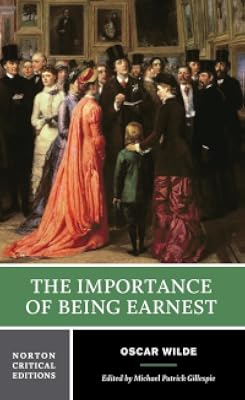
The Importance of Being Earnest [Norton Critical Edition]
by Oscar Wilde 
On This Page
Description
Oscar Wilde created his final and most lasting play, comic masterpieces of all time, The Importance of Being Earnest, in 1895. The Importance of Being Earnest is a farce, playing with love, religion, and truth as it tells the tale of two men. Jack Worthing and Algernon Moncrieff, who bend the truth in order to add excitement to their lives. Jack invents an imaginary brother, Ernest, whom he uses as an excuse to escape from his dull country home and gallavant in town. Meanwhile, Algernon show more follows Jack's scam, but his imaginary friend, Bumbury, provides a convenient method of adventuring in the country. However, their deceptions eventually cross paths, resulting in a series of crises that threaten to spoil their romantic pursuits. Hailed as the first modern comedy in England, The Importance of Being Earnest is Wilde's most famous work.. Classic Literature. Humor (Fiction.) Fiction. Romance. show less
Tags
Recommendations








Member Reviews
What a farcical romp! Almost every word dripping from a character's mouth is seeped in dramatic and situational irony. The play reminded me (loosely) of a Shakespearean comedy where mixed identities are the norm. In this case, though, Wilde skewers the so-called norms of Victorian society with characters purposely engaging in made-up lives in order to allow them to carry forth with their pleasurable lives. I suspended my disbelief with aplomb because I would have not been able to have laughed out loud and enjoyed this "comedy of manners" otherwise. My favorite of Wilde's will always still be THE PORTRAIT OF DORIAN GRAY, but I enjoyed this nonetheless.
A frothy play that is immensely enjoyable to read, The Importance of Being Earnest bills itself as a trivial comedy for serious people. The inherent contradiction in the title is a taste of many paradoxes to come. The story concerns two wealthy and upper class men, Jack and Algy, who discover they share an unusual habit. They both have invented a false person who operates as an excuse when they want to escape the duties of regular life for a bit of decadent fun. Jack invented his scapegrace brother Ernest, and Algy created a perpetually sick friend of the name Bunbury.
For some time Jack and Algy have delighted in their deception, but their lives are complicated when love intrudes. Jack wants to marry Gwendolyn, but she knows him by his show more pseudonym of Ernest, and declares that she will only marry a man of that name. Furthermore, her mother refuses to bless the alliance, since his antecedents are unknown. In fact, he was discovered by his wealthy benefactor in a hand-bag in a train station, and as Lady Bracknell astutely observes, she can't allow her daughter to marry into a cloak-room and form an alliance with a parcel. Jack repairs to his country home to think over matters, but Algy beats him there. Algy has learned that Jack had a beautiful young ward in the country, and he is eager to meet her, despite Jack's insistence to the contrary.
Algy cleverly assumes the identity of Ernest, Jack's supposed reprobate brother, when he meets Cecily. He professes his love for the young lady, only to discover that she has loved him for some time. At least, she is in love with Jack's brother Ernest, and just like Gwendolyn, declares that she will only marry Ernest. Now both Algy and Jack are in the quandary of having the wrong name; what's worse, Gwendolyn decides to defy her mama and visit her Ernest at his country house. She is startled to learn that he has a lovely young ward, but takes it in good stride, until Cecily reveals her recent engagement to Ernest. Gwendolyn counters with her prior engagement to Ernest, and the double identities and word plays unleash a hilarious confusion that is fought out in word and wit.
Reading and watching this play is sheer delight. It has sparkling lines of dialogue and clever plot twists that are almost too ridiculous but fit organically in the world the author created. The action, or rather steady stream of conversation since very little real action takes place, keeps the momentum moving with never a lull in interest. Interactions between the characters are absurd in all the right ways, and the humor consistently made me laugh out loud. However this play has transcended above fluff reading, or a fun but forgettable show, because it offers compelling themes, characters, and messages along with its entertainment.
For readers interested in exploring this deeper meaning, along with the historical and literary context of the book, the Norton Critical Edition is the clear choice. The text of the play is annotated with thoughtful end notes, as are most academic texts, but following the play is a collection of critical pieces that sets this edition far above its peers. As with most Norton critical editions, the essays cover both contextual and analytic subjects. In this book, several essays devote time to the unique fin-de-siecle historical era that shaped Wilde and his fellow artists, and the influences of the theater and his personal life. A couple of critical essays touch on homosexual themes in the play, with the same amount focusing on aspects of dandyism that are prevalent in the drama. The supplemental material offer the opportunity to read the play at multiple levels. The entire book showcases the potential of literature to be entertaining and intellectually stimulating, to be a story while reaching much deeper into the human experience. show less
For some time Jack and Algy have delighted in their deception, but their lives are complicated when love intrudes. Jack wants to marry Gwendolyn, but she knows him by his show more pseudonym of Ernest, and declares that she will only marry a man of that name. Furthermore, her mother refuses to bless the alliance, since his antecedents are unknown. In fact, he was discovered by his wealthy benefactor in a hand-bag in a train station, and as Lady Bracknell astutely observes, she can't allow her daughter to marry into a cloak-room and form an alliance with a parcel. Jack repairs to his country home to think over matters, but Algy beats him there. Algy has learned that Jack had a beautiful young ward in the country, and he is eager to meet her, despite Jack's insistence to the contrary.
Algy cleverly assumes the identity of Ernest, Jack's supposed reprobate brother, when he meets Cecily. He professes his love for the young lady, only to discover that she has loved him for some time. At least, she is in love with Jack's brother Ernest, and just like Gwendolyn, declares that she will only marry Ernest. Now both Algy and Jack are in the quandary of having the wrong name; what's worse, Gwendolyn decides to defy her mama and visit her Ernest at his country house. She is startled to learn that he has a lovely young ward, but takes it in good stride, until Cecily reveals her recent engagement to Ernest. Gwendolyn counters with her prior engagement to Ernest, and the double identities and word plays unleash a hilarious confusion that is fought out in word and wit.
Reading and watching this play is sheer delight. It has sparkling lines of dialogue and clever plot twists that are almost too ridiculous but fit organically in the world the author created. The action, or rather steady stream of conversation since very little real action takes place, keeps the momentum moving with never a lull in interest. Interactions between the characters are absurd in all the right ways, and the humor consistently made me laugh out loud. However this play has transcended above fluff reading, or a fun but forgettable show, because it offers compelling themes, characters, and messages along with its entertainment.
For readers interested in exploring this deeper meaning, along with the historical and literary context of the book, the Norton Critical Edition is the clear choice. The text of the play is annotated with thoughtful end notes, as are most academic texts, but following the play is a collection of critical pieces that sets this edition far above its peers. As with most Norton critical editions, the essays cover both contextual and analytic subjects. In this book, several essays devote time to the unique fin-de-siecle historical era that shaped Wilde and his fellow artists, and the influences of the theater and his personal life. A couple of critical essays touch on homosexual themes in the play, with the same amount focusing on aspects of dandyism that are prevalent in the drama. The supplemental material offer the opportunity to read the play at multiple levels. The entire book showcases the potential of literature to be entertaining and intellectually stimulating, to be a story while reaching much deeper into the human experience. show less
Such a great play, if played well, I guess it would be a pleasure to watch it. It is so funny, I was literally laughing out LOUD on every page. I hope I didn't disturb the neighbors. The female characters are so great foolish in an unfoolish way. And the handbag, just unforgettable.
"The Importance of Being Earnest" or "A Trivial Comedy for Serious People" is a comedy of manners by playwright, novelist and poet Oscar Wilde.
It was the last play written by the celebrated Oscar Wilde, and proved to be his most popular and enduring. This hilarious satire is all about the double lives of two would-be bridegrooms.
The plot involves two fashionable young gentlemen, Algernon Moncrieff (Algy) and his close friend John Worthing (Jack), and their eventual successful courtship of Gwendolen Fairfax (Algy's cousin), and Cecily Cardew (Jack's cousin). This is one of the best comedies ever written and compares favorably with the best of Shakespearean comedy. As is always true with Oscar Wilde, sparkling dialogue abounds.
It was the last play written by the celebrated Oscar Wilde, and proved to be his most popular and enduring. This hilarious satire is all about the double lives of two would-be bridegrooms.
The plot involves two fashionable young gentlemen, Algernon Moncrieff (Algy) and his close friend John Worthing (Jack), and their eventual successful courtship of Gwendolen Fairfax (Algy's cousin), and Cecily Cardew (Jack's cousin). This is one of the best comedies ever written and compares favorably with the best of Shakespearean comedy. As is always true with Oscar Wilde, sparkling dialogue abounds.
So funny.
Ratings
Members
- Recently Added By
Lists

University literature
145 works; 5 members
Author Information

1,789+ Works 121,472 Members
Flamboyant man-about-town, Oscar Wilde had a reputation that preceded him, especially in his early career. He was born to a middle-class Irish family (his father was a surgeon) and was trained as a scholarship boy at Trinity College, Dublin. He subsequently won a scholarship to Magdalen College, Oxford, where he was heavily influenced by John show more Ruskin and Walter Pater, whose aestheticism was taken to its radical extreme in Wilde's work. By 1879 he was already known as a wit and a dandy; soon after, in fact, he was satirized in Gilbert and Sullivan's Patience. Largely on the strength of his public persona, Wilde undertook a lecture tour to the United States in 1882, where he saw his play Vera open---unsuccessfully---in New York. His first published volume, Poems, which met with some degree of approbation, appeared at this time. In 1884 he married Constance Lloyd, the daughter of an Irish lawyer, and within two years they had two sons. During this period he wrote, among others, The Picture of Dorian Gray (1891), his only novel, which scandalized many readers and was widely denounced as immoral. Wilde simultaneously dismissed and encouraged such criticism with his statement in the preface, "There is no such thing as a moral or an immoral book. Books are well written or badly written. That is all." In 1891 Wilde published A House of Pomegranates, a collection of fantasy tales, and in 1892 gained commercial and critical success with his play, Lady Windermere's Fan He followed this comedy with A Woman of No Importance (1893), An Ideal Husband (1895), and his most famous play, The Importance of Being Earnest (1895). During this period he also wrote Salome, in French, but was unable to obtain a license for it in England. Performed in Paris in 1896, the play was translated and published in England in 1894 by Lord Alfred Douglas and was illustrated by Aubrey Beardsley. Lord Alfred was the son of the Marquess of Queensbury, who objected to his son's spending so much time with Wilde because of Wilde's flamboyant behavior and homosexual relationships. In 1895, after being publicly insulted by the marquess, Wilde brought an unsuccessful slander suit against the peer. The result of his inability to prove slander was his own trial on charges of sodomy, of which he was found guilty and sentenced to two years of hard labor. During his time in prison, he wrote a scathing rebuke to Lord Alfred, published in 1905 as De Profundis. In it he argues that his conduct was a result of his standing "in symbolic relations to the art and culture" of his time. After his release, Wilde left England for Paris, where he wrote what may be his most famous poem, The Ballad of Reading Gaol (1898), drawn from his prison experiences. Among his other notable writing is The Soul of Man under Socialism (1891), which argues for individualism and freedom of artistic expression. There has been a revived interest in Wilde's work; among the best recent volumes are Richard Ellmann's, Oscar Wilde and Regenia Gagnier's Idylls of the Marketplace , two works that vary widely in their critical assumptions and approach to Wilde but that offer rich insights into his complex character. (Bowker Author Biography) show less
Oscar Wilde has a Legacy Library. Legacy libraries are the personal libraries of famous readers, entered by LibraryThing members from the Legacy Libraries group.
Some Editions
Series
Belongs to Publisher Series
Common Knowledge
- Canonical title
- The Importance of Being Earnest [Norton Critical Edition]
- Disambiguation notice
- Do Not Combine: This is a "Norton Critical Edition", it is a unique work with significant added material, including essays and background materials. Do not combine with other editions of the work. Please maintain the p... (show all)hrase "Norton Critical Edition" in the Canonical Title and Publisher Series fields.
Classifications
Statistics
- Members
- 703
- Popularity
- 40,644
- Reviews
- 6
- Rating
- (4.21)
- Languages
- English
- Media
- Paper, Audiobook
- ISBNs
- 2
- ASINs
- 5